CBSE Class 10 Social Science The Rise of Nationalism in Europe Important Questions 2027
Last updated:
19 questions from The Rise of Nationalism in Europe (India and the Contemporary World-II) appeared in 6 of the 7 CBSE papers we analysed (2022–2026) — here are the topics that matter, the questions that repeat, and every previous-year question from this chapter.
Key facts
History - India and the Contemporary World-II unit — 20 marks in the official syllabus
Asked in 6 of 7 analysed papers (2022–2026)
About 2.7 questions per paper (OR alternatives counted separately)
4 question patterns repeated across papers
Important topics in The Rise of Nationalism in Europe
#
Topic
Asked in
Importance
1
Making of nationalism in Europe / liberalism and conservatism
Board 2024Board 2025Sample 2025Sample 2026
★★★☆☆
2
Unification of Germany and Italy
Board 2024Board 2025Board 2026
★★☆☆☆
3
French Revolution and the idea of the nation
Board 2023Board 2025Sample 2025Sample 2026
★★☆☆☆
4
Culture and Romanticism in nation-building
Board 2023Sample 2025
★☆☆☆☆
5
Nationalism, imperialism and the Balkans
Board 2024
★☆☆☆☆
Repeated questions from The Rise of Nationalism in Europe
1. Treaty of Vienna (1815) and the spirit of conservatism
2×Sample 2025Sample 20265 marks
'The Treaty of Vienna was drawn up in 1815 with the object of undoing most of the changes that had come about in Europe during the Napoleonic wars.' Highlight the significant provisions of this treaty.
2. Formation of the British nation-state as a long process
2×Board 2024Sample 20265 marks
'In Britain the formation of the nation-state was not the result of a sudden upheaval or revolution but was the result of a long-drawn-out process.' Analyse this statement with suitable reasons.
3. Romanticism as a nationalist cultural movement
2×Board 2023Sample 20252/5 marks
'Romanticism, a cultural movement sought to develop a particular form of nationalist sentiment.' Justify the statement with suitable arguments.
4. Liberalism and national unity in early 19th-century Europe
2×Board 2024Board 20255 marks
How was liberalism allied to national unity in Europe in the early decades of the 19th century ? Analyse.
The Rise of Nationalism in Europe questions by paper
Paper
Questions
Marks
Board 2022
0
0
Board 2023
3
5
Board 2024
5
13
Board 2025
3
11
Sample 2025
3
11
Board 2026
2
10
Sample 2026
3
11
Counts include both options of internal-choice (OR) questions.
Previous year questions: The Rise of Nationalism in Europe
Board 2026 2 questions
Describe the process of unification of Germany.
5 marks
Describe the process of unification of Italy.
5 marks
Sample 2026 3 questions
Match the following and Choose the correct option: COLUMN I: A. Frederic Sorrieu; B. Statue of Liberty; C. Foreground in front of the Statue of Liberty; D. Sorrieu's utopian vision. COLUMN II: 1. Torch of enlightenments; 2. Shattered remains of absolutist Institutions; 3. Democratic and Social Republics; 4. French Artist. Options: 1. A-4, B-1, C-2, D-3 2. A-2, B-4, C-4, D-1 3. A-1, B-2, C-4, D-3 4. A-4, B-1, C-3, D-4
1 mark
'In Britain the formation of the nation-state was not the result of a sudden upheaval or revolution but was the result of a long-drawn-out process.' Analyse this statement with suitable reasons.
5 marks
'The Treaty of Vienna was drawn up in 1815 with the object of undoing most of the changes that had come about in Europe during the Napoleonic wars.' Highlight the significant provisions of this treaty.
5 marks
Board 2025 3 questions
Which one of the following regions became a part of unified Italy in 1866 ? (A) Sardinia-Piedmont (B) Venetia (C) Sicily (D) Papal State
1 mark
Analyse the significance of the 'Napoleonic Code' in making the administrative system rational and efficient.
5 marks
How was liberalism allied to national unity in Europe in the early decades of the 19th century ? Analyse.
5 marks
Sample 2025 3 questions
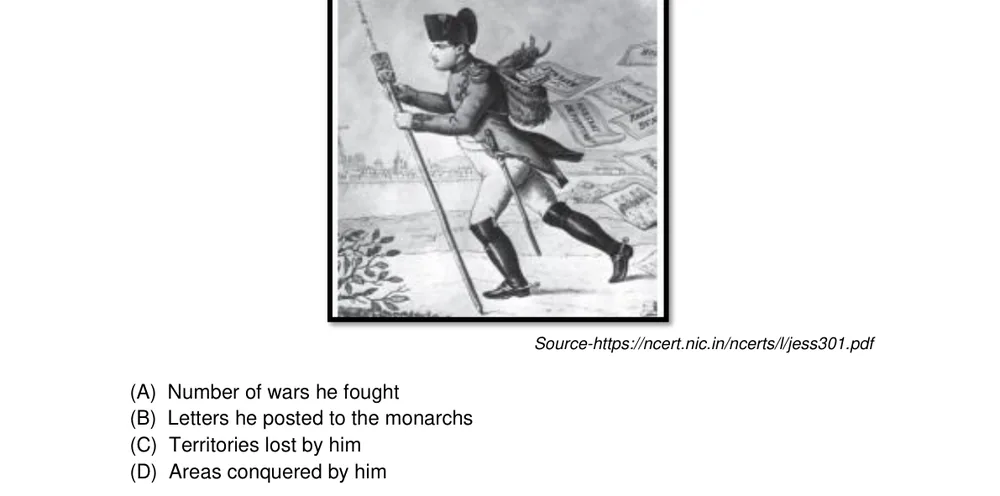
Napoleon in the given picture is depicted as a postman. What do each letter falling from his bag represent?
(A) Number of wars he fought
(B) Letters he posted to the monarchs
(C) Territories lost by him
(D) Areas conquered by him
1 mark
'Romanticism, a cultural movement sought to develop a particular form of nationalist sentiment.' Justify the statement with suitable arguments.
5 marks
'The Treaty of Vienna depicted the spirit of conservatism.' Substantiate the statement with key features of the treaty.
5 marks
Board 2024 5 questions
From which of the following countries did Giuseppe Garibaldi belong to? (a) Austria (b) Italy (c) Greece (d) Spain
1 mark
Two statements are given below. They are Assertion (A) and Reason (R). Read both the statements and choose the correct option. Assertion (A): The most serious source of nationalist tension in Europe after 1871 was Balkan. Reason (R): A large part of the Balkan was under the control of Ottoman Empire. Options: (a) Both, (A) and (R) are true and (R) is the correct explanation of (A). (b) Both, (A) and (R) are true but (R) is not the correct explanation of (A). (c) (A) is true but (R) is false. (d) (A) is false but (R) is true.
1 mark
Arrange the following events in chronological order and choose the correct option from the following: I. Treaty of Constantinople II. Defeat of Napoleon III. Unification of Italy IV. Unification of Germany. Options: (a) I, II, IV and III (b) II, III, I and IV (c) II, I, IV and III (d) IV, I, III and II
1 mark
How did the ideology of 'liberalism' affect the Europe in early nineteenth century? Explain.
5 marks
Explain the process of formation of 'United Kingdom of Great Britain'.
5 marks
Board 2023 3 questions
Match the following attributes of allegory of Germania with its significance and choose the correct option:
Attributes: a. Broken Chains; b. Breast-Plate with eagle; c. Crown of oak leaves; d. Sword
Significance: I. Heroism; II. Readiness to fight; III. Strength; IV. Being free
Options:
(A) a-I, b-II, c-III, d-IV
(B) a-IV, b-III, c-I, d-II
(C) a-II, b-I, c-IV, d-III
(D) a-III, b-IV, c-II, d-I
1 mark
Explain Romanticism as a cultural movement in Europe.
2 marks
Explain Frederic Sarrieu's dream in the context of democratic and social republics in France during 1848.
2 marks
Frequently asked questions
What are the most important topics in CBSE Class 10 Social Science The Rise of Nationalism in Europe?
By how often and how recently they were asked: Making of nationalism in Europe / liberalism and conservatism; Unification of Germany and Italy; French Revolution and the idea of the nation.
How many marks does The Rise of Nationalism in Europe carry in the CBSE Class 10 Social Science exam?
The Rise of Nationalism in Europe is part of the History - India and the Contemporary World-II unit, which carries 20 marks in the official syllabus. In the analysed papers it had about 2.7 questions per paper.
Do questions from The Rise of Nationalism in Europe repeat in board exams?
Yes — 4 question patterns from this chapter appeared in two or more past board or official sample papers. They are listed on this page with the years they were asked.