CBSE Class 10 Social Science Print Culture and the Modern World Important Questions 2027
Last updated:
19 questions from Print Culture and the Modern World (India and the Contemporary World-II) appeared in 6 of the 7 CBSE papers we analysed (2022–2026) — here are the topics that matter, the questions that repeat, and every previous-year question from this chapter.
Key facts
History - India and the Contemporary World-II unit — 20 marks in the official syllabus
Asked in 6 of 7 analysed papers (2022–2026)
About 2.7 questions per paper (OR alternatives counted separately)
0 question patterns repeated across papers
Important topics in Print Culture and the Modern World
Origin and spread of print technology (China, Japan, Europe)
Board 2025Board 2026Sample 2025
★☆☆☆☆
Print Culture and the Modern World questions by paper
Paper
Questions
Marks
Board 2022
0
0
Board 2023
2
4
Board 2024
3
4
Board 2025
3
3
Sample 2025
2
4
Board 2026
4
8
Sample 2026
5
6
Counts include both options of internal-choice (OR) questions.
Previous year questions: Print Culture and the Modern World
Board 2026 4 questions
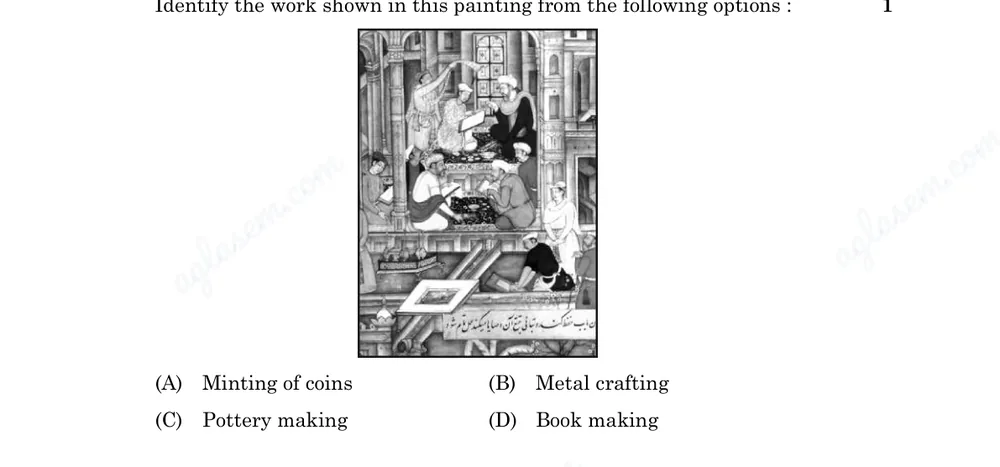
The given painting is from the sixteenth century from Mughal India. Identify the work shown in this painting from the following options:
(A) Minting of coins
(B) Metal crafting
(C) Pottery making
(D) Book making
1 mark
Which one of the following pairs is correctly matched?
Column – A (Writer) — Column – B (Contribution)
(A) Ram Chaddha – Bengal Gazette
(B) Gangadhar Bhattacharya – Kesari
(C) Jyotiba Phule – Gulamgiri
(D) Rashsundari Devi – Padmarg
1 mark
Evaluate the role of print in the French Revolution.
3 marks
Evaluate the role of Buddhist Missionaries in printing culture.
3 marks
Sample 2026 5 questions
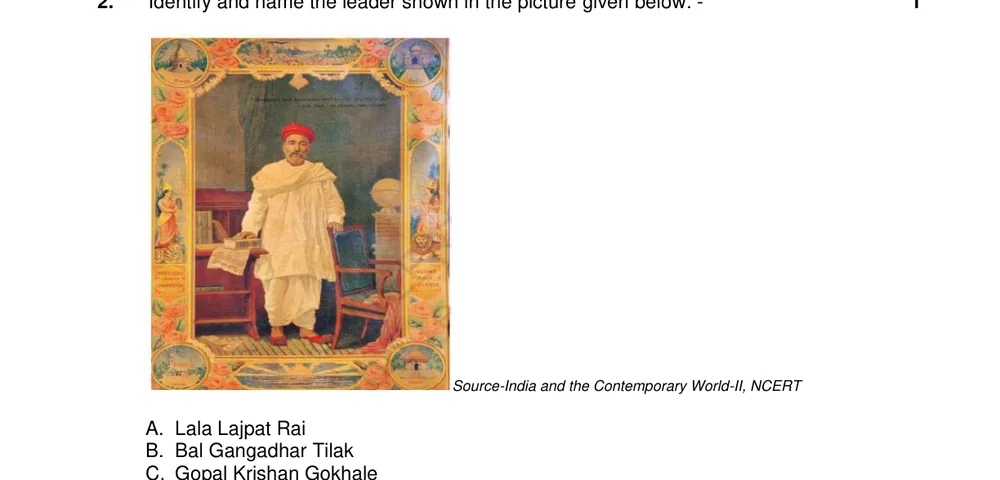
Identify and name the leader shown in the picture given below: [image of a leader, Source-India and the Contemporary World-II, NCERT]. A. Lala Lajpat Rai B. Bal Gangadhar Tilak C. Gopal Krishan Gokhale D. Raja Rammohan Roy
1 mark
Louise-Sebastien Mercier proclaimed "Tremble, therefore, tyrants of the world! Tremble before the virtual writer!" Who are referred to as the tyrants in this context? A. Educated classes who wanted to change the society B. Absolutist institutions like monarchy and church C. Authors of the new books D. Printing press
1 mark
[Source: 'Why Newspapers?' Extract 1 - Krishnaji Trimbuck Ranade inhabitant of Poona intends to publish a Newspaper in the Marathi Language with a view of affording useful information on every topic of local interest. It will be open for free discussion on subjects of general utility, scientific investigation and the speculations connected with the antiquities, statistics, curiosities, history and geography of the country and of the Deccan especially... the patronage and support of all interested in the diffusion of knowledge and Welfare of the People is earnestly solicited. (Bombay Telegraph and Courier, 6 January 1849). Extract 2 - "The task of the native newspapers and political associations is identical to the role of the Opposition in the House of Commons in Parliament in England. That is to critically examine government policy to suggest improvements, by removing those parts that will not be to the benefit of the people, and also by ensuring speedy implementation. These associations ought to carefully study the particular issues, gather diverse relevant information on the nation as well as on what are the possible and desirable improvements, and this will surely earn it considerable influence." (Source: Native Opinion, 3 April 1870)] 8.1 Explain the main reason for publishing newspapers by Krishna ji.
1 mark
8.2 How was the task of native newspaper and political association seen identical to the role of the opposition?
1 mark
8.3 Analyze the reasons for the popularity of newspapers during the 19th century.
2 marks
Board 2025 3 questions
Assume you are doing research on 15th century print culture. Which of the following would be the most significant advantage for your research ? (A) Easier access to rare manuscripts (B) Reduced need for libraries (C) Increase in the ability to copy text by hand (D) Increased speed and accuracy of print
1 mark
[Source: Print and Censorship — The power of the printed word is most often seen in the way governments seek to regulate and suppress print. The colonial government kept continuous track of all books and newspapers published in India and passed numerous laws to control the press. During the First World War, under the Defence of India Rules, 22 newspapers had to furnish securities. Of these, 18 shut down rather than comply with government orders. The Sedition Committee Report under Rowlatt in 1919 further strengthened controls that led to imposition of penalties on various newspapers. At the outbreak of the Second World War, the Defence of India Act was passed, allowing censoring of reports of war-related topics. All reports about the Quit India movement came under its purview. In August 1942, about 90 newspapers were suppressed.] (34.1) Explain the meaning of 'censor'.
1 mark
(34.2) Why did the colonial administration keep an eye on books and newspapers ?
1 mark
Sample 2025 2 questions
Consider the statements given below and choose the correct answer.
Statement I. By the 1870s, caricatures and cartoons were being published in Indian journals and newspapers, commenting on social and political issues.
Statement II: Some caricatures praised the educated Indians' fascination with Western tastes and clothes, while others were looking forward to social change.
(A) Statement (I) is correct and (II) is incorrect.
(B) Statement (I) is incorrect and (II) is correct.
(C) Both (I) & (II) are incorrect.
(D) Both (I) & (II) are correct
1 mark
'By the seventeenth century, as urban culture bloomed in China, the uses of print diversified'. Explain the statement by giving suitable examples.
3 marks
Board 2024 3 questions
[Source: Printed Words] This is how Mercier describes the impact of the printed word, and the power of reading in one of his books: 'Anyone who had seen me reading would have compared me to a man dying of thirst who was gulping down some fresh, pure water.... Lighting my lamp with extraordinary caution, I threw myself hungrily into the reading. An easy eloquence, effortless and animated, carried me from one page to the next without my noticing it. A clock struck off the hours in the silence of the shadows, and I heard nothing. My lamp began to run out of oil and produced only a pale light, but still I read on. I could not even take out time to raise the wick for fear of interrupting my pleasure. How those new ideas rushed into my brain! How my intelligence adopted them!' -- Q: How does the passage reflect the immersive nature of reading of Mercier?
1 mark
Why did Mercier describe himself as a virtual writer?
1 mark
How did reading influence Mercier's intellectual capacity and his engagement with new concepts? Explain in any two points.
2 marks
Board 2023 2 questions
Which one of the following aspects was common between the writings of B.R. Ambedkar and E.V. Ramaswamy Naicker?
(A) Wrote on the caste system in India
(B) Highlighted the experiences of women
(C) Raised awareness about cultural heritage
(D) Motivated Indians for their national freedom.
1 mark
Explain the implication of print culture on the religious reforms in India during 19th century.
3 marks
Frequently asked questions
What are the most important topics in CBSE Class 10 Social Science Print Culture and the Modern World?
By how often and how recently they were asked: Print culture, nationalism and reform in India; Reading mania and print in Europe; Origin and spread of print technology (China, Japan, Europe).
How many marks does Print Culture and the Modern World carry in the CBSE Class 10 Social Science exam?
Print Culture and the Modern World is part of the History - India and the Contemporary World-II unit, which carries 20 marks in the official syllabus. In the analysed papers it had about 2.7 questions per paper.
Do questions from Print Culture and the Modern World repeat in board exams?
No exact repeats were found yet; practise the previous-year questions on this page.