JEE Main Chemistry Important & Repeated Questions 2027
103 question types that recur across JEE Main Paper-1 shifts (2022–2025). JEE Main rarely repeats a question verbatim — but it reuses these templates every session. Master the pattern, not the numbers.
Some Basic Concepts in Chemistry
1. Limiting reagent
seen 4×202220232025
CaCO3(s) + 2HCl(aq) -> CaCl2(aq) + CO2(g) + H2O(l)
Consider the above reaction, what mass of CaCl2 will be formed if 250 mL of 0.76 M HCl reacts with 1000 g of CaCO3 ?
(Given : Molar mass of Ca, C, O, H and Cl are 40, 12, 16, 1 and 35.5 g mol-1, respectively)
(1) 5.272 g
(2) 2.636 g
(3) 3.908 g
(4) 10.545 g
2. % composition / molar mass
seen 3×20232025
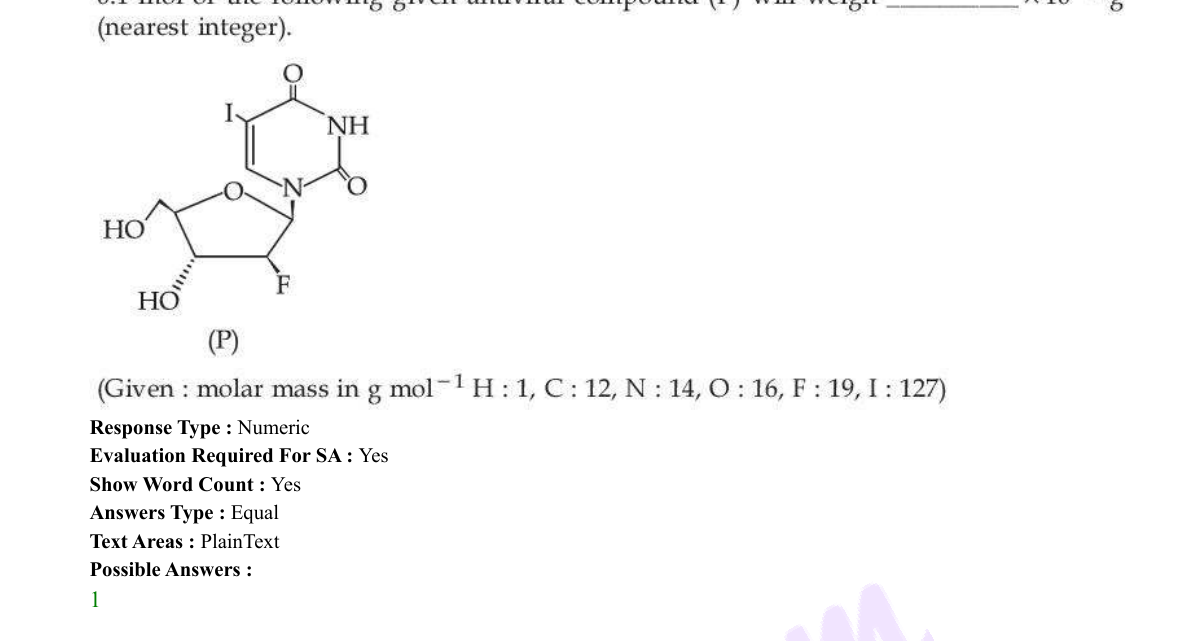
0.1 mol of the given antiviral compound (P) will weigh ______ *10-1 g (nearest integer). Compound P is an iodinated, fluorinated pyrimidine nucleoside (a uracil base bearing an iodine, N-linked to a deoxyribose-type sugar ring carrying two OH groups and a ring F substituent) as shown.
(Given : molar mass in g mol-1 H : 1, C : 12, N : 14, O : 16, F : 19, I : 127)
3. Reaction stoichiometry
seen 3×202220232024
Combustion of glucose (C6H12O6) produces CO2 and water. The amount of oxygen (in g) required for the complete combustion of 900 g of glucose is: [Molar mass of glucose in g mol-1 = 180]
(1) 32
(2) 800
(3) 960
(4) 480
4. Mole / Avogadro
seen 2×20232025
Among 10-9 g (each) of the following elements, which one will have the highest number of atoms? Element: Pb, Po, Pr and Pt
Options:
(1) Pb
(2) Po
(3) Pr
(4) Pt
5. Neutralisation / normality
seen 2×2022
SO2Cl2 on reaction with excess of water results into acidic mixture SO2Cl2 + 2H2O -> H2SO4 + 2HCl. 16 moles of NaOH is required for the complete neutralisation of the resultant acidic mixture. The number of moles of SO2Cl2 used is :
(A) 16
(B) 8
(C) 4
(D) 2
Atomic Structure
6. EM radiation nu/lambda
seen 2×2024
Wavenumber for a radiation having 5800 Å wavelength is x × 10 cm-1. The value of x is _______. (Integer answer)
7. Bohr / atomic model concepts
seen 2×20222025
Which of the following postulate of Bohr's model of hydrogen atom is not in agreement with quantum mechanical model of an atom?
Options:
(1) An atom can take only certain distinct energies E1, E2, E3, etc. These allowed states of constant energy are called the stationary states of atom.
(2) An atom in a stationary state does not emit electromagnetic radiation as long as it stays in the same state.
(3) When an electron makes a transition from a higher energy stationary state to a lower energy stationary state, then it emits a photon of light.
(4) The electron in a H atom's stationary state moves in a circle around the nucleus.
8. de Broglie wave
seen 2×20232024
Frequency of the de-Broglie wave of electron in Bohr's first orbit of hydrogen atom is ________ x 1013 Hz (nearest integer). [Given: RH (Rydberg constant) = 2.18 x 10⁻¹⁸ J, h (Planck's constant) = 6.6 x 10⁻³⁴ J.s.]
9. Quantum-number validity
seen 2×20222024
The correct set of four quantum numbers for the valence electron of rubidium atom (Z = 37) is :
(A) 5, 0, 0, +1/2
(B) 5, 1, 0, +1/2
(C) 5, 1, 1, +1/2
(D) 5, 0, 1, +1/2
10. Rydberg spectrum calc
seen 2×2023
If wavelength of the first line of the Paschen series of hydrogen atom is 720 nm, then the wavelength of the second line of this series is ______ nm. (Nearest integer)
Chemical Bonding and Molecular Structure
11. Hybridisation of centre
seen 5×20242025
Among SO2, NF3, NH3, XeF2, ClF3 and SF4, the hybridization of the molecule with non-zero dipole moment and highest number of lone-pairs of electrons on the central atom is :
(1) dsp2
(2) sp3d
(3) sp3d2
(4) sp3
12. VSEPR shape matching
seen 5×202320242025
Match the LIST-I with LIST-II
LIST-I (Molecule / ion): A. ICl2^-; B. H2O; C. SO2; D. XeF4
LIST-II (Bond pair : lone pair on the central atom): I. 4 : 2; II. 4 : 1; III. 2 : 3; IV. 2 : 2
Choose the correct answer from the options given below:
(1) A-III, B-IV, C-I, D-II
(2) A-IV, B-III, C-II, D-I
(3) A-III, B-IV, C-II, D-I
(4) A-II, B-I, C-IV, D-III
13. VSEPR feature counting
seen 5×202220232024
Number of compounds with one lone pair of electrons on central atom amongst following is ______ .
O3, H2O, SF4, ClF3, NH3, BrF5, XeF4
14. MOT species counting
seen 4×20222024
Number of molecules having bond order 2 from the following molecules is _______. C2, O2, Be2, Li2, Ne2, N2, He2
15. Specific-molecule shape
seen 2×20222025
A molecule with the formula AX4Y has all it's elements from p-block. Element A is rarest, monoatomic, non-radioactive from its group and has the lowest ionization enthalpy value among A, X and Y. Elements X and Y have first and second highest electronegativity values respectively among all the known elements. The shape of the molecule is :
(1) Octahedral
(2) Trigonal bipyramidal
(3) Square pyramidal
(4) Pentagonal planar
16. Hydrogen bonding
seen 2×20232024
Number of molecules from the following which can exhibit hydrogen bonding is ________. (nearest integer)
CH3OH, H2O, C2H6, C6H6, ortho-nitrophenol (benzene ring bearing -NO2 and -OH in ortho positions), HF, NH3
17. MO wavefunctions (LCAO)
seen 2×20222024
When ψA and ψB are the wave functions of atomic orbitals, then σ* is represented by:
(1) ψA + ψB
(2) ψA - ψB
(3) ψA + 2ψB
(4) ψA - 2ψB
18. Dipole moment / polarity
seen 2×20222023
The pair from the following pairs having both compounds with net non-zero dipole moment is
(1) CH2Cl2, CHCl3
(2) 1,4-Dichlorobenzene, 1,3-Dichlorobenzene
(3) cis-butene, trans-butene
(4) Benzene, anisidine
Chemical Thermodynamics
19. Hess's law / enthalpy
seen 4×202220232025
Given:
DeltaHosub [C (graphite)] = 710 kJ mol-1
Delta_(C-H) Ho = 414 kJ mol-1
Delta_(H-H) Ho = 436 kJ mol-1
Delta_(C=C) Ho = 611 kJ mol-1
The DeltaHfo for CH2=CH2 is ______ kJ mol-1 (nearest integer value)
20. Gibbs energy calc
seen 3×20232024
For the reaction at 298 K, 2A + B -> C. ΔH = 400 kJ mol-1 and ΔS = 0.2 kJ mol-1 K-1. The reaction will become spontaneous above ________ K.
21. dG spontaneity concept
seen 2×20232024
Which of the following is not correct ?
(A) ΔG is zero for a reversible reaction
(B) ΔG is positive for a spontaneous reaction
(C) ΔG is negative for a spontaneous reaction
(D) ΔG is positive for a non-spontaneous reaction
22. Isothermal work
seen 2×20222024
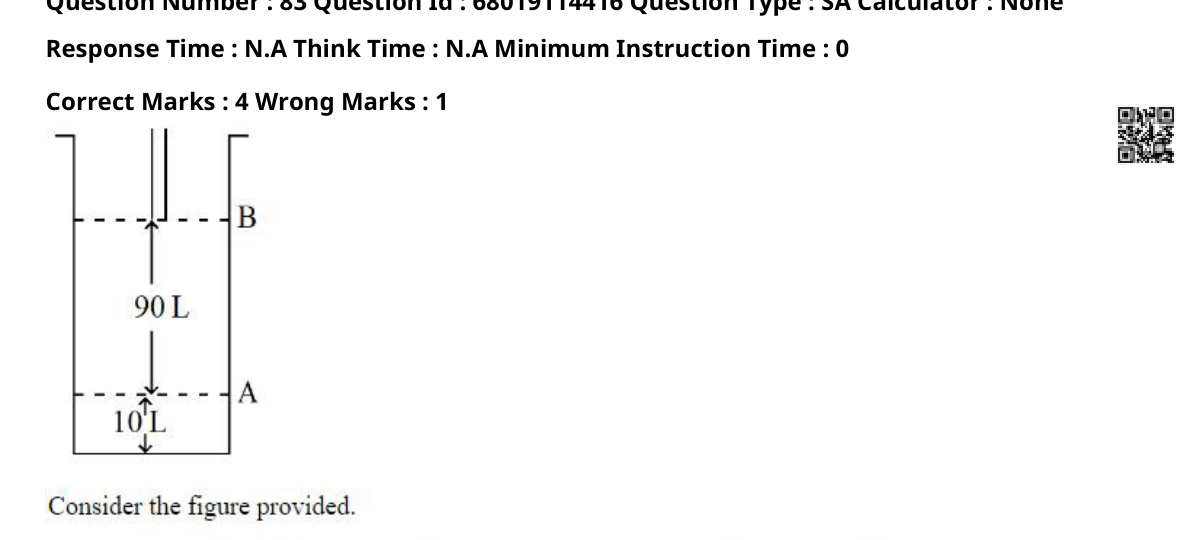
(A figure of a cylinder fitted with a piston is provided; the piston can be at position A corresponding to a gas volume of 10 L or at position B corresponding to 90 L.) Consider the figure provided. 1 mol of an ideal gas is kept in a cylinder, fitted with a piston, at the position A, at 18 degree C. If the piston is moved to position B, keeping the temperature unchanged, then 'x' L atm work is done in this reversible process. x = ___ L atm. (nearest integer) [Given: Absolute temperature = degree C + 273.15, R = 0.08206 L atm mol-1 K-1]
Solutions
23. Concentration terms
seen 6×20232024
The density of 'x' M solution ('x' molar) of NaOH is 1.12 g mL-1, while in molality, the concentration of the solution is 3 m (3 molal). Then x is
(Given: Molar mass of NaOH is 40 g/mol)
(1) 3.5
(2) 3.8
(3) 3.0
(4) 2.8
24. Freezing-point depression
seen 5×202220232024
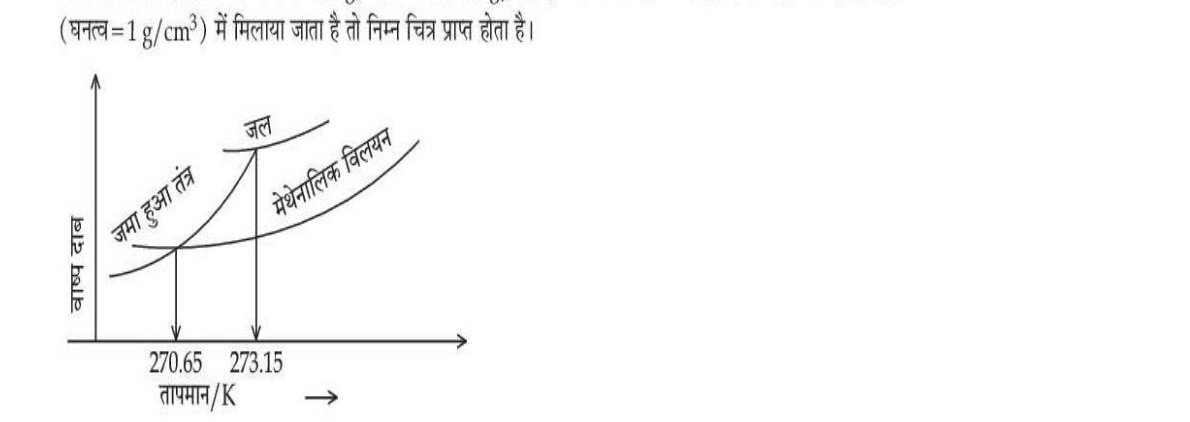
When 'x' ×10-2 mL methanol (molar mass = 32 g; density = 0.792 g/cm3) is added to 100 mL water (density = 1 g/cm3), the following diagram is obtained. [Vapour pressure vs Temperature/K plot for Water, Methanolic solution and Frozen system, with values 270.65 and 273.15 marked on the temperature axis.]
x = ________ (nearest integer).
[Given : Molal freezing point depression constant of water at 273.15 K is 1.86 K kg mol-1]
25. Osmotic pressure
seen 3×20232024
Consider the dissociation of the weak acid HX as given below HX(aq) <=> H^+(aq) + X^-(aq), Ka = 1.2 x 10⁻⁵. [Ka: dissociation constant] The osmotic pressure of 0.03 M aqueous solution of HX at 300 K is ________ x 10-2 bar (nearest integer). [Given: R = 0.083 L bar mol-1 K-1]
26. Boiling-point elevation
seen 2×20242025
2 moles each of ethylene glycol and glucose are dissolved in 500 g of water. The boiling point of the resulting solution is:
(Given: Ebullioscopic constant of water = 0.52 K kg mol-1)
Options:
(1) 379.2 K
(2) 277.3 K
(3) 377.3 K
(4) 375.3 K
27. RLVP
seen 2×20222023
Mass of Urea (NH2CONH2) required to be dissolved in 1000 g of water in order to reduce the vapour pressure of water by 25% is ______ g. (Nearest integer)
Given: Molar mass of N, C, O and H are 14, 12, 16 and 1 g mol-1 respectively.
Equilibrium
28. Kp / Kc relation
seen 5×202320242025
Consider the following equilibrium,
CO(g) + 2H2(g) <=> CH3OH(g)
0.1 mol of CO along with a catalyst is present in a 2 dm3 flask maintained at 500 K. Hydrogen is introduced into the flask until the pressure is 5 bar and 0.04 mol of CH3OH is formed. The Kptheta is ______ *10-3 (nearest integer).
Given : R = 0.08 dm3 bar K-1 mol-1
Assume only methanol is formed as the product and the system follows ideal gas behaviour.
29. pH / ionic equilibrium
seen 4×202220232025
An aqueous solution of HCl with pH 1.0 is diluted by adding equal volume of water (ignoring dissociation of water). The pH of HCl solution would (Given log 2 = 0.30)
(1) remain same
(2) reduce to 0.5
(3) increase to 2
(4) increase to 1.3
30. Le Chatelier factors
seen 2×2025
In the following system, PCl5(g) <=> PCl3(g) + Cl2(g) at equilibrium, upon addition of xenon gas at constant T & p, the concentration of
Options:
(1) PCl3 will increase
(2) Cl2 will decrease
(3) PCl5 will increase
(4) PCl5, PCl3 & Cl2 remain constant
31. Combined K
seen 2×20222024
For the given hypothetical reactions, the equilibrium constants are as follows:
X <=> Y; K1 = 1.0
Y <=> Z; K2 = 2.0
Z <=> W; K3 = 4.0
The equilibrium constant for the reaction X <=> W is
(1) 7.0
(2) 8.0
(3) 12.0
(4) 6.0
Redox Reactions and Electrochemistry
32. Nernst / cell EMF
seen 5×2022202320242025
Consider the following electrochemical cell at standard condition.
Au(s) | QH2, Q | NH4X (0.01 M) || Ag^+ (1 M) | Ag(s) Ecell = +0.4 V
The couple QH2/Q represents quinhydrone electrode, the half cell reaction is given below :
Q + 2e^- + 2H^+ -> QH2, E°Q/QH2 = +0.7 V
(Given : E°Ag+/Ag = +0.8 V and 2.303*R*T/F = 0.06 V)
The pKb value of the ammonium halide salt (NH4X) used here is ______. (nearest integer)
33. Molar conductivity
seen 4×202220242025
Given below are two statements:
Statement I: Mohr's salt is composed of only three types of ions-ferrous, ammonium and sulfate.
Statement II: If the molar conductance at infinite dilution for ferrous, ammonium and sulfate ions are x1, x2 and x3 S cm2 mol-1, respectively then the molar conductance for Mohr's salt solution at infinite dilution would be given by x1 + x2 + 2x3.
In the light of the given statements, choose the correct answer from the options given below:
(1) Both Statements I and Statement II are true
(2) Both Statements I and Statement II are false
(3) Statement I is true but Statement II are false
(4) Statement I is false but Statement II is true
34. Electrode potential combine
seen 3×2023
The standard electrode potential of M^+/M in aqueous solution does not depend on
(1) Ionisation of a solid metal atom
(2) Sublimation of a solid metal
(3) Hydration of a gaseous metal ion
(4) Ionisation of a gaseous metal atom
35. Cell notation
seen 2×2024
The reaction: (1/2) H2(g) + AgCl(s) -> H^+(aq) + Cl^-(aq) + Ag(s) occurs in which of the following galvanic cell:
(1) Ag | AgCl(s) | KCl(soln.) || AgNO3(aq.) | Ag
(2) Pt | H2(g) | KCl(soln.) | AgCl(s) | Ag
(3) Pt | H2(g) | HCl(soln.) | AgCl(s) | Ag
(4) Pt | H2(g) | HCl(soln.) | AgNO3(aq) | Ag
36. Redox classification
seen 2×20232024
Match List-I with List-II.
List-I (Reaction)
(A) N2(g) + O2(g) -> 2NO(g)
(B) 2Pb(NO3)2(s) -> 2PbO(s) + 4NO2(g) + O2(g)
(C) 2Na(s) + 2H2O(l) -> 2NaOH(aq) + H2(g)
(D) 2NO2(g) + 2OH^-(aq) -> NO2^-(aq) + NO3^-(aq) + H2O(l)
List-II (Type of redox reaction)
(I) Decomposition
(II) Displacement
(III) Disproportionation
(IV) Combination
Choose the correct answer from the options given below :
(1) (A)-(IV), (B)-(I), (C)-(II), (D)-(III)
(2) (A)-(II), (B)-(III), (C)-(IV), (D)-(I)
(3) (A)-(III), (B)-(II), (C)-(I), (D)-(IV)
(4) (A)-(I), (B)-(II), (C)-(III), (D)-(IV)
37. Oxidation number / balancing
seen 2×20232024
Chlorine undergoes disproportionation in alkaline medium as shown below :
a Cl2(g) + b OH^-(aq) -> c ClO^-(aq) + d Cl^-(aq) + e H2O(l)
The values of a, b, c and d in a balanced redox reaction are respectively :
(A) 2, 4, 1 and 3
(B) 2, 2, 1 and 3
(C) 1, 2, 1 and 1
(D) 3, 4, 4 and 2
38. Iodometry
seen 2×20232024
Thiosulphate reacts differently with iodine and bromine in the reactions given below:
2S2O32- + I2 -> S4O62- + 2I^-
S2O32- + 5Br2 + 5H2O -> 2SO42- + 4Br^- + 10H^+
Which of the following statement justifies the above dual behaviour of thiosulphate?
(1) Bromine is a stronger oxidant than iodine
(2) Bromine is a weaker oxidant than iodine
(3) Thiosulphate undergoes oxidation by bromine and reduction by iodine in these reactions
(4) Bromine undergoes oxidation and iodine undergoes reduction in these reactions
Chemical Kinetics
39. First-order half-life calc
seen 5×202220242025
In a reaction A + B -> C, initial concentrations of A and B are related as [A]0 = 8[B]0. The half lives of A and B are 10 min and 40 min, respectively. If they start to disappear at the same time, both following first order kinetics, after how much time will the concentration of both the reactants be same?
Options:
(1) 20 min
(2) 40 min
(3) 60 min
(4) 80 min
40. Arrhenius equation
seen 5×202220232024
For a reaction taking place in three steps at same temperature, overall rate constant K = (K1 K2)/K3. If Ea1, Ea2 and Ea3 are 40, 50 and 60 kJ/mol respectively, the overall Ea is ______ kJ/mol.
41. Order determination
seen 3×202220242025
A person's wound was exposed to some bacteria and then bacterial growth started to happen at the same place. The wound was later treated with some antibacterial medicine and the rate of bacterial decay (r) was found to be proportional with the square of the existing number of bacteria at any instance. Which of the following set of graphs correctly represents the 'before' and 'after' situation of the application of the medicine? [Given: N = No. of bacteria, t = time, bacterial growth follows 1st order kinetics.]
(1) Before: N/N0 rises exponentially with t; After: r decreases with N
(2) Before: rises exponentially; After: r increases linearly with N
(3) Before: rises exponentially; After: r increases (parabolic) with N
(4) Before: rises exponentially; After: r increases (parabolic) with N
42. Multi-step kinetics
seen 2×20232024
For a reaction A -(K1)-> B -(K2)-> C. If the rate of formation of B is set to be zero then the concentration of B is given by:
(1) (K1 - K2)[A]
(2) K1 K2 [A]
(3) (K1 + K2)[A]
(4) (K1 / K2)[A]
43. Catalyst matching
seen 2×2022
Match List - I with List - II
List - I : (A) N2(g) + 3H2(g) -> 2NH3(g) ; (B) CO(g) + 3H2(g) -> CH4(g) + H2O(g) ; (C) CO(g) + H2(g) -> HCHO(g) ; (D) CO(g) + 2H2(g) -> CH3OH(g)
List - II (catalysts) : (I) Cu ; (II) Cu/ZnO - Cr2O3 ; (III) FexOy + K2O + Al2O3 ; (IV) Ni
Choose the correct answer from the options given below :
(A) (A)-(II), (B)-(IV), (C)-(I), (D)-(III)
(B) (A)-(II), (B)-(I), (C)-(IV), (D)-(III)
(C) (A)-(III), (B)-(IV), (C)-(I), (D)-(II)
(D) (A)-(III), (B)-(I), (C)-(IV), (D)-(II)
Classification of Elements and Periodicity in Properties
44. Electron gain enthalpy trend
seen 4×202220232024
The electron affinity value are negative for
A. Be -> Be^-
B. N -> N^-
C. O -> O2-
D. Na -> Na^-
E. Al -> Al^-
Choose the most appropriate answer from the options given below:
(1) A, B and C only
(2) D and E only
(3) A and D only
(4) A, B, D and E only
45. Mixed periodic trends
seen 2×20242025
Which of the following statements are correct?
A. The process of adding an electron to a neutral gaseous atom is always exothermic.
B. The process of removing an electron from an isolated gaseous atom is always endothermic.
C. The 1st ionization energy of boron is less than that of beryllium.
D. The electronegativity of C is 2.5 in CH4 and CCl4.
E. Li is the most electropositive among elements of group I.
Choose the correct answer from the options given below:
Options:
(1) B, C and E Only
(2) B and C Only
(3) B and D Only
(4) A, C and D Only
46. Ionization enthalpy order
seen 2×20222024
Given below are two statements : one is labelled as Assertion A and the other is labelled as Reason R :
Assertion A : The first ionisation enthalpy decreases across a period.
Reason R : The increasing nuclear charge outweighs the shielding across the period.
In the light of the above statements, choose the most appropriate from the options given below :
(A) Both A and R are true and R is the correct explanation of A
(B) Both A and R are true but R is NOT the correct explanation of A
(C) A is true but R is false
(D) A is false but R is true
p- Block Elements
47. Inert pair effect
seen 3×20242025
The group 14 elements A and B have the first ionisation enthalpy values of 708 and 715 kJ mol-1 respectively. The above values are lowest among their group members. The nature of their ions A2+ and B4+ respectively is
(1) reducing and oxidising
(2) oxidising and reducing
(3) both reducing
(4) both oxidising
48. Group 15 statements
seen 2×20242025
Given below are two statements:
Statement I: The N-N single bond is weaker and longer than that of P-P single bond.
Statement II: Compounds of group 15 elements in +3 oxidation states readily undergo disproportionation reactions.
In the light of the above statements, choose the correct answer from the options given below
Options:
(1) Both Statement I and Statement II are true
(2) Both Statement I and Statement II are false
(3) Statement I is true but Statement II is false
(4) Statement I is false but Statement II is true
49. Group 14 trends
seen 2×2024
Evaluate the following statements related to group 14 elements for their correctness.
(A) Covalent radius decreases down the group from C to Pb in a regular manner.
(B) Electronegativity decreases from C to Pb down the group gradually.
(C) Maximum covalence of C is 4 whereas other elements can expand their covalence due to presence of d orbitals.
(D) Heavier elements do not form pπ-pπ bonds.
(E) Carbon can exhibit negative oxidation states.
Choose the correct answer from the options given below :
(1) (A) and (B) Only
(2) (C) and (D) Only
(3) (A), (B) and (C) Only
(4) (C), (D) and (E) Only
50. Phosphorus oxoacids
seen 2×2023
Which of the Phosphorus oxoacid can create silver mirror from AgNO3 solution? Options: 1) H4P2O5 2) (HPO3)n 3) H4P2O6 4) H4P2O7
51. Interhalogen compounds
seen 2×2022
The interhalogen compound formed from the reaction of bromine with excess of fluorine is a :
(A) hypohalite
(B) halate
(C) perhalate
(D) halite
d- and f- Block Elements
52. Spin-only moment (d-block)
seen 8×2022202320242025
The metal ions that have the calculated spin-only magnetic moment value of 4.9 B.M. are:
A. Cr2+
B. Fe2+
C. Fe3+
D. Co2+
E. Mn3+
Choose the correct answer from the options given below:
Options:
(1) A, B and E Only
(2) A, D and E Only
(3) B and E Only
(4) A, C and E Only
53. KMnO4 chemistry
seen 5×20222024
Given below are two statements:
Statement (I): Fusion of MnO2 with KOH and an oxidising agent gives dark green K2MnO4.
Statement (II): Manganate ion on electrolytic oxidation in alkaline medium gives permanganate ion.
In the light of the above statements, choose the correct answer from the options given below:
(1) Both Statement I and Statement II are true
(2) Both Statement I and Statement II are false
(3) Statement I is true but Statement II is false
(4) Statement I is false but Statement II is true
54. Cr oxoanion chemistry
seen 3×202320242025
Consider the following reactions
A + NaCl + H2SO4 (little amount) -> CrO2Cl2 + Side Products
CrO2Cl2 (Vapour) + NaOH -> B + NaCl + H2O
B + H^+ -> C + H2O
The number of terminal 'O' present in the compound 'C' is ______.
55. Lanthanoid chemistry
seen 3×20232024
The number of element from the following that do not belong to lanthanoids is Eu, Cm, Er, Tb, Yb and Lu
(1) 5
(2) 1
(3) 3
(4) 4
56. Enthalpy of atomisation
seen 2×2025
The number of valence electrons present in the metal among Cr, Co, Fe and Ni which has the lowest enthalpy of atomisation is
(1) 8
(2) 9
(3) 6
(4) 10
57. Transition-metal reactivity
seen 2×20222023
Which of the following statements are correct?
(A) The M3+/M2+ reduction potential for iron is greater than manganese.
(B) The higher oxidation states of first row d-block elements get stabilized by oxide ion.
(C) Aqueous solution of Cr2+ can liberate hydrogen from dilute acid.
(D) Magnetic moment of V2+ is observed between 4.4 - 5.2 BM.
Choose the correct answer from the options given below:
(1) (B), (C) only
(2) (A), (B), (D) only
(3) (A), (B) only
(4) (C), (D) only
Coordination Compounds
58. CFT electron configuration
seen 7×202320242025
Given below are two statements :
Statement (I) : In octahedral complexes, when Delta0 < P high spin complexes are formed. When Delta0 > P low spin complexes are formed.
Statement (II) : In tetrahedral complexes because of Deltat < P, low spin complexes are rarely formed.
In the light of the above statements, choose the most appropriate answer from the options given below :
(1) Both Statement I and Statement II are correct
(2) Both Statement I and Statement II are incorrect
(3) Statement I is correct but Statement II is incorrect
(4) Statement I is incorrect but Statement II is correct
59. Spin-only magnetic moment
seen 7×2022202320242025
The number of paramagnetic complexes among [FeF6]3-, [Fe(CN)6]3-, [Mn(CN)6]3-, [Co(C2O4)3]3-, [MnCl6]3-, and [CoF6]3-, which involved d2sp3 hybridization is ______
60. Wavelength absorbed order
seen 2×20242025
The correct order of the complexes [Co(NH3)5(H2O)]3+ (A), [Co(NH3)6]3+ (B), [Co(CN)6]3- (C) and [CoCl(NH3)5]2+ (D) in terms of wavelength of light absorbed is
Options:
(1) C > B > A > D
(2) C > B > D > A
(3) D > C > B > A
(4) D > A > B > C
61. Ionisation isomerism
seen 2×20222025
An octahedral complex having molecular composition Co.5NH3.Cl.SO4 has two isomers A and B. The solution of A gives a white precipitate with AgNO3 solution and the solution of B gives white precipitate with BaCl2 solution. The type of isomerism exhibited by the complex is,
(1) Linkage isomerism
(2) Co-ordinate isomerism
(3) Ionisation isomerism
(4) Geometrical isomerism
62. Isomer count
seen 2×20222025
The number of optical isomers exhibited by the iron complex (A) obtained from the following reaction is ______.
FeCl3 + KOH + H2C2O4 -> A
63. Ni-DMG test
seen 2×20232024
Consider the following reactions
NiS + HNO3 + HCl -> A + NO + S + H2O
A + NH4OH + H3C-C(=N-OH)-C(=N-OH)-CH3 (dimethylglyoxime) -> B + NH4Cl + H2O
The number of protons that do not involve in hydrogen bonding in the product B is ________.

64. Primary/secondary valency
seen 2×20232024
An octahedral complex with the formula CoCl3.nNH3 upon reaction with excess of AgNO3 solution gives 2 moles of AgCl. Consider the oxidation state of Co in the complex is 'x'. The value of "x + n" is ___.
(1) 3
(2) 6
(3) 5
(4) 8
65. Ligand donor/acceptor character
seen 2×20222024
Given below are two statements:
Statement I: N(CH3)3 and P(CH3)3 can act as ligands to form transition metal complexes.
Statement II: As N and P are from same group, the nature of bonding of N(CH3)3 and P(CH3)3 is always same with transition metals.
In the light of the above statements, choose the most appropriate answer from the options given below:
(1) Both Statement I and Statement II are correct.
(2) Both Statement I and Statement II are incorrect.
(3) Statement I is correct but Statement II is incorrect.
(4) Statement I is incorrect but Statement II is correct.
Purification and Characterisation of Organic Compounds
66. Combustion estimation
seen 5×202220232025
On complete combustion 1.0 g of an organic compound (X) gave 1.46 g of CO2 and 0.567 g of H2O. The empirical formula mass of compound (X) is ______ g.
(Given molar mass in g mol-1 C : 12, H : 1, O : 16)
(1) 15
(2) 30
(3) 45
(4) 60
67. Nitrogen estimation
seen 3×202220242025
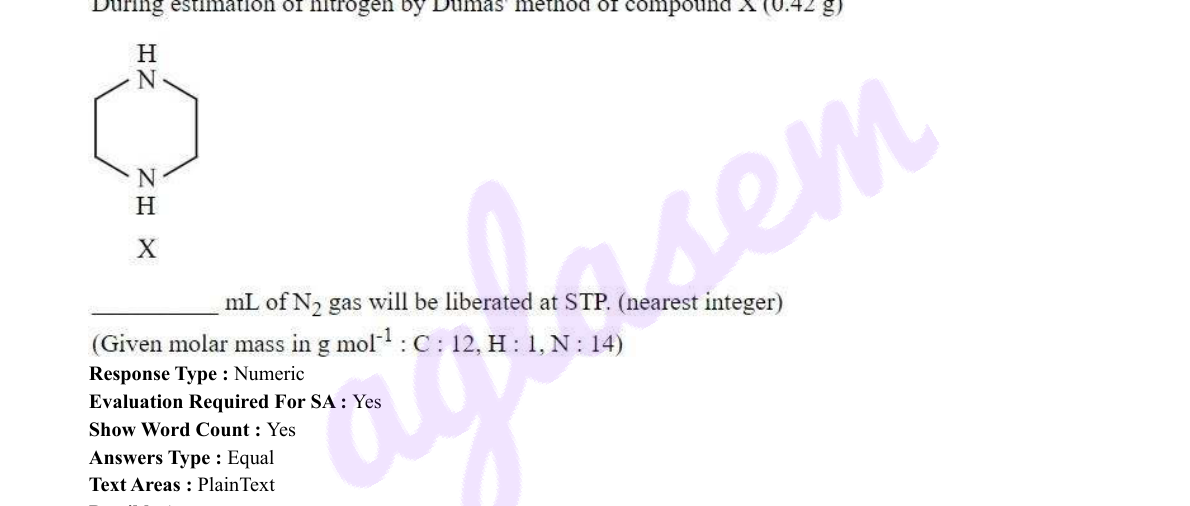
During estimation of nitrogen by Dumas' method of compound X (0.42 g), where X is piperazine (a six-membered ring with two NH groups at 1,4 positions, C4H10N2), ______ mL of N2 gas will be liberated at STP. (nearest integer)
(Given molar mass in g mol-1 C: 12, H: 1, N: 14)
68. Element detection (Lassaigne)
seen 3×20232024
In qualitative test for identification of presence of phosphorous, the compound is heated with an oxidising agent. Which is further treated with nitric acid and ammonium molybdate respectively. The yellow coloured precipitate obtained is:
(1) Na3PO4.12MoO3
(2) (NH4)3PO4.12MoO3
(3) (NH4)3PO4.12(NH4)2MoO4
(4) MoPO4.21NH4NO3
69. Separation technique selection
seen 3×202220232024
Which of the following statements are correct?
A. Glycerol is purified by vacuum distillation because it decomposes at its normal boiling point.
B. Aniline can be purified by steam distillation as aniline is miscible in water.
C. Ethanol can be separated from ethanol water mixture by azeotropic distillation because it forms azeotrope.
D. An organic compound is pure, if mixed M.P. is remained same.
Choose the most appropriate answer from the options given below:
(1) A, B, C only
(2) A, B, D only
(3) A, C, D only
(4) B, C, D only
70. Chromatography / Rf
seen 3×202220232024
The correct statement among the following, for a "chromatography" purification method is :
(1) Non-polar compounds are retained at top and polar compounds come down in column chromatography.
(2) Rf is an integral value.
(3) Organic compounds run faster than solvent in the thin layer chromatographic plate.
(4) Rf of a polar compound is smaller than that of a non-polar compound.
Some Basic Principles of Organic Chemistry
71. IUPAC nomenclature
seen 3×20242025
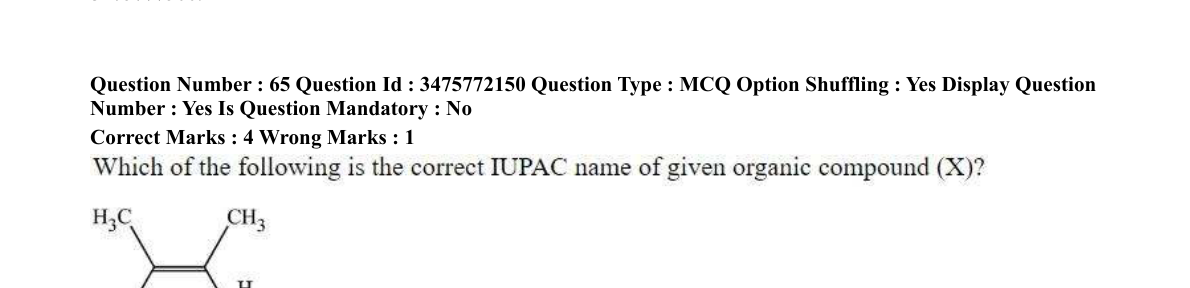
Which of the following is the correct IUPAC name of given organic compound (X)? [Structure X: a but-2-ene with CH3 groups on C2 and C3 and a CH2Br group, i.e. 1-bromo-2-methylbut-2-ene skeleton]
(1) 4-Bromo-3-methylbut-2-ene
(2) 1-Bromo-2-methylbut-2-ene
(3) 2-Bromo-2-methylbut-2-ene
(4) 3-Bromo-3-methylprop-2-ene
72. Resonance / electronic effects
seen 3×20232024
The interaction between π bond and lone pair of electrons present on an adjacent atom is responsible for :
(A) Electromeric effect
(B) Resonance effect
(C) Hyperconjugation
(D) Inductive effect
73. Stereoisomer counting
seen 3×20222024
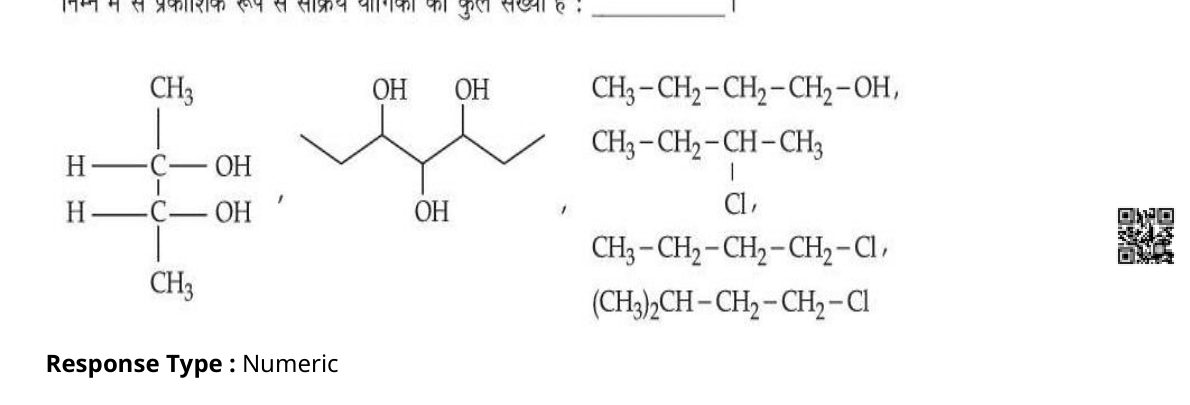
Total number of optically active compounds from the following is _______. (Structures shown: 2,3-dihydroxy-2,3-dimethyl compound H-C(CH3)(OH)-C(H)(OH)-CH3 (butane-2,3-diol type with methyls), hexane-2,3,4-triol type (CH3CH2-CH(OH)-CH(OH)-CH(OH)-CH2CH3), CH3-CH2-CH2-CH2-OH, CH3-CH2-CHCl-CH3 (2-chlorobutane), CH3-CH2-CH2-CH2-Cl, (CH3)2CH-CH2-CH2-Cl.)
74. Intermediate stability
seen 2×20242025
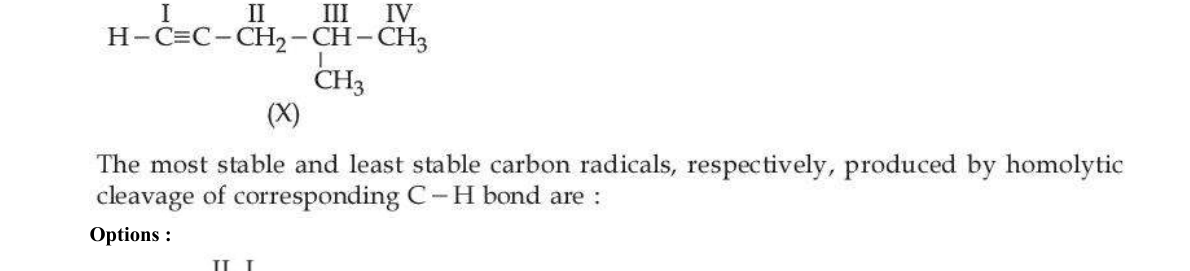
Consider the following compound (X): H-C(I)≡C(II)-CH2(III)-CH(IV)(-CH3)-CH3, where carbons are labelled I (terminal alkyne CH), II (alkyne C), III (CH2), IV (CH bearing a CH3 branch), followed by a terminal CH3. The most stable and least stable carbon radicals, respectively, produced by homolytic cleavage of corresponding C-H bond are :
(1) II, I
(2) III, II
(3) II, IV
(4) I, IV
75. Isomerism types
seen 2×20242025
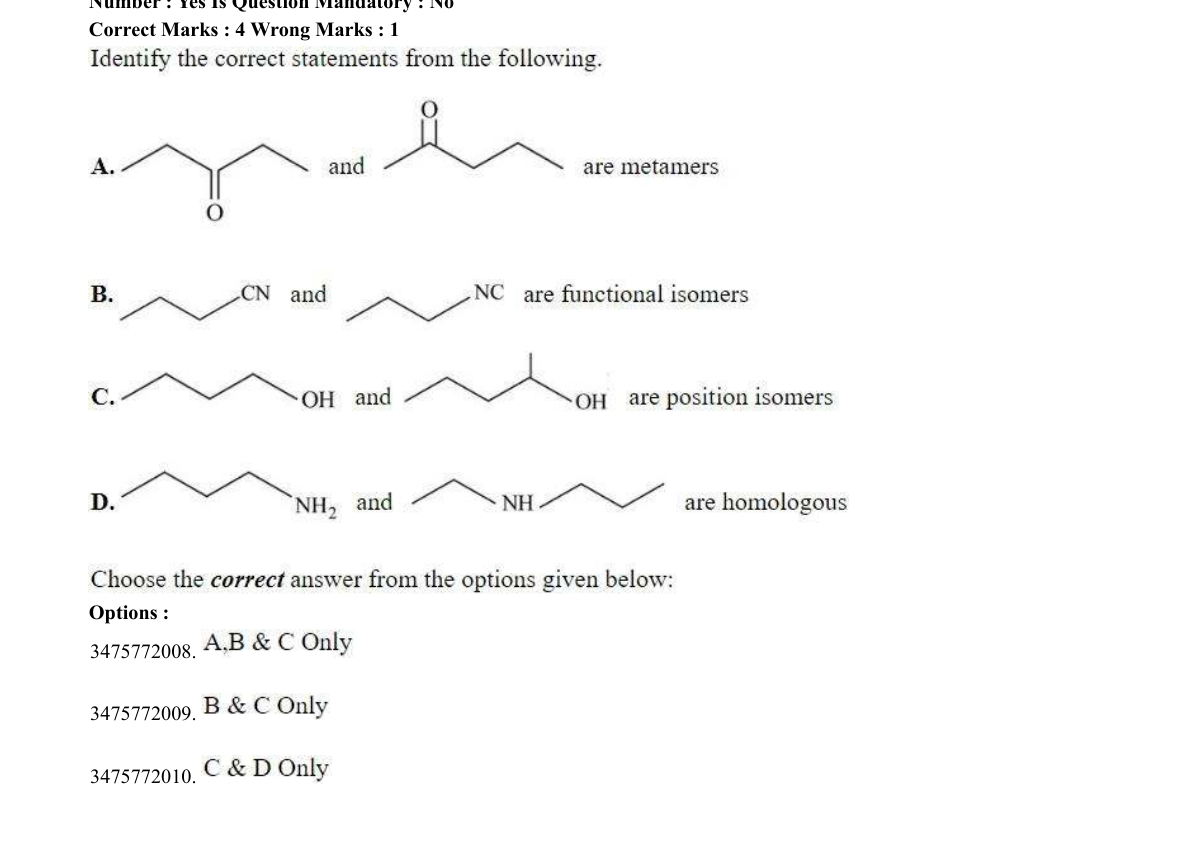
Identify the correct statements from the following.
A. CH3-CO-CH2-CH3 (butan-2-one) and CH3-CH2-CH2-CHO (butanal) are metamers.
B. CH3-CH2-CH2-CN (butanenitrile) and CH3-CH2-CH2-NC (propyl isocyanide) are functional isomers.
C. CH3-CH2-CH2-CH2-OH (butan-1-ol) and CH3-CH2-CH(OH)-CH3 (butan-2-ol) are position isomers.
D. CH3-CH2-CH2-CH2-NH2 (butan-1-amine) and CH3-CH2-NH-CH2-CH3 (N-ethylethanamine) are homologous.
Choose the correct answer from the options given below:
Options:
(1) A, B & C Only
(2) B & C Only
(3) C & D Only
(4) A & B Only
76. Hybridization / geometry
seen 2×20222024
The shape of carbocation is:
(1) tetrahedral
(2) trigonal planar
(3) diagonal
(4) diagonal pyramidal
Hydrocarbons
77. Ozonolysis of alkenes
seen 5×202220242025
Given below are two statements:
Statement I: Ozonolysis followed by treatment with Zn, H2O of cis-2-butene gives ethanal.
Statement II: The product obtained by ozonolysis followed by treatment with Zn, H2O of 3,6-dimethyloct-4-ene has no chiral carbon atom.
In the light of the above statements, choose the correct answer from the options given below
(1) Both Statement I and Statement II are true
(2) Both Statement I and Statement II are False
(3) Statement I is true but Statement II is false
(4) Statement I is false but Statement II are true
78. Aromaticity / Huckel
seen 3×20242025
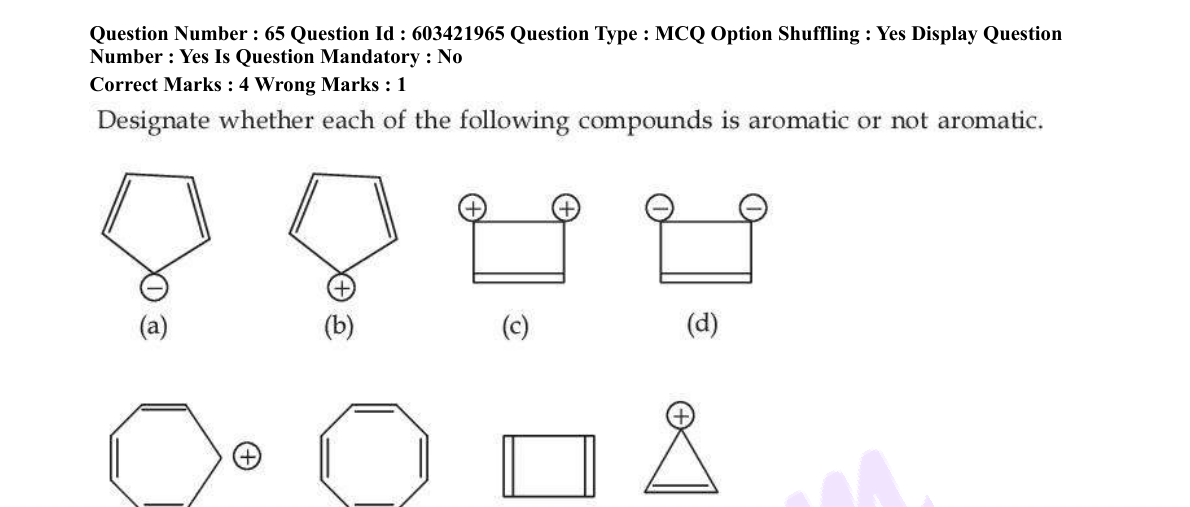
Designate whether each of the following compounds is aromatic or not aromatic. The structures shown are: (a) cyclopentadienyl anion, (b) cyclopentadienyl cation, (c) cyclobutadiene dication, (d) cyclobutadiene dianion, (e) cycloheptatrienyl (tropylium) cation, (f) cyclooctatetraene, (g) cyclobutadiene, (h) cyclopropenyl cation.
(1) b, e, f, g aromatic and a, c, d, h not aromatic
(2) a, c, d, e, h aromatic and b, f, g not aromatic
(3) a, b, c, d aromatic and e, f, g, h not aromatic
(4) e, g aromatic and a, b, c, d, f, h not aromatic
79. Electrophilic addition to alkenes
seen 3×20222023
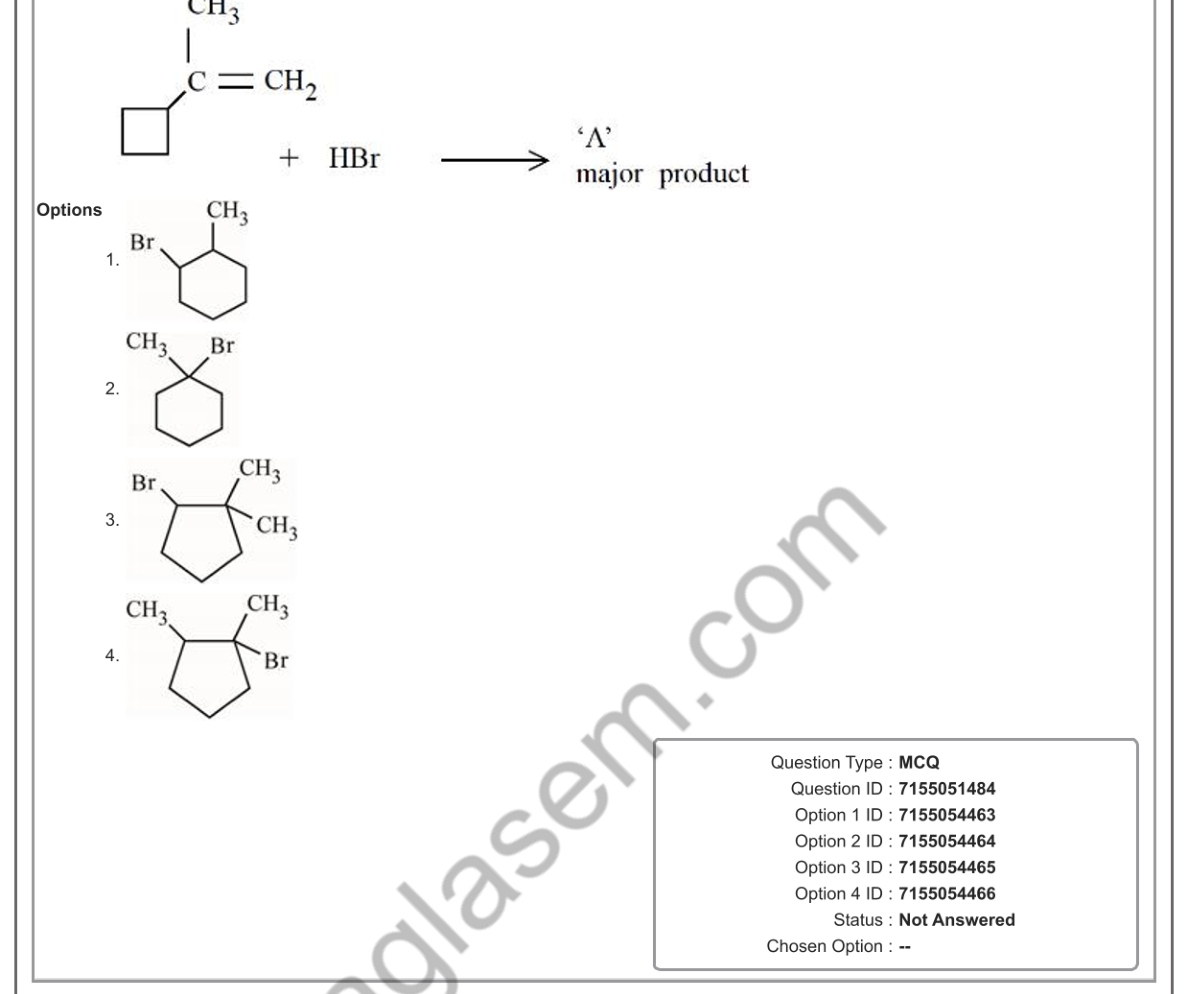
In the following given reaction, 'A' is [1-cyclobutyl-substituted alkene: a cyclobutane ring bearing C(CH3)=CH2] + HBr -> 'A' major product. Options: 1) 1-bromo-2-methylcyclohexane (Br and CH3 on adjacent carbons of cyclohexane) 2) 1-bromo-1-methylcyclohexane (Br and CH3 on same carbon of cyclohexane) 3) 1-bromo-2,2-dimethylcyclopentane (Br on one carbon; gem-dimethyl on adjacent carbon of cyclopentane) 4) 1-bromo-1,2-dimethylcyclopentane (two CH3 and Br on a cyclopentane ring)
80. Side-chain oxidation to COOH
seen 2×20232024
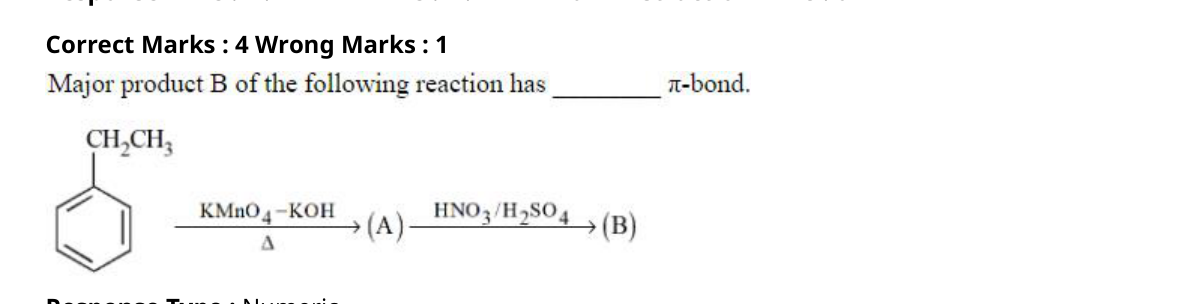
Major product B of the following reaction has ___ pi-bond.
(Ethylbenzene, C6H5-CH2CH3) --KMnO4 - KOH, delta--> (A) --HNO3 / H2SO4--> (B)
Organic Compounds Containing Halogens
81. SN1/SN2 mechanism & product
seen 3×20222024
Given below are two statements:
Statement (I): SN2 reactions are 'stereospecific', indicating that they result in the formation of only one stereo-isomer as the product.
Statement (II): SN1 reactions generally result in formation of product as racemic mixtures.
In the light of the above statements, choose the correct answer from the options given below:
(1) Both Statement I and Statement II are true
(2) Both Statement I and Statement II are false
(3) Statement I is true but Statement II is false
(4) Statement I is false but Statement II is true
82. Substitution reactivity order
seen 2×20232024
Which among the following compounds will undergo fastest SN2 reaction?
All options are cyclobutane-based alkyl bromides:
(1) 1-bromo-1-methylcyclobutane (Br and a CH3 on the same ring carbon; tertiary)
(2) (2-bromopropan-2-yl)cyclobutane: cyclobutyl-C(CH3)2Br (tertiary/neopentyl-type)
(3) (bromomethyl)cyclobutane: cyclobutyl-CH2Br (primary)
(4) (1-bromoethyl)cyclobutane: cyclobutyl-CH(CH3)Br (secondary)
83. Finkelstein / iodide catalysis
seen 2×2023
Assertion A: Hydrolysis of an alkyl chloride is a slow reaction but in the presence of NaI, the rate of the hydrolysis increases. Reason R: I^- is a good nucleophile as well as a good leaving group. In the light of the above statements, choose the correct from the options given below: Options: 1) A is true but R is false 2) Both A and R are true and R is the correct explanation of A 3) Both A and R are true but R is NOT the correct explanation of A 4) A is false but R is true
Organic Compounds Containing Oxygen
84. Acidity order
seen 5×202220242025
Which of the following compounds is least likely to give effervescence of CO2 in presence of aq. NaHCO3?
(1) 4-nitrobenzoic acid (p-NO2-C6H4-COOH)
(2) anilinium chloride (Ph-NH3^+ Cl^-)
(3) 3-nitrophenol (m-NO2-C6H4-OH)
(4) 2,4,6-trinitrophenol (picric acid)
85. Aldol condensation
seen 3×202220242025
Given below are two statements :
Statement (I) : Vanillin (4-hydroxy-3-methoxybenzaldehyde) will react with NaOH and also with Tollen's reagent.
Statement (II) : Vanillin will undergo self aldol condensation very easily.
In the light of the above statements, choose the most appropriate answer from the options given below :
(1) Both Statement I and Statement II are correct
(2) Both Statement I and Statement II are incorrect
(3) Statement I is correct but Statement II is incorrect
(4) Statement I is incorrect but Statement II is correct
86. Phenol named reactions
seen 2×2024
In Reimer-Tiemann reaction, phenol is converted into salicylaldehyde through an intermediate. The structure of intermediate is ________.
(1) ortho-CHCl2 substituted phenol (benzene ring bearing -OH and, ortho to it, -CHCl2)
(2) sodium salt: benzene ring bearing -O^- Na^+ and, ortho to it, -CHO
(3) sodium salt: benzene ring bearing -O^- Na^+ and, ortho to it, -CH3
(4) sodium salt: benzene ring bearing -O^- Na^+ and, ortho to it, -CHCl2
87. Anisole EAS directive
seen 2×2024
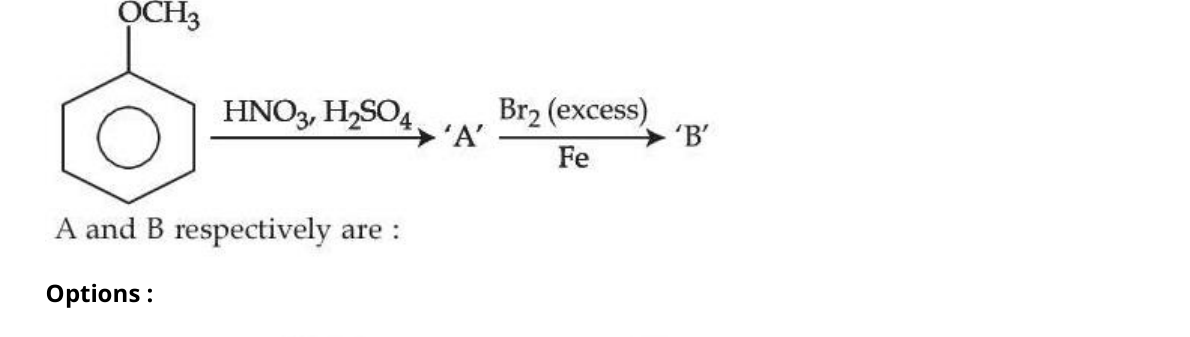
The major products formed :
Anisole (C6H5-OCH3) --(HNO3, H2SO4)--> 'A' --(Br2 (excess)/Fe)--> 'B'. A and B respectively are :
(1) A = 2-nitroanisole and B = 4-bromo-2-nitroanisole
(2) A = 4-nitroanisole and B = 2-bromo-4-nitroanisole
(3) A = 2-nitroanisole and B = 3,5-dibromo-2-nitroanisole (2-methoxy-1-nitro-3,5-dibromobenzene)
(4) A = 4-nitroanisole and B = 2,6-dibromo-4-nitroanisole
88. Ether cleavage (HBr)
seen 2×20232024
The major product (P) in the following reaction is :
[3-ethoxy-styrene: benzene ring bearing -O-CH2CH3 at one position and -CH=CH2 at meta position] + conc. HBr (excess), Heat -> (P)
(A) 1-bromo-3-(2-bromoethyl)benzene (ring -Br and -CH2CH2Br)
(B) 3-(2-bromoethyl)phenol (ring -OH and -CH2CH2Br)
(C) 3-(1-bromoethyl)phenol (ring -OH and -CHBr-CH3)
(D) 1-bromo-3-(1-bromoethyl)benzene (ring -Br and -CHBr-CH3)

89. Alcohol dehydration
seen 2×20222024
Identify the major products A and B respectively in the following set of reactions. Substrate is 1-methylcyclohexan-1-ol:
(1-methylcyclohexan-1-ol) --Conc. H2SO4, delta--> A
(1-methylcyclohexan-1-ol) --CH3COCl / Pyridine--> B
Options:
(1) A = methylenecyclohexane (exocyclic =CH2) and B = 2-acetyl-1-methylcyclohexan-1-ol (ring with CH3, OH and COCH3)
(2) A = 1-methylcyclohex-1-ene and B = 1-methylcyclohexyl acetate (ring with CH3 and OCOCH3)
(3) A = 1-methylcyclohex-1-ene and B = 4-acetyl-1-methylcyclohexan-1-ol (ring with CH3, OH and CH3CO at para)
(4) A = methylenecyclohexane (exocyclic =CH2) and B = 1-acetyl-1-methylcyclohexane (ring with CH3 and COCH3)
90. HVZ reaction
seen 2×20222024
Identify the product (P) in the following reaction:
(Cyclopentanecarboxylic acid, cyclopentane-COOH) --i) Br2 / Red P; ii) H2O--> (P)
Options:
(1) 1-bromocyclopentane-1-carboxylic acid (Br on the same ring carbon that bears -COOH; -COOH and -Br)
(2) Cyclopentanecarbonyl bromide (ring -COBr)
(3) 2-bromocyclopentane-1-carboxylic acid (ring -COOH with -Br on the adjacent carbon)
(4) 1-bromocyclopentane-1-carbaldehyde (ring -CHO and -Br on same carbon)
91. Aldehyde chemical tests
seen 2×20222024
From the compounds given below, number of compounds which give positive Fehling's test is ______ .
Benzaldehyde, Acetaldehyde, Acetone, Acetophenone, Methanal, 4-nitrobenzaldehyde, cyclohexane carbaldehyde.
92. Aldol + cyanohydrin sequence
seen 2×2023
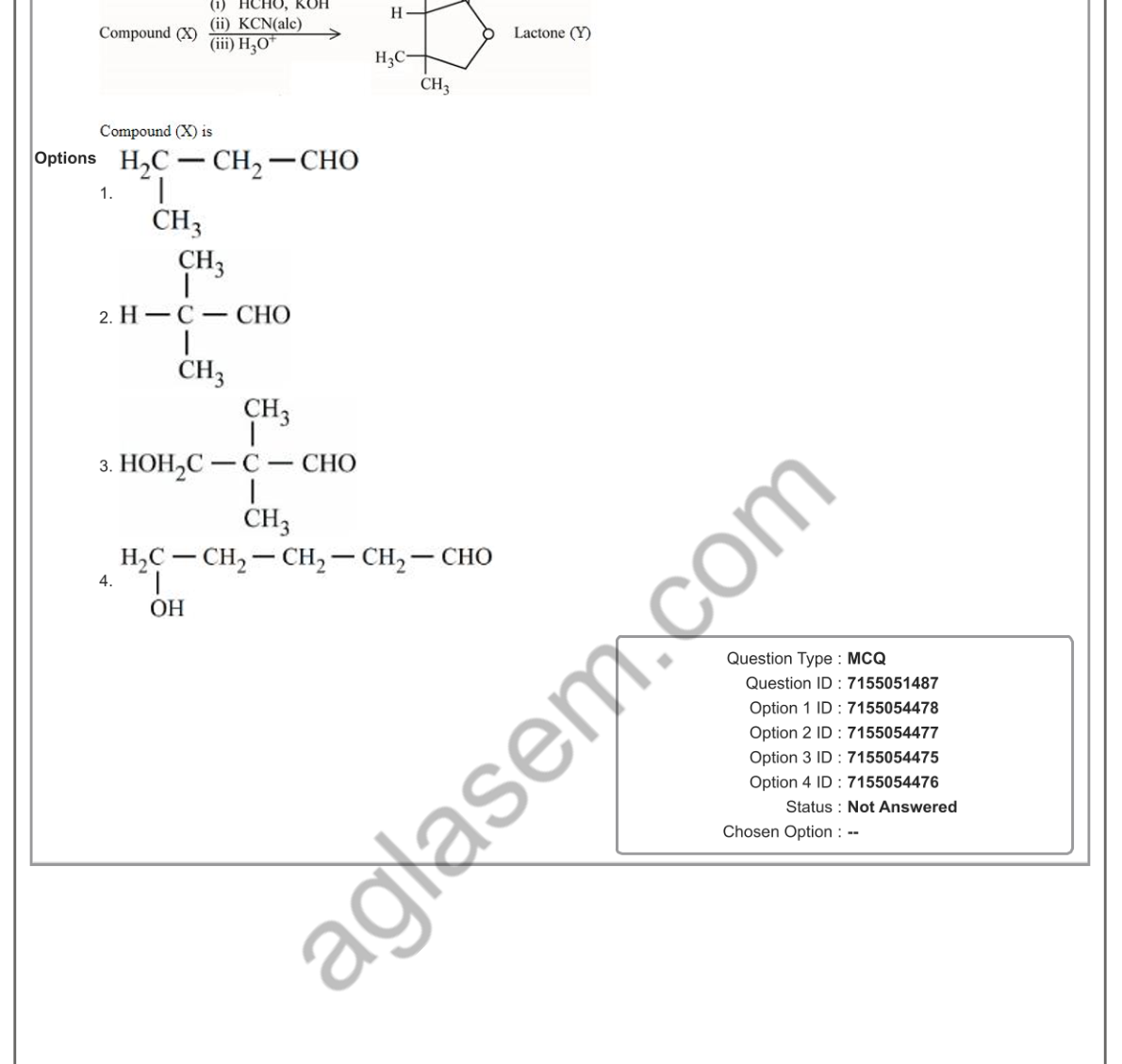
Compound (X) undergoes following sequence of reactions to give the Lactone (Y). Compound (X) --(i) HCHO, KOH (ii) KCN(alc) (iii) H3O^+--> Lactone (Y) [Y is a five-membered gamma-lactone bearing OH, H, H3C and CH3 substituents]. Compound (X) is Options: 1) H2C(CH3)-CH2-CHO 2) (CH3)2CH-CHO (H-C(CH3)2-CHO) 3) HOH2C-C(CH3)2-CHO 4) HO-CH2-CH2-CH2-CH2-CHO
93. Phenol bromination
seen 2×20222023
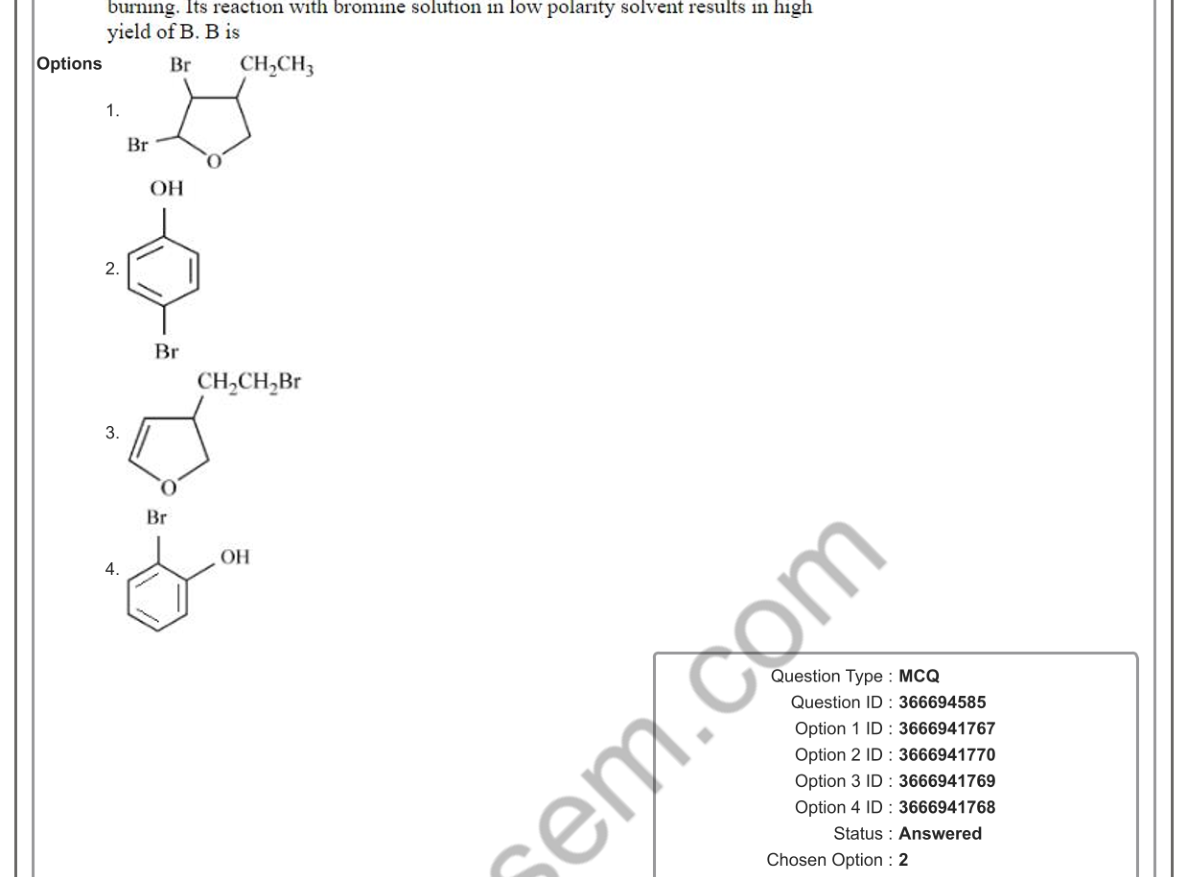
An organic compound 'A' with empirical formula C6H6O gives sooty flame on burning. Its reaction with bromine solution in low polarity solvent results in high yield of B. B is (structures shown as options; see figure). Option 2: 4-bromophenol (para). Option 4: 2-bromophenol (ortho). Options 1 and 3: brominated dihydrofuran-type structures.
Organic Compounds Containing Nitrogen
94. Diazonium salt reactions
seen 4×202220242025
Identify [A], [B] and [C], respectively in the following reaction sequence:
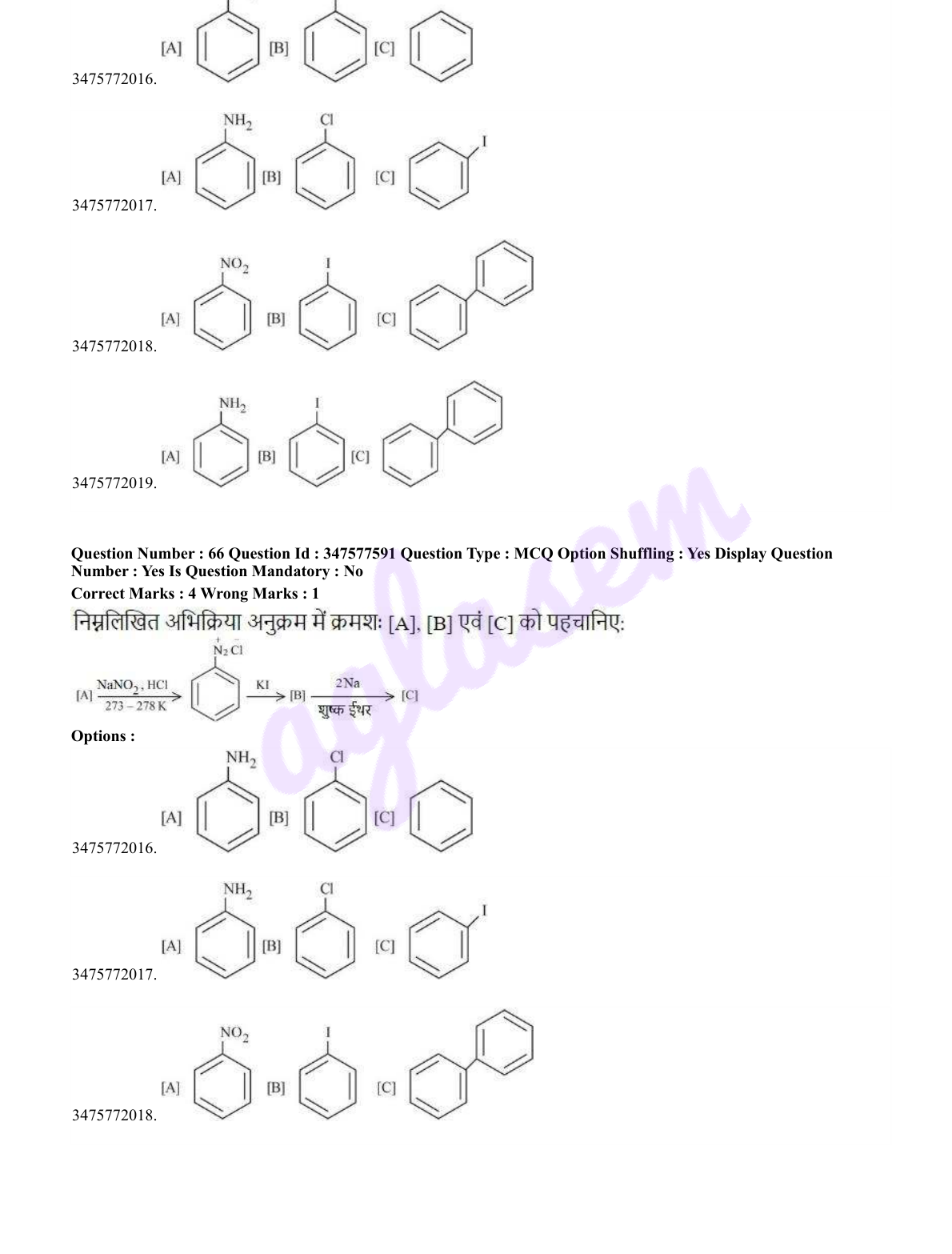
[A] --NaNO2, HCl (273-278 K)--> C6H5-N2^+Cl^- (benzenediazonium chloride) --KI--> [B] --2Na / Dry ether--> [C]
Options:
(1) [A] aniline (C6H5NH2), [B] chlorobenzene (C6H5Cl), [C] benzene (C6H6)
(2) [A] aniline (C6H5NH2), [B] chlorobenzene (C6H5Cl), [C] iodobenzene (C6H5I)
(3) [A] nitrobenzene (C6H5NO2), [B] iodobenzene (C6H5I), [C] biphenyl (C6H5-C6H5)
(4) [A] aniline (C6H5NH2), [B] iodobenzene (C6H5I), [C] biphenyl (C6H5-C6H5)
95. Hinsberg test
seen 3×2024
Given below are two statements:
Statement (I): All the following compounds react with p-toluenesulfonyl chloride. C6H5NH2, (C6H5)2NH, (C6H5)3N
Statement (II): Their products in the above reaction are soluble in aqueous NaOH.
In the light of the above statements, choose the correct answer from the options given below:
(1) Both Statement I and Statement II are true
(2) Both Statement I and Statement II are false
(3) Statement I is true but Statement II is false
(4) Statement I is false but Statement II is true
96. N-compound structure elucidation
seen 3×20222023
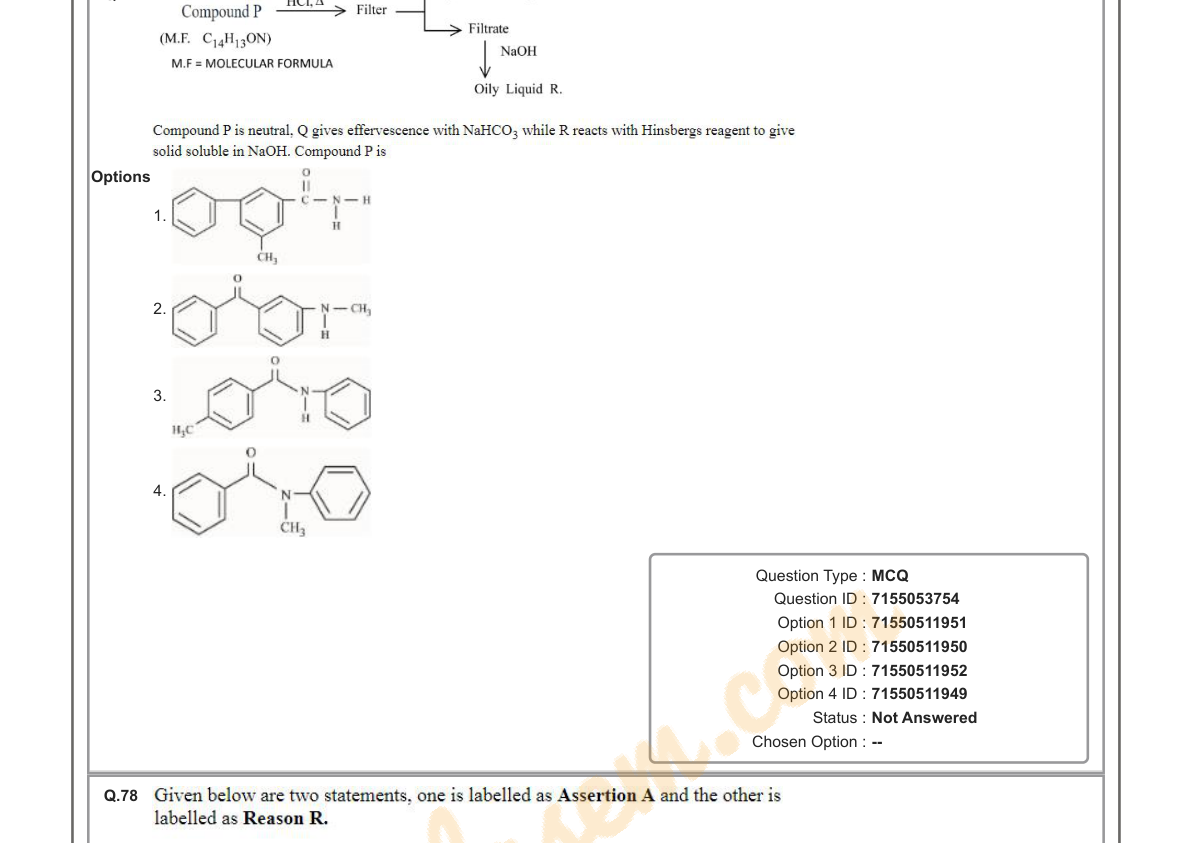
Compound P (M.F. C14H13ON) --(HCl, Delta)--> filter to give Residue Q + Filtrate; Filtrate --(NaOH)--> Oily Liquid R. Compound P is neutral, Q gives effervescence with NaHCO3 while R reacts with Hinsberg's reagent to give solid soluble in NaOH. Compound P is (options are structures)
(1) a methyl-substituted benzamide (C(=O)-NH-)
(2) a benzophenone-type N-methyl amine
(3) 4-methyl-N-phenylbenzamide (H3C-C6H4-C(=O)-NH-C6H5)
(4) N-methyl-N-phenylbenzamide (C6H5-C(=O)-N(CH3)-C6H5)
97. Azo dye mass
seen 2×2024
9.3 g of pure aniline upon diazotisation followed by coupling with phenol gives an orange dye. The mass of orange dye produced (assume 100% yield/conversion) is ________ g. (nearest integer)
Biomolecules
98. Identify correct sugar structure
seen 2×20222025
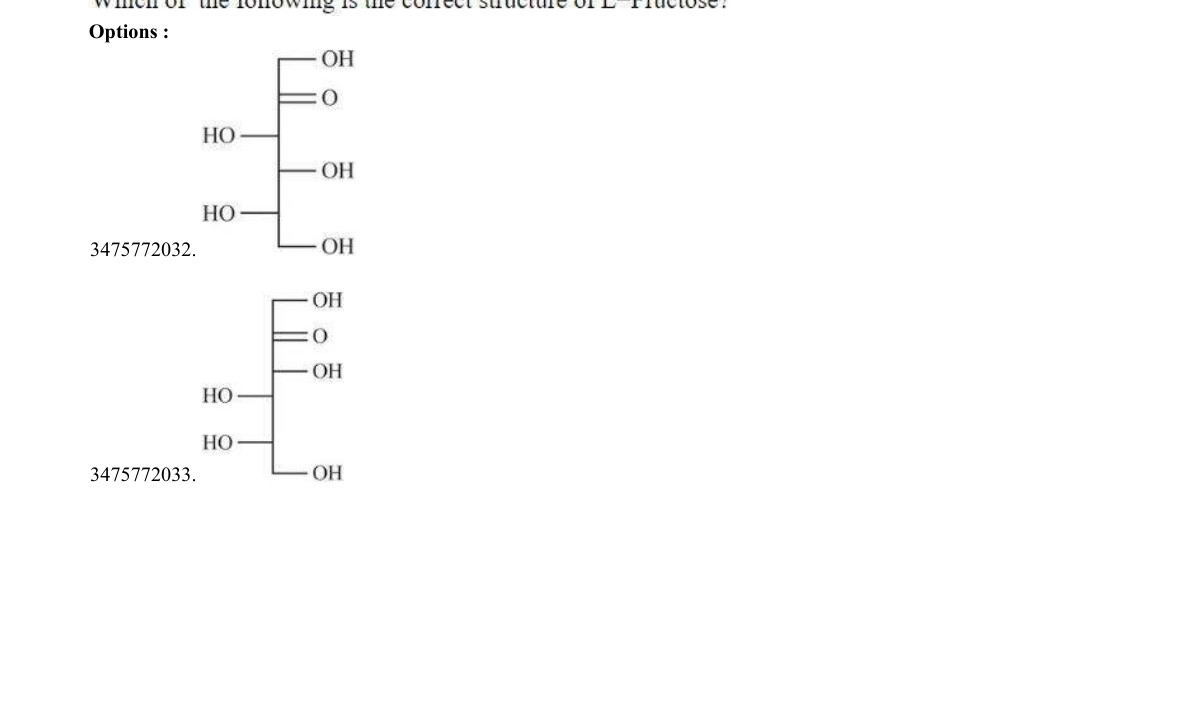
Which of the following is the correct structure of L-Fructose?
Options: (Fischer projections of fructose stereoisomers; L-fructose has the reference -OH on C5 on the left and the correct configuration at all stereocentres)
(1) CH2OH-CO-(HO-)CH-(HO-)CH-(HO-)CH-CH2OH type Fischer projection option 1
(2) Fischer projection option 2
(3) Fischer projection option 3
(4) Fischer projection option 4
99. Enzymes
seen 2×20232024
The incorrect statements regarding enzymes are :
(A) Enzymes are biocatalysts.
(B) Enzymes are non-specific and can catalyse different kinds of reactions.
(C) Most Enzymes are globular proteins.
(D) Enzyme - oxidase catalyses the hydrolysis of maltose into glucose.
Choose the correct answer from the option given below :
(1) (B) and (D)
(2) (B), (C) and (D)
(3) (A), (B) and (C)
(4) (B) and (C)
100. Amino acids from protein hydrolysis
seen 2×20232024
Type of amino acids obtained by hydrolysis of proteins is :
(A) α
(B) β
(C) γ
(D) δ
101. Protein structure stability
seen 2×20222023
The one that does not stabilize 2° and 3° structures of proteins is
(1) H-bonding
(2) van der Waals forces
(3) -O-O- linkage
(4) -S-S- linkage
Principles Related to Practical Chemistry
102. Qualitative salt analysis
seen 7×20242025
Choose the correct tests with respective observations.
(A) CuSO4 (acidified with acetic acid) + K4[Fe(CN)6] -> Chocolate brown precipitate.
(B) FeCl3 + K4[Fe(CN)6] -> Prussian blue precipitate.
(C) ZnCl2 + K4[Fe(CN)6], neutralised with NH4OH -> White or bluish white precipitate.
(D) MgCl2 + K4[Fe(CN)6] -> Blue precipitate.
(E) BaCl2 + K4[Fe(CN)6], neutralised with NaOH -> White precipitate.
Choose the correct answer from the options given below :
(1) A, B and C only
(2) B, D and E only
(3) C, D and E only
(4) A, D and E only
103. Functional group tests
seen 2×20222024
Match List - I with List - II.
List - I (Test) — List - II (Identification)
(A) Bayer's test (I) Phenol
(B) Ceric ammonium nitrate test (II) Aldehyde
(C) Phthalein dye test (III) Alcoholic-OH group
(D) Schiff's test (IV) Unsaturation
Choose the correct answer from the options given below:
(1) (A)-(IV), (B)-(III), (C)-(I), (D)-(II)
(2) (A)-(IV), (B)-(I), (C)-(II), (D)-(III)
(3) (A)-(II), (B)-(III), (C)-(IV), (D)-(I)
(4) (A)-(III), (B)-(I), (C)-(IV), (D)-(II)