JEE Main Guess Paper 2027
A full-length JEE Main practice paper for 2027 — 75 questions across Physics, Chemistry, Mathematics, built from the most-repeated question types in past papers. We refresh it as newer papers are released.
JEE Main — Guess Paper 2027
Time: 180 minutes · 75 questions · Maximum marks: 300 · Practice paper
Physics25 questions · 100 marks
Q1.4 marks
Match the LIST-I with LIST-II
LIST-I: A. Triatomic rigid gas; B. Diatomic non-rigid gas; C. Monoatomic gas; D. Diatomic rigid gas
LIST-II: I. Cp/Cv = 5/3; II. Cp/Cv = 7/5; III. Cp/Cv = 4/3; IV. Cp/Cv = 9/7
Choose the correct answer from the options given below:
(1) A-III, B-II, C-IV, D-I
(2) A-III, B-IV, C-I, D-II
(3) A-II, B-IV, C-I, D-III
(4) A-IV, B-II, C-III, D-I
Why this question: Kinetic Theory of Gases → DOF, equipartition & gamma — seen 7× 2022202320242025
Q2. 4 marks
An element delta l = delta x i-hat is placed at the origin and carries a large current I = 10 A. The magnetic field on the y-axis at a distance of 0.5 m from the element (delta x of 1 cm length) is:
(1) 4x10⁻⁸ T
(2) 8x10⁻⁸ T
(3) 10x10-8 T
(4) 12x10-8 T
Why this question: Magnetic Effects of Current and Magnetism → Biot-Savart loop/arc field — seen 6× 2022202320242025
Q3.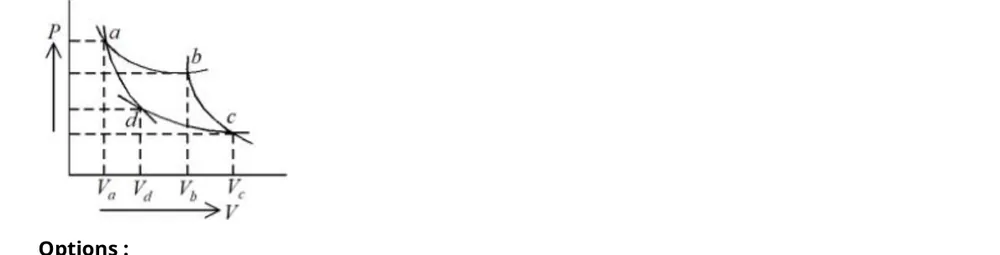 4 marks
Two different adiabatic paths for the same gas intersect two isothermal curves as shown in P-V diagram. The relation between the ratio Va/Vd and the ratio Vb/Vc is:
(1) Va/Vd = Vb/Vc
(2) Va/Vd != Vb/Vc
(3) Va/Vd = (Vb/Vc)^(-1)
(4) Va/Vd = (Vb/Vc)2
Why this question: Thermodynamics → Adiabatic / isothermal processes — seen 6× 2022202320242025
Q4. 4 marks
In the following circuit, the reading of the ammeter will be (Take Zener breakdown voltage = 4 V)
(1) 24 mA
(2) 80 mA
(3) 10 mA
(4) 60 mA
Why this question: Electronic Devices → Zener regulator circuit — seen 5× 2022202320242025
Q5.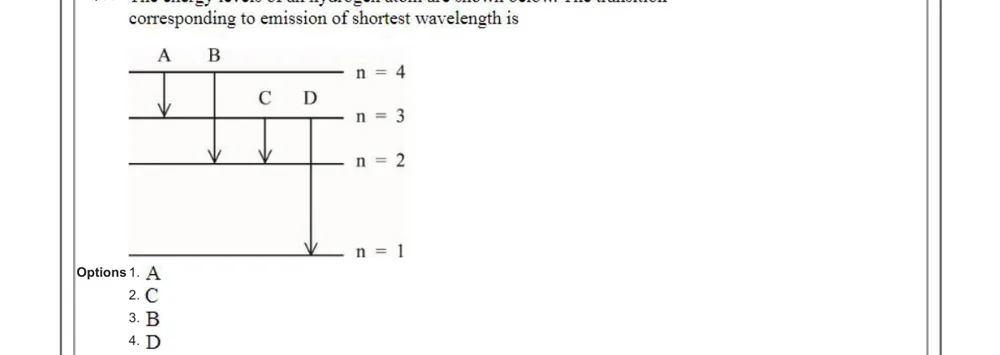 4 marks
The energy levels of an hydrogen atom are shown below (arrows A, B, C, D between levels n = 1, 2, 3, 4). The transition corresponding to emission of shortest wavelength is
(1) A
(2) C
(3) B
(4) D
Why this question: Atoms and Nuclei → Hydrogen spectral wavelengths (Rydberg) — seen 5× 202320242025
Q6.4 marks
Moment of inertia of a rod of mass 'M' and length 'L' about an axis passing through its center and normal to its length is 'alpha'. Now the rod is cut into two equal parts and these parts are joined symmetrically to form a cross shape. Moment of inertia of cross about an axis passing through its center and normal to plane containing cross is :
(1) alpha
(2) alpha/2
(3) alpha/8
(4) alpha/4
Why this question: Rotational Motion → MI of rigid-body systems (parallel axis) — seen 5× 202220232025
Q7.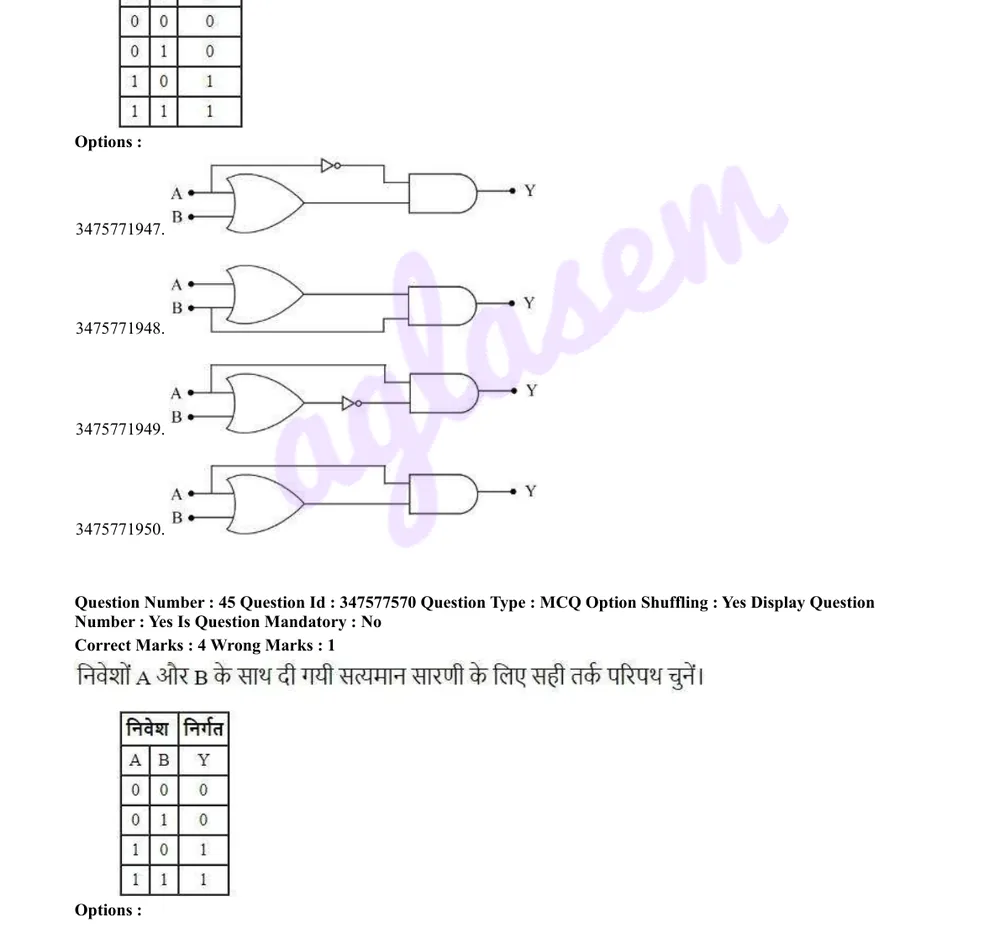 4 marks
Choose the correct logic circuit for the given truth table having inputs A and B.
Truth table (A, B -> Y): 0,0 -> 0 ; 0,1 -> 0 ; 1,0 -> 1 ; 1,1 -> 1
Options: (logic gate circuit diagrams)
(1) A and B into an OR gate, its output inverted (NOT) then fed with A into an AND gate producing Y
(2) A and B into an OR gate whose output feeds an AND gate producing Y
(3) A and B into an OR gate whose output is inverted at the AND gate input, producing Y
(4) A and B into an OR gate whose output feeds an AND gate (with A) producing Y
Why this question: Electronic Devices → Logic gates / truth tables — seen 5× 2022202320242025
Q8.4 marks
Four particles A, B, C, D of mass m/2, m, 2m, 4m, have same momentum, respectively. The particle with maximum kinetic energy is:
(1) A
(2) B
(3) C
(4) D
Why this question: Work, Energy and Power → KE-momentum (p2 = 2mK) problems — seen 5× 20222024
Q9.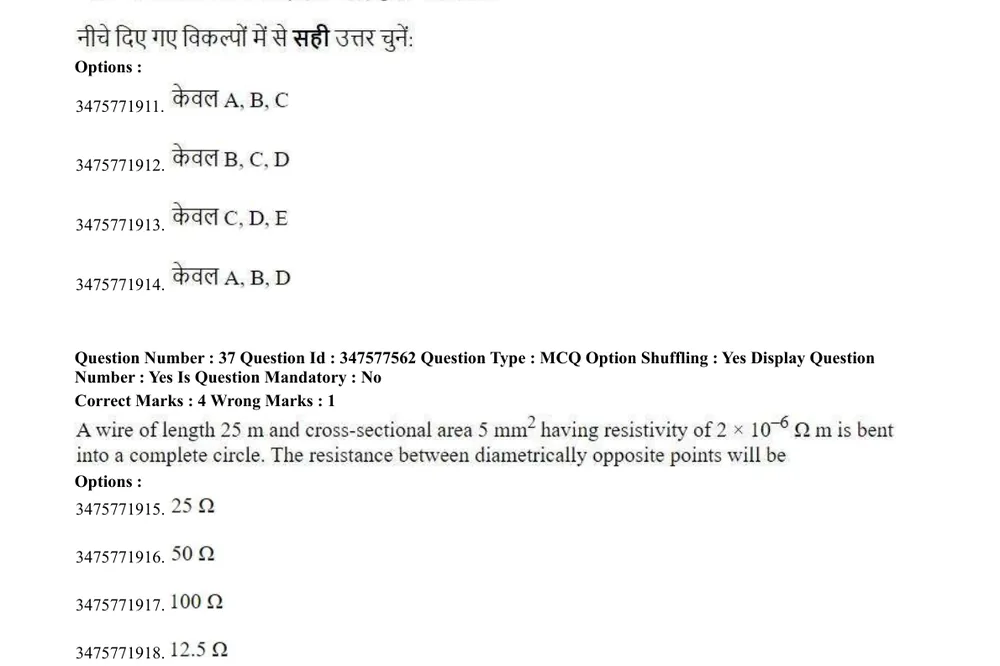 4 marks
A parallel plate capacitor is filled equally (half) with two dielectrics of dielectric constants epsilon1 and epsilon2, as shown in figures. The distance between the plates is d and area of each plate is A. If capacitance in first configuration and second configuration are C1 and C2 respectively, then C1/C2 is: (First Configuration: the two dielectric slabs stacked horizontally one above the other; Second Configuration: the two dielectric slabs placed side by side vertically)
Options:
(1) epsilon0(epsilon1 + epsilon2)/2
(2) 4 epsilon1 epsilon2/(epsilon1 + epsilon2)2
(3) epsilon1 epsilon2/(epsilon1 + epsilon2)
(4) epsilon1 epsilon22/(epsilon1 + epsilon2)2
Why this question: Electrostatics → Dielectric capacitance — seen 5× 2022202320242025
Q10.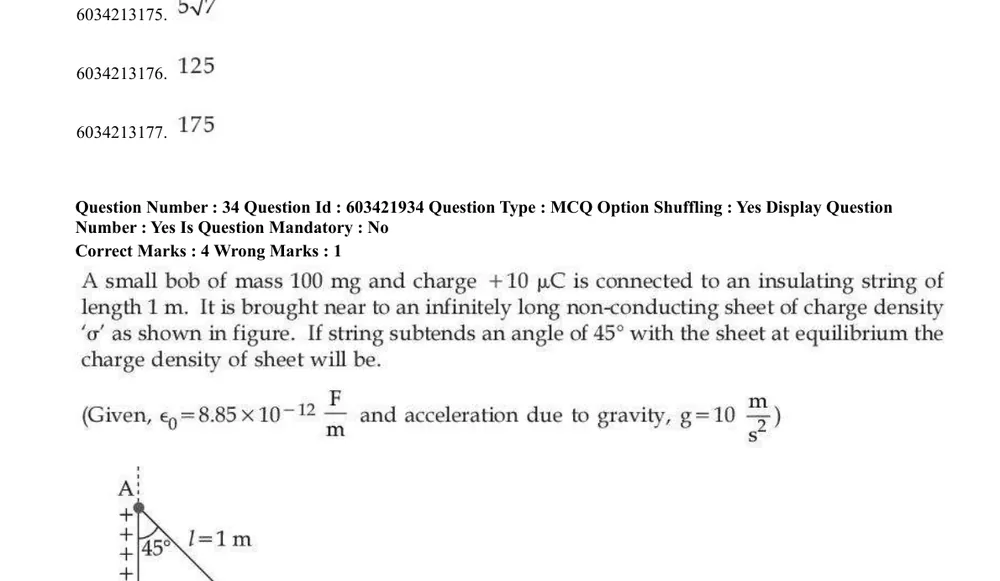 4 marks
A small bob of mass 100 mg and charge +10 microC is connected to an insulating string of length 1 m. It is brought near to an infinitely long non-conducting sheet of charge density 'sigma' as shown in figure. If string subtends an angle of 45 degrees with the sheet at equilibrium the charge density of sheet will be.
(Given, epsilon0 = 8.85*10-12 F/m and acceleration due to gravity, g = 10 m/s2)
(1) 1.77 nC/m2
(2) 0.885 nC/m2
(3) 17.7 nC/m2
(4) 885 nC/m2
Why this question: Electrostatics → Charged sheets field & force — seen 4× 20242025
Q11.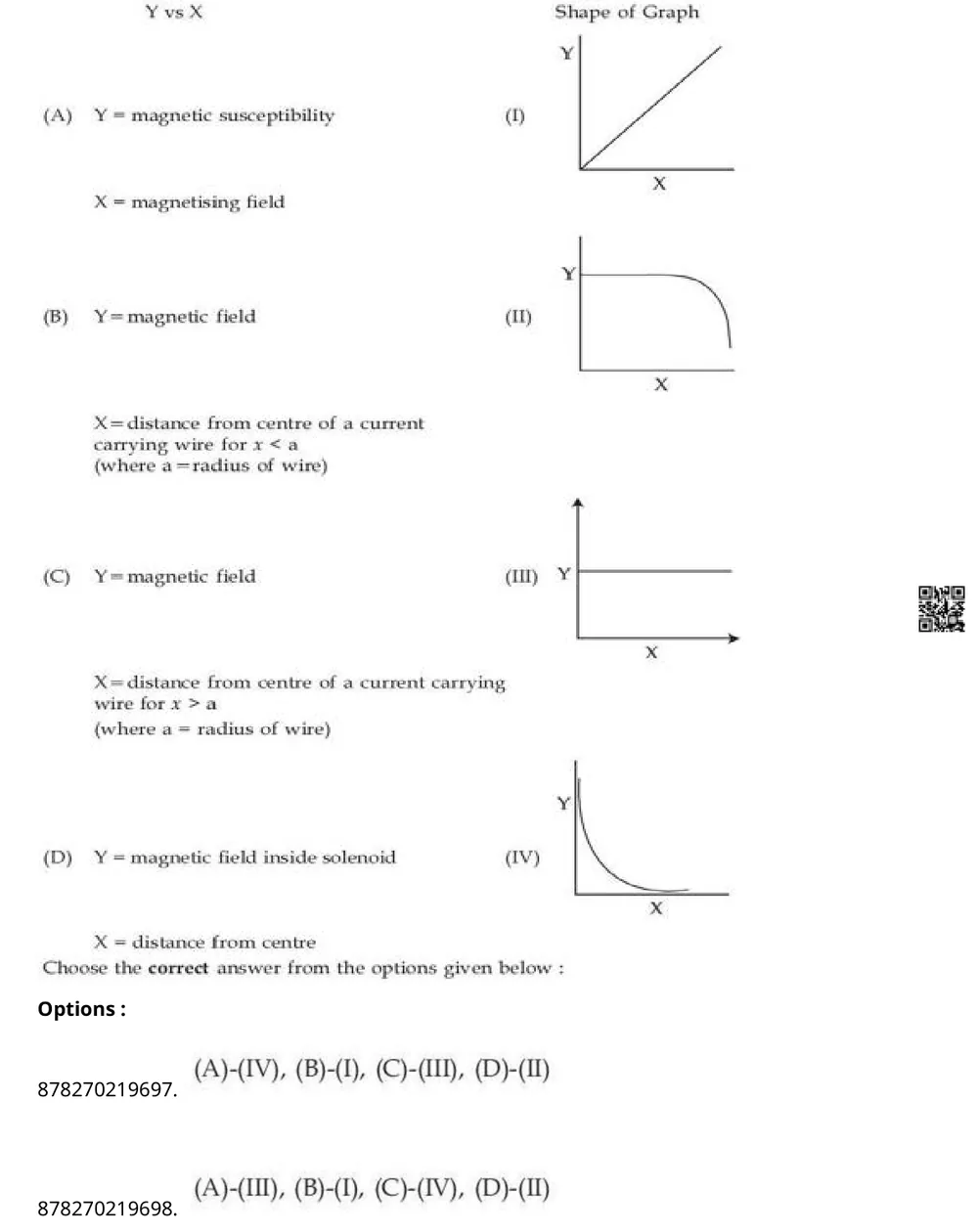 4 marks
Match List-I with List-II :
List-I (Y vs X)
(A) Y = magnetic susceptibility, X = magnetising field
(B) Y = magnetic field, X = distance from centre of a current carrying wire for x < a (where a = radius of wire)
(C) Y = magnetic field, X = distance from centre of a current carrying wire for x > a (where a = radius of wire)
(D) Y = magnetic field inside solenoid, X = distance from centre
List-II (Shape of Graph)
(I) straight line through origin with positive slope
(II) constant then falling curve
(III) horizontal constant line
(IV) decreasing (inverse) curve
Choose the correct answer from the options given below :
(1) (A)-(IV), (B)-(I), (C)-(III), (D)-(II)
(2) (A)-(III), (B)-(I), (C)-(IV), (D)-(II)
(3) (A)-(I), (B)-(III), (C)-(II), (D)-(IV)
(4) (A)-(III), (B)-(IV), (C)-(I), (D)-(II)
Why this question: Magnetic Effects of Current and Magnetism → Susceptibility & permeability — seen 4× 20242025
Q12.4 marks
Match List - I with List - II.
List - I: (A) Coefficient of viscosity (B) Intensity of wave (C) Pressure gradient (D) Compressibility
List - II: (I) [M L0 T-3] (II) [M L-2 T-2] (III) [M-1 L T2] (IV) [M L-1 T-1]
Choose the correct answer from the options given below :
(1) (A)-(IV), (B)-(II), (C)-(I), (D)-(III)
(2) (A)-(II), (B)-(III), (C)-(IV), (D)-(I)
(3) (A)-(I), (B)-(IV), (C)-(III), (D)-(II)
(4) (A)-(IV), (B)-(I), (C)-(II), (D)-(III)
Why this question: Units and Measurements → Match-the-column dimensional formulae — seen 4× 202320242025
Q13.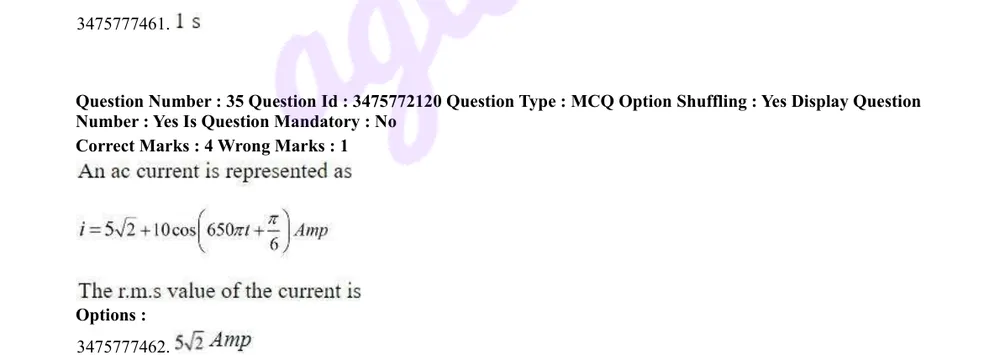 4 marks
A wire of resistance R is bent into a triangular pyramid as shown in figure with each segment having same length. The resistance between points A and B is R/n. The value of n is:
(1) 10
(2) 12
(3) 14
(4) 16
Why this question: Current Electricity → Equivalent resistance of networks — seen 4× 20232025
Q14.4 marks
In series RLC resonator, if the self inductance and capacitance become double, the new resonant frequency (f2) and new quality factor (Q2) will be: (f1 = original resonant frequency, Q1 = original quality factor)
(A) f2 = f1/2 and Q2 = Q1
(B) f2 = f1 and Q2 = Q1/2
(C) f2 = 2f1 and Q2 = Q1
(D) f2 = f1 and Q2 = 2Q1
Why this question: Electromagnetic Induction and Alternating Currents → LCR resonance / Q / bandwidth — seen 5× 202220232024
Q15.4 marks
The work function of a metal is 3 eV. The color of the visible light that is required to cause emission of photoelectrons is.
Options:
(1) Yellow
(2) Green
(3) Red
(4) Blue
Why this question: Dual Nature of Matter and Radiation → Photoelectric equation calculations — seen 4× 202220242025
Q16.4 marks
To find the spring constant (k) of a spring experimentally, a student commits 2% positive error in the measurement of time and 1% negative error in measurement of mass. The percentage error in determining value of k is:
(1) 3%
(2) 5%
(3) 1%
(4) 4%
Why this question: Units and Measurements → Percentage error in a derived quantity — seen 4× 20232024
Q17.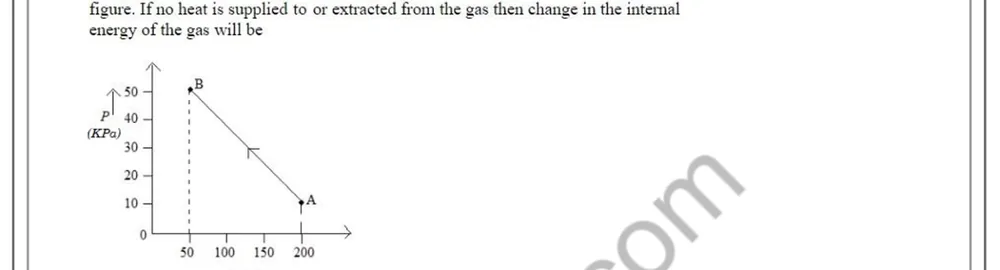 4 marks
The pressure of a gas changes linearly with volume from A to B as shown in figure. If no heat is supplied to or extracted from the gas then change in the internal energy of the gas will be (in the P-V graph, B is at (50 cc, 50 kPa) and A is at (200 cc, 10 kPa)). Options: (1) zero (2) 4.5 J (3) 6 J (4) -4.5 J
Why this question: Thermodynamics → First law Q = dU + W — seen 4× 20232024
Q18.4 marks
Two coherent sources of light interfere. The intensity ratio of two sources is 1 : 4. For this interference pattern if the value of (Imax + Imin)/(Imax - Imin) is equal to (2 alpha + 1)/(beta + 3), then alpha/beta will be :
Option A: 1.5
Option B: 2
Option C: 0.5
Option D: 1
Why this question: Optics → Imax/Imin of two sources — seen 4× 202220242025
Q19.4 marks
Pressure inside a soap bubble is greater than the pressure outside by an amount : (given : R = Radius of bubble, S = Surface tension of bubble)
(1) 2S/R
(2) 4S/R
(3) S/R
(4) 4R/S
Why this question: Properties of Solids and Liquids → Laplace excess pressure (surface tension) — seen 4× 20222024
Q20.4 marks
A sample contains mixture of helium and oxygen gas. The ratio of root mean square speed of helium and oxygen in the sample, is:
(1) 2 sqrt(2) / 1
(2) 1 / (2 sqrt(2))
(3) 1/32
(4) 1/4
Why this question: Kinetic Theory of Gases → RMS speed & temperature — seen 4× 202220232024
Q21.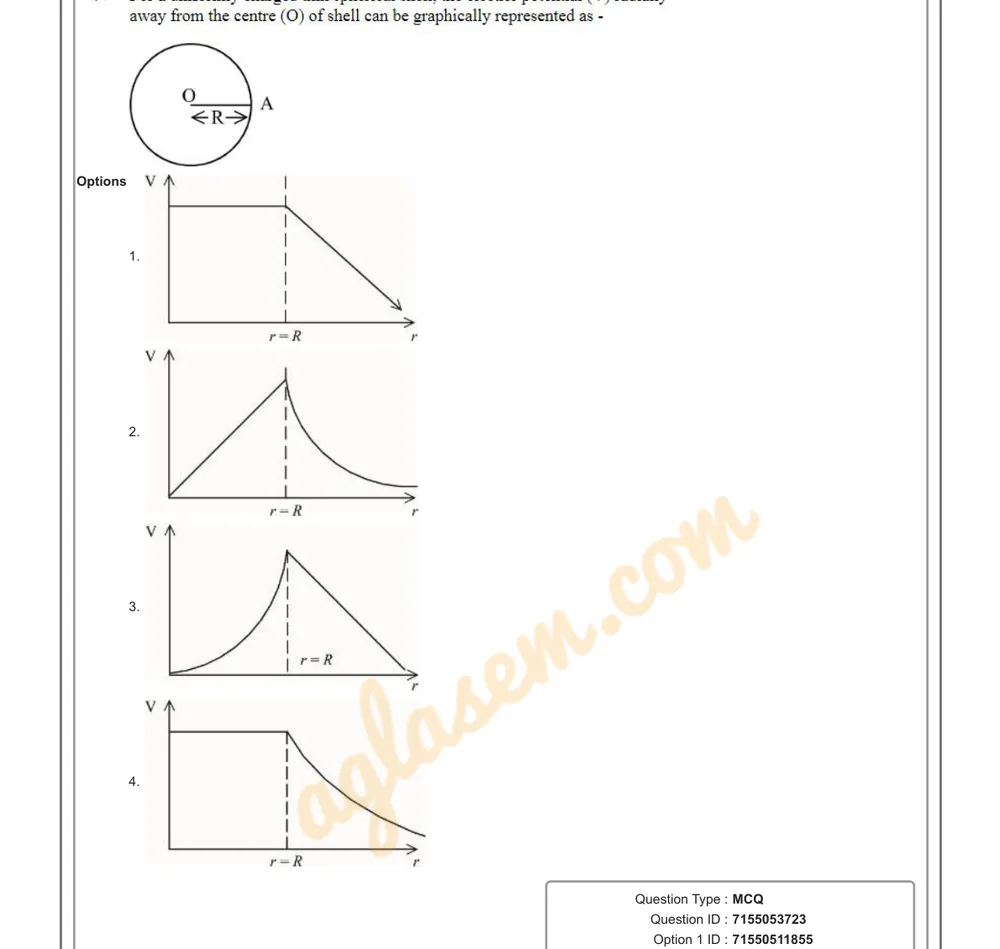 4 marks Numerical
For a uniformly charged thin spherical shell, the electric potential (V) radially away from the centre (O) of shell can be graphically represented as - (options are four V vs r graphs)
(1) V constant for r < R, then decreasing linearly to zero
(2) V rising (concave) to a cusp at r = R, then decaying
(3) V rising to a peak at r = R, then decaying on both sides
(4) V constant for r < R, then decaying as 1/r for r > R
Why this question: Electrostatics → Potential of spherical shell — seen 4× 20232025
Q22.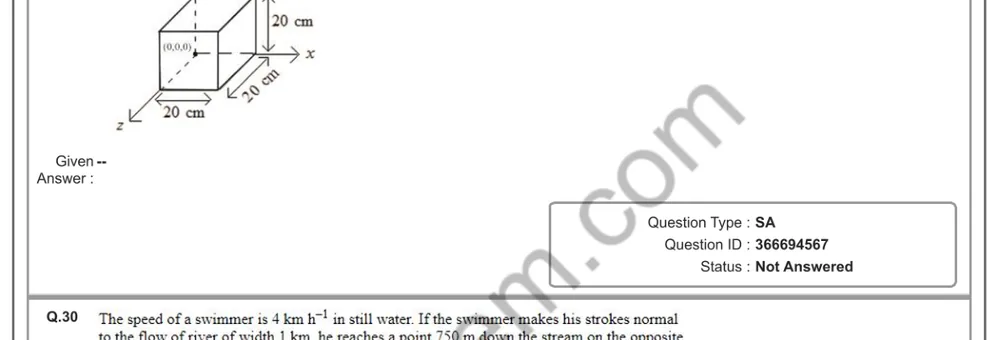 4 marks Numerical
Expression for an electric field is given by E = 4000 x2 i V/m. The electric flux through the cube of side 20 cm when placed in electric field (as shown in the figure) is ______ V cm. (Cube of side 20 cm with one corner at origin (0,0,0).)
Why this question: Electrostatics → Flux & Gauss's law — seen 4× 202220232024
Q23. 4 marks Numerical
A mass m is attached to two strings as shown in figure. The spring constants of two springs are K1 and K2. For the frictionless surface, the time period of oscillation of mass m is
(1) (1/2 pi) sqrt((K1 + K2)/m)
(2) (1/2 pi) sqrt((K1 - K2)/m)
(3) 2 pi sqrt(m/(K1 - K2))
(4) 2 pi sqrt(m/(K1 + K2))
Why this question: Oscillations and Waves → SHM period of spring-connected mass — seen 4× 20222023
Q24. 4 marks Numerical
Two wires each of radius 0.2 cm and negligible mass, one made of steel and the other made of brass are loaded as shown in the figure. The elongation of the steel wire is ____ × 10-6 m. [Young's modulus for steel = 2 × 10¹¹ N m-2 and g = 10 m s-2] (figure: 1.6 m steel wire with 2 kg load, 1 m brass wire with 1.14 kg load)
Why this question: Properties of Solids and Liquids → Elongation/strain/force from Young's modulus — seen 4× 20222023
Q25.4 marks Numerical
Considering Bohr's atomic model for hydrogen atom :
(A) the energy of H atom in ground state is same as energy of He^+ ion in its first excited state.
(B) the energy of H atom in ground state is same as that for Li^++ ion in its second excited state.
(C) the energy of H atom in its ground state is same as that of He^+ ion for its ground state.
(D) the energy of He^+ ion in its first excited state is same as that for Li^++ ion in its ground state.
Choose the correct answer from the options given below :
(1) (A), (B) only
(2) (A), (C) only
(3) (B), (D) only
(4) (A), (D) only
Why this question: Atoms and Nuclei → Bohr energy-level (eV) calculations — seen 3× 20222025
Chemistry25 questions · 100 marks
Q26.4 marks
The metal ions that have the calculated spin-only magnetic moment value of 4.9 B.M. are:
A. Cr2+
B. Fe2+
C. Fe3+
D. Co2+
E. Mn3+
Choose the correct answer from the options given below:
Options:
(1) A, B and E Only
(2) A, D and E Only
(3) B and E Only
(4) A, C and E Only
Why this question: d- and f- Block Elements → Spin-only moment (d-block) — seen 8× 2022202320242025
Q27.4 marks
Choose the correct tests with respective observations.
(A) CuSO4 (acidified with acetic acid) + K4[Fe(CN)6] -> Chocolate brown precipitate.
(B) FeCl3 + K4[Fe(CN)6] -> Prussian blue precipitate.
(C) ZnCl2 + K4[Fe(CN)6], neutralised with NH4OH -> White or bluish white precipitate.
(D) MgCl2 + K4[Fe(CN)6] -> Blue precipitate.
(E) BaCl2 + K4[Fe(CN)6], neutralised with NaOH -> White precipitate.
Choose the correct answer from the options given below :
(1) A, B and C only
(2) B, D and E only
(3) C, D and E only
(4) A, D and E only
Why this question: Principles Related to Practical Chemistry → Qualitative salt analysis — seen 7× 20242025
Q28.4 marks
Given below are two statements :
Statement (I) : In octahedral complexes, when Delta0 < P high spin complexes are formed. When Delta0 > P low spin complexes are formed.
Statement (II) : In tetrahedral complexes because of Deltat < P, low spin complexes are rarely formed.
In the light of the above statements, choose the most appropriate answer from the options given below :
(1) Both Statement I and Statement II are correct
(2) Both Statement I and Statement II are incorrect
(3) Statement I is correct but Statement II is incorrect
(4) Statement I is incorrect but Statement II is correct
Why this question: Coordination Compounds → CFT electron configuration — seen 7× 202320242025
Q29.4 marks
Match List - I with List - II.
List - I (Complex ion) — List - II (Spin only magnetic moment in B.M.)
(A) [Cr(NH3)6]3+ (I) 4.90
(B) [NiCl4]2- (II) 3.87
(C) [CoF6]3- (III) 0.0
(D) [Ni(CN)4]2- (IV) 2.83
Choose the correct answer from the options given below:
(1) (A)-(IV), (B)-(III), (C)-(I), (D)-(II)
(2) (A)-(II), (B)-(IV), (C)-(I), (D)-(III)
(3) (A)-(I), (B)-(IV), (C)-(II), (D)-(III)
(4) (A)-(II), (B)-(III), (C)-(I), (D)-(IV)
Why this question: Coordination Compounds → Spin-only magnetic moment — seen 7× 2022202320242025
Q30.4 marks
The density of 'x' M solution ('x' molar) of NaOH is 1.12 g mL-1, while in molality, the concentration of the solution is 3 m (3 molal). Then x is
(Given: Molar mass of NaOH is 40 g/mol)
(1) 3.5
(2) 3.8
(3) 3.0
(4) 2.8
Why this question: Solutions → Concentration terms — seen 6× 20232024
Q31.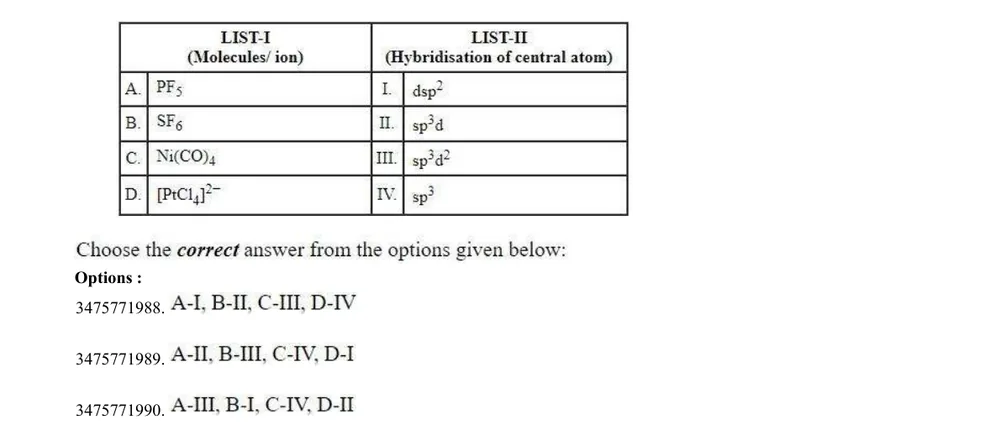 4 marks
Match the LIST-I with LIST-II
LIST-I (Molecules/ion) | LIST-II (Hybridisation of central atom)
A. PF5 | I. dsp2
B. SF6 | II. sp3d
C. Ni(CO)4 | III. sp3d2
D. [PtCl4]2- | IV. sp3
Choose the correct answer from the options given below:
Options:
(1) A-I, B-II, C-III, D-IV
(2) A-II, B-III, C-IV, D-I
(3) A-III, B-I, C-IV, D-II
(4) A-IV, B-I, C-II, D-III
Why this question: Chemical Bonding and Molecular Structure → Hybridisation of centre — seen 5× 20242025
Q32.4 marks
On complete combustion 1.0 g of an organic compound (X) gave 1.46 g of CO2 and 0.567 g of H2O. The empirical formula mass of compound (X) is ______ g.
(Given molar mass in g mol-1 C : 12, H : 1, O : 16)
(1) 15
(2) 30
(3) 45
(4) 60
Why this question: Purification and Characterisation of Organic Compounds → Combustion estimation — seen 5× 202220232025
Q33.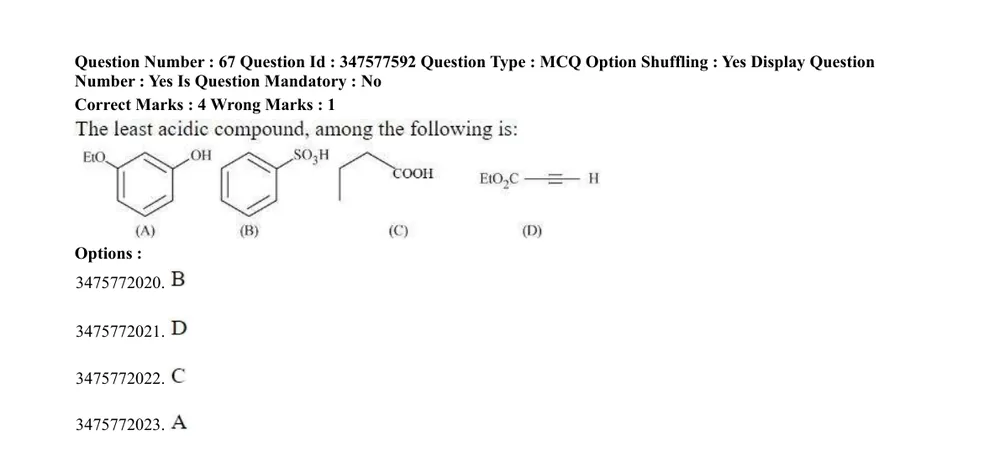 4 marks
The least acidic compound, among the following is:
(A) 3-ethoxyphenol (EtO-C6H4-OH)
(B) benzenesulfonic acid (C6H5-SO3H)
(C) butanoic acid (CH3CH2CH2-COOH)
(D) ethyl propiolate (EtO2C-C(triple bond)C-H, a terminal alkyne ester)
Options:
(1) B
(2) D
(3) C
(4) A
Why this question: Organic Compounds Containing Oxygen → Acidity order — seen 5× 202220242025
Q34.4 marks
Match the LIST-I with LIST-II
LIST-I (Molecule / ion): A. ICl2^-; B. H2O; C. SO2; D. XeF4
LIST-II (Bond pair : lone pair on the central atom): I. 4 : 2; II. 4 : 1; III. 2 : 3; IV. 2 : 2
Choose the correct answer from the options given below:
(1) A-III, B-IV, C-I, D-II
(2) A-IV, B-III, C-II, D-I
(3) A-III, B-IV, C-II, D-I
(4) A-II, B-I, C-IV, D-III
Why this question: Chemical Bonding and Molecular Structure → VSEPR shape matching — seen 5× 202320242025
Q35.4 marks
At -20 degrees C and 1 atm pressure, a cylinder is filled with equal number of H2, I2 and HI molecules for the reaction H2(g) + I2(g) <=> 2HI(g), the Kp for the process is x x 10-1. x = ________.
[Given: R = 0.082 L atm K-1 mol-1]
(1) 1
(2) 10
(3) 0.01
(4) 2
Why this question: Equilibrium → Kp / Kc relation — seen 5× 202320242025
Q36.4 marks
The emf of cell Tl | Tl^+ (0.001M) || Cu2+ (0.01M) | Cu is 0.83 V at 298 K. It could be increased by:
(1) increasing concentration of Tl^+ ions
(2) increasing concentration of Cu2+ ions
(3) increasing concentration of both Tl^+ and Cu2+ ions
(4) decreasing concentration of both Tl^+ and Cu2+ ions
Why this question: Redox Reactions and Electrochemistry → Nernst / cell EMF — seen 5× 2022202320242025
Q37.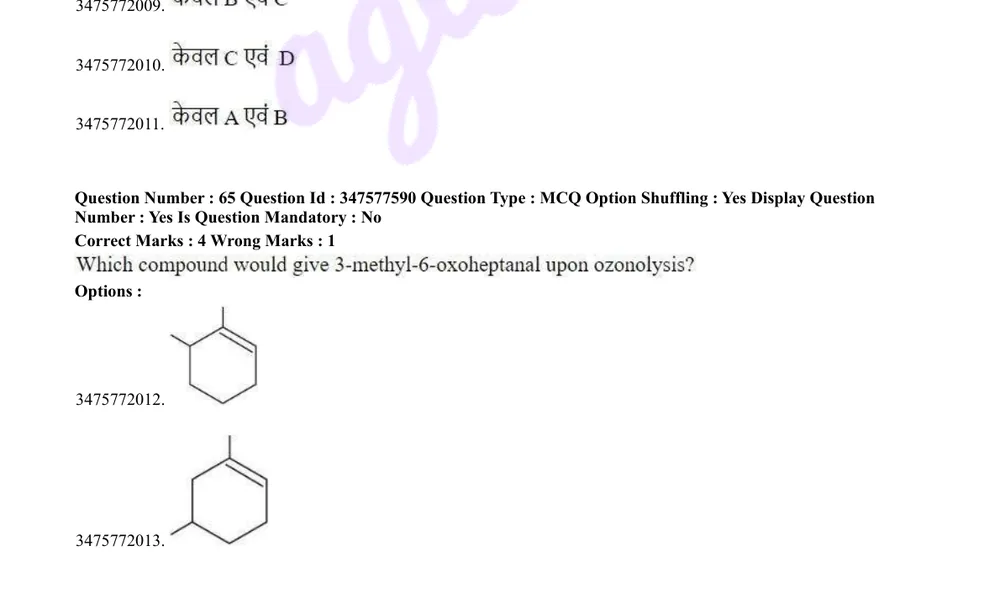 4 marks
Which compound would give 3-methyl-6-oxoheptanal upon ozonolysis?
Options: (four cyclohexene structures bearing methyl substituents at different ring positions; select the alkene whose reductive ozonolysis of the ring C=C yields 3-methyl-6-oxoheptanal)
(1) 1,6-dimethylcyclohexene
(2) 1-methyl-4-methylcyclohexene (1-methyl, methyl at position 4/5)
(3) 1,4-dimethylcyclohexene
(4) 1,3-dimethylcyclohexene
Why this question: Hydrocarbons → Ozonolysis of alkenes — seen 5× 202220242025
Q38.4 marks
In a reaction A + B -> C, initial concentrations of A and B are related as [A]0 = 8[B]0. The half lives of A and B are 10 min and 40 min, respectively. If they start to disappear at the same time, both following first order kinetics, after how much time will the concentration of both the reactants be same?
Options:
(1) 20 min
(2) 40 min
(3) 60 min
(4) 80 min
Why this question: Chemical Kinetics → First-order half-life calc — seen 5× 202220242025
Q39.4 marks
Given below are two statements:
Statement (I): Fusion of MnO2 with KOH and an oxidising agent gives dark green K2MnO4.
Statement (II): Manganate ion on electrolytic oxidation in alkaline medium gives permanganate ion.
In the light of the above statements, choose the correct answer from the options given below:
(1) Both Statement I and Statement II are true
(2) Both Statement I and Statement II are false
(3) Statement I is true but Statement II is false
(4) Statement I is false but Statement II is true
Why this question: d- and f- Block Elements → KMnO4 chemistry — seen 5× 20222024
Q40.4 marks
In the depression of freezing point experiment A. Vapour pressure of the solution is less than that of pure solvent B. Vapour pressure of the solution is more than that of pure solvent C. Only solute molecules solidify at the freezing point D. Only solvent molecules solidify at the freezing point. Choose the most appropriate answer from the options given below: Options: 1) B and C only 2) A and D only 3) A and C only 4) A only
Why this question: Solutions → Freezing-point depression — seen 5× 202220232024
Q41.4 marks
Correct order of limiting molar conductivity for cations in water at 298 K is:
Options:
(1) Mg2+ > H^+ > Ca2+ > K^+ > Na^+
(2) H^+ > Na^+ > K^+ > Ca2+ > Mg2+
(3) H^+ > Na^+ > Ca2+ > Mg2+ > K^+
(4) H^+ > Ca2+ > Mg2+ > K^+ > Na^+
Why this question: Redox Reactions and Electrochemistry → Molar conductivity — seen 4× 202220242025
Q42.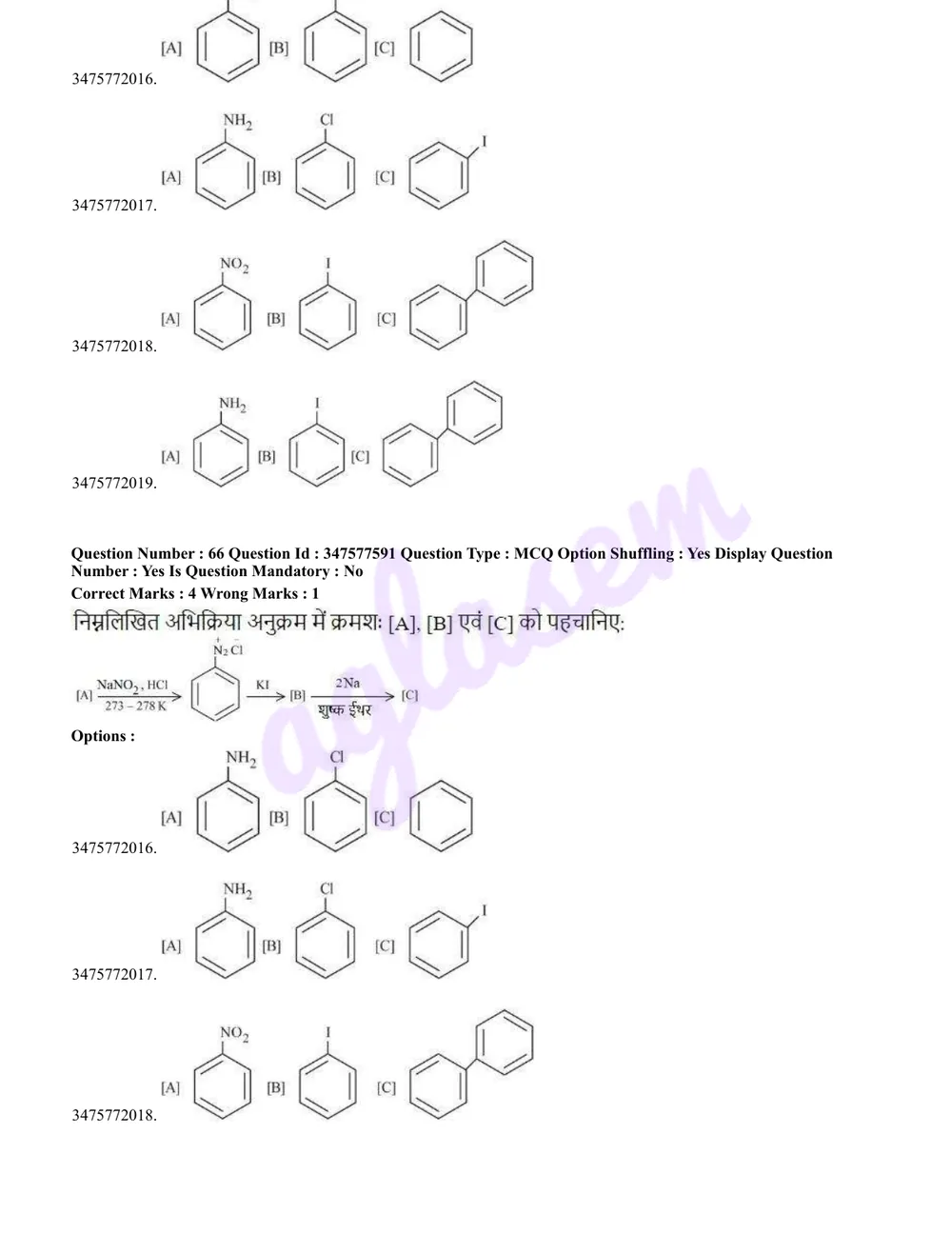 4 marks
Identify [A], [B] and [C], respectively in the following reaction sequence:
[A] --NaNO2, HCl (273-278 K)--> C6H5-N2^+Cl^- (benzenediazonium chloride) --KI--> [B] --2Na / Dry ether--> [C]
Options:
(1) [A] aniline (C6H5NH2), [B] chlorobenzene (C6H5Cl), [C] benzene (C6H6)
(2) [A] aniline (C6H5NH2), [B] chlorobenzene (C6H5Cl), [C] iodobenzene (C6H5I)
(3) [A] nitrobenzene (C6H5NO2), [B] iodobenzene (C6H5I), [C] biphenyl (C6H5-C6H5)
(4) [A] aniline (C6H5NH2), [B] iodobenzene (C6H5I), [C] biphenyl (C6H5-C6H5)
Why this question: Organic Compounds Containing Nitrogen → Diazonium salt reactions — seen 4× 202220242025
Q43.4 marks
Given
(A) 2CO(g) + O2(g) -> 2CO2(g), ΔH1° = -x kJ mol-1
(B) C(graphite) + O2(g) -> CO2(g), ΔH2° = -y kJ mol-1
The ΔH° for the reaction C(graphite) + 1/2 O2(g) -> CO(g) is
(1) (2x - y)/2
(2) (x + 2y)/2
(3) (x - 2y)/2
(4) 2y - x
Why this question: Chemical Thermodynamics → Hess's law / enthalpy — seen 4× 202220232025
Q44.4 marks
An aqueous solution of HCl with pH 1.0 is diluted by adding equal volume of water (ignoring dissociation of water). The pH of HCl solution would (Given log 2 = 0.30)
(1) remain same
(2) reduce to 0.5
(3) increase to 2
(4) increase to 1.3
Why this question: Equilibrium → pH / ionic equilibrium — seen 4× 202220232025
Q45.4 marks
CaCO3(s) + 2HCl(aq) -> CaCl2(aq) + CO2(g) + H2O(l)
Consider the above reaction, what mass of CaCl2 will be formed if 250 mL of 0.76 M HCl reacts with 1000 g of CaCO3 ?
(Given : Molar mass of Ca, C, O, H and Cl are 40, 12, 16, 1 and 35.5 g mol-1, respectively)
(1) 5.272 g
(2) 2.636 g
(3) 3.908 g
(4) 10.545 g
Why this question: Some Basic Concepts in Chemistry → Limiting reagent — seen 4× 202220232025
Q46.4 marks Numerical
Number of compounds with one lone pair of electrons on central atom amongst following is ______ .
O3, H2O, SF4, ClF3, NH3, BrF5, XeF4
Why this question: Chemical Bonding and Molecular Structure → VSEPR feature counting — seen 5× 202220232024
Q47.4 marks Numerical
For a reaction taking place in three steps at same temperature, overall rate constant K = (K1 K2)/K3. If Ea1, Ea2 and Ea3 are 40, 50 and 60 kJ/mol respectively, the overall Ea is ______ kJ/mol.
Why this question: Chemical Kinetics → Arrhenius equation — seen 5× 202220232024
Q48.4 marks Numerical
Number of molecules having bond order 2 from the following molecules is _______. C2, O2, Be2, Li2, Ne2, N2, He2
Why this question: Chemical Bonding and Molecular Structure → MOT species counting — seen 4× 20222024
Q49.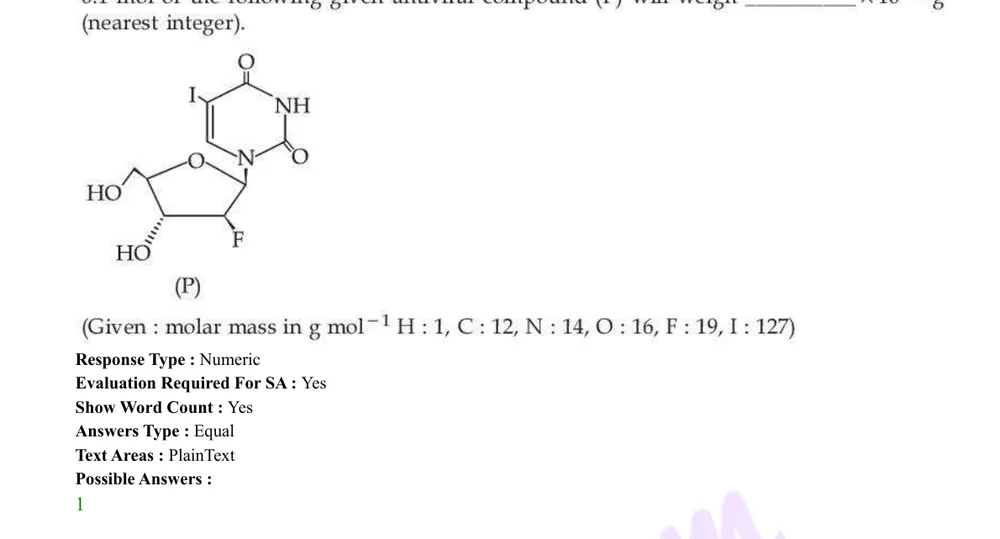 4 marks Numerical
0.1 mol of the given antiviral compound (P) will weigh ______ *10-1 g (nearest integer). Compound P is an iodinated, fluorinated pyrimidine nucleoside (a uracil base bearing an iodine, N-linked to a deoxyribose-type sugar ring carrying two OH groups and a ring F substituent) as shown.
(Given : molar mass in g mol-1 H : 1, C : 12, N : 14, O : 16, F : 19, I : 127)
Why this question: Some Basic Concepts in Chemistry → % composition / molar mass — seen 3× 20232025
Q50.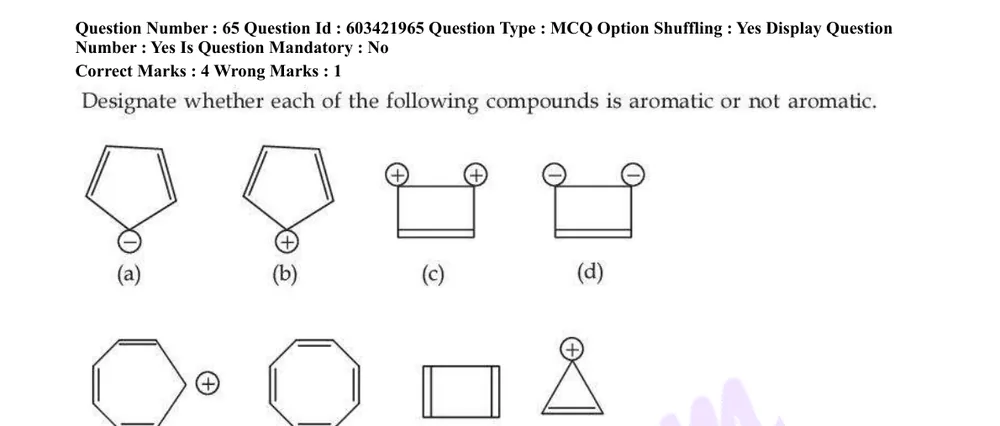 4 marks Numerical
Designate whether each of the following compounds is aromatic or not aromatic. The structures shown are: (a) cyclopentadienyl anion, (b) cyclopentadienyl cation, (c) cyclobutadiene dication, (d) cyclobutadiene dianion, (e) cycloheptatrienyl (tropylium) cation, (f) cyclooctatetraene, (g) cyclobutadiene, (h) cyclopropenyl cation.
(1) b, e, f, g aromatic and a, c, d, h not aromatic
(2) a, c, d, e, h aromatic and b, f, g not aromatic
(3) a, b, c, d aromatic and e, f, g, h not aromatic
(4) e, g aromatic and a, b, c, d, f, h not aromatic
Why this question: Hydrocarbons → Aromaticity / Huckel — seen 3× 20242025
Mathematics25 questions · 100 marks
Q51.4 marks
Let the shortest distance between the lines (x - 3)/3 = (y - alpha)/(-1) = (z - 3)/1 and (x + 3)/(-3) = (y + 7)/2 = (z - beta)/4 be 3 sqrt(30). Then the positive value of 5 alpha + beta is (1) 40 (2) 42 (3) 46 (4) 48
Why this question: Three Dimensional Geometry → Shortest distance between skew lines — seen 11× 2022202320242025
Q52.4 marks
If the system of linear equations
3x + y + beta*z = 3
2x + alpha*y - z = -3
x + 2y + z = 4
has infinitely many solutions, then the value of 22*beta - 9*alpha is :
(1) 49
(2) 43
(3) 37
(4) 31
Why this question: Matrices and Determinants → System of linear equations — seen 10× 2022202320242025
Q53.4 marks
Let a belongs to R and A be a matrix of order 3x3 such that det(A) = -4 and A + I = [[1, a, 1], [2, 1, 0], [a, 1, 2]], where I is the identity matrix of order 3x3. If det((a + 1)*adj((a - 1)*A)) is 2m * 3n, m, n belongs to {0, 1, 2, ..., 20}, then m + n is equal to :
(1) 14
(2) 15
(3) 16
(4) 17
Why this question: Matrices and Determinants → Determinant & adjoint properties — seen 8× 2022202320242025
Q54.4 marks
Let y = y(x) be the solution curve of the differential equation x(x2 + ex) dy + (ex (x - 2) y - x3) dx = 0, x > 0, passing through the point (1, 0). Then y(2) is equal to
(1) 4/(4 - e2)
(2) 2/(2 - e2)
(3) 4/(4 + e2)
(4) 2/(2 + e2)
Why this question: Differential Equations → Linear ODE (integrating factor) — seen 7× 2022202320242025
Q55.4 marks
If the area of the region bounded by the curves y = 4 - x2/4 and y = (x - 4)/2 is equal to alpha, then 6 alpha equals
(1) 210
(2) 220
(3) 240
(4) 250
Why this question: Integral Calculus → Area between curve and line — seen 7× 2022202320242025
Q56.4 marks
Let the vertices Q and R of the triangle PQR lie on the line (x + 3)/5 = (y - 1)/2 = (z + 4)/3, QR = 5 and the coordinates of the point P be (0, 2, 3). If the area of the triangle PQR is m/n then :
(1) 5*m - 21*sqrt(2)*n = 0
(2) 5*m - 2*sqrt(21)*n = 0
(3) m - 5*sqrt(21)*n = 0
(4) 2*m - 5*sqrt(21)*n = 0
Why this question: Three Dimensional Geometry → Foot of perpendicular to a line (3D) — seen 6× 202220242025
Q57.4 marks
Let z be a complex number such that |z| = 1. If (2 + k2*z)/(k + zbar) = k*z, k belongs to R, then the maximum distance of k + i*k2 from the circle |z - (1 + 2i)| = 1 is :
(1) sqrt(3) + 1
(2) 2
(3) sqrt(5) + 1
(4) 3
Why this question: Complex Numbers and Quadratic Equations → Complex locus & distance — seen 6× 2022202320242025
Q58.4 marks
Let A be the set of all functions f: Z -> Z and R be a relation on A such that R = {(f, g) : f(0) = g(1) and f(1) = g(0)}. Then R is :
(1) Reflexive but neither symmetric nor transitive
(2) Symmetric but neither reflexive nor transitive
(3) Transitive but neither reflexive nor symmetric
(4) Symmetric and transitive but not reflexive
Why this question: Sets, Relations and Functions → Relation properties — seen 6× 2022202320242025
Q59.4 marks
The value of integral from -1 to 1 of [ (1 + sqrt(|x| - x)) ex + (sqrt(|x| - x)) e^(-x) ] / (ex + e^(-x)) dx is equal to (1) 2 + 2 sqrt(2)/3 (2) 3 - 2 sqrt(2)/3 (3) 1 - 2 sqrt(2)/3 (4) 1 + 2 sqrt(2)/3
Why this question: Integral Calculus → Definite integral by symmetry (King) — seen 5× 2022202320242025
Q60.4 marks
Let f, g : (1, infinity) -> R be defined as f(x) = (2x + 3)/(5x + 2) and g(x) = (2 - 3x)/(1 - x). If the range of the function fog : [2, 4] -> R is [alpha, beta], then 1/(beta - alpha) is equal to (1) 2 (2) 29 (3) 56 (4) 68
Why this question: Sets, Relations and Functions → Range of a function — seen 5× 202320242025
Q61.4 marks
Let vector a = 4i - j + k, vector b = 11i - j + k and vector c be a vector such that (a + b) x c = c x (-2a + 3b). If (2a + 3b) . c = 1670, then |c|2 is equal to :
(1) 1609
(2) 1600
(3) 1618
(4) 1627
Why this question: Vector Algebra → Solve for unknown vector — seen 5× 202220232024
Q62.4 marks
In an increasing geometric progression of positive terms, the sum of the second and sixth terms is 70/3 and the product of the third and fifth terms is 49. Then the sum of the 4th, 6th and 8th terms is equal to :
(1) 78
(2) 84
(3) 91
(4) 96
Why this question: Sequence and Series → Determine a GP — seen 5× 20232024
Q63.4 marks
Let Pn = alphan + betan, n belongs to N. If P10 = 123, P9 = 76, P8 = 47 and P1 = 1, then the quadratic equation having roots 1/alpha and 1/beta is :
(1) x2 - x + 1 = 0
(2) x2 + x - 1 = 0
(3) x2 - x - 1 = 0
(4) x2 + x + 1 = 0
Why this question: Complex Numbers and Quadratic Equations → Power sums of roots (recurrence) — seen 4× 20242025
Q64.4 marks
limx->0^+ [tan(5 (x)^(1/3)) loge(1 + 3x2)] / [(tan-1(3 sqrt(x)))2 (e^(5 (x)^(4/3)) - 1)] is equal to
(1) 1
(2) 1/3
(3) 5/3
(4) 1/15
Why this question: Limit, Continuity and Differentiability → Standard limit evaluation — seen 4× 202220242025
Q65.4 marks
Let y = y(x) be the solution of the differential equation (1 + y2) e^(tan x) dx + cos2 x (1 + e^(2 tan x)) dy = 0, y(0) = 1. Then y(pi/4) is equal to
(1) 1/e2
(2) 1/e
(3) 2/e
(4) 2/e2
Why this question: Differential Equations → Variable-separable ODE — seen 4× 20222024
Q66.4 marks
If the function f(x) = 2*x3 - 9*a*x2 + 12*a2*x + 1, where a > 0, attains its local maximum and local minimum values at p and q, respectively, such that p2 = q, then f(3) is equal to :
(1) 37
(2) 55
(3) 10
(4) 23
Why this question: Limit, Continuity and Differentiability → Local extrema of a cubic — seen 4× 202220242025
Q67.4 marks
The term independent of x in the expansion of ((x + 1)/(x2/3 + 1 - x1/3) - (x - 1)/(x - x1/2))10, x > 1, is :
(1) 150
(2) 210
(3) 120
(4) 240
Why this question: Binomial Theorem and Its Simple Applications → Term independent of x — seen 4× 202220242025
Q68.4 marks
Considering the principal values of the inverse trigonometric functions, sin-1( (sqrt(3)/2) x + (1/2) sqrt(1 - x2) ), -1/2 < x < 1/sqrt(2), is equal to (1) pi/4 + sin-1 x (2) pi/6 + sin-1 x (3) 5pi/6 - sin-1 x (4) -5pi/6 - sin-1 x
Why this question: Trigonometry → Evaluate inverse-trig expression — seen 4× 202220232025
Q69.4 marks
If all the words with or without meaning made using all the letters of the word "NAGPUR" are arranged as in a dictionary, then the word at 315th position in this arrangement is :
(1) NRAGPU
(2) NRAPGU
(3) NRAGUP
(4) NRAPUG
Why this question: Permutations and Combinations → Dictionary rank — seen 4× 202220232024
Q70.4 marks
A company has two plants A and B to manufacture motorcycles. 60% motorcycles are manufactured at plant A and the remaining are manufactured at plant B. 80% of the motorcycles manufactured at plant A are rated of the standard quality, while 90% of the motorcycles manufactured at plant B are rated of the standard quality. A motorcycle picked up randomly from the total production is found to be of the standard quality. If p is the probability that it was manufactured at plant B, then 126p is
(1) 56
(2) 64
(3) 66
(4) 54
Why this question: Statistics and Probability → Bayes' theorem — seen 4× 202220232024
Q71.4 marks Numerical
Let m and n be the number of points at which the function f(x) = max{ x, x3, x5, ..., x21 }, x in R, is not differentiable and not continuous, respectively. Then m + n is equal to ______
Why this question: Limit, Continuity and Differentiability → Count non-diff/discontinuity points — seen 6× 2022202320242025
Q72.4 marks Numerical
Let A = [[alpha, -1], [6, beta]], alpha > 0, such that det(A) = 0 and alpha + beta = 1. If I denotes 2x2 identity matrix, then the matrix (I + A)8 is :
(1) [[4, -1], [6, -1]]
(2) [[257, -64], [514, -127]]
(3) [[766, -255], [1530, -509]]
(4) [[1025, -511], [2024, -1024]]
Why this question: Matrices and Determinants → Powers of a matrix / trace — seen 5× 2022202320242025
Q73.4 marks Numerical
If the area of the region {(x, y): |4 - x2| <= y <= x2, y <= 4, x >= 0} is (80*sqrt(2)/alpha - beta), alpha, beta belongs to N, then alpha + beta is equal to ______.
Why this question: Integral Calculus → Area with modulus/min-max curves — seen 5× 2022202320242025
Q74.4 marks Numerical
Let [.] denote the greatest integer function. If integral from 0 to e3 of [1/ex-1] dx = alpha - loge(2), then alpha3 is equal to ______.
Why this question: Integral Calculus → Integral of GIF/modulus function — seen 5× 2022202320242025
Q75.4 marks Numerical
The number of relations on the set A = {1, 2, 3}, containing at most 6 elements including (1, 2), which are reflexive and transitive but not symmetric, is ______
Why this question: Sets, Relations and Functions → Counting relations/elements — seen 4× 202320242025