ISC Class 12 Sociology Guess Paper 2027
Last updated:
A full practice paper on the official Sociology pattern, built from the most-likely questions by repetition analysis. Not an official or leaked paper.
ISC Class 12 Sociology — Guess Paper 2027
Time: 3 hours · Maximum marks: 70 · Practice paper
Section ACompulsory. Question 1 has fourteen sub-parts of one mark each: multiple-choice questions (including assertion-reason and scenario/statement-selection items) followed by very-short-answer questions (identify, define, analogy, state one). No internal choice.
Q1.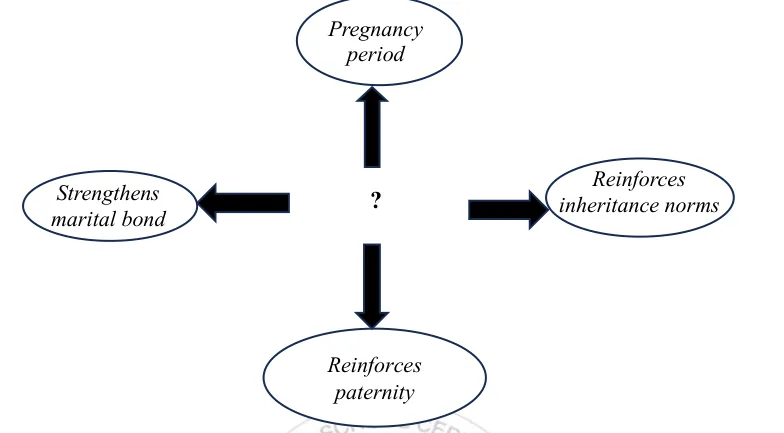 1 mark
[flowchart: '?' at the centre with arrows to 'Pregnancy period', 'Strengthens marital bond', 'Reinforces inheritance norms' and 'Reinforces paternity']
The flowchart above represents different aspects of:
(a) Amitate
(b) Couvade
(c) Avunculate
(d) Teknonymy
Why this question: Social Institutions and Kinship → Identify the kinship usage from a description or scenario (MCQ) — appeared 6× Board 2023Board 2024Board 2025Sample 2025Sample 2026Sample 2027
Q2.1 mark
Rita a qualified engineer from an upper-middle class family, chose to marry Srikant, a skilled electrician from a lower socio-economic group. Rita's relatives criticised her decision arguing that such a marriage would lower her family's prestige and social balance.
Choose the correct statements that explain the motivation for Rita's decision.
(P) She exercised her individual choice.
(Q) She was influenced by caste endogamy.
(R) Her decision was influenced by social movements.
(S) Her basis for selecting her spouse was 'shared understanding' among other factors.
(a) Only (P) and (Q)
(b) Only (P) and (S)
(c) Only (Q) and (R)
(d) Only (R) and (S)
Why this question: Marriage → Hypergamy and hypogamy: identify from a scenario — appeared 3× Board 2024Sample 2023Sample 2027
Q3.1 mark
The Rabaris are an indigenous tribe of nomadic cattle and camel herders and shepherds that live throughout northwest India. Moving mainly through the regions of Rajasthan and Gujarat, they go back to their village once a year and make their living by selling milk.
Which type of economic activity does the Rabari tribe engage in for a living?
(a) Shifting axe cultivation
(b) Food gathering
(c) Pastoralism
(d) Handicrafts
Why this question: Economic Organisation → Economies of Indian tribes (food gathering, pastoralism, handicrafts) (MCQ) — appeared 2× Sample 2025Sample 2026
Q4.1 mark
Mahi lives in a communal residence with other young members of her tribe. Her village also has similar communal residences for widows and widowers. All the members residing there learn about their tribal practices and are inducted into the tribal way of life. This communal residence imparts a knowledge of tribal values and culture to the youth.
Choose the correct statements that describe the residence that Mahi inhabits.
(P) Mahi lives in a joint family.
(Q) She lives in a dormitory.
(R) She inhabits Avunculocal residence.
(S) It acts as a centre for socialisation and education of the youth.
(a) Only (P) and (Q)
(b) Only (Q) and (R)
(c) Only (R) and (S)
(d) Only (Q) and (S)
Why this question: Tribal India → Dormitories: identify and explain their functions (MCQ) — appeared 2× Sample 2025Sample 2026
Q5.1 mark
Ravi lost his wife Seema after two years of marriage. He married Seema's younger sister Suman. What is this rule of marriage known as?
(a) Levirate
(b) Hypogamy
(c) Hypergamy
(d) Sororate
Why this question: Marriage → Levirate and sororate: identify the rule of marriage (MCQ) — appeared 3× Board 2023Sample 2023Sample 2024
Q6.1 mark
An episode of 'Beyond Boundaries' aired on YouTube, titled 'Three Brothers, One Wife-Inside India's Rare Marriage Tradition', begins with the story of Kiran who is married to three brothers at the same time. This traditional marriage practice known as 'Jajda' is followed by the Hatti tribe of Himachal Pradesh where polyandry is common.
Which one of the following is the MOST appropriate justification for the form of marriage referred to above?
(a) To reduce jealousy
(b) To create large families
(c) To manage family assets
(d) To clearly define paternity and parental roles
Why this question: Marriage → Polygamy (polyandry / polygyny): identify, features and merits (MCQ) — appeared 2× Board 2025Sample 2027
Q7.1 mark
In the context of traditional agrarian economy in India, which one of the following statements describes the relationship of owners with tenants and sharecroppers?
(a) Owners manage the land while tenants and sharecroppers collectively own the land.
(b) Owners cultivate the land themselves while tenants pay a fixed fee for land use and sharecroppers own the land they work on.
(c) Tenants manage the land and pay a portion of the produce to owners while sharecroppers lease the land and pay rent to the owners.
(d) Owners lease the land to tenants who pay rent to them while sharecroppers work on the land and share the produce with the owner.
Why this question: Economic Organisation → Agrarian economic structure: owner, tenant and sharecropper (MCQ) — appeared 3× Board 2023Board 2025Sample 2024
Q8.1 mark
Identify the scenario that reflects Regionalism.
(a) The Women's Suffrage Movement in the US campaigned for women's rights to vote.
(b) Catalan Independence Movement in Spain advocates for the independence of Catalonia region from Spain to form a distinct nation.
(c) The Gorkhaland Movement in West Bengal demands the creation of a separate state in India for the Gorkha people of Darjeeling.
(d) The Amma Kodavas in Karnataka followed strict vegetarianism, wore the sacred thread and adopted many Brahminical rituals to move up in the social hierarchy.
Why this question: Tribal India → Political problems of tribes: regionalism and separatism (MCQ) — appeared 2× Board 2026Sample 2026
Q9.1 mark
Given below are two statements marked as Assertion and Reason. Read the statements carefully and choose the correct option.
Assertion: Avoidance has been prevalent in all forms of societies especially primitive communities.
Reason: As a social mechanism, avoidance prevents conflict especially in communities that are not governed by any written laws, by imposing strict behavioural norms on kin members.
(a) Both Assertion and Reason are true and Reason is the correct explanation for Assertion.
(b) Both Assertion and Reason are true but Reason is not the correct explanation for Assertion.
(c) Assertion is true and Reason is false.
(d) Both Assertion and Reason are false.
Why this question: Social Institutions and Kinship → Assertion-Reason on kinship usages (teknonymy, joking relationship, couvade, avoidance) — appeared 4× Board 2025Sample 2024Sample 2025Sample 2026
Q10.1 mark
Given below are two statements marked Assertion and Reason. Read the two statements carefully and choose the correct option.
Assertion: Bal Panchayats ensure democratic participation of children in local governance.
Reason: Children contact the members of the local panchayat and engage in constructive dialogues with them to seek accountability and action on various issues.
(a) Both Assertion and Reason are true and Reason is the correct explanation for Assertion.
(b) Both Assertion and Reason are true but Reason is not the correct explanation for Assertion.
(c) Assertion is true and Reason is false.
(d) Both Assertion and Reason are false.
Why this question: Political Organization → Role of Bal Panchayats in the lives of children and social change (MCQ) — appeared 2× Board 2026Sample 2025
Q11.1 mark
Analyse the relationship between the first pair and complete the analogy.
Moral Code: Ensures social conformity :: Totemism: ________
Why this question: Religion and Society → Totemism: identify from an example and explain features (one-mark) — appeared 3× Sample 2025Sample 2026Sample 2027
Q12.1 mark
Anshul works and lives in Ahmedabad. He wants to buy a television set and decides to wait for the discounts offered during 'Black Friday' sale. This sale is an American shopping tradition that has evolved from the local markets in the US and has spread to other countries.
Which aspect of development does the above scenario reflect?
Why this question: Social Change and Development → Identify the aspect of development (urbanisation, industrialisation, modernisation, globalisation) (one-mark) — appeared 5× Board 2023Board 2024Board 2025Board 2026Sample 2024
Q13.1 mark
Rani lives in the residence of her maternal uncle along with her brothers, sisters, maternal grandmother, mother, and maternal aunts.
The type of residence referred to here is ________.
Why this question: Social Institutions and Kinship → Identify the type of residence (matrilocal, patrilocal, avunculocal) — appeared 4× Board 2023Sample 2023Sample 2024
Q14.1 mark
State any one difference between Consanguineous and Conjugal families.
Why this question: Family → Consanguineous vs conjugal family: identify and differentiate (one-mark) — appeared 4× Board 2023Board 2024Sample 2023Sample 2025
Section BSeven short-answer questions of four marks each (Questions 2-8). Two are data/case-based (graph, table or excerpt) with a one-mark and a three-mark sub-part. Internal choices are provided in three of these questions.
Q15.4 marks
According to the Kumbaras, a caste of potters from Karnataka, their origin is from the Creator. They firmly believe that they are the only ones who can produce unique clay items such as idols of deities and oil lamps which are used for religious and cultural occasions in that region.
With reference to the above case, discuss the theory of origin of caste being referred to.
Why this question: Social Stratification: Class and Caste → Divine Origin theory of caste — appeared 5× Board 2023Sample 2024Sample 2025Sample 2026Sample 2027
Q16.4 marks
The relationship between Joint family Systems and Social Change and Development is an inverse one. Comment on the statement with the help of relevant examples.
Why this question: Family → Changes in the joint family: factors, urbanisation and social change — appeared 4× Board 2023Sample 2024Sample 2026Sample 2027
Q17.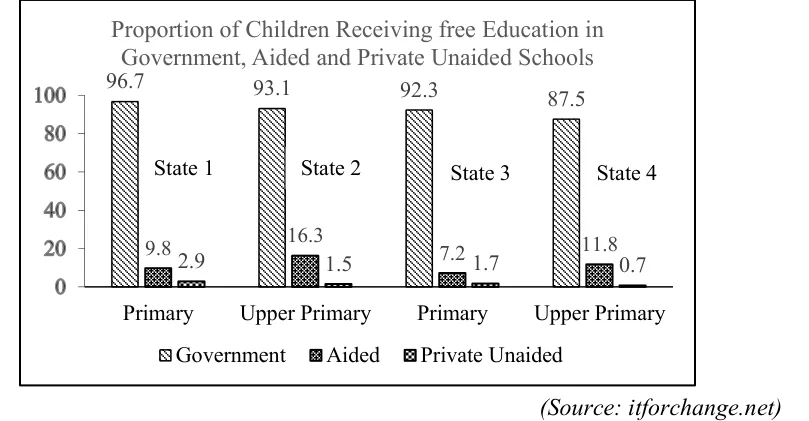 4 marks
The graph given below depicts the results of the study done to assess the implementation of Right to Education (2009) in Government, Aided and Private Unaided schools in four states in India. Study the graph and answer the question that follows:
[Bar graph - Proportion of children receiving free education (Government / Aided / Private Unaided): State 1 Primary 96.7 / 9.8 / 2.9; State 2 Upper Primary 93.1 / 16.3 / 1.5; State 3 Primary 92.3 / 7.2 / 1.7; State 4 Upper Primary 87.5 / 11.8 / 0.7]
Analyse the effectiveness of Right to Education in addressing the disparity in education.
Why this question: Social Change and Development → Right to Education (RTE) Act: implications and effectiveness — appeared 4× Board 2023Sample 2024Sample 2025Sample 2026
Q18.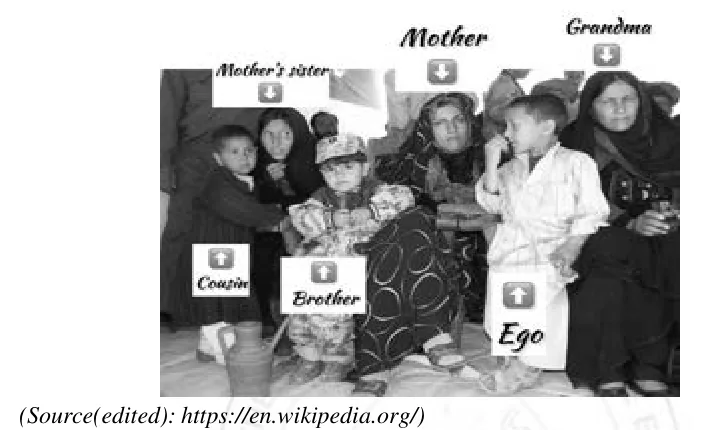 4 marks
Identify the examples of the three degrees of kinship from the image shown below. Discuss each of the three degrees briefly.
Why this question: Social Institutions and Kinship → Explain degree of kinship and identify primary, secondary and tertiary kin — appeared 4× Board 2023Sample 2024Sample 2025Sample 2026
Q19.4 marks
Comment on the relevance of MacIver's idea of family as a social unit by referring to any four features of his theory.
Why this question: Family → Features of family as given by MacIver — appeared 4× Board 2023Sample 2024Sample 2025Sample 2026
Q20.1 mark
State one feature of Classificatory kinship terms.
Why this question: Social Institutions and Kinship → Identify or define descriptive / classificatory kinship terms — appeared 4× Board 2023Board 2024Board 2025Sample 2026
Q21.1 mark
'In the remote village of a state in India, women rarely owned land or handled money, even though they worked on family farms for long hours. Any attempt by women to question decisions was labelled as disrespectful and damaging to family honour. Men continued to dominate social, economic, and political spheres.' (Source: themint.com)
Name the ideology reflected in the above scenario.
Why this question: Gender → Identify patriarchal ideology — appeared 3× Board 2024Sample 2023Sample 2027
Q22.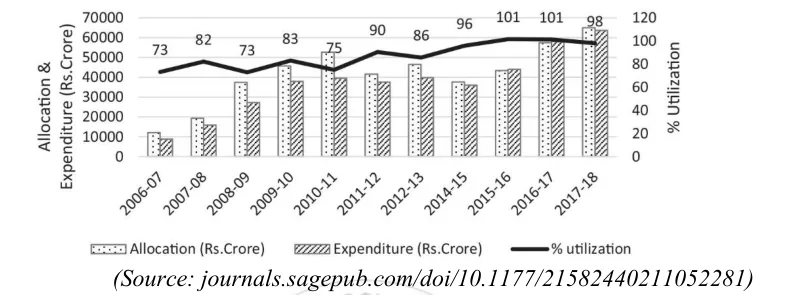 3 marks
[context: graph of MGNREGA fund allocation, expenditure and % utilisation, 2006-2018]
What do you infer about the effectiveness of MGNREGA in meeting employment needs over the period?
Why this question: Economic Organisation → MGNREGA: features, implications and effectiveness (case/passage-based) — appeared 1× Sample 2027
Q23.3 marks
[context: table showing protests worldwide rising from 425 (2006-2010) to 946 (2016-2020)]
Analyse the reasons for this trend.
Why this question: Social Change and Development → Social movements: meaning, role and trends (case/passage-based) — appeared 1× Sample 2027
Section CFour long-answer questions of seven marks each (Questions 9-12). Question 12 is based on a passage/excerpt with a one-mark identification sub-part and a six-mark analytical sub-part. Internal choices are provided in two of these questions.
Q24.7 marks
Discuss the functional aspect of religion by referring to the theories of Durkheim, Radcliffe Brown and Malinowski.
Why this question: Religion and Society → Functional theories of religion (Durkheim, Malinowski, Radcliffe Brown) — appeared 4× Board 2024Sample 2023Sample 2025Sample 2026
Q25.7 marks
'Be a man and toughen up.'
Examine the above statement.
Why this question: Gender → Impact of patriarchy and gender bias on men and women — appeared 3× Board 2026Sample 2025Sample 2027
Q26.7 marks
Discuss any seven features of Monogamy.
Why this question: Marriage → Monogamy: definition, features, functions and relevance — appeared 3× Sample 2023Sample 2025Sample 2026
Q27.1 mark
Analyse the relationship between the first pair and complete the analogy.
(a) Free goods: Gifts of Nature :: ________: Command a price
(b) Consanguineous kinship: Blood ties :: Affinal kinship: ________
Why this question: Economic Organisation → Free goods and economic goods (one-mark) — appeared 3× Board 2023Sample 2024Sample 2026
Q28.6 marks
With the help of suitable examples for each, elaborate on Descriptive and Classificatory kinship terms.
Why this question: Social Institutions and Kinship → Descriptive and classificatory kinship terms: meaning, features and examples — appeared 3× Board 2024Board 2026Sample 2024