ISC Class 12 Physics Important Questions 2027 (Repeated in Board Exams)
Last updated:
112 question patterns that appeared in two or more of the analysed papers (4 board + 5 official sample papers (2023–2027)). The numbers change; the question does not.
Electrostatics
1. Derive electric field on the axial/end-on line of a dipole
3×Board 2026Sample 2023Sample 20273 marks
Obtain an expression of intensity of electric field at a point lying on the axis of an electric dipole.
2. Torque on an electric dipole in a uniform field (τ = pE sinθ)
2×Sample 2024Sample 20271/3 marks
An electric dipole is kept in a uniform electric field E with its axis making an angle θ with the field. Show forces acting on each charge and hence prove that torque acting is given by τ = pE sinθ
3. Net dipole moment of a molecule from bond dipoles and geometry
2×Sample 2025Sample 20262 marks
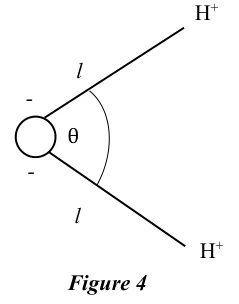
Arrangement of an oxygen ion and two hydrogen ions in a water molecule is shown in Figure 4. Calculate electric dipole moment of water molecule. Express your answer in terms of e (charge on hydrogen ion), l and θ.
4. Field of an infinite charged plane sheet (E = σ/2ε0) and its use
2×Board 2025Sample 20271/2 marks
A tiny bird carrying a charge of q = 8 × 10-17 C dives vertically down towards a large positively charged metallic plate kept on a table in a horizontal position. What should be the surface charge density (σ) of the plate so that the bird stops in its flight, close to the plate? (Mass of the bird = 50g)
5. Identify locus of zero potential of an electric dipole
3×Board 2024Board 2025Sample 20231 marks
In case of a short electric dipole, what is the locus of a point having zero potential?
6. Compute electric flux emanating from a closed surface via Gauss's law
2×Board 2026Sample 20261/2 marks
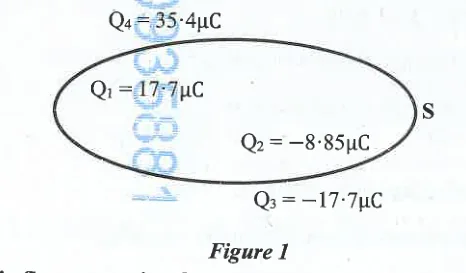
Four-point charges Q1 = +17·7μC, Q2 = −8·85μC, Q3 = −17·7μC and Q4 = 35·4μC are kept as shown in Figure 1 below. Calculate electric flux emanating from the closed surface S.
7. Derive equivalent capacitance of capacitors in series
2×Board 2024Sample 20242/3 marks
Obtain an expression for equivalent capacitance C when three capacitors C1, C2 and C3 are connected in series.
8. Derive electric field on the equatorial/broadside line of a dipole
2×Board 2023Sample 20243 marks
Obtain an expression for intensity of electric field at a point in broadside position of an electric dipole.
9. Reason how electric flux changes when radius/enclosed charge changes
2×Board 2023Board 20241/2 marks
A hollow sphere of radius R has a point charge q at its centre. Electric flux emanating from the sphere is X. How will the electric flux change, if at all, when (a) radius of the sphere is doubled? (b) charge q is replaced by an electric dipole?
Current Electricity
10. Apply Kirchhoff's laws to a multi-loop DC network to find branch currents
4×Board 2023Board 2024Board 2025Sample 20262/3 marks
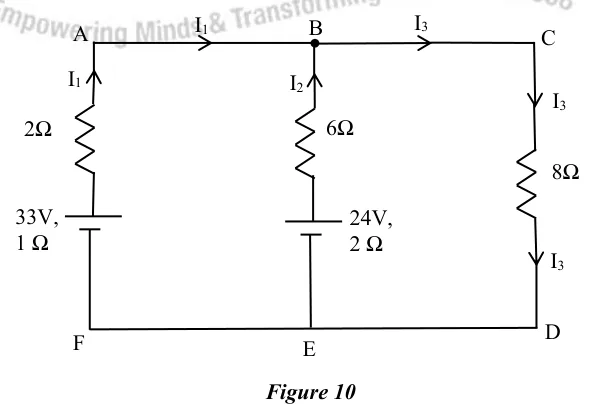
Using Kirchhoff's laws of electrical networks, calculate the current I3.
11. Graph of heating power P developed in a wire versus current I
3×Board 2023Sample 2025Sample 20261 marks
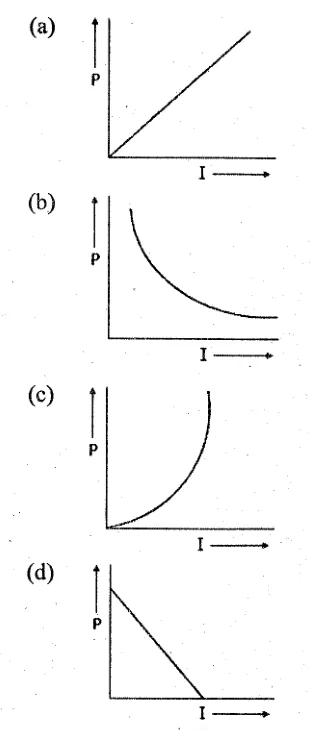
An electric current (I) flowing through a metallic wire is gradually increased. The graph of heating power (P) developed in it versus the current (I) is: (options (a)-(d) are the graphs shown)
12. Effect of potential difference on drift velocity of electrons
3×Board 2024Sample 2024Sample 20251 marks
The drift velocity of electrons in a conductor is vd = -eEτ/m. How does the drift velocity change with a change in the potential difference across the conductor?
13. Compare resistance and temperature of a conductor from I-V graphs at two temperatures
2×Sample 2025Sample 20262 marks
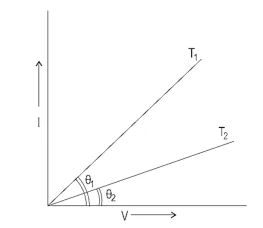
The current (I)-voltage (V) graphs for a conductor are given at two different temperatures T1 and T2. (a) At which temperature T1 or T2 is the resistance higher? (b) Which temperature (T1 or T2) is higher?
14. Draw a potentiometer circuit to compare emfs of two cells
2×Board 2026Sample 20272 marks
Draw a labelled diagram of an arrangement used in Physics laboratory to compare emfs of two given cells X and Y.
15. Metre bridge: find the unknown resistance from the balance point
2×Sample 2023Sample 20272/3 marks
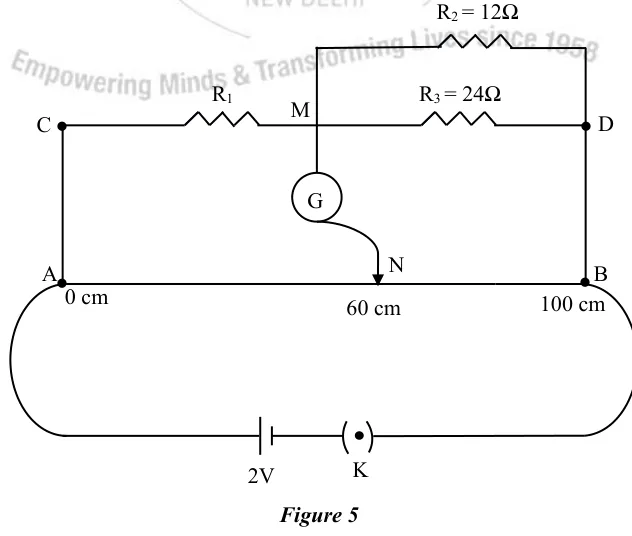
In the circuit shown in Figure 5, the central zero galvanometer G shows no deflection when the key K is closed. Calculate the value of resistor R1.
16. Apply Kirchhoff's loop rule to find a branch current
2×Sample 2024Sample 20251/2 marks
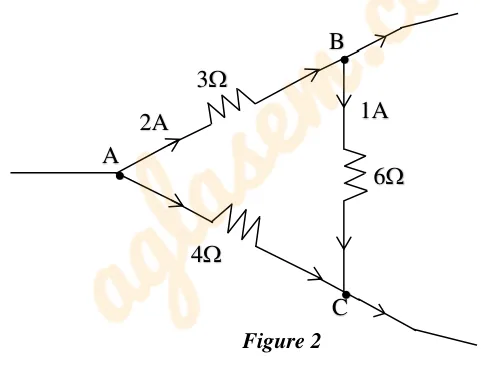
Figure 2 shows a part of Wheatstone bridge circuit. With the help of Kirchhoff's loop rule, calculate the current flowing through the 4Ω resistor.
17. Internal resistance of a cell from potentiometer balancing lengths
2×Sample 2024Sample 20252 marks
In a potentiometer, a cell is balanced against 110 cm when the circuit is open. A cell is balanced at 100 cm when short-circuited through a resistance of 10 Ω. Find the internal resistance of the cell.
18. Relate internal and external resistance for equal current in series vs parallel cells
2×Sample 2024Sample 20253 marks
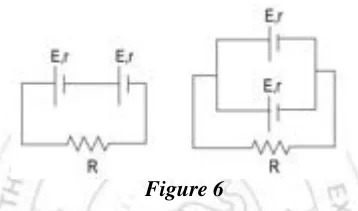
Study the two circuits shown in Figure 6. The cells in the two circuits are identical. The resistance of R is the same in both. If the same current flows through R in both circuits, calculate the internal resistance of each cell in terms of the resistance R.
19. How drift velocity changes when wire length changes at fixed voltage
2×Sample 2024Sample 20252 marks
A copper wire of length 'l' is connected to a source. If the copper wire is replaced by another copper wire of the same area of cross-section but length '4l', how will the drift velocity change? Explain your answer.
20. Apply Kirchhoff's junction rule to find a branch current
2×Board 2026Sample 20251/2 marks
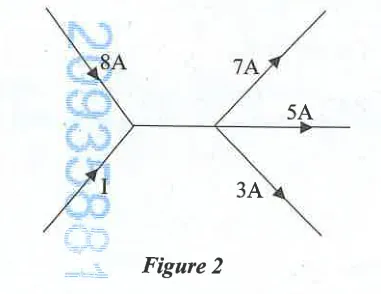
(a) Find the value of current 'I' in Figure 2. (b) State the conservation principle on which your calculation is based.
21. MCQ on a balanced Wheatstone bridge (no galvanometer current)
2×Board 2025Sample 20251 marks
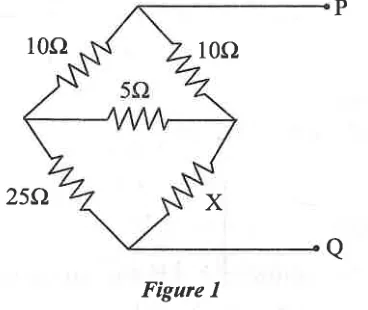
When a battery is connected between the terminals P and Q, as shown in Figure 1, it is found that no current flows through 5Ω resistor. Then, the value of resistor X is:
(a) 10Ω
(b) 20Ω
(c) 25Ω
(d) 45Ω
22. State the balancing/null condition of a Wheatstone bridge
2×Board 2023Sample 20241 marks
State the condition for a balanced Wheatstone bridge.
23. Net emf and internal resistance of a battery formed from combined cells
2×Board 2023Board 20263 marks
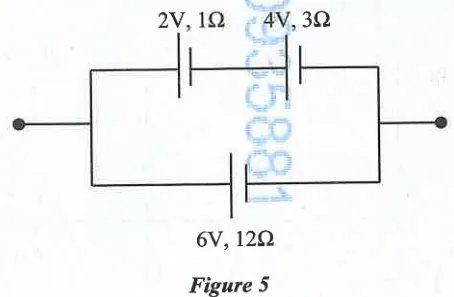
Figure 5 shows a battery consisting of three cells. Calculate: (a) emf of the battery. (b) internal resistance of the battery.
Magnetic Effects of Current and Magnetism
24. Radius of the circular path of a charged particle in a magnetic field
3×Sample 2023Sample 2025Sample 20262 marks
Calculate the radius of the circular path described by the electron (v = 8×10⁷ ms-1, B = 1·3×10-3T).
25. Derive magnetic field near a long straight wire using Ampere's circuital law
3×Board 2023Sample 2024Sample 20263 marks
Using Ampere circuital law, obtain an expression for magnetic field 'B' at a point at a perpendicular distance 'r' from a long current carrying conductor.
26. Convert a galvanometer to an ammeter and find the shunt resistance
3×Board 2023Sample 2024Sample 20252 marks
A galvanometer of resistance 100 Ω gives a full-scale deflection for a potential difference of 200 mV. What must be the resistance connected to convert the galvanometer into an ammeter of the range 0-200 mA?
27. Temperature dependence of magnetic susceptibility of a diamagnetic substance
2×Sample 2025Sample 20261 marks
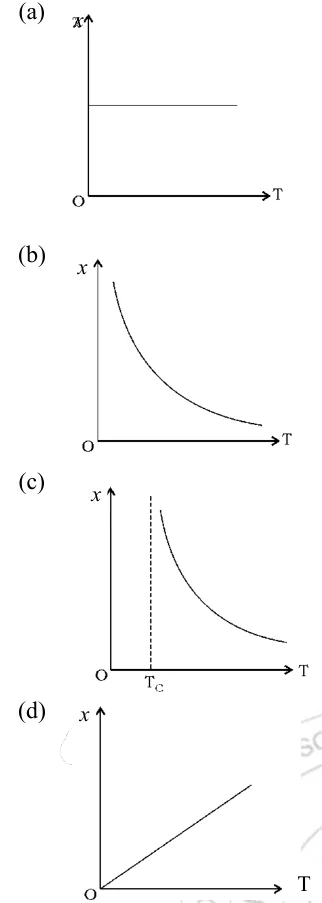
The variation of magnetic susceptibility (x) with absolute temperature (T) for a diamagnetic substance is: (options (a)-(d) are the graphs shown)
28. Verify axial magnetic field values of a circular coil against theory
2×Sample 2025Sample 20263 marks
A student records data for the magnitude (B) of the magnetic field at axial points at different distances x from the centre O of a circular coil of radius a carrying current I: B = B0 at x=0, B0/(2√2) at x=a, B0/(5√5) at x=2a, B0/(10√10) at x=3a. Verify (for any two) that these observations agree with the expected theoretical values of B.
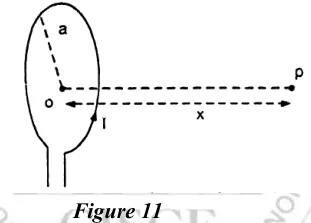
29. Why a charged particle follows a circular path in a magnetic field
2×Sample 2025Sample 20261 marks
An electron moving along positive X axis with a velocity of 8×10⁷ ms-1 enters a region having uniform magnetic field B = 1·3 × 10-3 T along positive Y axis. Explain why the electron describes a circular path.
30. Derive magnetic field at the centre of a circular coil using Biot-Savart law
3×Board 2024Board 2026Sample 20233 marks
Obtain an expression for magnetic field (B) at the centre of a circular coil having 'n' turns of radius 'R' when it is carrying a current 'I'.
31. Force (per unit length) between two parallel current-carrying wires
3×Board 2024Board 2026Sample 20231/2 marks
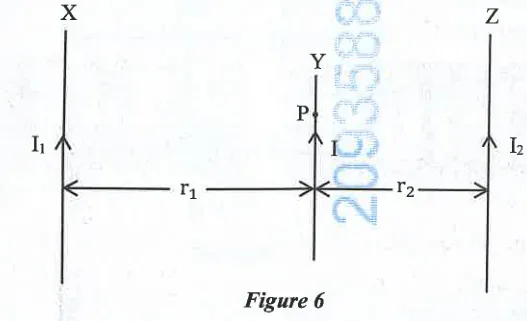
Figure 6 shows a long straight conductor X carrying a current I1. A point P is at a perpendicular distance 'r1' from it. How much force does conductor X exert on a short conductor Y of length 'l' which is carrying a current 'I' and is kept at point P parallel to the conductor X?
32. Magnetic field of a long straight current-carrying wire (B = μ0 I/2πr)
2×Board 2024Sample 20271 marks
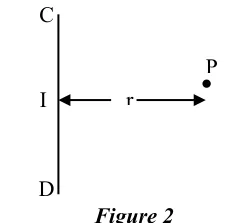
In Figure 2, CD is an infinitely long and straight metallic wire carrying a current I. Point P is at a perpendicular distance r from it. Which combination of I and r gives maximum magnetic field at point P, pointing into the plane of the paper?
(a) I = 4A towards C, with r = 0·500 m
(b) I = 4A towards D, with r = 0·250 m
(c) I = 8A towards C, with r = 0·125 m
(d) I = 8A towards C, with r = 0·050 m
33. Change in field at coil centre when the coil is rewound to a different radius
2×Sample 2024Sample 20251 marks
A circular coil having N turns of radius R carrying a current I produces a magnetic field B at its centre O. If this coil is opened and rewound such that the radius of the newly formed coil is 2R, carrying the same current I, what will be the magnetic field at the centre O?
(a) 2B
(b) B
(c) B/2
(d) B/4
Electromagnetic Induction and Alternating Currents
34. Series LCR/RL AC circuit: find impedance, current and phase
5×Board 2023Board 2024Board 2025Sample 2023Sample 20243/4/5 marks
An alternating emf E = 5·0 Sin(314t)V is applied to a circuit containing a resistor connected in series with an unknown component X. The current in the circuit is I = 3·0 Sin(314t − π/3) A. (a) Identify the component X. (b) Calculate rms value (Irms) of the current. (c) Find the frequency of the source. (d) Calculate power factor. (e) Find the impedance (Z) of the circuit.
35. Motional emf of a moving rod / axle (ε = Blv) and induced current
3×Board 2025Sample 2023Sample 20272/3 marks
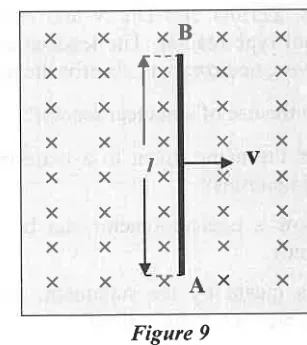
Figure 9 shows a metallic rod MN of length l = 3m moving in an external uniform magnetic field B = (1/π) T directed into the plane of paper. The position of the rod changes with time as x = πt (x in metre, t in second). (1) Calculate the motional emf developed in the rod. (2) Name the law used to find the direction of induced current.
36. Series LCR resonance curve: impedance/Q-factor interpretation
3×Board 2024Sample 2025Sample 20262/3 marks
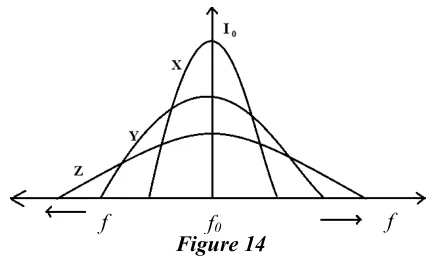
Three students X, Y and Z studied variation of A.C. with frequency in a series LCR circuit using an AC source of same emf and inductance of the same value, obtaining resonance curves. (a) Who used minimum resistance? (b) In which case will the quality Q factor be maximum? (c) What did the students conclude about the nature of impedance at resonant frequency (f0)?
37. Identify step-up / step-down transformer for a given use
2×Sample 2024Sample 20271 marks
State any one difference between a transformer used at the power generating station and the transformer in a city which is used to supply power to households.
38. Ratio of capacitor current at two supply frequencies
2×Sample 2025Sample 20262 marks
An ideal capacitor is connected across 220V, 50Hz, and 220V, 100Hz supplies. Find the ratio of current flowing through it in the two cases.
39. Resistor on an AC source e = E0 sin ωt: rms current / average power
2×Board 2026Sample 20272 marks
An ac generator generating an emf e = 300 sin (100πt)V is connected to a 100Ω resistor. Calculate the average power consumed by the resistor.
40. Define / explain motional emf
3×Board 2023Board 2026Sample 20241 marks
What is motional emf?
41. Why a spark appears when an inductive circuit is switched off (self-induction)
2×Sample 2023Sample 20272 marks
Explain why a blue coloured spark appears in a switch contact when a circuit containing a load like a heater, geyser or an electric iron is switched off.
42. Find self-inductance of a coil from its dc and ac (reactance) response
2×Board 2026Sample 20263 marks
When a coil is connected to a 200V dc supply, the current flowing through it is 1A. However, when it is connected to the 200V, 50Hz ac supply, the current is 0·5A. (1) Explain why current flowing is less when the coil is connected to an ac supply. (2) Calculate coefficient of self-inductance (L) of the coil.
43. Self-inductance of a solenoid from its dimensions and turns
2×Board 2026Sample 20242 marks
A 20cm length of a long iron cored solenoid has 25 turns. If the area of cross section of the solenoid is 1 × 10⁻⁴ m2, calculate its coefficient of self-inductance (L). (Relative permeability of iron = 3000.)
44. Why a transformer core is made of soft iron
2×Board 2024Board 20261 marks
State why soft iron is preferred to steel as a material for the core of a transformer.
45. Self-inductance from induced emf and rate of change of current
2×Board 2024Board 20252/3 marks
When current flowing through a solenoid decreases from 15A to 0 in 0·2s, an emf of 30V is induced in it. Calculate the coefficient of self-inductance of the solenoid.
Electromagnetic Waves
46. Name X-rays as the EM wave used in a stated application
4×Board 2023Board 2026Sample 2025Sample 20261 marks
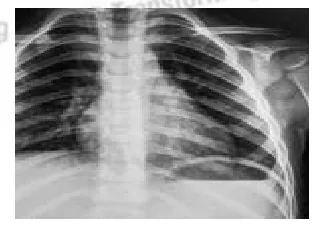
Name the electromagnetic radiation that has been used in obtaining the image below.
47. Name microwaves as the EM wave used in a stated application
3×Board 2025Sample 2024Sample 20261 marks
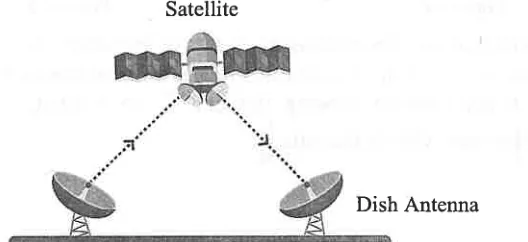
Name the electromagnetic wave travelling from the satellite to the dish antenna shown in the image above.
48. All EM waves travel at speed c in vacuum
2×Board 2024Board 20261 marks
Which physical quantity is the same for UV rays, red light and radio waves when they are travelling in vacuum?
Ray Optics and Optical Instruments
49. Identify a microscope as the instrument for viewing small objects
4×Board 2024Sample 2023Sample 2025Sample 20261 marks
A student studies details of a microorganism with the help of an instrument. Name the instrument used by him.
50. Derive the lens maker's formula from surface refraction
3×Sample 2023Sample 20261/2/3 marks
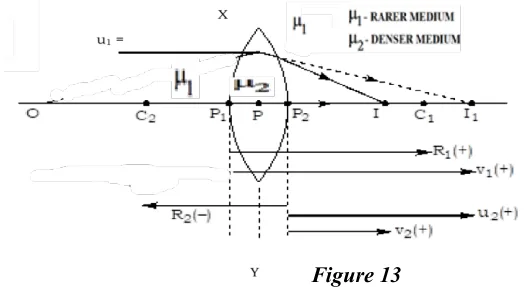
With reference to the lens maker's formula: Apply the formula (expression) of refraction at a single spherical surface to (a) refraction at first spherical surface. (b) refraction at second spherical surface.
51. Draw the ray diagram of a compound microscope (image at D)
3×Sample 2024Sample 2025Sample 20262 marks
Draw a labelled ray diagram of an image formed by this instrument (compound microscope), assuming (a) a small upright object. (b) image lies at least distance of distinct vision.
52. Focal length of a lens after cutting it into parts
3×Board 2026Sample 2024Sample 20251/2 marks
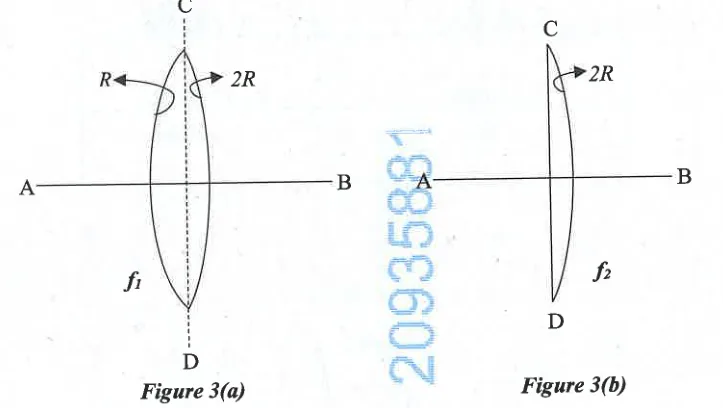
A bi-convex lens of focal length f1 is placed in air (Figure 3a). The radii of curvature of its first and second surfaces are R and 2R respectively. The lens is cut along the plane CD. Compare the focal length f2 of the resulting lens (Figure 3b) with that of the original lens (Figure 3a).
53. Assertion-reason: focal length of a mirror in water (f = R/2)
2×Sample 2026Sample 20271 marks
Assertion: The focal length of a convex mirror will increase, if the mirror is placed in water.
Reason: The focal length of a convex mirror is equal to half its radius of curvature.
(a) Both Assertion and Reason are true, and Reason is the correct explanation for Assertion.
(b) Both Assertion and Reason are true, but Reason is not the correct explanation for Assertion.
(c) Assertion is true and Reason is false.
(d) Assertion is false and Reason is true.
54. Advantage of a reflecting (mirror) telescope over a refracting one
3×Board 2024Board 2025Sample 20261 marks
Why are giant telescopes of reflecting type? Give any one scientific reason.
55. Net focal length / power of thin lenses in contact
3×Board 2025Board 2026Sample 20231/2 marks
A thin convex lens of power 5D is kept in contact with a thin concave lens of power 8D. Calculate the focal length of the combination.
56. Compare focal lengths of objective and eyepiece (microscope / telescope)
2×Board 2026Sample 20271 marks
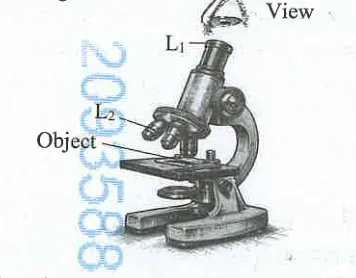
The image shows a compound microscope. Which one of the two lenses L1 (near the eye/view) or L2 (near the object) has a larger focal length?
57. Refractive index of a prism from deviation data (prism formula numerical)
2×Board 2026Sample 20272 marks
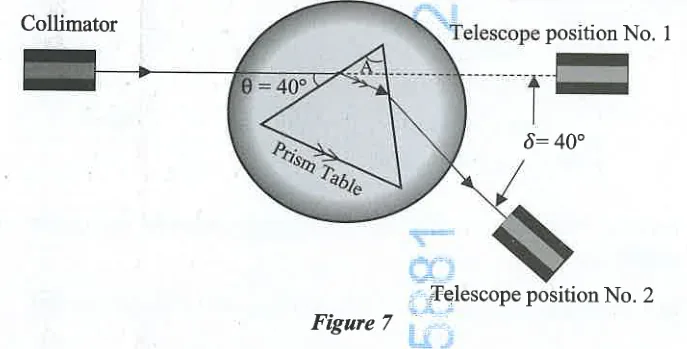
A monochromatic ray of light incident on one refracting surface of an equilateral prism suffers a deviation as shown in Figure 7. Calculate the refractive index of the material of the prism.
58. Dispersive power of a prism material
2×Board 2026Sample 20271 marks
'Since prism B (minimum deviation 47°) has larger minimum deviation than prism A (34°), the student claims it must also have the greater dispersive power.' Is this statement always correct? Justify your answer.
59. Focal length / power of a lens changes when immersed in a liquid
2×Board 2025Sample 20271 marks
[context: an optical sensor for a drone: LED light passes through a convex spherical refracting surface (R = 20 cm, air μ1 = 1·0 to glass μ2 = 1·5), then a thin biconvex lens of focal length 10 cm, then strikes a concave mirror of radius of curvature 30 cm focusing on a photodetector] If the drone operates in a highly humid or misty environment where a film of water completely coats the lens surfaces, how will the refractive power of this lens change?
60. Derive the prism formula relating A, deltam and refractive index
3×Board 2023Board 2025Sample 20233 marks
For any prism, show that refractive index 'n' of its material is given by: n = sin((A+δm)/2) / sin(A/2), where the terms have their usual meaning.
61. Refractive index of a lens from the lens maker's formula given f and R
2×Sample 2024Sample 20251 marks
The focal length of a double convex lens is equal to the radius of curvature of either surface. What is the refractive index of its material?
62. Define a thin prism (small refracting angle)
2×Sample 2024Sample 20251 marks
What is meant by a thin prism?
63. Equivalent focal length of an arrangement of cut lens halves
2×Sample 2024Sample 20252 marks
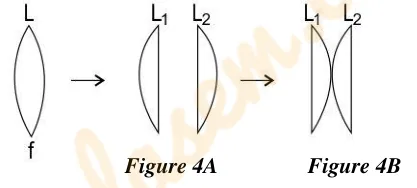
The two parts are arranged as shown in Figure 4B. What is the focal length of the final combination?
64. Prism deviating/dispersing white light (which colour deviates most)
2×Board 2024Sample 20261 marks
When a beam of white light is incident on a prism, the prism:
(a) only disperses the incident light.
(b) only deviates the incident light.
(c) deviates as well as disperses incident light.
(d) neither deviates nor disperses incident light.
65. Derive the refraction relation at a single spherical surface
2×Board 2023Sample 20243 marks
For refraction at convex spherical surface of denser medium η2 surrounded by a rarer medium of refractive index η1, derive a formula connecting object distance u, image distance v, and radius of curvature R for the object in rarer medium and a real image formed inside the denser medium.
66. Name the property of an optical instrument (magnifying/resolving power)
2×Board 2024Sample 20231 marks
What is the ability of an optical instrument to form enlarged images called?
67. Optical phenomena / ray diagram for the formation of a rainbow
2×Board 2023Sample 20232 marks
Name any two phenomena which take place in the formation of a rainbow.
Wave Optics
68. Effect of changing slit separation on the fringe width
3×Sample 2024Sample 2025Sample 20271 marks
Teacher: Two students performed the same Young's double slit experiment. One student obtained wider fringes. What is the possible reason for this observation? Student: The student who obtained wider fringes must have increased the distance between the two slits. State whether the answer is correct or incorrect; correct it with a brief explanation.
69. Path difference condition for a bright fringe in YDSE
3×Sample 2023Sample 2024Sample 20271 marks
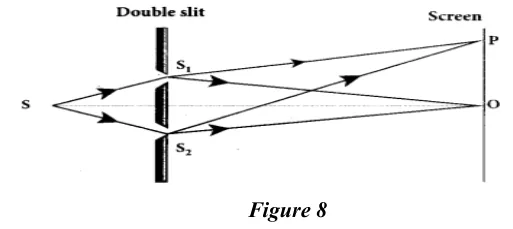
A physics teacher drew a ray diagram (Young's double slit, Figure 8) and asked: There is a point P on the screen where the path difference between two interfering light waves is exactly 1·2 × 10-6 m. If the light emitted by the source has a wavelength of 600 nm, will a bright or a dark fringe form at P? Student: Dark fringe will be obtained. State whether the student's answer is correct or incorrect; correct it with a brief explanation.
70. Prove Snell's law / laws of refraction using Huygens' principle
4×Board 2024Board 2025Sample 2023Sample 20242/3 marks
Use Huygen's wave theory to prove Snell's law.
71. Prove the law of reflection using Huygens' principle
3×Board 2023Board 2026Sample 20253 marks
Using Huygen's wave theory and a labelled diagram, show that angle of reflection (r) is equal to angle of incidence (i).
72. Derive the fringe width expression for Young's double slit experiment
2×Board 2024Sample 20263 marks
In Young's double slit experiment, show that fringe width ω (fringe separation) is given by ω = λD/d where the terms have their usual meaning.
73. Effect of changing wavelength on the interference fringe pattern
2×Board 2025Sample 20251 marks
What will be the change in the interference pattern if the given light is replaced with monochromatic light of wavelength 500nm?
74. Type of wavefront associated with a distant source
2×Board 2023Sample 20241 marks
With what type of source of light are plane wavefronts associated?
75. Effect on the angular width of the single-slit central maximum
2×Board 2023Sample 20231 marks
In a single slit Fraunhofer diffraction experiment, how does the angular width of central maximum change when the slit width is increased?
76. Coherent sources as the condition for sustained interference
2×Board 2023Sample 20231 marks
What is the essential condition for obtaining a sustained interference?
77. Young's double slit numerical for slit separation / fringe positions
2×Board 2023Board 20252 marks
Two identical rectangular slits 5mm apart are illuminated with a monochromatic light of wavelength 600nm. The screen is kept 1·2m away from the slits. Calculate the distance between the 5th bright fringe on one side and the 3rd bright fringe on the other side of the central bright band.
Dual Nature of Radiation and Matter
78. Maximum kinetic energy of photoelectrons using Einstein's equation
3×Board 2023Sample 2026Sample 20271/2 marks
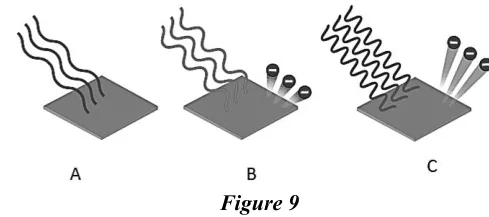
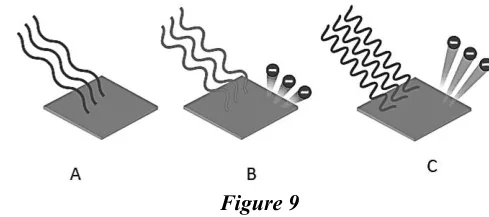
If the photon energy in image B = 2·8 eV (work function 2·3 eV), calculate the maximum kinetic energy of the emitted photo electrons.
79. Pair annihilation of an electron-positron pair into gamma photons
3×Sample 2024Sample 2025Sample 20261 marks
What happens when an electron collides with a positron?
80. Determine which metal/light emits photoelectrons by comparing energy with work function
3×Board 2026Sample 2024Sample 20271/2 marks
Study the images shown in Figure 9 (light incident on three surfaces A, B, C; all three surfaces have same work function = 2·3eV). Why are no photoelectrons emitted in image 'A'?
81. Minimum photon energy required for pair production
3×Board 2025Board 2026Sample 20271/2 marks
When can a gamma ray photon produce a proton and an antiproton pair?
82. de Broglie wavelength of particles accelerated through a potential difference
2×Board 2026Sample 20261 marks
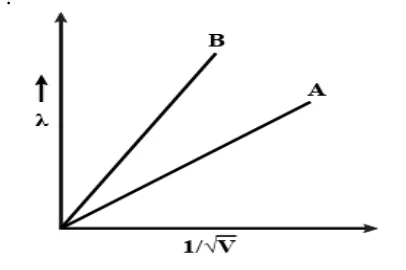
Two charged particles having same charge but different masses are passed through a potential difference V. When V is varied, de-Broglie wavelength (λ) of the particles varies as shown in graphs. Which graph is for heavier particles and why?
83. Effect of light intensity on stopping potential
2×Board 2024Sample 20251 marks
How does stopping potential in photoelectric emission vary if the intensity of the incident radiation increases?
84. Davisson-Germer / electron diffraction as evidence of matter waves
2×Board 2025Board 20261 marks
State the conclusion that was drawn from Davisson-Germer's experiment.
85. Define / give an example of pair production
2×Board 2024Sample 20241 marks
What is 'Pair production'?
86. Draw the stopping potential versus frequency graph
2×Board 2025Sample 20232 marks
Plot a labelled graph of stopping potential (Vs) versus frequency (f) of incident UV radiation.
87. Determine Planck's constant from the stopping potential vs frequency slope
2×Board 2025Sample 20231 marks
State how the value of Planck's constant can be determined from this graph (stopping potential vs frequency).
88. de Broglie wavelength in terms of kinetic energy
2×Board 2024Board 20251 marks
If kinetic energy of moving electrons is made four times, then their de Broglie wavelength becomes:
(a) eight times.
(b) four times.
(c) two times.
(d) half.
Atoms and Nuclei
89. State / explain Bohr's postulate of angular-momentum quantisation
4×Board 2024Board 2025Board 2026Sample 20231/2/3 marks
What is meant by the following statement? 'Angular momentum of an orbiting electron is quantised.'
90. Binding energy per nucleon vs mass number curve and nuclear stability
3×Board 2026Sample 2023Sample 20262 marks
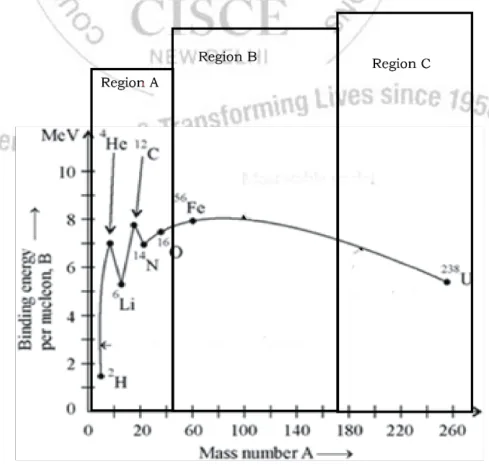
Study the binding energy per nucleon versus mass number graph. Indicate which region corresponds to: (1) Nuclei prone to fission. (2) Nuclei prone to fusion. (3) Most stable nuclei.
91. Name the hydrogen spectral series for a given region/transition
3×Board 2023Board 2024Sample 20271/2 marks
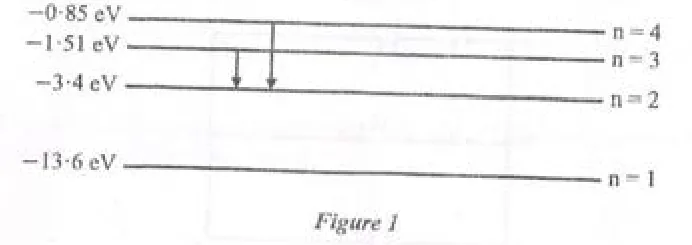
Figure 1 is the Energy level diagram for Hydrogen atom. Study the transitions shown and answer: (a) State the type of spectrum obtained. (b) Name the series of spectrum obtained.
92. Energy released in a nuclear reaction from the mass defect
3×Board 2024Sample 2024Sample 20252 marks
Find the energy released during the fission reaction {}23592U + {}10n → {}23692U → {}9036Kr + {}14356Ba + 3{}10n, given masses {}235U = 235·0439u, {}90Kr = 89·9195u, {}143Ba = 142·9206u, {}1n = 1·0087u.
93. Show that 1u is equivalent to 931.5 MeV
2×Sample 2025Sample 20271/2 marks
Prove that 1u = 931·5 MeV where the terms have their usual meaning.
94. Define isotones
2×Sample 2024Sample 20271 marks
What are isotones?
95. Numerical wavelength of radiation for an atomic energy-level transition
2×Sample 2025Sample 20262/3 marks
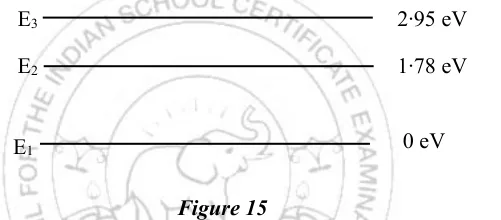
In an atom X (energy levels E1 = 0·00eV, E2 = 1·78eV, E3 = 2·95eV, ground state 0 eV for reference), electrons absorb energy exciting them to higher levels and emit photons on returning. What wavelength of radiation is needed to excite the atom to energy level E2 from E1?
96. Derive the expression for the radius of the nth Bohr orbit
3×Board 2024Board 2025Sample 20233 marks
Show that radius (rn) of the nth Bohr orbit varies directly with square of the principal quantum number (n) of the orbit.
97. Derive the orbital velocity of the electron in the nth Bohr orbit
2×Board 2023Sample 20273 marks
Write Bohr's equations for circular motion of an electron around the nucleus and conservation of angular momentum. Using them, obtain an expression for orbital velocity of an electron.
98. State the hypothesis/conclusion from the alpha-particle scattering experiment
2×Sample 2024Sample 20251/2 marks
During Rutherford's gold foil experiment, most alpha-particles did not deflect, however some showed a deflection of 180°. What hypothesis was made to justify the deflection of alpha-particle by 180°?
99. Name parts of a nuclear reactor and state their functions
3×Board 2023Board 2024Board 20252/3 marks
A group of students visited Bhabha Atomic Research Centre and observed reactors (Apsara a swimming pool type reactor; water slows fast neutrons and absorbs heat). (1) What is the use of a nuclear reactor? (2) What is the name given to a material which slows down fast moving neutrons? (3) State how a nuclear reactor can be shut down in case of an emergency.
100. Numerical for the angular momentum of an electron in the nth Bohr orbit
2×Board 2023Sample 20261/3 marks
According to Bohr's theory of hydrogen atom, calculate (1) angular momentum of the electron in second Bohr orbit. (2) radius of the third Bohr orbit.
101. Numerical for mass defect and binding energy (per nucleon) of a nucleus
2×Board 2024Sample 20252/3 marks
Find the binding energy per nucleon of {}235U given mass of neutral {}23592U = 235·0439u, mass of a proton = 1·0073u, mass of a neutron = 1·0087u.
102. Scale radius/velocity of Bohr orbits with orbit number
2×Board 2024Board 20261/2 marks
Radius of the first Bohr orbit of hydrogen atom is 0·05nm. Calculate the radius of the third orbit.
Electronic Devices (Semiconductors)
103. MCQ on diode resistance under forward/reverse (or ideal) bias
3×Board 2026Sample 2025Sample 20271 marks
Identify the phenomena that occur when a P-N junction diode is forward biased.
(P) The width of the depletion layer decreases.
(Q) The height of the potential barrier is lowered.
(R) The effective resistance of the diode increases significantly.
(S) The reverse current flows mainly due to the diffusion of majority charge carriers.
(a) Both (P) and (Q)
(b) Both (R) and (S)
(c) Both (P) and (S)
(d) Both (Q) and (R)
104. Variation of semiconductor resistance/conductivity with temperature
3×Board 2023Board 2025Sample 20271 marks
Explain why resistance of a semiconductor material decreases when its temperature is increased.
105. Identify a material type from its energy-band feature (no forbidden band)
3×Board 2023Board 2025Sample 20271 marks
In an energy band diagram of a certain material, forbidden band is absent. Identify the material.
106. Solar cell: what it is and the energy conversion it performs
2×Sample 2025Sample 20271 marks
What is a solar cell?
107. Identify the forward-biased diode from the circuit polarity
2×Sample 2025Sample 20261 marks
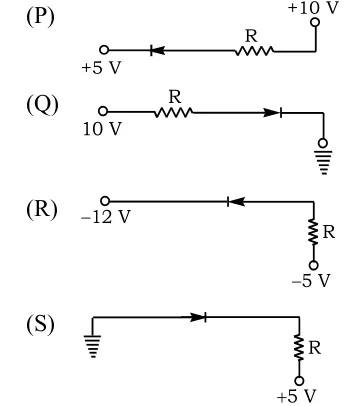
In which of the following figures is the p-n diode forward biased?
(a) Only (P), (Q) and (S)
(b) Only (R)
(c) Only (P) and (R)
(d) Only (Q) and (S)
108. Define the potential barrier of a p-n junction
3×Board 2024Board 2026Sample 20231 marks
What is meant by potential barrier?
109. Doping an intrinsic semiconductor to obtain an extrinsic one
2×Board 2026Sample 20231 marks
How did Annie obtain an extrinsic semiconductor from an intrinsic semiconductor?
110. Identify the characteristics of an n-type semiconductor
2×Board 2025Sample 20231 marks
N-type semiconductor is that which has:
(a) majority of holes as charge carriers.
(b) majority of free electrons as charge carriers.
(c) trivalent element added as an impurity.
(d) an equal number of holes and free electrons.
111. Define the depletion region of a p-n junction
2×Board 2024Sample 20231 marks
With reference to a semiconductor diode, define the following term: depletion region.
112. Draw a full-wave rectifier circuit and its output waveform
2×Board 2023Board 20253 marks
Draw a labelled diagram of a full wave rectifier. Show graphically how its output voltage varies with time.