ISC Class 12 Physics Guess Paper 2027
Last updated:
A full practice paper on the official Physics pattern, built from the most-likely questions by repetition analysis. Not an official or leaked paper.
ISC Class 12 Physics — Guess Paper 2027
Time: 3 hours · Maximum marks: 70 · Practice paper
Section ACompulsory. Question 1 consists of fourteen sub-parts of one mark each: part (A) is seven multiple-choice questions and part (B) is seven very-short-answer questions. No internal choice.
Q1.1 mark
Identify the phenomena that occur when a P-N junction diode is forward biased.
(P) The width of the depletion layer decreases.
(Q) The height of the potential barrier is lowered.
(R) The effective resistance of the diode increases significantly.
(S) The reverse current flows mainly due to the diffusion of majority charge carriers.
(a) Both (P) and (Q)
(b) Both (R) and (S)
(c) Both (P) and (S)
(d) Both (Q) and (R)
Why this question: Electronic Devices (Semiconductors) → MCQ on diode resistance under forward/reverse (or ideal) bias — appeared 3× Board 2026Sample 2025Sample 2027
Q2.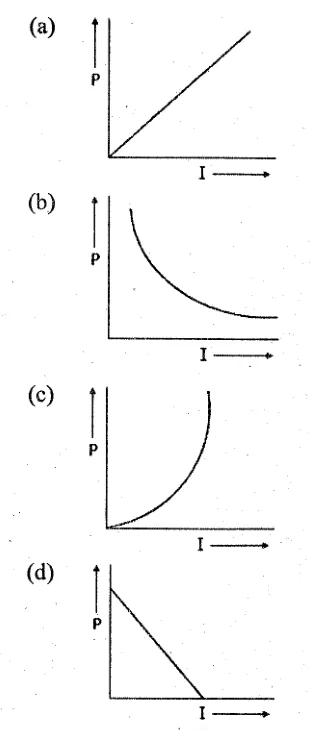 1 mark
An electric current (I) flowing through a metallic wire is gradually increased. The graph of heating power (P) developed in it versus the current (I) is: (options (a)-(d) are the graphs shown)
Why this question: Current Electricity → Graph of heating power P developed in a wire versus current I — appeared 3× Board 2023Sample 2025Sample 2026
Q3.1 mark
Explain why resistance of a semiconductor material decreases when its temperature is increased.
Why this question: Electronic Devices (Semiconductors) → Variation of semiconductor resistance/conductivity with temperature — appeared 3× Board 2023Board 2025Sample 2027
Q4.1 mark
The drift velocity of electrons in a conductor is vd = -eEτ/m. How does the drift velocity change with a change in the potential difference across the conductor?
Why this question: Current Electricity → Effect of potential difference on drift velocity of electrons — appeared 3× Board 2024Sample 2024Sample 2025
Q5.1 mark
A thin convex lens of power 5D is kept in contact with a thin concave lens of power 8D. Calculate the focal length of the combination.
Why this question: Ray Optics and Optical Instruments → Net focal length / power of thin lenses in contact — appeared 3× Board 2025Board 2026Sample 2023
Q6.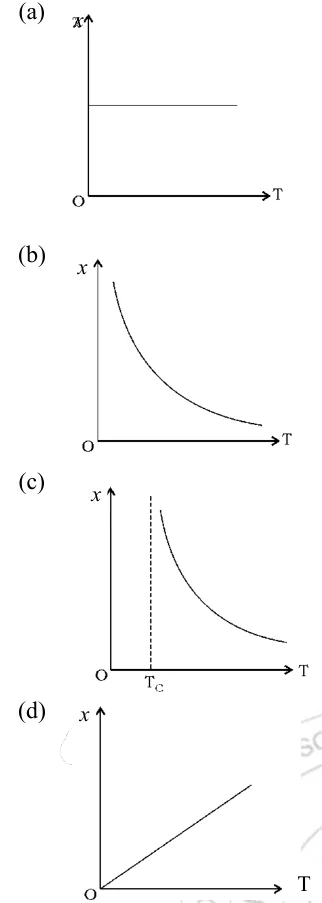 1 mark
The variation of magnetic susceptibility (x) with absolute temperature (T) for a diamagnetic substance is: (options (a)-(d) are the graphs shown)
Why this question: Magnetic Effects of Current and Magnetism → Temperature dependence of magnetic susceptibility of a diamagnetic substance — appeared 2× Sample 2025Sample 2026
Q7.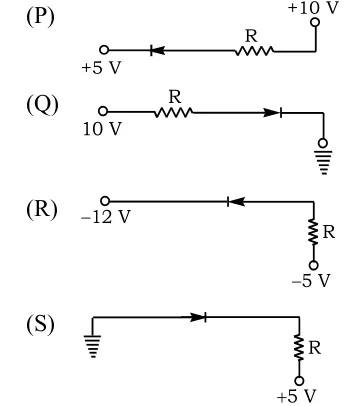 1 mark
In which of the following figures is the p-n diode forward biased?
(a) Only (P), (Q) and (S)
(b) Only (R)
(c) Only (P) and (R)
(d) Only (Q) and (S)
Why this question: Electronic Devices (Semiconductors) → Identify the forward-biased diode from the circuit polarity — appeared 2× Sample 2025Sample 2026
Q8.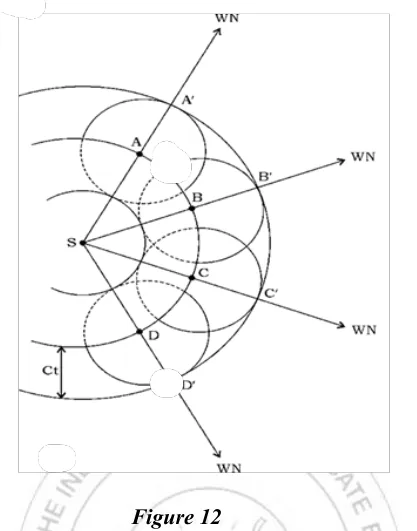 1 mark
Study the diagram shown in Figure 12. Identify a primary wavefront in Figure 12.
Why this question: Wave Optics → Identify elements (primary/secondary wavefront, wave normal) in a Huygens construction — appeared 3× Sample 2026
Q9.1 mark
A student studies details of a microorganism with the help of an instrument. Name the instrument used by him.
Why this question: Ray Optics and Optical Instruments → Identify a microscope as the instrument for viewing small objects — appeared 4× Board 2024Sample 2023Sample 2025Sample 2026
Q10.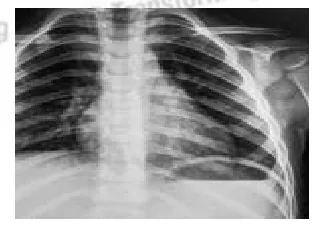 1 mark
Name the electromagnetic radiation that has been used in obtaining the image below.
Why this question: Electromagnetic Waves → Name X-rays as the EM wave used in a stated application — appeared 4× Board 2023Board 2026Sample 2025Sample 2026
Q11.1 mark
Teacher: Two students performed the same Young's double slit experiment. One student obtained wider fringes. What is the possible reason for this observation? Student: The student who obtained wider fringes must have increased the distance between the two slits. State whether the answer is correct or incorrect; correct it with a brief explanation.
Why this question: Wave Optics → Effect of changing slit separation on the fringe width — appeared 3× Sample 2024Sample 2025Sample 2027
Q12.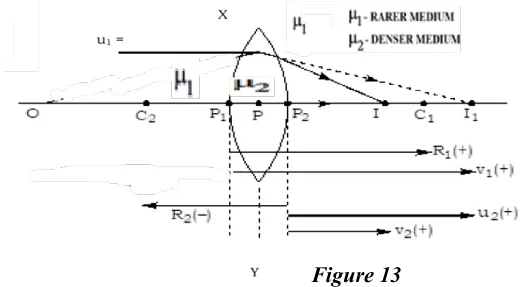 1 mark
[context: With reference to the lens maker's formula (Figure 13), the formula of refraction at a single spherical surface has been applied to the first and second spherical surfaces of a lens.] Combine these two expressions / equations to obtain an expression for focal length of the lens.
Why this question: Ray Optics and Optical Instruments → Derive the lens maker's formula from surface refraction — appeared 3× Sample 2023Sample 2026
Q13.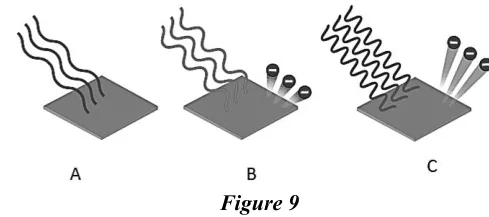 1 mark
If the photon energy in image B = 2·8 eV (work function 2·3 eV), calculate the maximum kinetic energy of the emitted photo electrons.
Why this question: Dual Nature of Radiation and Matter → Maximum kinetic energy of photoelectrons using Einstein's equation — appeared 3× Board 2023Sample 2026Sample 2027
Q14.1 mark
What happens when an electron collides with a positron?
Why this question: Dual Nature of Radiation and Matter → Pair annihilation of an electron-positron pair into gamma photons — appeared 3× Sample 2024Sample 2025Sample 2026
Section BSeven questions of two marks each (short answer / short numerical). Internal choices are provided in two of these questions.
Q15.2 marks
Draw a labelled ray diagram of an image formed by this instrument (compound microscope), assuming (a) a small upright object. (b) image lies at least distance of distinct vision.
Why this question: Ray Optics and Optical Instruments → Draw the ray diagram of a compound microscope (image at D) — appeared 3× Sample 2024Sample 2025Sample 2026
Q16.2 marks
The work functions for metals M1 and M2 are 1·9eV and 5·0eV respectively. Perform necessary calculations to find out which metal emits photoelectrons, when monochromatic light of wavelength 410nm is incident on them.
Why this question: Dual Nature of Radiation and Matter → Determine which metal/light emits photoelectrons by comparing energy with work function — appeared 3× Board 2026Sample 2024Sample 2027
Q17.2 marks
Calculate the radius of the circular path described by the electron (v = 8×10⁷ ms-1, B = 1·3×10-3T).
Why this question: Magnetic Effects of Current and Magnetism → Radius of the circular path of a charged particle in a magnetic field — appeared 3× Sample 2023Sample 2025Sample 2026
Q18.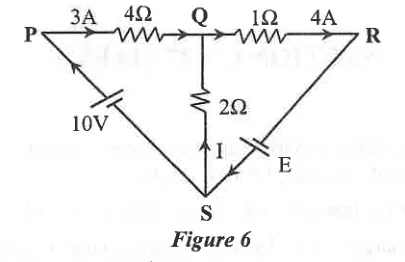 2 marks
Figure 6 shows an electric circuit. Apply Kirchhoff's laws to calculate: (a) current 'I' flowing through the 2Ω resistor. (b) emf of the cell 'E'.
Why this question: Current Electricity → Apply Kirchhoff's laws to a multi-loop DC network to find branch currents — appeared 4× Board 2023Board 2024Board 2025Sample 2026
Q19.2 marks
Calculate the minimum amount of energy which a gamma ray photon should possess in order to produce a proton and an anti-proton pair.
Why this question: Dual Nature of Radiation and Matter → Minimum photon energy required for pair production — appeared 3× Board 2025Board 2026Sample 2027
Q20.2 marks
Use Huygen's wave theory to prove Snell's law.
Why this question: Wave Optics → Prove Snell's law / laws of refraction using Huygens' principle — appeared 4× Board 2024Board 2025Sample 2023Sample 2024
Q21.2 marks
A train is moving on horizontal tracks that are 1·2m apart. Its displacement (x) depends on time (t) as x(m) = 3t2 + 6. Vertical component of earth's magnetic field in its region of motion is 2 × 10⁻⁵ T. Calculate the emf induced between two ends of its axle rod 10s after the train starts moving.
Why this question: Electromagnetic Induction and Alternating Currents → Motional emf of a moving rod / axle (ε = Blv) and induced current — appeared 3× Board 2025Sample 2023Sample 2027
Section CNine questions of three marks each (derivations, reasoning and numericals). Internal choices are provided in two of these questions.
Q22.3 marks
A 220V, 50Hz ac source is connected to a coil having coefficient of self-inductance of 1H and a resistance of 400Ω. Calculate: (1) the reactance of the coil. (2) the impedance of the coil. (3) the current flowing through the coil.
Why this question: Electromagnetic Induction and Alternating Currents → Series LCR/RL AC circuit: find impedance, current and phase — appeared 5× Board 2023Board 2024Board 2025Sample 2023Sample 2024
Q23.3 marks
Obtain an expression of intensity of electric field at a point lying on the axis of an electric dipole.
Why this question: Electrostatics → Derive electric field on the axial/end-on line of a dipole — appeared 3× Board 2026Sample 2023Sample 2027
Q24.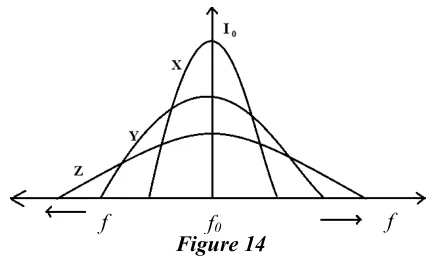 3 marks
Three students X, Y and Z studied variation of A.C. with frequency in a series LCR circuit using an AC source of same emf and inductance of the same value, obtaining resonance curves. (a) Who used minimum resistance? (b) In which case will the quality Q factor be maximum? (c) What did the students conclude about the nature of impedance at resonant frequency (f0)?
Why this question: Electromagnetic Induction and Alternating Currents → Series LCR resonance curve: impedance/Q-factor interpretation — appeared 3× Board 2024Sample 2025Sample 2026
Q25.3 marks
State the postulate of Bohr's theory regarding (1) Quantisation of angular momentum of an electron. (2) Emission of energy by an atom.
Why this question: Atoms and Nuclei → State / explain Bohr's postulate of angular-momentum quantisation — appeared 4× Board 2024Board 2025Board 2026Sample 2023
Q26.3 marks
Using Ampere circuital law, obtain an expression for magnetic field 'B' at a point at a perpendicular distance 'r' from a long current carrying conductor.
Why this question: Magnetic Effects of Current and Magnetism → Derive magnetic field near a long straight wire using Ampere's circuital law — appeared 3× Board 2023Sample 2024Sample 2026
Q27.3 marks
Using Huygen's wave theory and a labelled diagram, show that angle of reflection (r) is equal to angle of incidence (i).
Why this question: Wave Optics → Prove the law of reflection using Huygens' principle — appeared 3× Board 2023Board 2026Sample 2025
Q28.3 marks
An electric dipole is kept in a uniform electric field E with its axis making an angle θ with the field. Show forces acting on each charge and hence prove that torque acting is given by τ = pE sinθ
Why this question: Electrostatics → Torque on an electric dipole in a uniform field (τ = pE sinθ) — appeared 2× Sample 2024Sample 2027
Q29.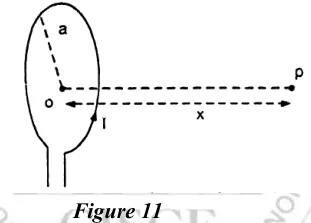 3 marks
A student records data for the magnitude (B) of the magnetic field at axial points at different distances x from the centre O of a circular coil of radius a carrying current I: B = B0 at x=0, B0/(2√2) at x=a, B0/(5√5) at x=2a, B0/(10√10) at x=3a. Verify (for any two) that these observations agree with the expected theoretical values of B.
Why this question: Magnetic Effects of Current and Magnetism → Verify axial magnetic field values of a circular coil against theory — appeared 2× Sample 2025Sample 2026
Q30.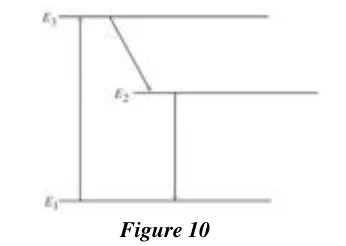 3 marks
In an atom X (energy levels E1 = 0·00eV, E2 = 1·78eV, E3 = 2·95eV, ground state 0 eV), transition takes place between E1 and E2. (1) What wavelength of radiation is needed to excite the atom to energy level E2 from E1? (2) Suppose the external source has a power of 100 W. What would be the rate of photon emission?
Why this question: Atoms and Nuclei → Numerical wavelength of radiation for an atomic energy-level transition — appeared 2× Sample 2025Sample 2026
Section DThree questions of five marks each (long answer with multiple sub-parts, derivations and numericals); each is set here as its 3-mark and 2-mark sub-parts. Internal choices are provided in two of these questions.
Q31.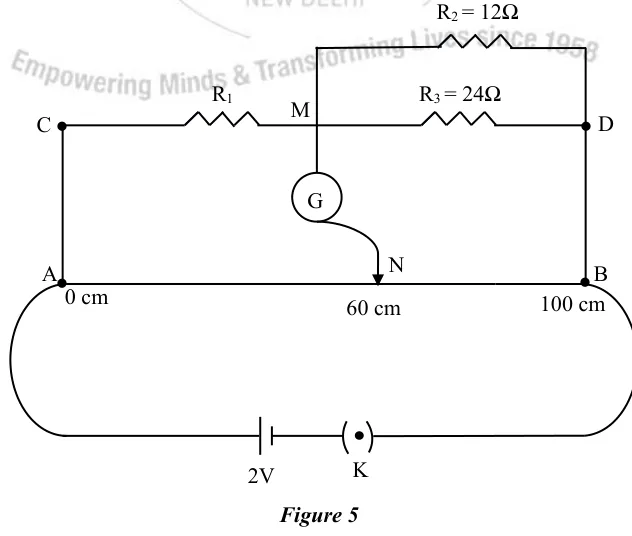 3 marks
In the circuit shown in Figure 5, the central zero galvanometer G shows no deflection when the key K is closed. Calculate the value of resistor R1.
Why this question: Current Electricity → Metre bridge: find the unknown resistance from the balance point — appeared 2× Sample 2023Sample 2027
Q32.3 marks
For any prism, show that refractive index 'n' of its material is given by: n = sin((A+δm)/2) / sin(A/2), where the terms have their usual meaning.
Why this question: Ray Optics and Optical Instruments → Derive the prism formula relating A, deltam and refractive index — appeared 3× Board 2023Board 2025Sample 2023
Q33.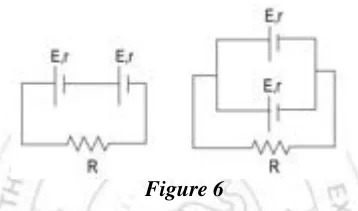 3 marks
Study the two circuits shown in Figure 6. The cells in the two circuits are identical. The resistance of R is the same in both. If the same current flows through R in both circuits, calculate the internal resistance of each cell in terms of the resistance R.
Why this question: Current Electricity → Relate internal and external resistance for equal current in series vs parallel cells — appeared 2× Sample 2024Sample 2025
Q34.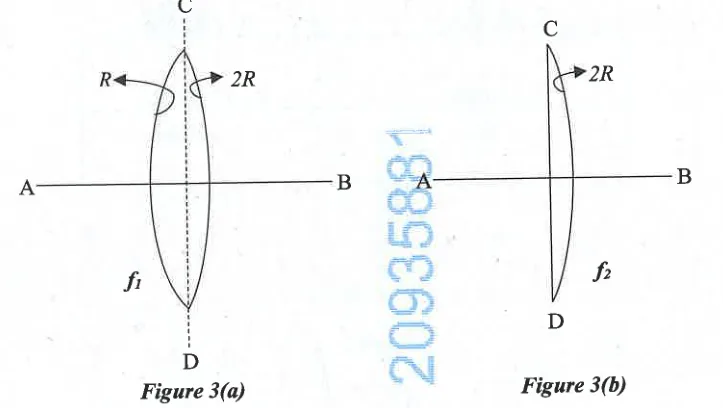 2 marks
A bi-convex lens of focal length f1 is placed in air (Figure 3a). The radii of curvature of its first and second surfaces are R and 2R respectively. The lens is cut along the plane CD. Compare the focal length f2 of the resulting lens (Figure 3b) with that of the original lens (Figure 3a).
Why this question: Ray Optics and Optical Instruments → Focal length of a lens after cutting it into parts — appeared 3× Board 2026Sample 2024Sample 2025
Q35.2 marks
A galvanometer of resistance 100 Ω gives a full-scale deflection for a potential difference of 200 mV. What must be the resistance connected to convert the galvanometer into an ammeter of the range 0-200 mA?
Why this question: Magnetic Effects of Current and Magnetism → Convert a galvanometer to an ammeter and find the shunt resistance — appeared 3× Board 2023Sample 2024Sample 2025
Q36.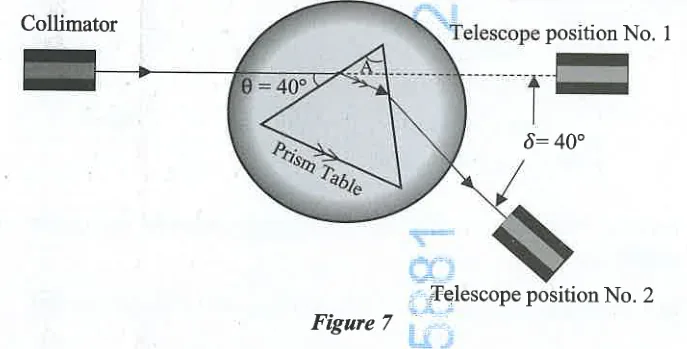 2 marks
A monochromatic ray of light incident on one refracting surface of an equilateral prism suffers a deviation as shown in Figure 7. Calculate the refractive index of the material of the prism.
Why this question: Ray Optics and Optical Instruments → Refractive index of a prism from deviation data (prism formula numerical) — appeared 2× Board 2026Sample 2027