ISC Class 12 Chemistry Important Questions 2027 (Repeated in Board Exams)
Last updated:
78 question patterns that appeared in two or more of the analysed papers (4 board + 5 official sample papers (2023–2027)). The numbers change; the question does not.
Solutions
1. Rank solutions by a colligative property using van't Hoff factor
3×Sample 2024Sample 20271/5 marks
The correct order of freezing point of 0.5 M solution of urea, AlCl3, KCl and MgCl2 is:
(a) AlCl3 > MgCl2 > KCl > urea
(b) Urea > KCl > MgCl2 > AlCl3
(c) MgCl2 > KCl > AlCl3 > urea
(d) KCl > MgCl2 > AlCl3 > urea
2. Mass of solute for a given depression of freezing point
4×Board 2023Board 2026Sample 2024Sample 20261/2/5 marks
(i) Calculate the mass of ascorbic acid (molecular mass = 176 g mol-1) to be dissolved in 75 g of acetic acid to lower its freezing point by 1.5 degC. Assume the solute neither associates nor dissociates. (Kf for acetic acid = 3.9 K kg mol-1) (ii) A solution of an organic compound was prepared by dissolving 6.8 g in 0.1 litre of water. Calculate the osmotic pressure of this solution at 25 degC. (Molecular mass = 321.45 g mol-1) (iii) Why are aquatic species more comfortable in cold water than warm water?
3. Percentage/degree of association from freezing-point depression (dimer)
3×Board 2023Sample 2026Sample 20272/3/5 marks
(a) 300 ml of aqueous solution of protein contains 1.85 g of protein, the osmotic pressure at 25 degC is 3.05 x 10⁻³ atm. Calculate the molar mass of the protein. (b) Phenol (C6H5OH) associates in benzene to form a dimer. A solution of 2.5 g of phenol in 120 g of benzene lowers its freezing point by 0.85 K. Calculate the degree of association of phenol. (kf benzene=5.12 K kg mol-1, molecular mass of phenol=94) (c) The molecular weight of potassium chloride and sucrose is determined by the depression of freezing point method. Compared to their theoretical molecular weight, what will be their observed molecular weights? Justify.
4. Assertion-reason comparing delta Tf of two solutions
2×Board 2026Sample 20261 marks
Assertion: The depression of freezing point of 0.1 molal aqueous solution of MgCl2 is less than that of 0.1 molal aqueous solution of NaCl.
Reason: The number of particles furnished by 0.1 molal MgCl2 is less than that of 0.1 molal NaCl.
(a) Both Assertion and Reason are true and Reason is the correct explanation for Assertion.
(b) Both Assertion and Reason are true but Reason is not the correct explanation for Assertion.
(c) Assertion is true and Reason is false.
(d) Both Assertion and Reason are false.
5. Calculate boiling point of a solution from elevation
2×Sample 2024Sample 20252/5 marks
(a) Calculate the boiling point of urea solution when 8.0 g of urea is dissolved in 250 g of water. Boiling point of pure water is 373 K. (kb of water = 0.52 K kg mol-1, molecular mass of urea = 60 g mol-1) (b) Ethylene glycol is used as an antifreeze agent. Calculate the amount of ethylene glycol to be added to four kilogram of water to prevent it from freezing at -6 degC. (Kf of water = 1.86 K kg mol-1) Assume that ethylene glycol (CH2OH.CH2OH) does not dissociate or associate in aqueous solution. (c) What will be the effect on the value of molality and molarity of a solution with change in temperature?
6. Abnormal molar mass from delta Tf and infer association/dissociation
2×Board 2026Sample 20252/3 marks
(i) 0.680 g of a compound is dissolved in 15 g of benzene and the freezing point of solution is lowered by 1.44 degC. Calculate the experimental molecular mass of the compound. (Kf for benzene = 5.12 K kg mol-1) (ii) If the theoretical molecular mass of the compound is 80.5 g mol-1, suggest whether it is undergoing association or dissociation.
7. Grams of glucose for IV solution isotonic with blood
2×Board 2023Sample 20252/5 marks
[context: Osmosis and osmotic pressure play a very significant role in biological processes. The osmotic pressure of human blood is 8.21 atm at 27 degC. A 0.91% (mass/volume) solution of NaCl, known as saline water, is isotonic with fluids inside the human red blood cells, so the blood corpuscles neither swell nor shrink; medicines are mixed with saline water before being injected into the veins.] (a) What is an isotonic solution? (b) How much glucose should be used per 100 ml (aqueous solution) for intravenous injection isotonic with blood at 27 degC? (c) What would be the osmotic pressure of blood if the temperature is 37 degC? (d) A pure NaCl solution with salt concentration less than 0.91% (mass/volume) is hypertonic to human blood. Is this statement true or false? Give a reason. (e) Name the disease caused by taking a lot of salt or salty food, which results in water retention in tissue cells causing puffiness or swelling.
8. Molar mass of protein/haemoglobin from osmotic pressure
2×Board 2024Sample 20232 marks
If 200 cm3 of an aqueous solution of a protein contains 1.26 g of protein, the osmotic pressure of the solution at 300 K is found to be 2.57 x 10⁻³ atm. Calculate the molar mass of protein. (R = 0.0821 L atm K-1 mol-1)
9. Degree of dissociation of BaCl2 from boiling-point elevation
2×Board 2024Sample 20233 marks
An aqueous solution containing 12.50 g of barium chloride in 1000 g of water boils at 373.0834 K. Calculate the degree of dissociation of barium chloride. Given Kb for H2O = 0.52 K kg mol-1; molecular mass of BaCl2 = 208.34 g mol-1.
Electrochemistry
10. Variation of specific and molar conductivity with dilution
5×Board 2024Board 2025Sample 2023Sample 2025Sample 20261/3 marks
[context: Vishal measured the resistance of aqueous KCl solutions at 298 K using a conductivity cell connected to a Wheatstone bridge and recorded: 1.00 M: kappa = 111.3 x 10⁻³ S cm-1, Lambdam = 111.3 S cm2 mol-1; 0.10 M: kappa = 12.9 x 10⁻³, Lambdam = 129.0; 0.01 M: kappa = 1.41 x 10⁻³, Lambdam = 141.0] Why did the molar conductivity increase though the conductivity decreased with dilution?
11. Calculate E-cell and delta G for a given cell
4×Board 2024Sample 2024Sample 2025Sample 20262/3/5 marks
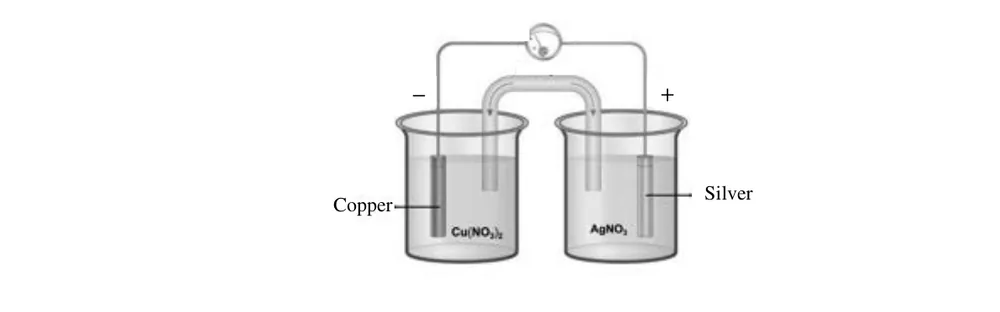
(a) Study the diagram given below that represents a Cu-Ag electrochemical cell (copper electrode in Cu(NO3)2, silver electrode in AgNO3) and answer the questions that follow. Given E0(Cu2+/Cu) = 0.337 V; E0(Ag^+/Ag) = 0.799 V. (1) Write the cell reaction. (2) Calculate the standard emf of the cell. (3) If [Cu2+] is 0.1 M and Ecell is 0.422 V at 25 degC, calculate [Ag^+]. (4) Calculate DeltaG for the cell. (b) Calculate molar conductivity (Lambda0m) for BaCl2 and Al2(SO4)3 from the data: Lambda0m Ba2+=127.2, Lambda0m Cl^-=76.3, Lambda0m Al3+=189, Lambda0m SO42-=160 S cm2 mol-1.
12. Limiting molar conductivity via Kohlrausch's law
3×Board 2026Sample 2026Sample 20271/2/3 marks
The molar conductivities at infinite dilution for NaI, CH3COONa and (CH3COO)2Mg are 126.9, 91.0 and 187.8 ohm-1 cm2 mol-1 respectively at 25 degC. Find out the molar conductivity of MgI2 at infinite dilution by using Kohlrausch's law of independent migration of ions.
13. Write Nernst equation and calculate cell EMF
4×Board 2023Board 2025Sample 2023Sample 20272/5 marks
Write the Nernst equation and calculate the emf of the following cell at 298 K: Mg(s) / Mg2+(1x10⁻³M) // Cu2+(1x10⁻⁴M) / Cu(s). Given EoMg2+/Mg = -2.373 V, EoCu2+/Cu = +0.337 V.
14. Calculate delta G (or max work) from standard EMF
4×Board 2023Board 2024Board 2026Sample 20232/5 marks
Calculate the value of DeltaG0 for the following cell at 25 degC. Zn(s) / Zn2+(1M) || Sn2+(1M) / Sn(s). Given E0Zn2+/Zn = -0.76 V, E0Sn2+/Sn = -0.14 V, 1 Faraday = 96500 coulombs.
15. Degree of dissociation of weak acid from molar conductivity
3×Board 2023Board 2026Sample 20243/5 marks
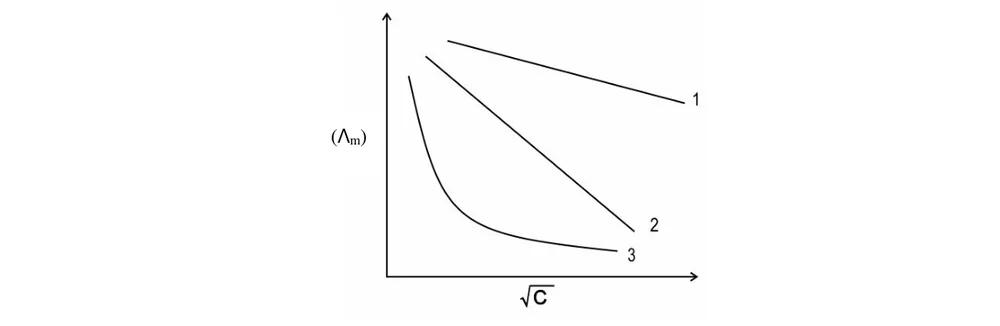
(a) The molar conductivity vs sqrt(C) curves for Na2SO4, H2SO4 and NH4OH are shown in random order (curves 1, 2, 3). Identify the curve corresponding to each and justify. (b) The molar conductivity (Lambdam) of a dilute solution of methanoic acid is 34.1 S cm2/mol. Calculate its degree of dissociation. (Given lambda0(H^+)=349.6 S cm2/mol and lambda0(HCOO^-)=54.6 S cm2/mol)
16. Feasibility of displacement / H2 liberation from electrode potentials
2×Board 2026Sample 20263 marks
(a) When a current of 0.75 ampere is passed through a CuSO4 solution for 25 minutes, 0.370 g of copper is deposited. Calculate the atomic weight of copper. (b) Two metals A and B have standard reduction potential values -0.76 V and +0.34 V respectively. Which of these metals will liberate H2 gas from dil. H2SO4? Why? (c) Why does the specific conductivity (kappa) of a solution decrease on dilution?
17. Faraday electrolysis in series cells (Ag/Cu/Zn)
2×Board 2024Sample 20273/5 marks
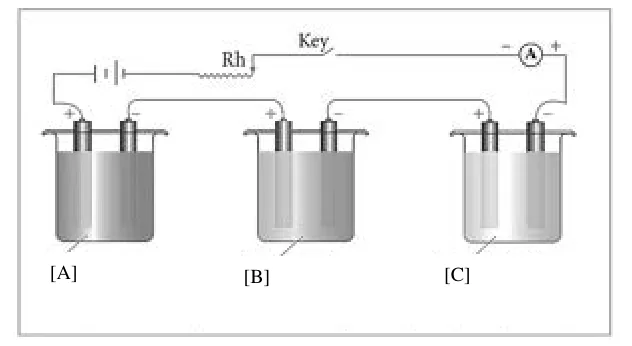
(a) A 0.05 M NH4OH solution offers a resistance of 30.8 ohms to a conductivity cell at 298 K. If the cell constant is 0.343 cm-1 and molar conductance of NH4OH at infinite dilution is 471.4 S cm2 mol-1, calculate (1) Specific conductance (2) Molar conductance (3) Degree of dissociation. (b) In the diagram of the electrolytic cell given below, A, B and C are connected in series, having electrolytes ZnSO4, AgNO3 and CuSO4 respectively. A steady current of 1.5 A was passed until 1.45 g of Ag was deposited at cathode of cell B. (Atomic mass Ag=108, Cu=63.5, Zn=65.3) (1) How long did the current flow? (2) What weight of Cu and Zn was deposited at cathode?
18. Identify strong/weak electrolyte from molar-conductance change on dilution
2×Sample 2024Sample 20251/2 marks
The solutions of two electrolytes A and B are diluted. Lambdam of B increases 1.5 times while that of A increases 25 times. Which of the two is a strong electrolyte? Give a reason.
19. Conceptual: salt bridge role and cell types
2×Board 2025Sample 20253 marks
Answer the following: (a) By referring to electrochemical series, how can anode and cathode half cells be identified in a galvanic cell? (b) What is the role of salt bridge in a galvanic cell? (c) Write an advantage and a disadvantage of a fuel cell.
20. Dry cell construction and limitations
2×Board 2024Sample 20251/3 marks
(i) Dry cells are commonly used in clocks, torches, calculators etc. (a) What acts as anode and cathode in dry cell? (b) Which chemical compounds are filled between anode and cathode of this cell? (c) Why do dry cells not have a long life?
21. Coulombs to deposit/electroplate aluminium
2×Board 2025Sample 20232/5 marks
Calculate the number of coulombs required to electroplate 4.75 g of aluminium when electrode reaction is Al3+ + 3e^- -> Al. (Given: Atomic weight of Al = 27 g mol-1, 1 Faraday = 96500 coulombs)
Chemical Kinetics
22. Order, rate law and rate constant from initial-rate data
5×Board 2024Board 2025Sample 2024Sample 2025Sample 20271/3 marks
Data for hypothetical reaction 2A + B -> 2AB: Exp 1: [A]=0.5, [B]=0.5, rate=1.8x10⁻⁴; Exp 2: [A]=1.0, [B]=0.5, rate=3.6x10⁻⁴; Exp 3: [A]=1.0, [B]=1.0, rate=3.6x10⁻⁴ (mol L-1 sec-1). The rate law expression is:
(a) rate=k[A]1[B]1
(b) rate=k[A]1[B]0
(c) rate=k[A]2[B]1
(d) rate=k[A]0[B]1
23. Activation energy when rate doubles per 10 degC (298-308 K)
3×Sample 2025Sample 2026Sample 20272 marks
In general, the rate of a reaction becomes double with every 10 degC rise in temperature. If this generalisation holds true, calculate the value of activation energy when temperature changes from 295 K to 305 K.
24. First-order: time from percentage decomposition/completion
4×Board 2023Board 2026Sample 2025Sample 20261/2/3 marks
A first order reaction is 40% complete in 20 minutes. Calculate the time required for 90% completion of the same reaction.
25. Effect of changing concentration on reaction rate for a given order
3×Board 2025Board 2026Sample 20261/2 marks
A reaction is of first order with respect to reactant [A] and second order with regard to reactant [B]. What is the effect on rate of reaction when: (i) concentration of only [B] is increased three times? (ii) concentration of both [A] and [B] is doubled?
26. Deduce order from the units of the rate constant
3×Board 2024Board 2025Sample 20261/3 marks
(i) The unit of rate constant of a reaction is same as that of its rate of reaction. Find the order of this reaction. (ii) Give one example of pseudo first order reaction. (iii) How will the rate of reaction be affected when the surface area of the reactant is reduced?
27. Activation energy from rate constants at two temperatures
3×Board 2023Board 2026Sample 20233 marks
(i) The rate constant of a first order reaction increases five times when the temperature is raised from 350 K to 500 K. Calculate the activation energy of the reaction. (R = 8.314 JK-1mol-1) (ii) The unit of rate constant of a reaction is same as that of its rate of reaction. What is the order of this reaction?
28. First-order fraction remaining after whole number of half-lives
2×Board 2024Sample 20272/3 marks
Rohan, a patient of thyroid disorder, was given radioactive Iodine-131 as part of his treatment. What amount of Iodine-131 will be left in Rohan's body after 48 days, if the half-life period of radioactive iodine-131 is 12 days? Assume no amount of the isotope was eliminated through biological processes.
29. First-order age/time from activity or concentration ratio
2×Sample 2024Sample 20251/3 marks
[context: Living beings maintain a balance of radioactive C-14 in their tissues (formed in the upper atmosphere: 7N14 + 0n1 -> 6C14 + 1H1; ratio C-14 : C-12 = 1 : 1012). After death C-14 decays (6C14 -> 7N14 + -1e0 + gamma rays) and is not replaced. The half-life of C-14 is 5770 years, so the age of a fossil can be determined.] In a piece of dead wood, the activity or concentration of C-14 is found to be one third of its initial activity. Calculate the age of the old wood.
30. Determine order and molecularity from a rate law
2×Board 2025Board 20261 marks
Fill in the blanks by choosing the appropriate word(s) from those given in the brackets:
[first, alc. AgCN, primary, decrease, third, increase, zero, Lucas, alc. KCN, KOH, no change, two, Tollen's, AgOH, tertiary]
The hydrolysis of ethyl acetate in acidic medium is a pseudo ______ order reaction. However, the molecularity of the reaction is ______.
31. First-order half-life independent of initial concentration
2×Board 2023Sample 20231 marks
For a first order reaction, the half-life period (t1/2) is:
(a) proportional to the initial concentration.
(b) inversely proportional to the initial concentration.
(c) proportional to the square root of the initial concentration.
(d) independent of the initial concentration.
d- and f-Block Elements
32. Complete and balance oxidising reactions of KMnO4/K2Cr2O7
8×Board 2023Board 2025Board 2026Sample 2023Sample 2025Sample 2026Sample 20272/3/5 marks
(i) Complete and balance the following chemical equation: KMnO4 + H2SO4 + H2S -> (ii) Why do transition metals form alloys? (iii) Potassium dichromate (K2Cr2O7) acts as a powerful oxidising agent in acidic medium. Explain.
33. Lanthanoid contraction - cause and consequences
5×Board 2023Board 2024Board 2025Sample 2024Sample 20251/2 marks
Assertion: The Zr-Hf pair of elements has the same value of atomic radii though Zr and Hf are placed in different periods in the periodic table.
Reason: The lanthanoid contraction prevents the expected increase in atomic radii of Hf.
(a) Both Assertion and Reason are true and Reason is the correct explanation for Assertion.
(b) Both Assertion and Reason are true but Reason is not the correct explanation for Assertion.
(c) Assertion is true and Reason is false.
(d) Both Assertion and Reason are false.
34. Reason for colour of transition-metal ions (d-d transition)
3×Board 2025Sample 2024Sample 20271/2 marks
Fill in the blanks by choosing the appropriate word(s) from those given in the brackets:
[methyl alcohol, ethyl alcohol, paired, one, Cannizzaro, d-d, salicylaldehyde, Perkin's, unpaired, f-f, salicylic acid, Kolbe's, two, 193000, 96500, Reimer-Tiemann]
The colour of transition metal ions is due to ______ electron(s) in d-subshell and ______ transition.
35. Magnetic character and low melting points of Zn/Cd/Hg
2×Sample 2026Sample 20272 marks
Substantiate the following statements with reasons: (i) Cobalt is attracted in a magnetic field whereas Zinc is not. (Co=27, Zn=30) (ii) The melting points and boiling points of Zn, Cd and Hg are low. (Zn=30, Cd=48, Hg=80)
36. Product/colour change on reduction of dichromate/permanganate (MCQ)
3×Board 2024Board 2026Sample 20241 marks
When H2S gas is passed through acidified K2Cr2O7 solution, the colour of the solution changes to:
(a) green
(b) orange
(c) black
(d) red
37. Classification/definition of a transition element
3×Board 2024Sample 2023Sample 20242 marks
Give a reason for each of the following: (i) Zinc, cadmium and mercury are considered as d-block elements but not regarded as transition elements. (ii) Transition metals possess a great tendency to form complex compounds.
38. Variable oxidation states and complex-forming tendency
2×Sample 2023Sample 20251/2 marks
Fill in the blanks by choosing the appropriate word(s) from those given in the brackets:
[four, three, remains same, propane, ns1-2, increases, six, propan-2-ol, (n-1)d1-10, two, decreases, Clemmensen's, Wolff-Kishner]
The variation and magnitude of oxidation state in coordination complexes is due to the participation of inner ______ electrons in addition to outer ______ electrons.
Coordination Compounds
39. VBT hybridisation, magnetic behaviour and geometry of complexes
6×Board 2026Sample 2023Sample 2024Sample 2025Sample 2026Sample 20272/5 marks
Answer the following with respect to the coordination complex ion [Cr(NH3)6]3+: (a) What is the hybridisation state of the central metal atom? (b) Comment on the magnetic nature of the complex ion.
40. CFT configuration, high/low spin, unpaired electrons and CFSE
6×Board 2025Board 2026Sample 2024Sample 2025Sample 2026Sample 20271/2/3/5 marks
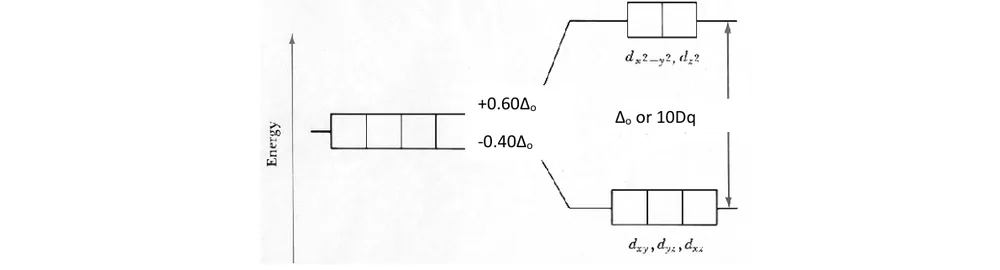
Observe the diagram below of splitting of d-orbitals in an octahedral field and answer the following questions. (a) Identify the electronic configuration of d5 ion, if Deltao < P. (b) Comment on the relationship between crystal field stabilisation energy (Deltao) and the strength of the ligand.
41. Find coordination number and oxidation state of central metal
4×Board 2023Board 2025Sample 2025Sample 20261 marks
The sum of coordination number and oxidation number of metal 'M' in the complex [M(en)2Cl2] is:
(a) 6
(b) 8
(c) 9
(d) 10
42. Ionisation isomerism and ions furnished on ionisation
3×Board 2025Sample 2024Sample 20271/2 marks
Cobalt (III) chloride forms several octahedral complexes with ammonia. Which will NOT give a test for chloride ions with silver nitrate solution at 25 degC?
(a) CoCl3.6NH3
(b) CoCl3.5NH3
(c) CoCl3.4NH3
(d) CoCl3.3NH3
43. Deduce isomerism types, IUPAC name and structure (Werner)
3×Board 2023Board 2024Sample 20275 marks
(i) The compound [PtCl2(NH3)2] known as cis-platin is used in chemotherapy. (a) Write its IUPAC name and the type of isomerism it exhibits. (b) What is the geometry of the compound? (ii) What type of structural isomers are [Pt(NH3)3Br]NO3 and [Pt(NH3)3(NO3)]Br? How can they be distinguished by a chemical test? (iii) A coordination compound CoCl3.4H2O precipitates silver chloride when treated with silver nitrate. The molar conductance of its solution corresponds to a total of two ions. Write the structural formula of the compound and name it.
44. IUPAC name from formula and formula from IUPAC name
2×Board 2026Sample 20262 marks
Write the IUPAC names of the following complex compounds: (i) [Pt(NH3)4Cl2]SO4 (ii) K2[Ni(CN)4]
45. Identify complex by magnetic behaviour and geometry (MCQ)
2×Board 2024Board 20261 marks
Which one of the following is a tetrahedral complex as well as diamagnetic in nature?
(a) [Ni(CN)4]2-
(b) [NiCl4]2-
(c) [Cu(NH3)4]2+
(d) [Ni(CO)4]
Haloalkanes and Haloarenes
46. Alkyl halide with KCN vs AgCN (cyanide vs isocyanide)
3×Board 2026Sample 2026Sample 20271/3 marks
Rehan and Ananya were given the same alkyl halide (C2H5Cl). Rehan used alcoholic KCN and Ananya used alcoholic AgCN. Rehan's compound could be converted to a carboxylic acid on hydrolysis but Ananya could not obtain the same acid, due to the bonding behaviour of cyanide ions. Write the chemical equations of the reactions and the IUPAC names of the compounds formed by Rehan and Ananya.
47. Nucleophilic substitution product/equation for halogen compounds
2×Board 2023Sample 20261/2 marks
When Chlorobenzene is heated with aq. ammonia in the presence of Cu2O at high pressure, it gives:
(a) aniline
(b) phenyl isocyanide
(c) diphenyl
(d) diphenylamine
48. Assertion-reason on electrophilic aromatic substitution of haloarenes
2×Board 2025Sample 20231 marks
Assertion: The process of halogenation of benzene takes place in the presence of anhydrous FeCl3.
Reason: Anhydrous FeCl3 prepares nucleophile to attack the benzene ring.
(a) Both Assertion and Reason are true and Reason is the correct explanation for Assertion.
(b) Both Assertion and Reason are true but Reason is not the correct explanation for Assertion.
(c) Assertion is true and Reason is false.
(d) Both Assertion and Reason are false.
49. A-to-B conversion involving the iodoform reaction
2×Board 2024Board 20262 marks
Write chemical equations to convert each of the following: (i) Chlorobenzene to aniline (ii) Iodoform to acetylene
50. Optical isomerism and properties of enantiomers
2×Board 2023Sample 20241/2 marks
Two compounds, D-2-chlorobutane and L-2-chlorobutane, are enantiomers of each other. Name one physical property that is: (i) same for D-2-chlorobutane and L-2-chlorobutane. (ii) different for D-2-chlorobutane and L-2-chlorobutane.
Alcohols, Phenols and Ethers
51. Cleavage of ethers by HI (product and SN1/SN2 mechanism)
4×Board 2024Sample 2025Sample 2026Sample 20271/2 marks
Assertion: When an ether containing a primary alkyl group and tertiary alkyl group is treated with hydrogen iodide, tertiary alkyl iodide is formed.
Reason: The reaction takes place via SN1 mechanism, and the more stable tertiary carbocation is formed easily which combines with iodide ion to form tertiary alkyl iodide.
(a) Both Assertion and Reason are true and Reason is the correct explanation for Assertion.
(b) Both Assertion and Reason are true but Reason is not the correct explanation for Assertion.
(c) Assertion is true and Reason is false.
(d) Both Assertion and Reason are false.
52. A-to-B conversions using Grignard alcohol synthesis, Reimer-Tiemann and Williamson
4×Board 2024Board 2026Sample 2026Sample 20272/3 marks
How will the following be converted? (Give chemical equations) (a) Diethyl ether from sodium ethoxide (b) Propan-2-ol from Grignard's reagent (c) Phenol from Cumene
53. Acidity of phenol and comparison of acidic strength
3×Board 2025Board 2026Sample 20271 marks
[context: The boiling points of alcohols are higher than those of corresponding ethers due to intermolecular hydrogen bonding and increase with molecular mass; for isomeric alcohols the order is 1 deg > 2 deg > 3 deg: Propan-1-ol 370 K, Butan-1-ol 391 K, Butan-2-ol 371 K, 2-methyl-propan-2-ol 356 K. Aliphatic alcohols are weak acids, weaker than water and phenol. Phenols are used both as a disinfectant and an antiseptic at different concentrations.] Although alcohols are weaker acids than water, phenol is more acidic than alcohols. Justify.
54. Preparation of picric acid from phenol (with other conversions)
3×Board 2025Sample 2023Sample 20242/3/5 marks
[context: Phenol is an aromatic alcohol used to prepare many important compounds such as picric acid. It is widely used in household and industrial settings as a cleaner and disinfectant, and as a primary chemical to make plastics. Phenol is less soluble in water as compared to aliphatic alcohol. Some aliphatic alcohols are toxic and can be addictive.] (i) How is the acid (picric acid) prepared from phenol? Write the chemical reaction. (ii) 'Phenol is less soluble in water as compared to aliphatic alcohol.' Explain. (iii) Write the chemical equation for the preparation of phenol from chlorobenzene. (iv) An organic compound [A] C4H10O gives positive Lucas test within five minutes at room temperature. [A] upon oxidation with K2Cr2O7/H2SO4 forms [B] which does not respond to Tollen's test. Identify compounds [A] and [B]. (v) In the above reaction, [B] gets reduced with Zn/Hg and HCl and forms [C]. Identify [C] and write the balanced reaction for the conversion of [B] to [C].
55. Chemical tests to distinguish pairs of compounds
3×Board 2024Board 2025Sample 20252/3 marks
Write the chemical test to distinguish between each of the following pairs of compounds: (i) Ethanol and propan-1-al (ii) Phenol and benzoic acid
56. Boiling point trend of alcohols with chain length/branching
2×Sample 2024Sample 20271 marks
[context: The boiling points of alcohols are higher than those of corresponding ethers due to intermolecular hydrogen bonding and increase with molecular mass; for isomeric alcohols the order is 1 deg > 2 deg > 3 deg: Propan-1-ol 370 K, Butan-1-ol 391 K, Butan-2-ol 371 K, 2-methyl-propan-2-ol 356 K. Aliphatic alcohols are weak acids, weaker than water and phenol. Phenols are used both as a disinfectant and an antiseptic at different concentrations.] The boiling point of 2-methyl-propan-2-ol is much lower than that of butan-1-ol, although both have the same molecular formula. Give a reason.
57. Kolbe reaction to salicylic acid / aspirin
2×Sample 2024Sample 20271/2 marks
Fill in the blanks by choosing the appropriate word(s) from those given in the brackets:
[methyl alcohol, ethyl alcohol, paired, one, Cannizzaro, d-d, salicylaldehyde, Perkin's, unpaired, f-f, salicylic acid, Kolbe's, two, 193000, 96500, Reimer-Tiemann]
The product formed when sodium phenoxide is treated with CO2 at 400 K, under 4-7 atm pressure and then acidified with dilute HCl is ______. The reaction is known as ______ reaction.
58. Lucas reagent and reactivity order of 1/2/3 alcohols
2×Board 2026Sample 20241/2 marks
Fill in the blanks by choosing the appropriate word(s) from those given in the brackets:
[first, alc. AgCN, primary, decrease, third, increase, zero, Lucas, alc. KCN, KOH, no change, two, Tollen's, AgOH, tertiary]
A mixture of anhydrous ZnCl2 and conc. HCl is called ______ reagent which shows maximum reactivity with ______ alcohol.
59. Identify unknown compounds A-C in an alcohol/phenol reaction sequence
3×Board 2023Board 20242/3 marks
An organic compound [A] having molecular formula C4H10O forms a compound [B] with molecular formula C4H8O on oxidation. Compound [B] gives a positive iodoform test. The reaction of compound [B] with CH3MgBr followed by hydrolysis gives compound [C] with molecular formula C5H12O. Identify the compounds [A], [B] and [C]. Write the reaction for the conversion of compound [A] to compound [B].
60. Balanced equations for named reactions (Reimer-Tiemann/Kolbe/Williamson/Finkelstein)
2×Board 2025Sample 20233 marks
Write chemical equations to illustrate the following name reactions: (i) Finkelstein reaction (ii) Williamson's synthesis (iii) Reimer-Tiemann reaction
61. Product of alcohol dehydration at a given temperature
2×Board 2024Sample 20231/2 marks
Fill in the blanks by choosing the appropriate word(s) from those given in the brackets:
[lead poisoning, zero, phosgene, dependent, cancer, independent, diethyl ether, first, ethyl carbonate, ethene]
The dehydration of ethyl alcohol with conc. H2SO4 at 140 degC mainly yields ______ while at 170 degC the main product formed is ______.
Aldehydes, Ketones and Carboxylic Acids
62. Cannizzaro reaction (product/sequence)
4×Board 2024Sample 2025Sample 2026Sample 20271/2/5 marks
Fill in the blanks by choosing the appropriate word(s) from those given in the brackets:
[methyl alcohol, ethyl alcohol, paired, one, Cannizzaro, d-d, salicylaldehyde, Perkin's, unpaired, f-f, salicylic acid, Kolbe's, two, 193000, 96500, Reimer-Tiemann]
Formaldehyde reacts with conc. alkali to give sodium formate and ______ due to the absence of alpha-hydrogen atom. The reaction is known as ______ reaction.
63. Rosenmund reduction and related carbonyl sequences
4×Board 2023Board 2025Sample 2024Sample 20252/3 marks
Identify the compounds [A], [B], [C] and [D] in the following reaction: CH3COOH + PCl5 -> [A] --H2/Pd-BaSO4, boiling xylene--> [B] --K2Cr2O7+H2SO4/[O]--> [C] --Ca(OH)2, heat--> [D]
64. Clemmensen reduction product/equation
3×Board 2023Sample 2025Sample 20261/2 marks
What happens when carbonyl compound is treated with zinc amalgam and concentrated hydrochloric acid? Give chemical equation and write the name of the reaction.
65. Grignard synthesis with acidity comparison of substituted acids
2×Sample 2023Sample 20275 marks
An organic compound [A] (C2Cl3O2H) is obtained when compound [B] reacts with red phosphorous and Cl2. [B] can be obtained on reaction of methyl magnesium bromide with carbon dioxide followed by acid hydrolysis. Upon partial reduction, [B] forms [C] (C2H4O) which gives yellow precipitate of iodoform on heating with iodine and sodium hydroxide. [C] also reacts with dilute NaOH to form [D]. (a) Identify [A], [B], [C] and [D]. (b) Write the reaction for formation of [A] from [B]. What is the reaction called? (c) Write the chemical test to distinguish between [C] and acetone. (d) Which will be more acidic, [A] or [B]? Why?
66. Identify carbonyl via oxime formation / distinguishing aldehyde from ketone
2×Board 2024Sample 20261/3 marks
An organic compound with molecular formula C3H6O does not give silver mirror test with Tollen's reagent but gives an oxime with hydroxylamine. The compound is:
(a) CH3CH2CHO
(b) CH3-CO-CH3
(c) CH2=CH-CH2OH
(d) CH2=CH-O-CH3
67. Chemical tests to distinguish carbonyl compounds and acids
2×Board 2026Sample 20232 marks
Write chemical tests to distinguish between the following pairs of compounds: (a) Acetaldehyde and acetone (b) Acetic acid and benzaldehyde
Organic Compounds containing Nitrogen
68. Identify compounds in amine sequences (Hofmann degradation, carbylamine, nitrile reduction)
6×Board 2023Board 2025Board 2026Sample 2023Sample 2026Sample 20272/3 marks
An organic compound [A] with molecular formula C3H7NO forms compound [B] on heating with Br2 and KOH. Compound [B] on heating with CHCl3 and alcoholic KOH produces a pungent smelling compound [C]. Compound [B] on reacting with C6H5SO2Cl forms compound [D] which is soluble in alkali. Write the structures of compounds [A], [B], [C] and [D].
69. Reduction of nitriles vs isocyanides (1 vs 2 amine)
3×Sample 2023Sample 2025Sample 20271/2 marks
Which of the following reactions will NOT give primary amine?
(a) C2H5NC --LiAlH4-->
(b) C2H5CN --LiAlH4-->
(c) C2H5CONH2 --Br2/KOH-->
(d) CH3CONH2 --Br2/KOH-->
70. Nitrobenzene reduction, diazotisation and onward conversions
3×Sample 2023Sample 2025Sample 20273 marks
Write the chemical equations for the following conversions: (i) Nitrobenzene to benzene (ii) Aniline to bromobenzene (iii) Methyl cyanide to ethylamine
71. Diazotisation and Sandmeyer reaction
3×Board 2026Sample 2023Sample 20262 marks
Write chemical reactions for the following named organic reactions: (i) Diazotisation reaction (ii) Sandmeyer's reaction
72. Balz-Schiemann and coupling reactions
2×Sample 2026Sample 20272 marks
Illustrate the following reactions with an example in each case: (a) Coupling reaction (b) Balz-Schiemann reaction
73. Reason for solubility and basicity of amines/aniline
3×Board 2023Sample 2023Sample 20241/2 marks
Assertion: Aniline is soluble in HCl while it is only slightly soluble in water.
Reason: Aniline cannot make hydrogen bonds with water but gets protonated easily by acids.
(a) Both Assertion and Reason are true and Reason is the correct explanation for Assertion.
(b) Both Assertion and Reason are true but Reason is not the correct explanation for Assertion.
(c) Assertion is true but Reason is false.
(d) Assertion is false but Reason is true.
74. Arrange amines in order of basic strength
2×Sample 2024Sample 20251/3 marks
The correct order of the increasing basic nature of Ammonia, Methylamine and Aniline is:
(a) Methylamine < Aniline < Ammonia
(b) Aniline < Methylamine < Ammonia
(c) Ammonia < Aniline < Methylamine
(d) Aniline < Ammonia < Methylamine
75. A-to-B conversions via diazonium replacement
2×Board 2023Sample 20233 marks
How will the following be converted? (Give chemical equation) (a) Ethyl bromide to ethyl isocyanide. (b) Aniline to benzene diazonium chloride. (c) Benzene diazonium chloride to phenol.
76. Carbylamine (isocyanide) reaction
2×Board 2023Board 20251 marks
Which one of the following can produce the foul smelling compound methyl isocyanide in presence of alcoholic KOH?
(a) Chloroform and aniline
(b) Chloroform and methanol
(c) Chloroform and dimethyl amine
(d) Chloroform and methyl amine
Biomolecules
77. Vitamin deficiency, sugar hydrolysis and protein denaturation
7×Board 2023Board 2024Board 2025Sample 2023Sample 2024Sample 2026Sample 20273 marks
(i) Identify the non-reducing sugar which on hydrolysis gives two reducing monosaccharides. (ii) Which structure of protein is normally unaffected during denaturation of protein? (iii) Name the vitamins whose deficiency cause the following diseases: (a) Rickets (b) Night blindness
78. Peptide linkage with glucose/nucleotide structure and reducing sugars
2×Board 2026Sample 20253 marks
(i) Give one example each of fibrous protein and globular protein. (ii) The structures of two amino acids, glycine and alanine, are given below. Draw the peptide linkage between these two amino acids.
Glycine: H2N-CH2-COOH Alanine: H2N-CH(CH3)-COOH
(iii) Justify that glucose is an aldose form of sugar, with the help of a chemical reaction.