ISC Class 12 Biology Guess Paper 2027
Last updated:
A full practice paper on the official Biology pattern, built from the most-likely questions by repetition analysis. Not an official or leaked paper.
ISC Class 12 Biology — Guess Paper 2027
Time: 3 hours · Maximum marks: 70 · Practice paper
Section ACompulsory. Question 1 has eighteen sub-parts; every answer carries one mark (twenty one-mark answers in all, as sub-parts xvi and xviii each have parts (a) and (b)): seven are MCQ-type (five four-option MCQs and two assertion-reason) and thirteen are very-short-answer (name/expand/analogy/reason/calculate/construct). No internal choice.
Q1.1 mark
A retroviral RNA undergoes reverse transcription to produce a double-stranded DNA molecule containing a six-nucleotide-long palindromic sequence. A partial segment of this double-stranded DNA is shown below:
5′– GGA --- – 3′
3′– --- --- --- – 5′
Obtain the six nucleotide long palindromic DNA sequence on the 3′ – 5′ strand of DNA.
Why this question: Biotechnology: Principles and Processes → identify / write a palindromic recognition sequence — appeared 3× Sample 2023Sample 2025Sample 2027
Q2.1 mark
A survey was conducted to study the age structure of a human population. The data obtained is shown below: Adults 60,000; Children 35,000; Old 50,000. Based on the above data, identify the MOST appropriate shape of the age pyramid for this population.
(a) Pyramidal
(b) Triangular
(c) Urn-shaped
(d) Bell-shaped
Why this question: Organisms and Populations → represent/explain the three types of age pyramids — appeared 3× Board 2023Sample 2026Sample 2027
Q3.1 mark
In a single-stranded segment of a DNA molecule, the base ratio (A+T):(G+C) is found to be 0·3:1. What will be the ratio (A + G):(T + C) for the entire double-stranded DNA molecule?
(a) 1:1
(b) 3:10
(c) 10:3
(d) 13:3
Why this question: Molecular Basis of Inheritance → calculate base percentages using Chargaff's rule — appeared 3× Board 2025Sample 2023Sample 2027
Q4.1 mark
Construct an ecological pyramid of biomass for the following food chain: Grass → Deer → Fleas
Why this question: Ecosystem → Pyramid of biomass for a given food chain — appeared 2× Board 2023Sample 2027
Q5.1 mark
If a person shows the production of interferons in his body, then he is suffering from:
(a) Malaria
(b) Ring worm
(c) Dengue
(d) Typhoid
Why this question: Human Health and Diseases → identify interferons as antiviral chemicals — appeared 2× Board 2024Sample 2024
Q6.1 mark
Stuti ate a cake containing nuts and immediately developed swelling of the lips and difficulty in breathing. Identify the chemical responsible for Stuti's condition.
(a) Insulin
(b) Histamine
(c) Interferon
(d) Adrenaline
Why this question: Human Health and Diseases → MCQ: chemical released in an allergic reaction (histamine) — appeared 1× Sample 2027
Q7.1 mark
Identify the vectors used for cloning genes into eukaryotic organisms.
(P) BAC
(Q) Bacteriophages
(R) Ti plasmid
(S) Disarmed retroviruses
(a) Only (P) and (Q)
(b) Only (P) and (R)
(c) Only (Q) and (S)
(d) Only (R) and (S)
Why this question: Biotechnology: Principles and Processes → MCQ: vectors for cloning genes into eukaryotes (Ti plasmid, disarmed retroviruses) — appeared 1× Sample 2027
Q8.1 mark
A research scholar isolated a novel restriction enzyme from Bacillus anthracis strain ZT4. It was the third restriction enzyme to be extracted from this specific strain. Derive the scientific name for this enzyme by applying the standard rules of biological nomenclature.
Why this question: Biotechnology: Principles and Processes → derive the name of a restriction enzyme by standard nomenclature — appeared 4× Board 2025Board 2026Sample 2026Sample 2027
Q9.1 mark
If the number of chromosomes in the cells of the calyx is 16, how many chromosomes will be formed in the endosperm after double fertilisation?
Why this question: Sexual Reproduction in Flowering Plants → work out endosperm chromosome number / ploidy (3n) numerical — appeared 4× Board 2025Board 2026Sample 2025Sample 2026
Q10.1 mark
A forest has a GPP of 20,000 kcal/m2/year, and 40% of this energy is used for respiration. Calculate the amount of energy available as NPP.
Why this question: Ecosystem → calculate GPP or NPP using GPP = NPP + respiration — appeared 4× Board 2025Sample 2023Sample 2024Sample 2027
Q11.1 mark
A rural area has a population density of 150 individuals per sq. km. If the area is 250 sq. km, what will be the total population of the rural area?
Why this question: Organisms and Populations → calculate natality / mortality / density / growth rate from population counts — appeared 4× Board 2024Board 2025Board 2026Sample 2027
Q12.1 mark
State the underlying principle of ELISA test.
Why this question: Biotechnology and its Applications → ELISA / PCR for molecular diagnosis and their principle — appeared 3× Sample 2023Sample 2025Sample 2027
Q13.1 mark
In the year 2021, the population of fish in a lake was 500. After one year, a biologist found that the population had an average natality of 120, average mortality of 65, immigration was 25 and emigration was 30. Calculate the total number of fish that were present in the lake in 2022.
Why this question: Organisms and Populations → calculate resultant population / growth rate from vital events — appeared 3× Board 2026Sample 2024Sample 2026
Q14.1 mark
Give a reason: The period of lactational amenorrhoea is marked by the absence of menstruation.
Why this question: Reproductive Health → explain lactational amenorrhoea as a natural contraceptive — appeared 3× Board 2025Sample 2023Sample 2024
Q15.1 mark
Ravi wanted to grow rice in his field. He was very concerned about environment degradation, so he did not want to use chemical fertilisers. Suggest a suitable biological method to Ravi.
Why this question: Microbes in Human Welfare → suggest a biofertiliser/biological method to raise soil fertility — appeared 2× Sample 2025Sample 2026
Q16.1 mark
Name the bond which exists between chain-A and chain-B of human insulin.
Why this question: Biotechnology and its Applications → proinsulin to mature insulin processing and disulphide linkage — appeared 3× Board 2024Board 2026Sample 2023
Q17.1 mark
A patient was found to have a mass of pancreatic cells in the liver producing large amounts of amylase. Further medical tests revealed a tumor in the pancreas. What type of tumour had developed in the pancreas?
Why this question: Human Health and Diseases → Types of tumours: benign vs malignant (metastasis) — appeared 2× Board 2025Sample 2027
Q18.1 mark
In a particular plant with bilobed dithecous anther, there were 50 Pollen Mother Cells. Only 25% could develop their pollen tubes. Calculate the number of pollen grains that would proceed for fertilisation.
Why this question: Sexual Reproduction in Flowering Plants → calculate pollen grains / male gametophytes from microspore mother cells — appeared 2× Board 2026Sample 2026
Q19.1 mark
Construct a pyramid of numbers for an ecosystem in which a single large aquatic plant supports a population of small herbivorous fish, which are consumed by a larger population of predatory fish such as kingfish.
Why this question: Ecosystem → draw a pyramid of numbers (tree-based, inverted) — appeared 2× Sample 2023Sample 2026
Q20.1 mark
Why are tendrils of vine (Vitis) and pea (Pisum) considered to be analogous organs?
Why this question: Evolution → identify/justify analogous organs as convergent evolution — appeared 2× Board 2025Sample 2026
Section BSeven questions (Q2-Q8), each carrying two marks. Internal choice is provided in two questions.
Q21.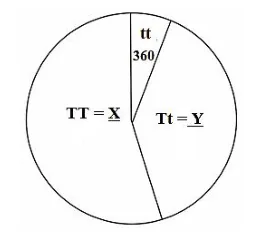 2 marks
The given pie chart shows the distribution of genotypes in a population of 9000 pea plants (TT = X, Tt = Y, tt = 360). The population is in Hardy-Weinberg equilibrium. It is known that 360 plants are homozygous recessive (tt). Using this information, calculate the following: (a) Frequency of the dominant allele (T) (b) Number of heterozygous pea plants
Why this question: Evolution → Hardy-Weinberg numerical: calculate allele / genotype frequencies — appeared 6× Board 2024Board 2025Sample 2024Sample 2025Sample 2026Sample 2027
Q22.2 marks
The amount of energy at the fourth trophic level in the food chain given below is 4 J. Grass -> Zebra -> Crocodile -> Vulture. What will be the amount of energy available at the sunlight and transducer level?
Why this question: Ecosystem → calculate energy at trophic levels using the 10% law — appeared 3× Board 2026Sample 2025Sample 2026
Q23.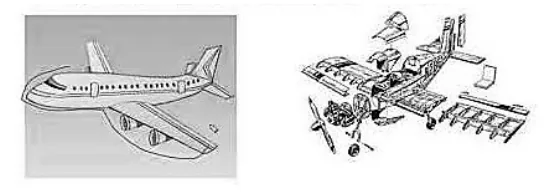 2 marks
The image shown below represents an ecological hypothesis proposed by Paul Ehrlich. Study it carefully and answer the following question. Identify and explain this ecological hypothesis.
Why this question: Biodiversity and its Conservation → explain the Rivet Popper Hypothesis — appeared 3× Board 2025Sample 2023Sample 2027
Q24.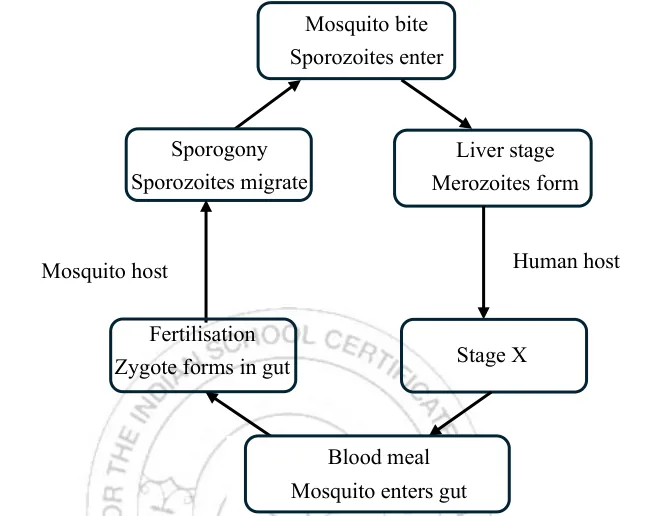 2 marks
The flowchart provided below represents the life cycle of Plasmodium, alternating between its human host and the female Anopheles mosquito. (a) Identify Stage 'X'. (b) Name the toxin directly responsible for the recurring chills and fever experienced by a patient suffering from malaria.
Why this question: Human Health and Diseases → outline / interpret the life cycle of the malarial parasite — appeared 3× Board 2023Board 2026Sample 2027
Q25.2 marks
An alien gene was ligated by a research scholar at Sal I site of pBR322 plasmid. It affected a selectable marker. (i) Name the selectable marker which was affected. (ii) State the underlying principle due to which the selectable marker was affected.
Why this question: Biotechnology: Principles and Processes → Insertional inactivation of a selectable marker in pBR322 — appeared 2× Sample 2025Sample 2027
Q26.2 marks
Name any two factors responsible for the loss of biodiversity in a geographical region.
Why this question: Biodiversity and its Conservation → explain the major causes of biodiversity loss (Evil Quartet) — appeared 3× Board 2023Sample 2024Sample 2025
Q27.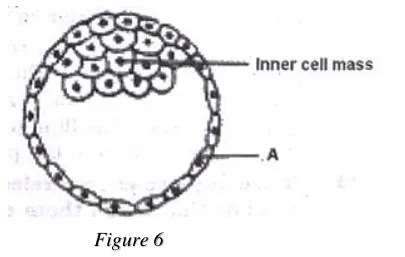 2 marks
The diagram given below represents a specific stage of human embryonic development. (a) Name the stage of human embryo represented by the given diagram. (b) Identify the part labelled 'A' and mention its function. (c) What happens to the inner cell mass after implantation?
Why this question: Human Reproduction → Blastocyst stage: trophoblast and inner cell mass — appeared 2× Sample 2024Sample 2027
Section CSeven questions (Q9-Q15), each carrying three marks. Internal choice is provided in two questions.
Q28.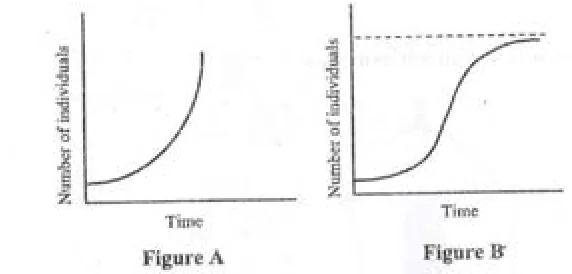 3 marks
Study the two figures shown below that represent two growth models (Figure A, Figure B). (i) Which one of the two figures represents an unlimited supply of nutrients? Give a reason. (ii) Which figure depicts a challenge to population growth? (iii) Explain the term reproductive fitness. (iv) Give the mathematical expressions for Figure A and Figure B.
Why this question: Organisms and Populations → draw/interpret growth curve and give mathematical expression — appeared 4× Board 2024Board 2025Board 2026Sample 2027
Q29.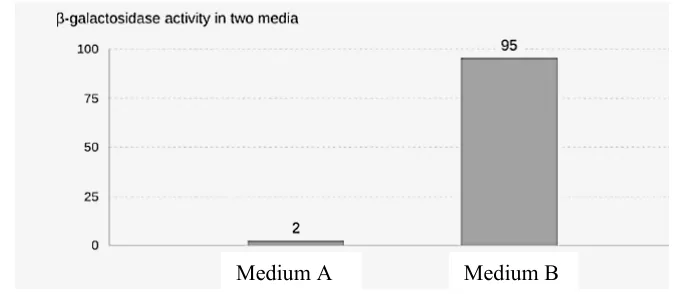 3 marks
The bar graph given below shows the growth of E. coli in two different media (Medium – A and Medium – B), along with the corresponding β-galactosidase activity (Medium A: 2; Medium B: 95) and the state of the lac operon in each case. Based on the above graph, answer the following questions: (a) Why is the operon switched OFF in one medium? (b) The lac operon is described as an example of negative regulation of gene expression. Explain the statement with reference to the role of the operator site.
Why this question: Molecular Basis of Inheritance → explain lac operon structure and function with lactose — appeared 3× Board 2023Sample 2026Sample 2027
Q30.3 marks
The red panda has been listed as an endangered species on the IUCN Red List since 2015. Regional captive breeding programmes have been established in the zoos around the world to protect the red panda from extinction. (i) Classify the biodiversity conservation programme referred to above. (ii) Mention any other two methods of conservation which belong to the same category.
Why this question: Biodiversity and its Conservation → name / explain in-situ and ex-situ conservation methods — appeared 3× Sample 2023Sample 2025Sample 2026
Q31.3 marks
Draw a neat, labelled diagram of the L.S. of an anatropous ovule.
Why this question: Sexual Reproduction in Flowering Plants → draw labelled L.S. of anatropous ovule — appeared 3× Board 2023Sample 2024Sample 2027
Q32.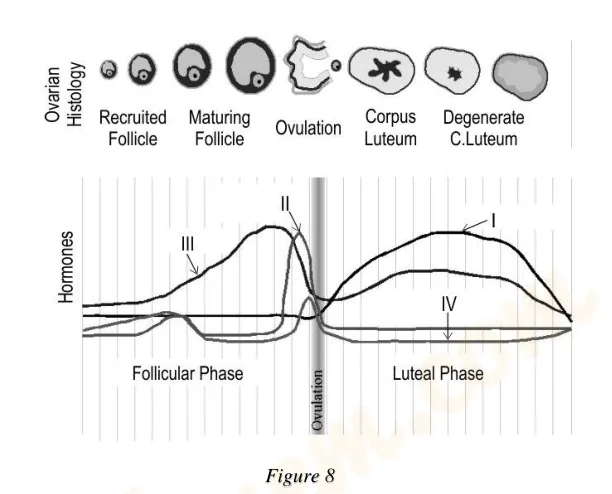 3 marks
The diagram given below shows various phases of the menstrual cycle in human beings. (i) Identify the plotlines that represent the following: (a) Progesterone (b) Luteinizing hormone. (ii) Give any two differences between Menstrual cycle and Estrus cycle.
Why this question: Human Reproduction → interpret menstrual-cycle diagram / hormone graph and answer — appeared 3× Board 2023Sample 2024Sample 2026
Q33.3 marks
Name the category of microorganisms that aid in biogas production. Provide an example of this category. Mention any four benefits of biogas compared to other energy sources.
Why this question: Microbes in Human Welfare → Biogas: main component (methane) and the methanogens that produce it — appeared 2× Sample 2024Sample 2027
Q34.3 marks
Draw a neat, labelled diagram of the Graafian follicle.
Why this question: Human Reproduction → Labelled diagram of T.S. of ovary / Graafian follicle — appeared 2× Board 2024Sample 2027
Section DThree questions (Q16-Q18), each carrying five marks (long-answer, often with pedigree/graph/table interpretation). Internal choice is provided in two questions.
Q35.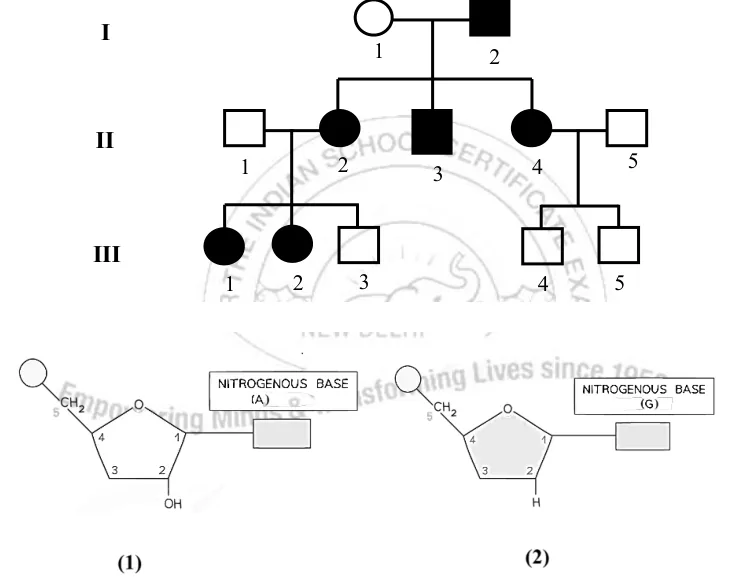 5 marks
(i) Marfan Syndrome is a human genetic disorder caused by a mutation in the FBN1 gene. This gene codes for fibrillin – 1, a protein that gives connective tissues strength and flexibility. People suffering from Marfan Syndrome show symptoms like dislocation of the eye lens, flat feet, unusually tall height and rupturing of aorta. The following pedigree chart represents the pattern of inheritance of Marfan Syndrome in a family. (a) Identify the type of inheritance from the given pedigree chart. (b) If the parents of a child are heterozygous for this particular trait, calculate the probability of the child being unaffected using a Punnett square. (ii) Prisha is provided with two nucleotides as shown below. Which of these nucleotides should she choose to make an ideal genetic material? Give a reason.
Why this question: Principles of Inheritance and Variation → Pedigree analysis: is the trait dominant/recessive and autosomal/sex-linked — appeared 2× Sample 2023Sample 2027
Q36.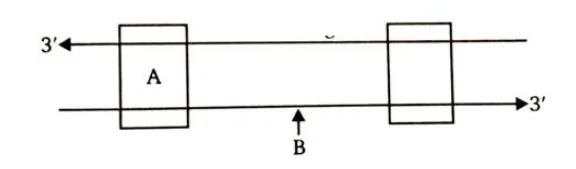 5 marks
(a) Write a brief note on Griffith's experiment. What was the conclusion drawn from this experiment? (b) Name the parts 'A' and 'B' of the transcription unit shown below.
Why this question: Molecular Basis of Inheritance → describe Griffith's experiment and state its conclusion — appeared 2× Board 2024Sample 2026
Q37.5 marks
(a) Why are the biocontrol agents preferred over the chemical pesticides? (b) Explain the role of any two biocontrol agents by mentioning their target pests.
Why this question: Microbes in Human Welfare → explain biocontrol and the role of specific biocontrol agents — appeared 2× Sample 2023Sample 2025