CBSE Class 12 Physics Guess Paper 2027
Last updated:
A full practice paper on the official Physics pattern, built from the most-likely questions by repetition analysis. Not an official or leaked paper.
CBSE Class 12 Physics — Guess Paper 2027
Time: 3 hours · Maximum marks: 70 · Practice paper
Section A16 questions of 1 mark each — 12 MCQ + 4 Assertion-Reason
Q1.1 mark
A galvanometer of resistance G Ohm is converted into an ammeter of range 0 to I A. If the current through the galvanometer is 0.1% of I, the resistance of the ammeter is: (A) G/999 Ohm (B) G/1000 Ohm (C) G/1001 Ohm (D) G/100.1 Ohm
Why this question: Moving Charges and Magnetism → Convert a galvanometer into an ammeter (shunt resistance) — appeared 3× Board 2024Board 2026Sample 2026
Q2.1 mark
The potential difference across a cell in an open circuit is 8 V. It falls to 4 V when a current of 4 A is drawn from it. The internal resistance of the cell is: (a) 4 ohm (b) 3 ohm (c) 2 ohm (d) 1 ohm
Why this question: Current Electricity → Find emf/internal resistance from terminal-voltage data — appeared 3× Board 2023Board 2025Sample 2026
Q3.1 mark
The ratio of the nuclear densities of two nuclei having the mass numbers 8 and 27 is (A) 8:27 (B) 3:2 (C) 2:3 (D) 1:1
Why this question: Nuclei → Nuclear density independent of mass number — appeared 3× Board 2023Board 2024Sample 2026
Q4.1 mark
The 'distance of closest approach' of an alpha-particle is 'd' when it moves with a velocity v head-on towards the target nucleus. If the velocity of alpha particle is halved, the new 'distance of closest approach' will be (A) d/2 (B) 2d (C) d/4 (D) 4d
Why this question: Atoms → Distance of closest approach numerical — appeared 3× Board 2022Board 2026Sample 2025
Q5.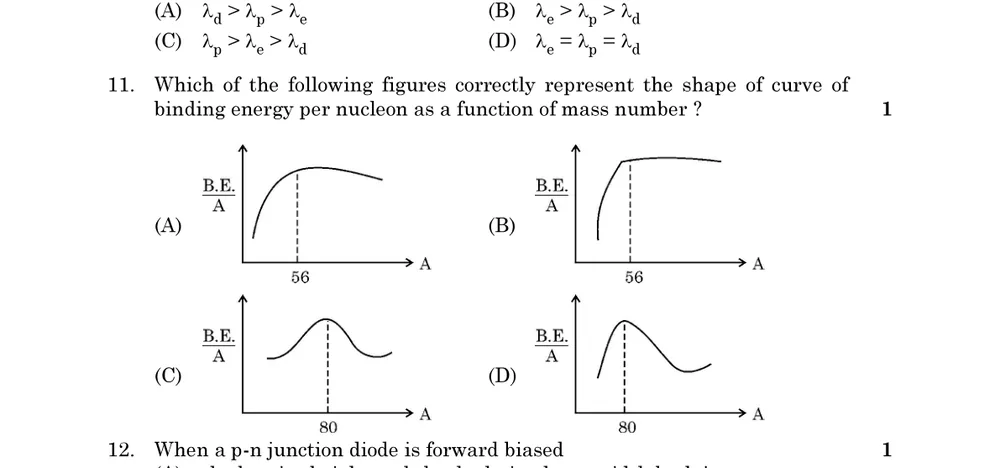 1 mark
Which of the following figures correctly represent the shape of curve of binding energy per nucleon as a function of mass number? (Options A, B, C, D show different curves of B.E./A versus mass number A.)
Why this question: Nuclei → Binding energy per nucleon curve — appeared 3× Board 2023Board 2025Sample 2025
Q6.1 mark
In an unbiased p-n junction, at equilibrium, which of the following statements is true? (A) Diffusion current is zero but drift current exists. (B) Diffusion current exists but drift current is zero. (C) Diffusion and drift currents are equal and opposite. (D) Both the diffusion and drift currents exist but are unequal.
Why this question: Semiconductor Electronics: Materials, Devices and Simple Circuits → Diffusion and drift currents in p-n junction — appeared 3× Board 2023Board 2026
Q7.1 mark
The diffraction effect can be observed in (A) sound waves only (B) light waves only (C) ultrasonic waves only (D) sound waves as well as light waves
Why this question: Wave Optics → Identify diffraction phenomenon (conceptual MCQ) — appeared 2× Sample 2025
Q8.1 mark
Four independent waves are expressed as (i) y1 = A1 sin omega t (ii) y2 = A2 sin 2 omega t (iii) y3 = A3 cos omega t (iv) y4 = A4 sin(omega t + pi/3). The interference between two of these waves is possible in (A) (i) and (iii) only (B) (iii) and (iv) only (C) (i), (iii) and (iv) only (D) All of them
Why this question: Wave Optics → Coherent sources - conditions for interference — appeared 2× Board 2026Sample 2026
Q9.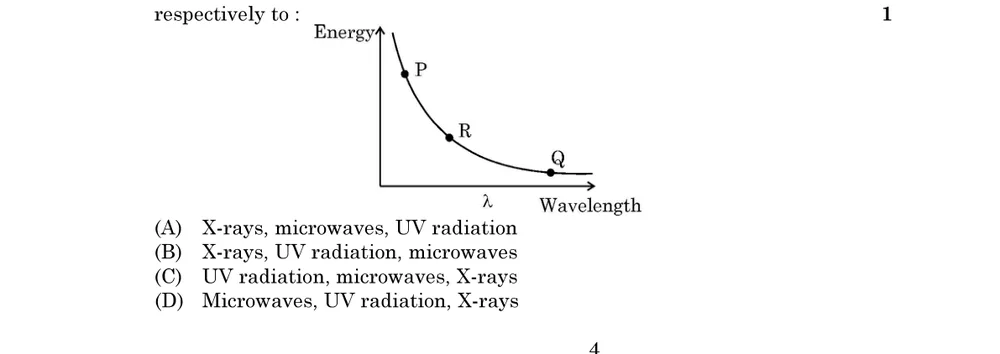 1 mark
The given diagram exhibits the relationship between the wavelength of the electromagnetic waves and the energy of photon associated with them. The three points P, Q and R marked on the diagram may correspond respectively to: (A) X-rays, microwaves, UV radiation (B) X-rays, UV radiation, microwaves (C) UV radiation, microwaves, X-rays (D) Microwaves, UV radiation, X-rays
Why this question: Electromagnetic Waves → Order/compare EM spectrum regions by energy & wavelength — appeared 2× Board 2025Sample 2026
Q10.1 mark
A conducting wire connects two charged metallic spheres A and B of radii r1 and r2 respectively. The distance between the spheres is very large compared to their radii. The ratio of electric fields, (EA/EB) at the surfaces of spheres A and B will be (A) r1/r2 (B) r2/r1 (C) r12/r22 (D) r22/r12
Why this question: Electrostatic Potential and Capacitance → Ratio of surface fields of two connected spheres (MCQ) — appeared 2× Board 2026Sample 2025
Q11.1 mark
A long straight wire of circular cross-section (radius a) carries a steady current I. The current is uniformly distributed across this cross-section. The magnitude of the magnetic field produced at a point at a distance (a/2) from the axis of the wire will be (A) Zero (B) mu0 I/(2 pi a) (C) mu0 I/(4 pi a) (D) mu0 I/(6 pi a)
Why this question: Moving Charges and Magnetism → Magnetic field of a current-carrying wire (uniform cross-section) via Ampere's law — appeared 2× Board 2026Sample 2025
Q12.1 mark
In a series LCR circuit, the voltage across the resistor, capacitor and inductor is 10 V each. If the capacitor is short circuited, the voltage across the inductor will be (A) 10 V (B) 5√2 V (C) 5/√2 V (D) 10√2 V
Why this question: Alternating Current → Voltage across the inductor when the capacitor is short-circuited — appeared 2× Board 2026Sample 2025
Q13.1 mark
Assertion (A): In Bohr model of hydrogen atom, the energy levels are discrete and quantised. Reason (R): In a hydrogen atom, the electrostatic force on the electron provides the necessary centripetal force to it to revolve around the nucleus. [Standard assertion-reason options: (A) both true, R correct explanation; (B) both true, R not correct explanation; (C) A true, R false; (D) both false]
Why this question: Atoms → Assertion-reason on Bohr energy/centripetal force — appeared 3× Board 2025Board 2026Sample 2026
Q14.1 mark
Assertion (A): If accelerated electrons are passed through a narrow slit, a diffraction pattern is observed. Reason (R): Electrons behave as both particles and waves. [Standard assertion-reason options: (A) both true, R correct explanation; (B) both true, R not correct explanation; (C) A true, R false; (D) both false]
Why this question: Dual Nature of Radiation and Matter → Assertion-reason on matter waves — appeared 2× Board 2026Sample 2025
Q15.1 mark
Assertion (A): When a bar of copper is placed in an external magnetic field, the field lines get concentrated inside the bar. Reason (R): Copper is a paramagnetic substance. Codes: (a) Both A and R are true and R is the correct explanation of A. (b) Both A and R are true, but R is not the correct explanation of A. (c) A is true, but R is false. (d) A is false and R is also false.
Why this question: Magnetism and Matter → Magnetic field-line behaviour in dia- vs paramagnetic materials — appeared 2× Board 2023Sample 2026
Q16.1 mark
Assertion (A): The critical angle of light passing from glass to air is minimum for violet colour. Reason (R): The wavelength of blue light is greater than the light of other colours.
Why this question: Ray Optics and Optical Instruments → Assertion-reason on critical angle vs wavelength — appeared 1× Sample 2026
Section B5 Very Short Answer questions of 2 marks each
Q17.2 marks
In a photoelectric experiment, the emitter plate is irradiated with radiation of 200 nm. The photocurrent becomes zero when the collector plate potential is −0.80 V. Calculate the work function (in eV) of the emitter.
Why this question: Dual Nature of Radiation and Matter → Work function / stopping potential numerical — appeared 3× Board 2026Sample 2025
Q18.2 marks
In a Young's double-slit experimental set-up with slit separation 0.6 mm a beam of light consisting of two wavelengths 440 nm and 660 nm is used to obtain interference pattern on a screen kept 1.5 m in front of the slits. Find the least distance of the point from the central maximum where the bright fringes due to both the wavelengths coincide.
Why this question: Wave Optics → Two-wavelength fringe coincidence in YDSE — appeared 2× Board 2026Sample 2025
Q19.2 marks
In a Young's double-slit experiment, two light waves, each of intensity I0, interfere at a point, having a path difference lambda/8 on the screen. Find the intensity at this point.
Why this question: Wave Optics → Resultant intensity at a given path difference (YDSE) — appeared 2× Board 2025Sample 2025
Q20. 2 marks
A transparent solid cylindrical rod (refractive index 2/sqrt(3)) is kept in air. A ray of light incident on its face travels along the surface of the rod, as shown in figure. Calculate the angle theta.
Why this question: Ray Optics and Optical Instruments → Critical angle / grazing incidence - find angle or refractive index — appeared 2× Board 2025Sample 2025
Q21.2 marks
Write an expression for the magnetic force per unit length between two parallel thin current carrying wires. Hence define one ampere.
Why this question: Moving Charges and Magnetism → Force between two parallel current-carrying wires / define the ampere — appeared 2× Board 2023Sample 2026
Section C7 Short Answer questions of 3 marks each
Q22.3 marks
A compound microscope consists of an objective lens of focal length 0.82 cm and an eyepiece lens of focal length 2.9 cm. An object is placed 0.91 cm from the objective lens. The image is formed at the near point (25 cm) from the eye. (I) Calculate the angular magnification of the microscope. (II) Draw the ray diagram of compound microscope in normal adjustment.
Why this question: Ray Optics and Optical Instruments → Compound microscope ray diagram & magnification numerical — appeared 3× Board 2022Sample 2025Sample 2026
Q23.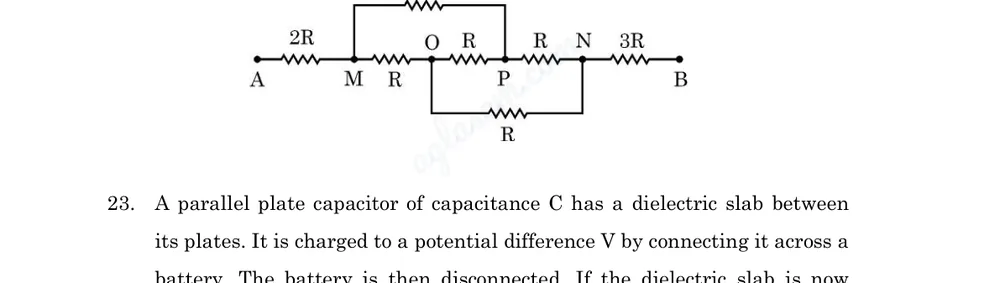 3 marks
(a) Obtain the condition of balance of a Wheatstone bridge. (b) Find net resistance of the network of resistors connected between A and B, as shown in figure.
Why this question: Current Electricity → Derive Wheatstone bridge balance condition — appeared 3× Board 2024Board 2026Sample 2025
Q24.3 marks
(a) Draw the ray diagram to show the image formation by a refracting telescope and write the expression for angular magnification for the telescope in normal adjustment. (b) Give two reasons to explain why a reflecting telescope is preferred over a refracting telescope.
Why this question: Ray Optics and Optical Instruments → Telescope ray diagram & angular magnification — appeared 3× Board 2022Board 2026Sample 2025
Q25.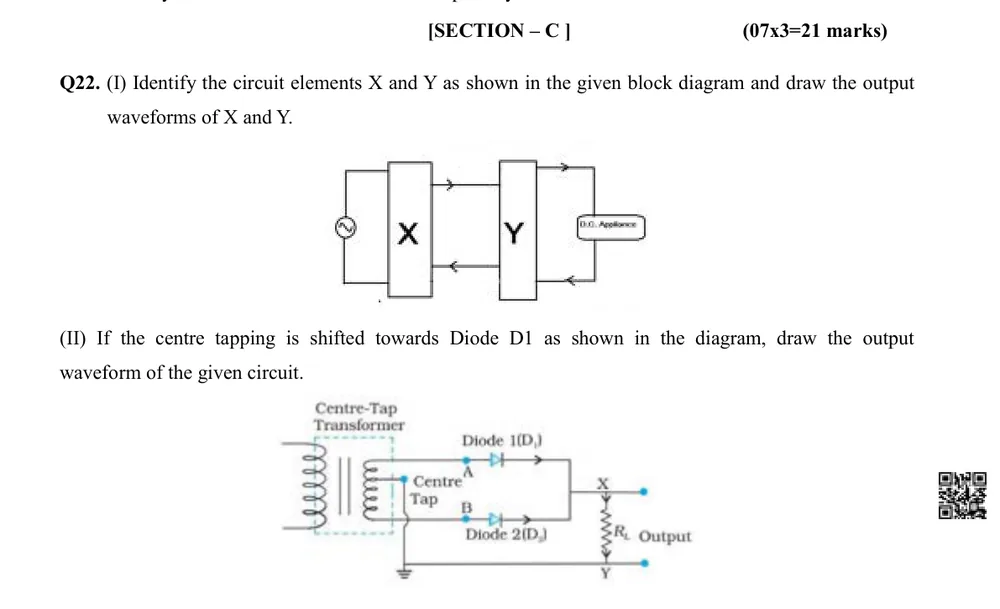 3 marks
(I) Identify the circuit elements X and Y as shown in the given block diagram and draw the output waveforms of X and Y. (II) If the centre tapping is shifted towards Diode D1 as shown in the diagram, draw the output waveform of the given circuit.
Why this question: Semiconductor Electronics: Materials, Devices and Simple Circuits → Full-wave rectifier working & waveforms — appeared 2× Sample 2025Sample 2026
Q26.3 marks
Find the expression for the capacitance of a parallel plate capacitor of plate area A and plate separation d when (I) a dielectric slab of thickness t and (II) a metallic slab of thickness t, where (t < d) are introduced one by one between the plates of the capacitor. In which case would the capacitance be more and why?
Why this question: Electrostatic Potential and Capacitance → Derive capacitance with a dielectric slab (t<d) — appeared 2× Sample 2025Sample 2026
Q27.3 marks
(a) Using Gauss's law, deduce an expression for electric field at a point due to a uniformly charged infinite plane thin sheet. (b) Two large thin plane sheets, each having surface charge density sigma, are held close and parallel to each other in air. What is the net electric field at a point (i) inside and (ii) outside, the sheets?
Why this question: Electric Charges and Fields → Field of an infinite charged plane sheet (Gauss) — appeared 2× Board 2026Sample 2025
Q28.3 marks
(i) A conductor of length l is connected across an ideal cell of emf E. Keeping the cell connected, the length of the conductor is increased to 2l by gradually stretching it. If R and R' are initial and final values of resistance and vd and vd' are initial and final values of drift velocity, find the relation between (i) R' and R and (ii) vd' and vd. (ii) When electrons drift in a conductor from lower to higher potential, does it mean that all the 'free electrons' of the conductor are moving in the same direction?
Why this question: Current Electricity → Resistance change on stretching a wire — appeared 2× Board 2025Sample 2025
Section D2 Case-study based questions of 4 marks each (with sub-parts)
Q29.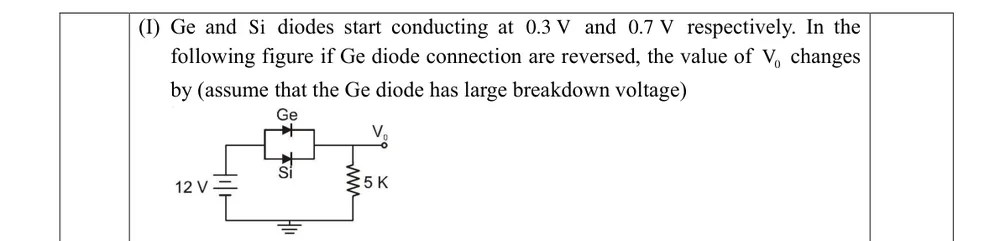 4 marks
[case context: forward/reverse biasing of a semiconductor diode — in forward bias p-side is at positive terminal and applied voltage drops mostly across the depletion region; in reverse bias n-side is positive] Ge and Si diodes start conducting at 0.3 V and 0.7 V respectively. In the following figure if Ge diode connection are reversed, the value of V0 changes by (assume that the Ge diode has large breakdown voltage) [circuit: 12 V source, Ge and Si diodes in parallel, 5 K resistor] (A) 0.2 V (B) 0.4 V (C) 0.6 V (D) 0.8 V
Why this question: Semiconductor Electronics: Materials, Devices and Simple Circuits → Diode-resistor network analysis — appeared 4× Sample 2026
Q30.4 marks
[case context: photoelectric effect apparatus with emitter C, collector A, terminal B and microammeter] In the given diagram, if terminal B is shifted towards the left then how will it affect the reading of the microammeter? [for V.I. candidates: If the supplied voltage is decreased, then what will be effect on the reading of the microammeter?]
Why this question: Dual Nature of Radiation and Matter → Photocurrent vs collector potential (vary voltage) — appeared 2× Sample 2026
Section E3 Long Answer questions of 5 marks each
Q31.5 marks
(a) Draw a labelled diagram of a step-up transformer. State the principle on which it works and obtain the ratio of secondary voltage to primary voltage in terms of number of turns and currents in the two coils. (b) The ratio of the number of turns in the primary to the secondary of an ideal transformer is 1 : 5. If 5 kW power at 200 V is supplied to the primary, find (i) current in the primary, and (ii) output voltage.
Why this question: Alternating Current → Transformer: working, turns/current ratio and energy-conservation numerical — appeared 3× Board 2024Board 2026Sample 2025
Q32.5 marks
(a) Using the relation for refraction at a curved spherical surface, derive the expression for lens maker's formula. (b) Three lenses L1, L2 and L3, each of focal length 40 cm, are placed coaxially. The distance between L1 and L2 and between L2 and L3 are 120 cm and 20 cm respectively. An object is kept at a distance of 80 cm to the left of lens L1. Find the distance of the final image formed from the object.
Why this question: Ray Optics and Optical Instruments → Derive lens maker's formula (+ application) — appeared 2× Board 2026Sample 2026
Q33.5 marks
(a) State Faraday's law of electromagnetic induction. (b) Derive an expression for the self-inductance of an air-filled long solenoid of length l and cross-sectional area A having N turns. (c) A conducting rod of length 50 cm, with one end pivoted, is rotated with angular speed of 60 rpm in a uniform magnetic field of 4.0 mT directed perpendicular to the plane of rotation of rod. Find the emf induced in the rod.
Why this question: Electromagnetic Induction → Self-inductance of a solenoid (derive / apply to find turns) — appeared 2× Board 2025Board 2026