CBSE Class 12 Physics Important Questions 2027 (Repeated in Board Exams)
61 question patterns that appeared in two or more of the analysed papers (5 board + 2 official sample papers (2022–2026)). The numbers change; the question does not.
Electric Charges and Fields
1. Field of an infinite charged plane sheet (Gauss)
2×Board 2026Sample 20253 marks
(a) Using Gauss's law, deduce an expression for electric field at a point due to a uniformly charged infinite plane thin sheet. (b) Two large thin plane sheets, each having surface charge density sigma, are held close and parallel to each other in air. What is the net electric field at a point (i) inside and (ii) outside, the sheets?
2. Derive equatorial field of a dipole
2×Board 2023Board 20265 marks
(a) An electric dipole consists of two point charges q and −q separated by a distance 2a. Derive an expression for the electric field E due to this dipole at a point distant r from the centre of the dipole on the equatorial plane. Write the expression for the electric field at a far off point, i.e. r >> a. (b) A dipole is placed in x-y plane such that charges q and −q are located at x = a and x = b respectively. There exists an electric field E = 2 i^ N C-1 in the region. Calculate the force F and torque tau experienced by the dipole.
Electrostatic Potential and Capacitance
3. Derive capacitance with a dielectric slab (t<d)
2×Sample 2025Sample 20263/5 marks
(A) A dielectric slab of thickness t, is introduced between the plates of parallel plate capacitor of area A and separation d (where t<d). Find an expression for the capacitance with the dielectric slab. (B) A copper sphere of capacitor C is dropped in ocean. Will the capacitance of the sphere increase, decrease or remain same? Justify. (C) A capacitor is connected across a source of potential difference V and then the separation 'd' between the plates is increased using insulating stick. Plot 'V' vs 'd' graph for the given capacitor. [For VI Candidates (C): A capacitor is connected across potential difference V and is then separation between plates 'd' is increased using insulating stick. Will the energy stored in capacitor increase or decrease? Justify]
4. Ratio of surface fields of two connected spheres (MCQ)
2×Board 2026Sample 20251 marks
A conducting wire connects two charged metallic spheres A and B of radii r1 and r2 respectively. The distance between the spheres is very large compared to their radii. The ratio of electric fields, (EA/EB) at the surfaces of spheres A and B will be (A) r1/r2 (B) r2/r1 (C) r12/r22 (D) r22/r12
Current Electricity
5. Derive Wheatstone bridge balance condition
3×Board 2024Board 2026Sample 20253/5 marks
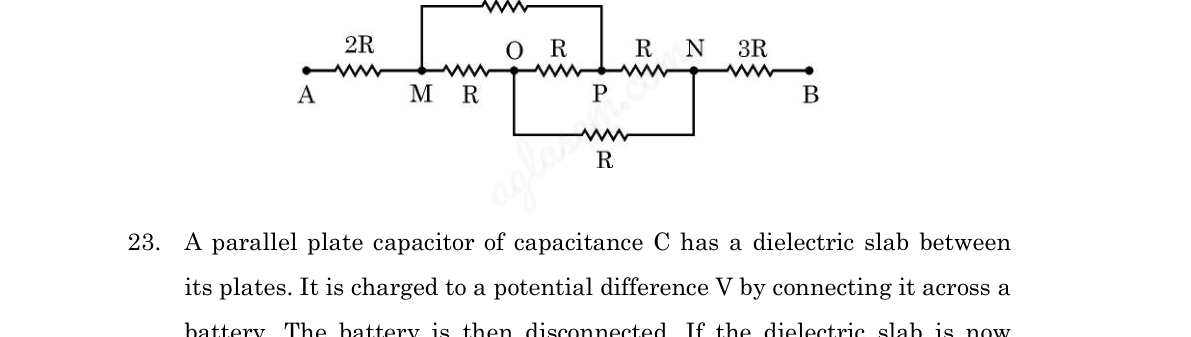
(a) Obtain the condition of balance of a Wheatstone bridge. (b) Find net resistance of the network of resistors connected between A and B, as shown in figure.
6. Find emf/internal resistance from terminal-voltage data
3×Board 2023Board 2025Sample 20261/2 marks
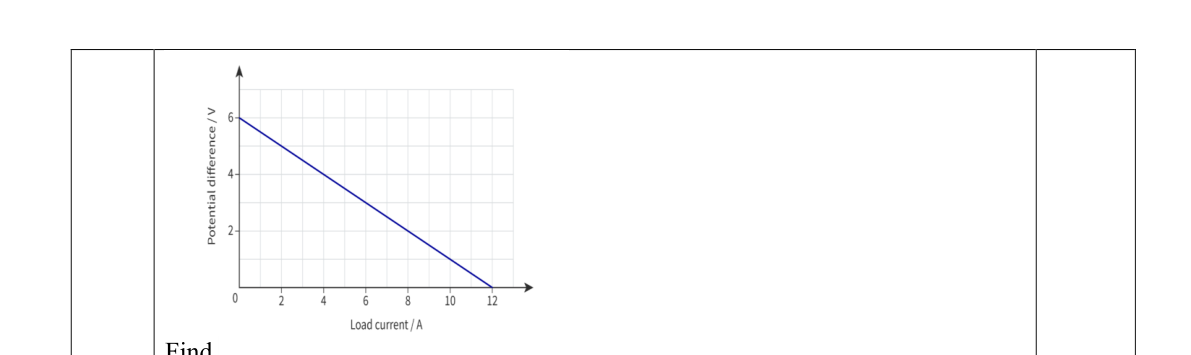
The following graph shows the potential difference across the terminals of a cell against its load current. [graph: potential difference (V) versus load current (A)] Find, (I) the emf of the cell and (II) the internal resistance of the cell. [For VI candidates: Find the relation between internal resistance, emf, external resistance and the total current in the circuit?]
7. Resistance change on stretching a wire
2×Board 2025Sample 20251/3 marks
(i) A conductor of length l is connected across an ideal cell of emf E. Keeping the cell connected, the length of the conductor is increased to 2l by gradually stretching it. If R and R' are initial and final values of resistance and vd and vd' are initial and final values of drift velocity, find the relation between (i) R' and R and (ii) vd' and vd. (ii) When electrons drift in a conductor from lower to higher potential, does it mean that all the 'free electrons' of the conductor are moving in the same direction?
8. Two cells in parallel: equivalent emf, r and current
2×Board 2025Board 20263/5 marks
(a) Two cells of emf E1 and E2 with internal resistances r1 and r2 respectively, are connected in parallel by connecting their positive terminals together and negative terminals together. Deduce an expression for equivalent emf and equivalent internal resistance of the combination. (b) A parallel combination, as stated in (a) above, of two cells of emfs E and 3E and internal resistances R each is connected across a resistance 2R. Find the current that flows through resistance 2R.
9. Derive current-drift velocity relation
2×Board 2024Board 20262/3 marks
What is the order of magnitude of drift velocity of electrons in a conductor? Deduce the relation between the current flowing through a conductor and drift velocity of electrons in it.
Moving Charges and Magnetism
10. Convert a galvanometer into an ammeter (shunt resistance)
3×Board 2024Board 2026Sample 20261/5 marks
[case context: moving coil galvanometer conversion.] A galvanometer with coil of resistance 20 ohm shows full scale deflection for a current of 5 mA. To convert it into an ammeter of range (0 – 10 A), a resistance of (A) 0.05 ohm should be connected in series with it. (B) 0.05 ohm should be connected in parallel with it. (C) 0.01 ohm should be connected in parallel with it. (D) 0.01 ohm should be connected in series with it.
11. Magnetic field of a current-carrying wire (uniform cross-section) via Ampere's law
2×Board 2026Sample 20251 marks
A long straight wire of circular cross-section (radius a) carries a steady current I. The current is uniformly distributed across this cross-section. The magnitude of the magnetic field produced at a point at a distance (a/2) from the axis of the wire will be (A) Zero (B) mu0 I/(2 pi a) (C) mu0 I/(4 pi a) (D) mu0 I/(6 pi a)
12. Current sensitivity vs voltage sensitivity of a galvanometer
2×Board 2026Sample 20251 marks
[case context: moving coil galvanometer converted to ammeter/voltmeter with suitable resistances.] The best way to increase current sensitivity of a galvanometer is by (A) increasing number of turns of the coil (B) increasing area of coil and magnetic field strength (C) decreasing area of coil and magnetic field strength (D) increasing torsional constant of the hair spring
13. Force between two parallel current-carrying wires / define the ampere
2×Board 2023Sample 20262/5 marks
Write an expression for the magnetic force per unit length between two parallel thin current carrying wires. Hence define one ampere.
14. Radial magnetic field gives constant torque / linear scale
2×Board 2025Board 20261 marks
[case context: A galvanometer detects/measures small currents; it works on the deflecting torque on a current-carrying coil in a magnetic field, related to current, number of turns, coil area and field; a hair spring gives a counter torque; it can be converted to an ammeter or voltmeter using suitable resistances.] The torque on the coil remains constant irrespective of the coil's orientation during rotation due to (A) use of soft iron core which increases the magnetic field. (B) radial magnetic field (C) hair spring which provides the counter torque (D) eddy current in the iron core which causes damping.
15. Force on a current-carrying wire in vector magnetic field (F = I L x B)
2×Board 2024Board 20251 marks
A 1 cm segment of a wire lying along x-axis carries current of 0.5 A along +x direction. A magnetic field B = (0.4 mT) j^ + (0.6 mT) k^ is switched on, in the region. The force acting on the segment is: (A) (2 j^ + 3 k^) mN (B) (-3 j^ + 2 k^) muN (C) (6 j^ + 4 k^) mN (D) (-4 j^ + 6 k^) muN
16. Biot-Savart: field of a circular loop on axis and at centre
2×Board 2023Board 20253/5 marks
Using Biot-Savart law, derive expression for the magnetic field (B) due to a circular current carrying loop at a point on its axis and hence at its centre.
Magnetism and Matter
17. Magnetic field-line behaviour in dia- vs paramagnetic materials
2×Board 2023Sample 20261/2 marks
Draw a diagram representing the behaviour of magnetic field lines for (A) diamagnetic & (B) paramagnetic substance. [For VI-Candidates: State Gauss's law of magnetism? Hence find the magnetic flux linked with the sphere enclosing a current carrying solenoid?]
Electromagnetic Induction
18. Maximum emf of a coil rotating in a magnetic field (numerical)
2×Board 2023Sample 20261/3 marks
A conducting coil of 50 turns and area 5/pi cm2 is rotating along the axis of solenoid of length 50cm and 2000 turns, carrying current of 5 A. What will be the value of maximum emf generated?
19. Self-inductance of a solenoid (derive / apply to find turns)
2×Board 2025Board 20261/5 marks
(a) State Faraday's law of electromagnetic induction. (b) Derive an expression for the self-inductance of an air-filled long solenoid of length l and cross-sectional area A having N turns. (c) A conducting rod of length 50 cm, with one end pivoted, is rotated with angular speed of 60 rpm in a uniform magnetic field of 4.0 mT directed perpendicular to the plane of rotation of rod. Find the emf induced in the rod.
Alternating Current
20. Transformer: working, turns/current ratio and energy-conservation numerical
3×Board 2024Board 2026Sample 20255 marks
(a) Draw a labelled diagram of a step-up transformer. State the principle on which it works and obtain the ratio of secondary voltage to primary voltage in terms of number of turns and currents in the two coils. (b) The ratio of the number of turns in the primary to the secondary of an ideal transformer is 1 : 5. If 5 kW power at 200 V is supplied to the primary, find (i) current in the primary, and (ii) output voltage.
21. Voltage across the inductor when the capacitor is short-circuited
2×Board 2026Sample 20251 marks
In a series LCR circuit, the voltage across the resistor, capacitor and inductor is 10 V each. If the capacitor is short circuited, the voltage across the inductor will be (A) 10 V (B) 5√2 V (C) 5/√2 V (D) 10√2 V
22. Average power in an AC circuit (P = (1/2) v0 i0 cos phi)
2×Board 2024Board 20251/3 marks
A voltage v = v0 sin omega t applied to a circuit drives a current i = i0 sin(omega t + phi) in the circuit. The average power consumed in the circuit over a cycle is: (A) Zero (B) i0 v0 cos phi (C) i0 v0 / 2 (D) (i0 v0 / 2) cos phi
23. Derive impedance of a series AC circuit using a phasor diagram
2×Board 2023Board 20243/5 marks
(i) A resistor and a capacitor are connected in series to an ac source v = vm sin omega t. Derive an expression for the impedance of the circuit. (ii) When does an inductor act as a conductor in a circuit? Give reason for it. (iii) An electric lamp is designed to operate at 110 V dc and 11 A current. If the lamp is operated on 220 V, 50 Hz ac source with a coil in series, then find the inductance of the coil.
Electromagnetic Waves
24. Order/compare EM spectrum regions by energy & wavelength
2×Board 2025Sample 20261 marks
Which of the following statement is true for the radio waves and the gamma rays? (A) The energy of gamma rays is lesser than that of the radio waves. (B) The frequency of the radio waves is higher than that of gamma rays. (C) The radio waves and the gamma rays have the same energy. (D) The energy of radio waves is lesser than that of the gamma rays.
25. Identify EM spectrum region from its use/application
2×Board 2022Board 20261/3 marks
Electromagnetic waves used in a diagnostic tool in medicine have a wavelength range (A) 1 nm to 10-3 nm (B) 400 nm to 1 nm (C) 1 mm to 700 nm (D) 0.1 m to 1 mm
Ray Optics and Optical Instruments
26. Compound microscope ray diagram & magnification numerical
3×Board 2022Sample 2025Sample 20263/5 marks
A compound microscope consists of an objective lens of focal length 0.82 cm and an eyepiece lens of focal length 2.9 cm. An object is placed 0.91 cm from the objective lens. The image is formed at the near point (25 cm) from the eye. (I) Calculate the angular magnification of the microscope. (II) Draw the ray diagram of compound microscope in normal adjustment.
27. Telescope ray diagram & angular magnification
3×Board 2022Board 2026Sample 20253/5 marks
(a) Draw the ray diagram to show the image formation by a refracting telescope and write the expression for angular magnification for the telescope in normal adjustment. (b) Give two reasons to explain why a reflecting telescope is preferred over a refracting telescope.
28. Derive lens maker's formula (+ application)
2×Board 2026Sample 20265 marks
(a) Using the relation for refraction at a curved spherical surface, derive the expression for lens maker's formula. (b) Three lenses L1, L2 and L3, each of focal length 40 cm, are placed coaxially. The distance between L1 and L2 and between L2 and L3 are 120 cm and 20 cm respectively. An object is kept at a distance of 80 cm to the left of lens L1. Find the distance of the final image formed from the object.
29. Derive prism relation (A+delta=i+e) & minimum deviation
2×Board 2024Sample 20265 marks
(A) Define angle of deviation in a prism? (B) Obtain the relation A+delta=i+e for a prism where A is the angle of prism, delta is the angle of deviation, i is the angle of incidence and e is the angle of emergence. Write this relation for the minimum deviation? (C) Write the condition for minimum deviation.
30. Critical angle / grazing incidence - find angle or refractive index
2×Board 2025Sample 20252/3 marks
A transparent solid cylindrical rod (refractive index 2/sqrt(3)) is kept in air. A ray of light incident on its face travels along the surface of the rod, as shown in figure. Calculate the angle theta.

31. Trace/identify ray path through prism undergoing TIR
2×Board 2023Sample 20261 marks
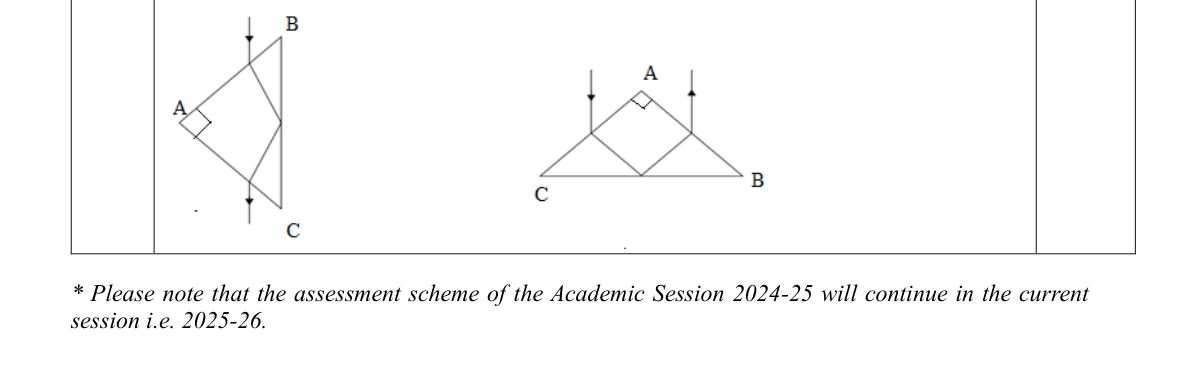
A glass prism has internal angles of 45°, 45° and 90°. The glass has a critical angle of 45°. Which of the following ray diagrams depicts the possible path of the light through the prism? [options (A), (B), (C), (D) are ray diagrams]
32. Lens cut perpendicular to principal axis - focal length/power of each half
3×Board 2022Board 2024Board 20251 marks
[case context] Thin lens case study. A convex lens of focal length 'f' is cut into two equal parts perpendicular to the principal axis. The focal length of each part will be: (A) f (B) 2f (C) f/2 (D) f/4
33. Why reflecting/Cassegrain telescope is preferred
2×Board 2023Sample 20252/3 marks
(I) Draw a ray diagram for the formation of image by a Cassegrain telescope. (II) Why these types of telescopes are preferred over refracting type telescopes? (Write 2 points)
34. Image by refraction at a single spherical surface
2×Board 2022Sample 20251 marks
A point object is placed at the centre of a glass sphere of radius 6 cm and refractive index 1.5. The distance of virtual image from the surface of the sphere is (A) 2 cm (B) 4 cm (C) 6 cm (D) 12 cm
35. Define TIR and state its conditions
2×Board 2023Board 20262/3 marks
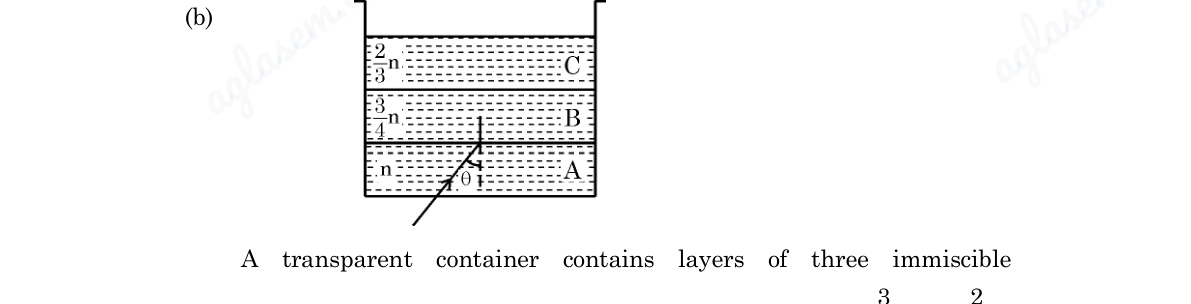
(a) State the two conditions under which total internal reflection occurs. (b) A transparent container contains layers of three immiscible transparent liquids A, B and C of refractive indices n, (3/4)n and (2/3)n, respectively. A laser beam is incident at the interface between A and B at an angle theta as shown in figure. Prove that the beam does not enter region C at all for sin theta ≥ 2/3.
36. Power of combination of two thin lenses in contact
2×Board 2022Board 20241 marks
[case context] Lens power P = 1/f; lenses in contact add algebraically. — Two convex lenses of focal lengths 60 cm and 20 cm are held coaxially in contact with each other. The power of the combination is: (A) 6.6 D (B) 15 D (C) (1/15) D (D) (1/80) D
37. Refraction-at-spherical-surface relation (identify/derive)
2×Board 2022Board 20231/5 marks
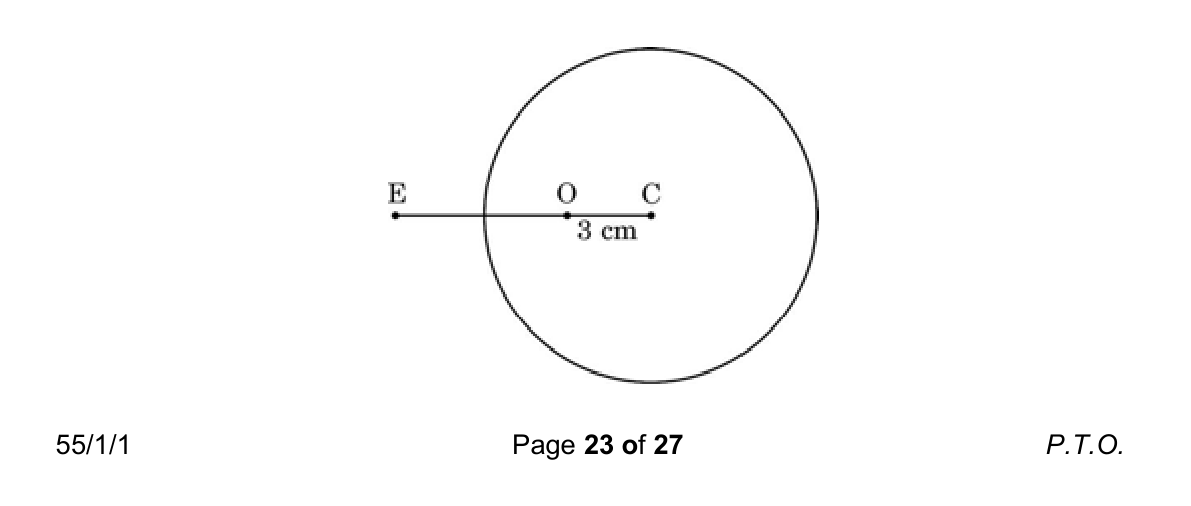
(i) A spherical surface of radius of curvature R separates two media of refractive indices n1 and n2. A point object is placed in front of the surface at distance u in medium of refractive index n1 and its image is formed by the surface at distance v, in the medium of refractive index n2. Derive a relation between u and v. (ii) A solid glass sphere of radius 6.0 cm has a small air bubble trapped at a distance 3.0 cm from its centre C as shown in the figure. The refractive index of the material of the sphere is 1.5. Find the apparent position of this bubble when seen through the surface of the sphere from an outside point E in air.
Wave Optics
38. Coherent sources - conditions for interference
2×Board 2026Sample 20261 marks
Four independent waves are expressed as (i) y1 = A1 sin omega t (ii) y2 = A2 sin 2 omega t (iii) y3 = A3 cos omega t (iv) y4 = A4 sin(omega t + pi/3). The interference between two of these waves is possible in (A) (i) and (iii) only (B) (iii) and (iv) only (C) (i), (iii) and (iv) only (D) All of them
39. Two-wavelength fringe coincidence in YDSE
2×Board 2026Sample 20252 marks
In a Young's double-slit experimental set-up with slit separation 0.6 mm a beam of light consisting of two wavelengths 440 nm and 660 nm is used to obtain interference pattern on a screen kept 1.5 m in front of the slits. Find the least distance of the point from the central maximum where the bright fringes due to both the wavelengths coincide.
40. Resultant intensity at a given path difference (YDSE)
2×Board 2025Sample 20252 marks
In a Young's double-slit experiment, two light waves, each of intensity I0, interfere at a point, having a path difference lambda/8 on the screen. Find the intensity at this point.
41. Fringe width & angular width numerical (YDSE)
2×Board 2023Board 20255 marks
(i) (1) What are coherent sources? Why are they necessary for observing a sustained interference pattern? (2) Lights from two independent sources are not coherent. Explain. (ii) Two slits 0.1 mm apart are arranged 1.20 m from a screen. Light of wavelength 600 nm from a distant source is incident on the slits. (1) How far apart will adjacent bright interference fringes be on the screen? (2) Find the angular width (in degree) of the first bright fringe.
42. Huygens' principle - refraction & verify Snell's law
2×Board 2022Board 20232/3 marks
Using Huygens' principle, draw a ray diagram showing the propagation of a plane wave refracting at a plane surface separating two media. Also verify Snell's law of refraction.
Dual Nature of Radiation and Matter
43. Work function / stopping potential numerical
3×Board 2026Sample 20251/2 marks
In a photoelectric experiment, the emitter plate is irradiated with radiation of 200 nm. The photocurrent becomes zero when the collector plate potential is −0.80 V. Calculate the work function (in eV) of the emitter.
44. Condition/threshold for photoemission
2×Sample 2025Sample 20261/2 marks
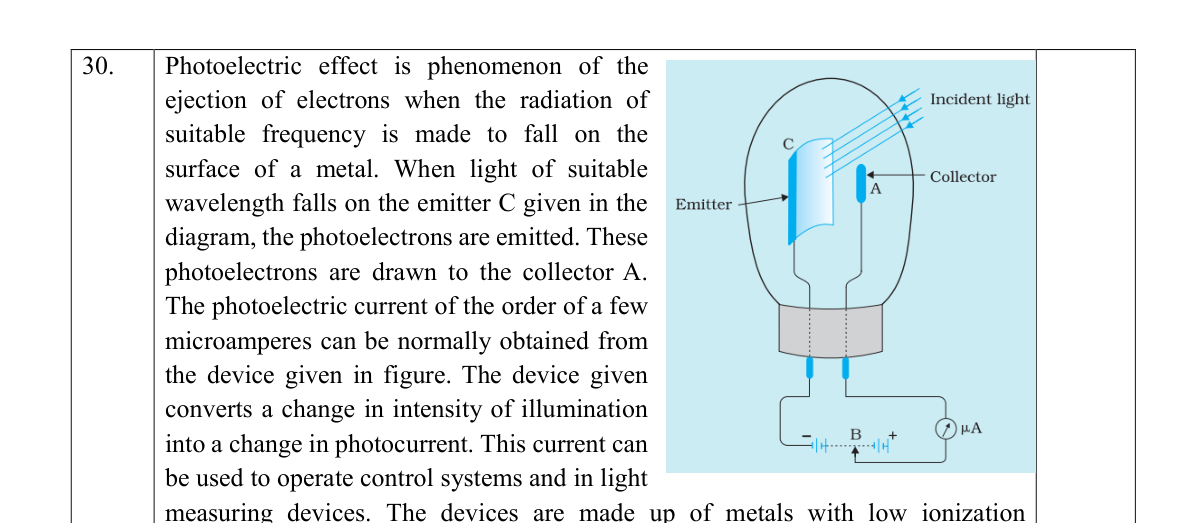
[case context: photoelectric effect — light of suitable frequency on emitter C ejects photoelectrons collected at collector A, giving a photocurrent of a few microamperes read by a microammeter; terminal B sets the applied voltage; platinum work function is 6.35 eV] If infrared radiation of 3 x 10¹¹ Hz is used as incident radiation, determine the reading of microammeter? Justify mathematically.
45. Assertion-reason on matter waves
2×Board 2026Sample 20251 marks
Assertion (A): If accelerated electrons are passed through a narrow slit, a diffraction pattern is observed. Reason (R): Electrons behave as both particles and waves. [Standard assertion-reason options: (A) both true, R correct explanation; (B) both true, R not correct explanation; (C) A true, R false; (D) both false]
46. Slope of stopping-potential vs frequency graph
2×Board 2025Board 20261 marks
[case context: stopping potential vs frequency graph.] Let m be the slope of the graph line for metal B. If e is the value of electron charge, then Planck's constant 'h' is given by (A) me (B) 1/me (C) m/e (D) e/m
47. Ratio of max KE/speed of photoelectrons
2×Board 2024Board 20261 marks
[case context: photoelectric effect.] The threshold frequency for a metal surface is v0. If the radiation of frequency 3v0 illuminates the surface, the maximum kinetic energy (KE) of photoelectrons is E1. If the frequency were increased to 6v0, the maximum KE of the photoelectrons becomes E2. Then (E1/E2) equals (A) 1/3 (B) 1/2 (C) 2/5 (D) 3/4
48. Compare de Broglie wavelengths of particles
2×Board 2022Board 20251/2 marks
Let lambdae, lambdap and lambdad be the wavelengths associated with an electron, a proton and a deuteron, all moving with the same speed. Then the correct relation between them is: (A) lambdad > lambdap > lambdae (B) lambdae > lambdap > lambdad (C) lambdap > lambdae > lambdad (D) lambdae = lambdap = lambdad
49. Assertion-reason on photoelectric effect
2×Board 2023Board 20241 marks
Assertion (A): In photoelectric effect, the kinetic energy of the emitted photoelectrons increases with increase in the intensity of the incident light. Reason (R): Photoelectric current depends on the wavelength of the incident light. [Codes: (A) Both A and R true, R is correct explanation of A; (B) Both A and R true, R is NOT the correct explanation of A; (C) A true, R false; (D) A false and R false]
Atoms
50. Assertion-reason on Bohr energy/centripetal force
3×Board 2025Board 2026Sample 20261 marks
Assertion (A): In Bohr model of hydrogen atom, the energy levels are discrete and quantised. Reason (R): In a hydrogen atom, the electrostatic force on the electron provides the necessary centripetal force to it to revolve around the nucleus. [Standard assertion-reason options: (A) both true, R correct explanation; (B) both true, R not correct explanation; (C) A true, R false; (D) both false]
51. Distance of closest approach numerical
3×Board 2022Board 2026Sample 20251/3 marks
The 'distance of closest approach' of an alpha-particle is 'd' when it moves with a velocity v head-on towards the target nucleus. If the velocity of alpha particle is halved, the new 'distance of closest approach' will be (A) d/2 (B) 2d (C) d/4 (D) 4d
52. n-dependence of Bohr orbit radius/period
2×Board 2023Board 20251/2 marks
Prove that, in Bohr model of hydrogen atom, the time period of revolution of an electron in nth orbit is proportional to n3.
Nuclei
53. Nuclear density independent of mass number
3×Board 2023Board 2024Sample 20261/3 marks
The ratio of the nuclear densities of two nuclei having the mass numbers 8 and 27 is (A) 8:27 (B) 3:2 (C) 2:3 (D) 1:1
54. Binding energy per nucleon curve
3×Board 2023Board 2025Sample 20251/2/3 marks
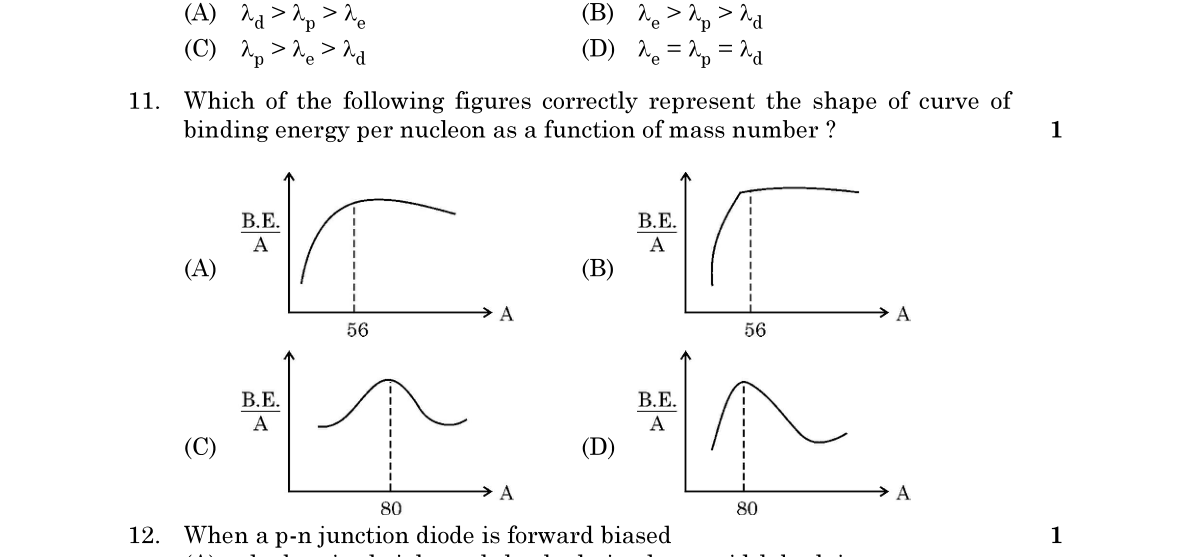
Which of the following figures correctly represent the shape of curve of binding energy per nucleon as a function of mass number? (Options A, B, C, D show different curves of B.E./A versus mass number A.)
55. Assertion-reason on mass defect/binding energy
2×Board 2026Sample 20251 marks
Assertion (A): The mass of a nucleus is less than the sum of the masses of the constituent nucleons. Reason (R): Energy is absorbed when the nucleons are bound together to form a nucleus. [Standard assertion-reason options: (A) both true, R correct explanation; (B) both true, R not correct explanation; (C) A true, R false; (D) both false]
56. Energy released in a nuclear reaction
2×Board 2022Sample 20263 marks
A fast-moving neutron collides with the nucleus of Plutonium (Pu), thereby producing Xenon (Xe) and Zirconium (Zr) along with neutrons. (I) Write the nuclear fission reaction. (II) Find the energy released in the above nuclear reaction. Given atomic masses: m(23994Pu) = 239.052157 u, m(10340Zr) = 102.926597 u, m(13454Xe) = 133.905040 u & m(10 n) = 1.00866 u.
Semiconductor Electronics: Materials, Devices and Simple Circuits
57. Full-wave rectifier working & waveforms
2×Sample 2025Sample 20263 marks
With the help of circuit diagram explain working of the full wave rectifier.
58. Diffusion and drift currents in p-n junction
3×Board 2023Board 20261/2/3 marks
In an unbiased p-n junction, at equilibrium, which of the following statements is true? (A) Diffusion current is zero but drift current exists. (B) Diffusion current exists but drift current is zero. (C) Diffusion and drift currents are equal and opposite. (D) Both the diffusion and drift currents exist but are unequal.
59. Draw circuit & V-I characteristics of diode
2×Board 2023Board 20252/3 marks
(a) Draw circuit arrangement for studying V-I characteristics of a p-n junction diode. (b) Show the shape of the characteristics of a diode. (c) Mention two information that you can get from these characteristics.
60. Effect of doping with an impurity
2×Board 2023Board 20241 marks
Ge is doped with As. Due to doping, (A) the structure of Ge lattice is distorted. (B) the number of conduction electrons increases. (C) the number of holes increases. (D) the number of conduction electrons decreases.
61. Identify rectifier output waveform
2×Board 2023Board 20241 marks
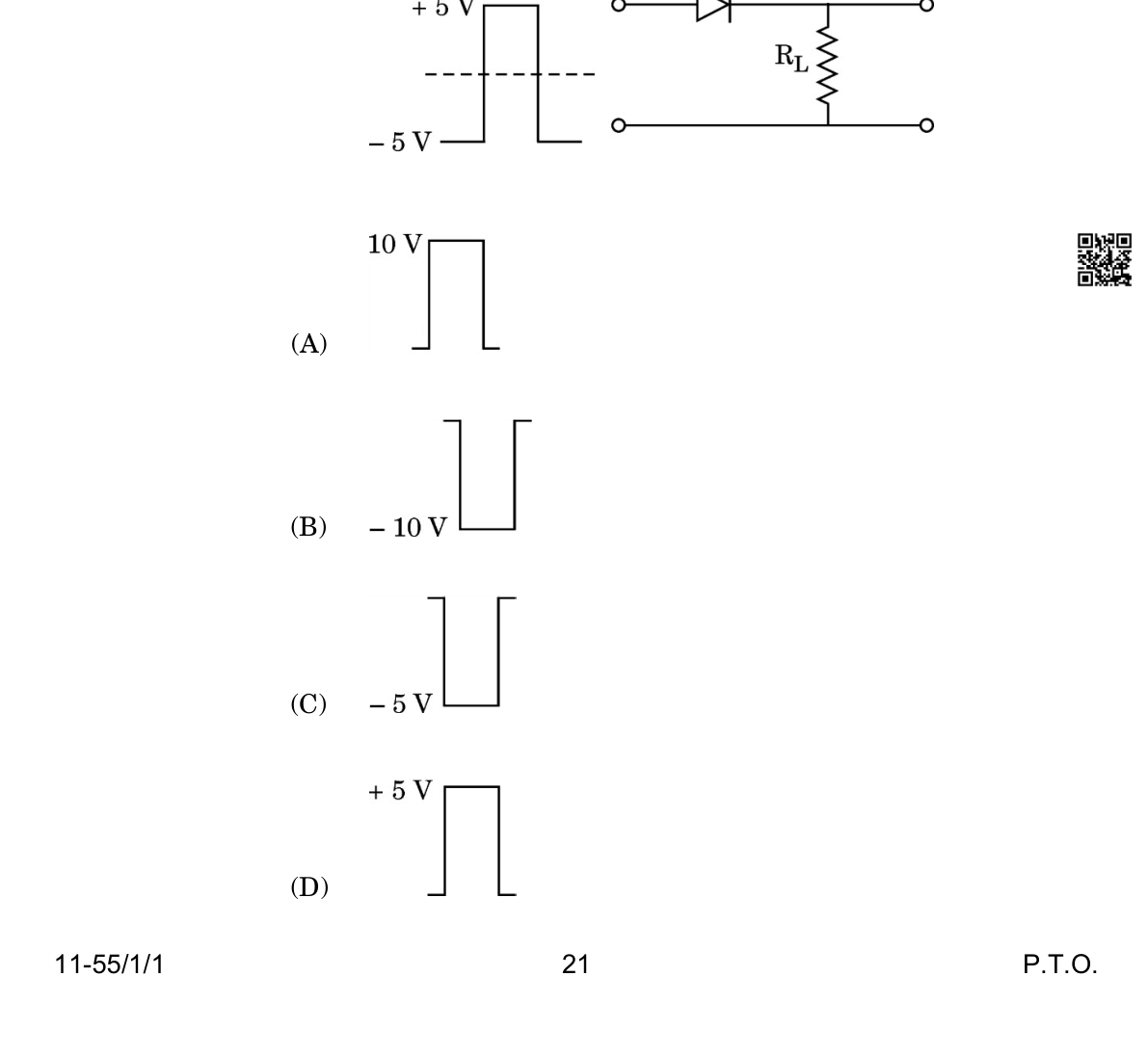
[case context] p-n junction diode as a rectifier. — A signal (a square wave alternating between +5 V and −5 V), as shown in the figure, is applied to a single p-n junction diode in series with load resistance RL. Identify the output across resistance RL from the given waveform options: (A) a +10 V pulse (B) a −10 V pulse (C) a −5 V pulse (D) a +5 V pulse.