CBSE Class 10 Social Science Power-sharing Important Questions 2027
Last updated:
16 questions from Power-sharing (Democratic Politics-II) appeared in 6 of the 7 CBSE papers we analysed (2022–2026) — here are the topics that matter, the questions that repeat, and every previous-year question from this chapter.
Key facts
Political Science - Democratic Politics-II unit — 20 marks in the official syllabus
Asked in 6 of 7 analysed papers (2022–2026)
About 2.3 questions per paper (OR alternatives counted separately)
Counts include both options of internal-choice (OR) questions.
Previous year questions: Power-sharing
Board 2026 4 questions
Two statements are given below. They are Assertion (A) and Reason (R). Read both the statements carefully and choose the correct option:
Assertion (A): The civil war in Sri Lanka resulted due to failure of political accommodation of ethnicity.
Reason (R): The distrust between the Sinhala and Tamil communities turned into widespread conflict in Sri Lanka.
Options:
(A) Both (A) and (R) are correct and (R) is the correct explanation of (A).
(B) Both (A) and (R) are correct, but (R) is not the correct explanation of (A).
(C) (A) is true, but (R) is false.
(D) (A) is false, but (R) is true.
1 mark
[Source: Power Sharing. Power is shared among different organs of government, such as the legislature, executive and judiciary. Let us call this horizontal distribution of power because it allows different organs of government placed at the same level to exercise different powers. Such a separation ensures that none of the organs can exercise unlimited power. Each organ checks the others. This results in a balance of power among various institutions. Last year, we studied that in a democracy, even though ministers and government officials exercise power, they are responsible to the Parliament or State Assemblies. Similarly, although judges are appointed by the executive, they can check the functioning of executive or laws made by the legislatures. This arrangement is called a system of checks and balances.]
28.1 Explain the term 'Balance of Power'.
1 mark
[Source: Power Sharing — see source passage in Q.28.] 28.2 Why is the judiciary considered independent in a democracy?
1 mark
[Source: Power Sharing — see source passage in Q.28.] 28.3 How is power shared among different organs of government?
2 marks
Sample 2026 5 questions
Which of the following statement(s) are true with respect to the ethnic composition of Belgium? I. 59 percent of the total population of Belgium lives in the Wallonia region and speaks French. II. 40 percent live in the Flemish region and speak Dutch. III. One percent of the Belgians speak German. IV. In the capital city Brussels, 80 percent people speak French while 20 per cent are Dutch speaking. Choose the correct option: A. I and II B. III and IV C. I, II and III D. I and IV
1 mark
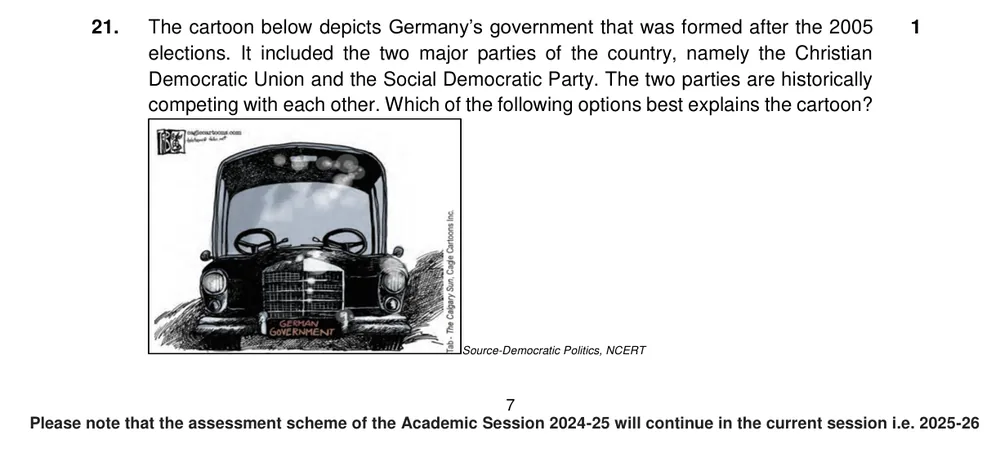
The cartoon below depicts Germany's government that was formed after the 2005 elections. It included the two major parties of the country, namely the Christian Democratic Union and the Social Democratic Party. The two parties are historically competing with each other. Which of the following options best explains the cartoon? [cartoon image, Source-Democratic Politics, NCERT] A. Coalition Government. B. Two Party System. C. Democratic government. D. Bi-party system.
1 mark
[Source: Sri Lanka emerged as an independent country in 1948. The leaders of the Sinhala community sought to secure dominance over government by virtue of their majority. As a result, the democratically elected government adopted a series of MAJORITARIAN measures to establish Sinhala supremacy. Over the years, it created feelings of alienation among the Sri Lankan Tamils. They felt that none of the major political parties led by the Buddhist Sinhala leaders was sensitive to their language and culture. As a result, the relations between the Sinhala and Tamil communities strained over time. On the other hand, the Belgian leaders took a different path. They recognised the existence of regional differences and cultural diversities. Between 1970 and 1993, they amended their constitution four times to work out an arrangement that would enable everyone to live together within the same country. (Source-Adapted from Power Sharing, NCERT)] 28.1 State any two demands of Tamils in Sri Lanka.
1 mark
28.2 State the results of the Majoritarian Government in Sri Lanka.
1 mark
28.3 Explain any two provisions of the Belgian model of power sharing.
2 marks
Board 2025 1 question
Belgium solved its problem of majoritarianism by strengthening which of the following types of government ? (A) Unitary (B) Presidential (C) Federal (D) Parliamentary
1 mark
Sample 2025 2 questions
Match List I with List II and select the correct answer using the codes below in the lists:
List I: 1. Ethnic; 2. Majoritarianism; 3. Civil war; 4. Unitary system.
List II: a. Either only one or two level government; b. a violent conflict opposing groups within a country; c. Belief that the majority community should be able to rule a country; d. a social division based on culture.
Options:
(A) 1.d), 2.a), 3.c), 4.b)
(B) 1.b), 2.d), 3.a), 4.c)
(C) 1.c), 2.a), 3.b), 4.d)
(D) 1.d), 2.c), 3.b), 4.a)
1 mark
India with vast population and diversity represents a classic example of power sharing that exemplifies the very spirit of democracy. Justify the statement.
2 marks
Board 2024 3 questions
Which of the following was the primary objective of Belgium to form the separate government in Brussels? (a) Promoting cultural events. (b) Managing international relations. (c) Enforcing local laws. (d) Ensuring linguistic accommodation.
1 mark
What role do 'checks and balances' play in a democratic country? Choose the most suitable option from the following. (a) To establish a direct form of government without representatives. (b) To create a separation of powers to prevent from authoritarianism. (c) To prevent any change to the Constitution. (d) To ensure absolute power for one branch of government.
1 mark
Why is power sharing desirable? Explain.
2 marks
Board 2023 1 question
Consider the following statements on Power Sharing and choose the correct option:
I. It deepens democracy.
II. It helps to reduce conflicts among social groups.
III. It is a way to ensure political stability.
IV. It brings socio-economic struggles.
Options:
(A) I, II and III
(B) II, III and IV
(C) I, III and IV
(D) I, II and IV
1 mark
Frequently asked questions
What are the most important topics in CBSE Class 10 Social Science Power-sharing?
By how often and how recently they were asked: Belgium and Sri Lanka case studies; Forms of power-sharing; Need for and outcomes of power-sharing.
How many marks does Power-sharing carry in the CBSE Class 10 Social Science exam?
Power-sharing is part of the Political Science - Democratic Politics-II unit, which carries 20 marks in the official syllabus. In the analysed papers it had about 2.3 questions per paper.
Do questions from Power-sharing repeat in board exams?
Yes — 1 question patterns from this chapter appeared in two or more past board or official sample papers. They are listed on this page with the years they were asked.