CBSE Class 10 Science Chapter 10 The Human Eye and the Colourful World Important Questions 2027
Last updated:
14 questions from The Human Eye and the Colourful World appeared in 6 of the 7 CBSE papers we analysed (2022–2026) — here are the topics that matter, the questions that repeat, and every previous-year question from this chapter.
Key facts
Natural Phenomena unit — 12 marks in the official syllabus
Asked in 6 of 7 analysed papers (2022–2026)
About 2.0 questions per paper (OR alternatives counted separately)
6 question patterns repeated across papers
Important topics in The Human Eye and the Colourful World
Atmospheric refraction and scattering (twinkling, blue sky, red sun, Tyndall)
Board 2023Sample 2026
★☆☆☆☆
4
Human eye structure and accommodation
Board 2024Board 2026
★☆☆☆☆
Repeated questions from The Human Eye and the Colourful World
1. Identify a vision defect and show its correction
4×Board 2023Board 2024Sample 2025Sample 20262/3 marks
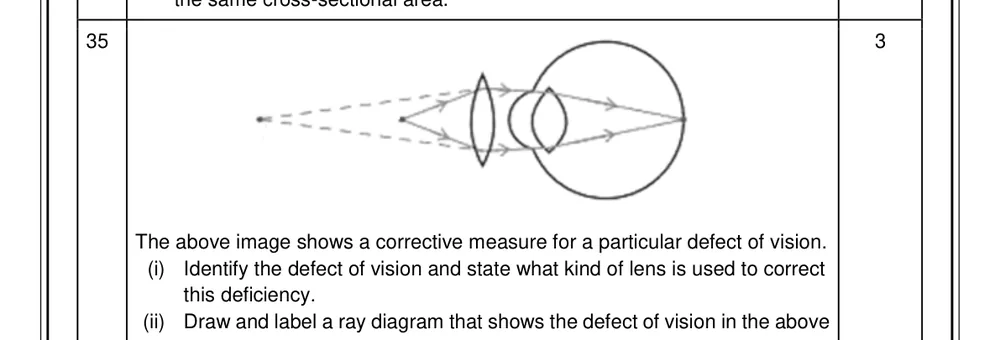
The given figure shows a corrective measure for a particular defect of vision. (i) Identify the defect of vision and state what kind of lens is used to correct this deficiency. (ii) Draw and label a ray diagram that shows the defect of vision in the above case before correction. (For visually impaired students: (i) What is dispersion of light? (ii) Explain the condition under which dispersion happens? (iii) Give one reason that causes presbyopia.)
Choose the correct option from the below which explains the reason for us to perceive the day sky as blue. A. As sunlight passes through the atmosphere, shorter wavelengths, such as blue are scattered more than other colors. B. The sky appears blue because all colors are scattered equally, but blue light is stronger and more visible to the human eye. C. The blue color of the sky is due to longer wavelengths like red and orange scattering more than shorter wavelengths, making blue stand out more. D. The atmosphere contains blue-colored particles that give the sky its blue appearance.
3. Prism dispersion: ray path / emergent colours
2×Board 2023Sample 20251/2 marks
White light is incident on a glass prism; ray x enters and two emergent rays A (upper) and B (lower) leave the prism. Choose the correct option for the colour of rays for A and B. A. Ray A Blue, Ray B Red B. Ray A Green, Ray B Yellow C. Ray A Red, Ray B Violet D. Ray A Violet, Ray B Indigo
4. Presbyopia from ciliary-weakening description (MCQ)
2×Board 2025Board 20261 marks
The vision defect which arises due to gradual weakening of the ciliary muscles and diminishing flexibility of eye lens is: (A) Myopia (B) Hypermetropia (C) Presbyopia (D) Myopia and hypermetropia both
5. Identify eye part by its function (MCQ)
2×Board 2024Board 20261 marks
The pair of eye parts responsible for admitting different amount of light in to the eyes is (A) Iris and pupil (B) Ciliary muscles and pupil (C) Retina and Iris (D) Ciliary muscles and cornea
6. Rainbow formation
2×Board 2024Board 20261/3 marks
Explain the phenomenon of rainbow formation in the sky. Draw the labelled ray diagram in support of your explanation.
The Human Eye and the Colourful World questions by paper
Paper
Questions
Marks
Board 2022
0
0
Board 2023
3
7
Board 2024
3
5
Board 2025
1
1
Sample 2025
2
4
Board 2026
3
5
Sample 2026
2
4
Counts include both options of internal-choice (OR) questions.
Previous year questions: The Human Eye and the Colourful World
Board 2026 3 questions
The pair of eye parts responsible for admitting different amount of light in to the eyes is (A) Iris and pupil (B) Ciliary muscles and pupil (C) Retina and Iris (D) Ciliary muscles and cornea
1 mark
The vision defect which arises due to gradual weakening of the ciliary muscles and diminishing flexibility of eye lens is: (A) Myopia (B) Hypermetropia (C) Presbyopia (D) Myopia and hypermetropia both
1 mark
Explain the phenomenon of rainbow formation in the sky. Draw the labelled ray diagram in support of your explanation.
3 marks
Sample 2026 2 questions
Choose the correct option from the below which explains the reason for us to perceive the day sky as blue. A. As sunlight passes through the atmosphere, shorter wavelengths, such as blue are scattered more than other colors. B. The sky appears blue because all colors are scattered equally, but blue light is stronger and more visible to the human eye. C. The blue color of the sky is due to longer wavelengths like red and orange scattering more than shorter wavelengths, making blue stand out more. D. The atmosphere contains blue-colored particles that give the sky its blue appearance.
1 mark
The given figure shows a corrective measure for a particular defect of vision. (i) Identify the defect of vision and state what kind of lens is used to correct this deficiency. (ii) Draw and label a ray diagram that shows the defect of vision in the above case before correction. (For visually impaired students: (i) What is dispersion of light? (ii) Explain the condition under which dispersion happens? (iii) Give one reason that causes presbyopia.)
3 marks
Board 2025 1 question
An old person is suffering from an eye defect caused by weakening of ciliary muscles and diminishing flexibility of the eye lens. If the defect of vision is 'a' which can be corrected by lens 'b', then 'a' and 'b' respectively are : (A) hypermetropia and convex lens (B) presbyopia and bifocal lens (C) myopia and concave lens (D) myopia and bifocal lens
1 mark
Sample 2025 2 questions
White light is incident on a glass prism; ray x enters and two emergent rays A (upper) and B (lower) leave the prism. Choose the correct option for the colour of rays for A and B. A. Ray A Blue, Ray B Red B. Ray A Green, Ray B Yellow C. Ray A Red, Ray B Violet D. Ray A Violet, Ray B Indigo
1 mark
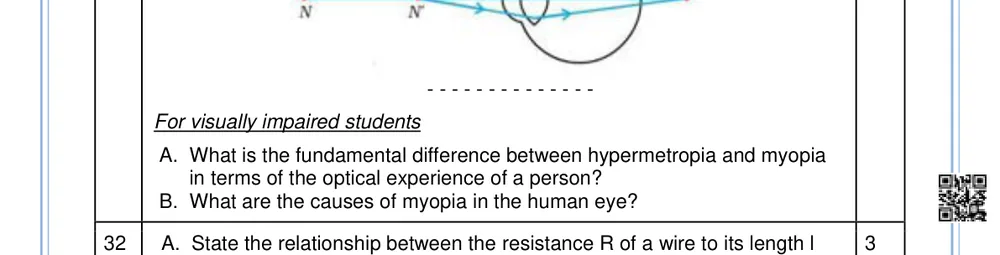
A. What is the fundamental difference between hypermetropia and myopia in terms of the optical experience of a person? B. The given diagram shows a special case of an eye defect (rays converging in front of / with respect to points N and N'). (i) What is the defect that is shown in the figure? (ii) State one cause for such a defect? (iii) Explain with reason if a concave lens can be used to correct the defect.
3 marks
Board 2024 3 questions
The lens system of human eye forms an image on a light sensitive screen, which is called as: (a) Cornea (b) Ciliary muscles (c) Optic nerves (d) Retina
1 mark
Assertion (A): The rainbow is a natural spectrum of sunlight in the sky. Reason (R): Rainbow is formed in the sky when the sun is overhead and water droplets are also present in air. Select the correct answer from codes: (a) Both A and R are true and R is the correct explanation of A. (b) Both A and R are true, but R is not the correct explanation of A. (c) A is true, but R is false. (d) A is false, but R is true.
1 mark
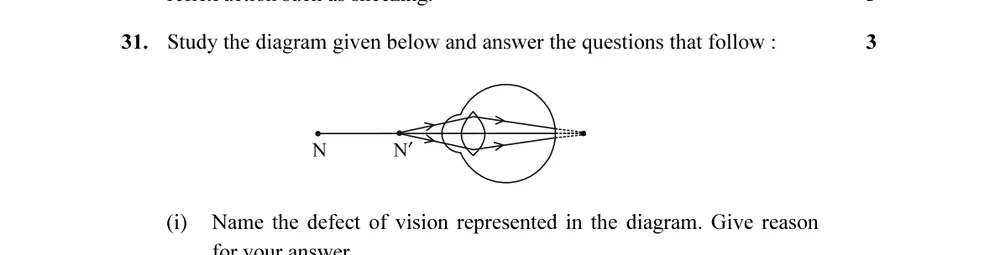
Study the diagram given below and answer the questions that follow: [ray diagram of a defective eye with points N and N' shown, rays converging in front of the retina] (i) Name the defect of vision represented in the diagram. Give reason for your answer. (ii) List two causes of this defect. (iii) With the help of a diagram show how this defect of vision is corrected.
3 marks
Board 2023 3 questions
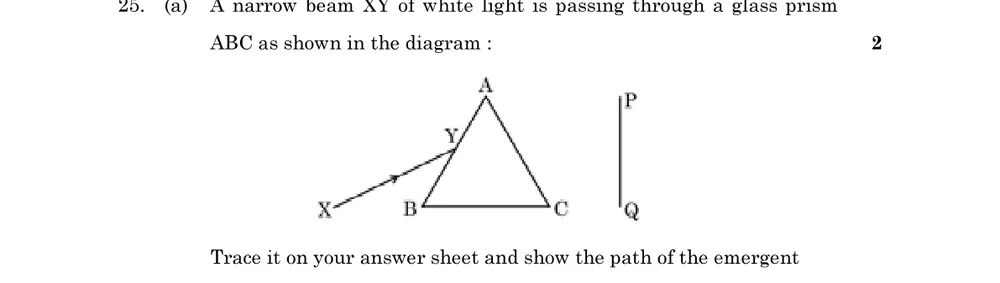
A narrow beam XY of white light is passing through a glass prism ABC as shown in the diagram. Trace it on your answer sheet and show the path of the emergent beam as observed on the screen PQ. Name the phenomenon observed and state its cause. [Diagram shows a triangular glass prism ABC with incident beam XY entering face AB at point Y, and a screen PQ placed to the right of the prism.]
2 marks
It is observed that the power of an eye to see nearby objects as well as far off objects diminishes with age. (i) Give reason for the above statement. (ii) Name the defect that is likely to arise in the eyes in such a condition. (iii) Draw a labelled ray diagram to show the type of corrective lens used for restoring the vision of such an eye.
2 marks
Give reasons for the following: (a) Danger signals installed at airports and at the top of tall buildings are of red colour. (b) The sky appears dark to the passengers flying at very high altitudes. (c) The path of a beam of light passing through a colloidal solution is visible.
3 marks
Frequently asked questions
What are the most important topics in CBSE Class 10 Science Chapter 10 The Human Eye and the Colourful World?
By how often and how recently they were asked: Defects of vision and their correction; Refraction through a prism and dispersion; Atmospheric refraction and scattering (twinkling, blue sky, red sun, Tyndall).
How many marks does The Human Eye and the Colourful World carry in the CBSE Class 10 Science exam?
The Human Eye and the Colourful World is part of the Natural Phenomena unit, which carries 12 marks in the official syllabus. In the analysed papers it had about 2.0 questions per paper.
Do questions from The Human Eye and the Colourful World repeat in board exams?
Yes — 6 question patterns from this chapter appeared in two or more past board or official sample papers. They are listed on this page with the years they were asked.