CBSE Class 10 Science Chapter 11 Electricity Important Questions 2027
Last updated:
29 questions from Electricity appeared in 7 of the 7 CBSE papers we analysed (2022–2026) — here are the topics that matter, the questions that repeat, and every previous-year question from this chapter.
Key facts
Effects of Current unit — 13 marks in the official syllabus
Asked in 7 of 7 analysed papers (2022–2026)
About 4.1 questions per paper (OR alternatives counted separately)
9 question patterns repeated across papers
Important topics in Electricity
#
Topic
Asked in
Importance
1
Heating effect of current and electric power numericals
Electric circuit diagrams and current/voltage calculation
Board 2023Board 2025Board 2026Sample 2025
★★☆☆☆
4
Resistance, resistivity and factors affecting resistance
Board 2024Board 2025Sample 2025Sample 2026
★☆☆☆☆
Repeated questions from Electricity
1. Calculate unknown resistances/currents/PD in a circuit
4×Board 2025Board 2026Sample 20253/5 marks
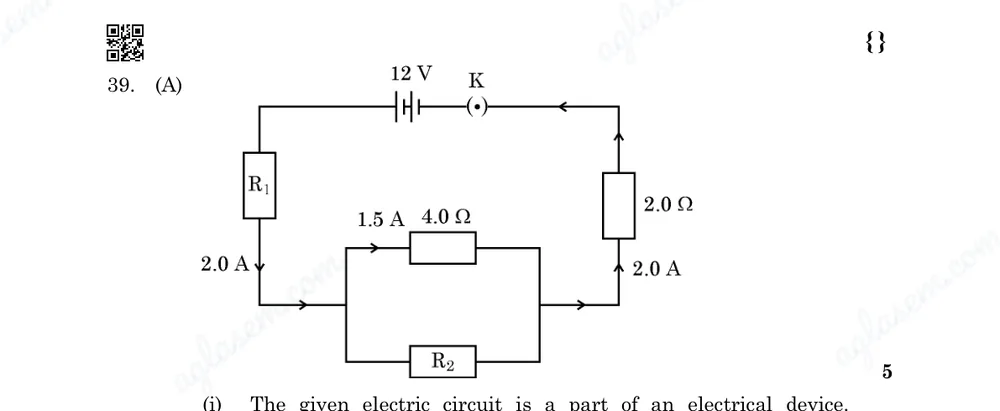
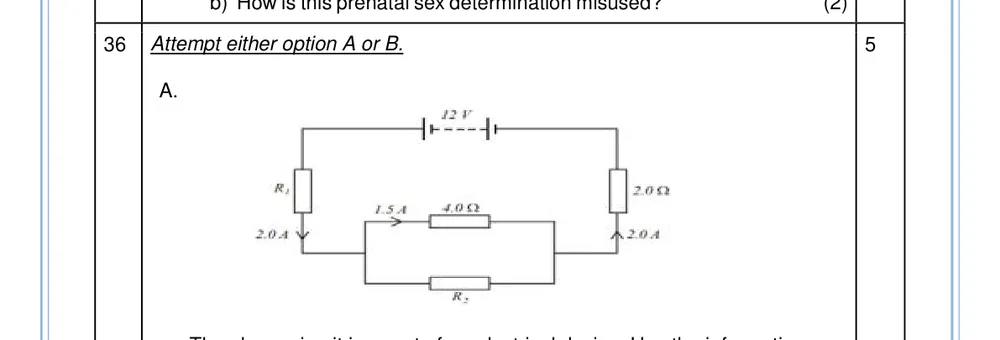
(i) The given electric circuit is a part of an electrical device. Use the information given in the electric circuit diagram to calculate: (I) Potential difference across the ends of resistor R2. (II) Value of resistor R2. (III) Value of resistor R1. [Circuit data: 12 V source with key K; branch with R1; a 4.0 Ohm resistor carrying 1.5 A; resistor R2 in parallel; a 2.0 Ohm resistor; total line current 2.0 A.] (ii) Write the factors on which resistance of a conductor depends and derive the formula for resistance of a given conductor.
2. Appliance power numerical (find I/P/R from rating)
4×Board 2023Board 2024Board 2026Sample 20265 marks
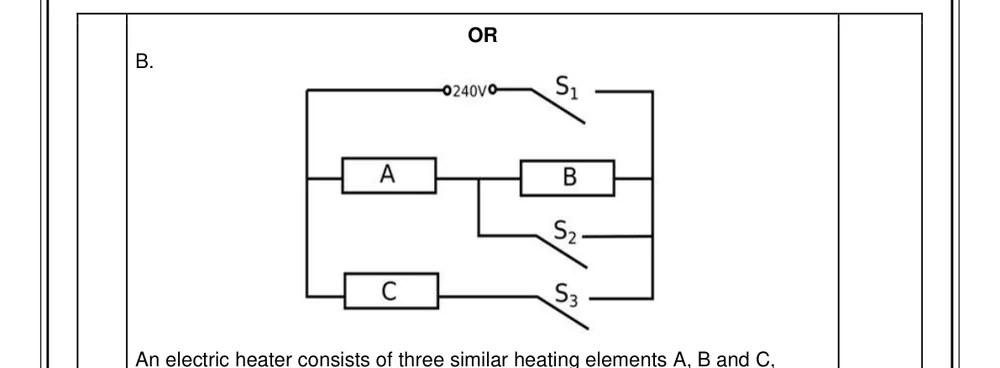
An electric heater consists of three similar heating elements A, B and C, connected as shown in the figure (with switches S1, S2 and S3 and a 240 V supply). Each heating element is rated as 1.2 kW, 240 V and has constant resistance. The circuit is connected to a 240 V supply. (i) Calculate the resistance of one heating element. (ii) Calculate the current in each resistor when only S1 and S3 are closed. (iii) Calculate the power dissipated across A when S1, S2 and S3 are closed. (For visually impaired students: A. (i) Explain why in household circuits only the fuse is connected in series with all the rest of the appliances but all appliances are connected in parallel to each other. (ii) A 1500 W heater and a 500 W fan are connected in parallel to a 220 V supply with a 10 A fuse; (a) calculate the total current drawn and (b) determine whether the 10 A fuse will blow. OR B. Two resistors R1=6 ohm and R2=12 ohm are connected in parallel to a 24 V battery for 5 minutes; (i) calculate the total heat generated and (ii) if each resistor is rated 100 W, determine whether it is safe.)
3. Equivalent resistance & current of a resistor network
3×Board 2022Sample 20262/3 marks
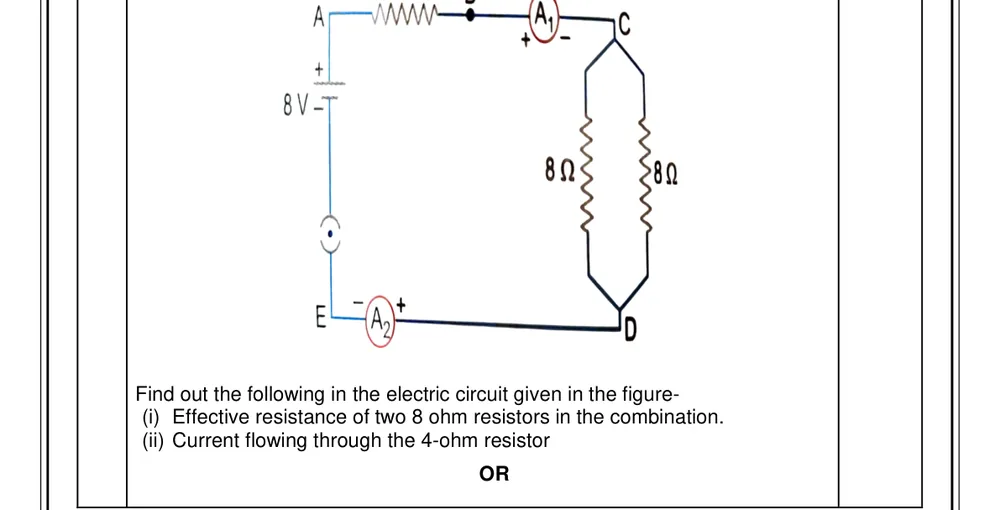
Find out the following in the electric circuit given in the figure (an 8 V cell in series with a 4 ohm resistor and ammeter A1, connected to two 8 ohm resistors joined in parallel between points C and D, with ammeter A2 in the return path): (i) Effective resistance of two 8 ohm resistors in the combination. (ii) Current flowing through the 4-ohm resistor.
4. State R=rhoL/A relation and derive/define resistivity
3×Board 2024Board 2025Sample 20253/5 marks
(a) Write the relationship between resistivity and resistance of a cylindrical conductor of length l and area of cross-section A. Hence derive the SI unit of resistivity. (b) Why are alloys used in electrical heating devices ?
5. Ratio of resistance/power: series vs parallel
2×Board 2023Sample 20251/2 marks
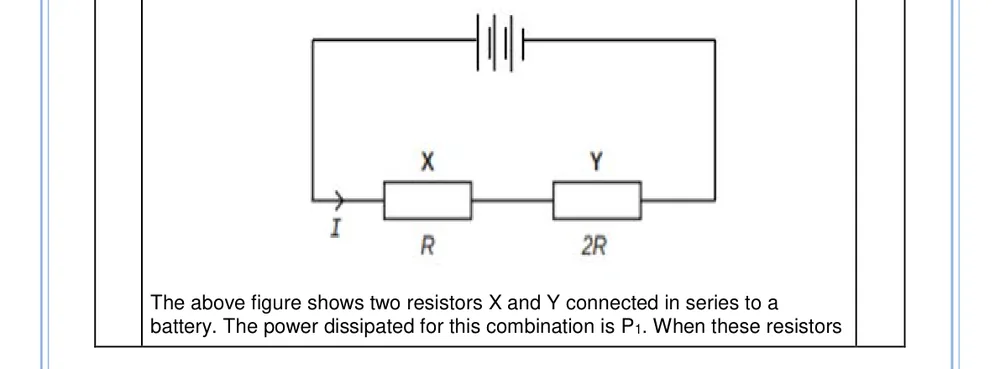
Attempt either option A or B. B. The given figure shows two resistors X (R) and Y (2R) connected in series to a battery. The power dissipated for this combination is P1. When these resistors are connected in parallel to the same battery then the power dissipated is given by P2. Find out the ratio P1/P2.
6. Current rating / fuse suitability from appliance power
2×Board 2025Board 20261/2 marks
A fuse in electric circuit is rated 4 A. Can it be used with an electric heater of rating 2 kW, 200 V? Explain your answer.
7. Total current for appliances in parallel
2×Board 2022Sample 20252/3 marks
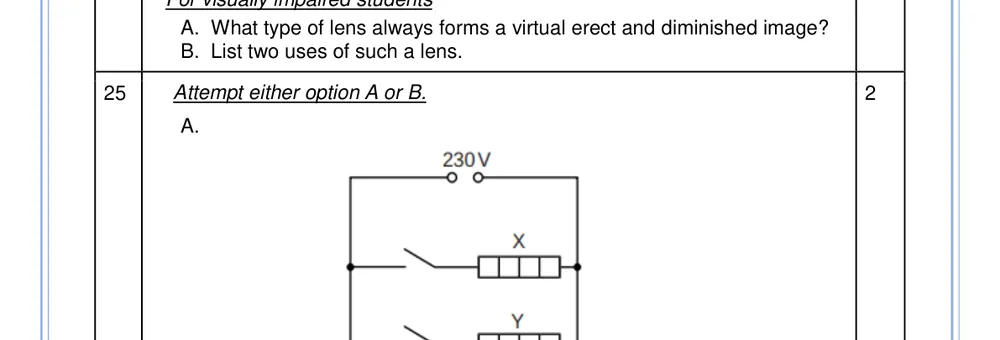
Attempt either option A or B. A. The electric circuit (given figure) in a clothes dryer contains two heaters X and Y in parallel connected to a 230 V power supply. When both switches are closed, the current in X is 3.5 A. Analyse the circuit and answer: (i) Calculate the power developed in heater X. (ii) If the resistance of X is double that of Y calculate the current in heater Y.
8. Rearrange/combine resistors for a required resistance
2×Board 2024Board 20252 marks
A wire of resistance R is cut into three equal parts. If these three parts are then joined in parallel, calculate the total resistance of the combination so formed.
9. Heat/power dissipated in a resistor
2×Board 2022Board 20242/3 marks
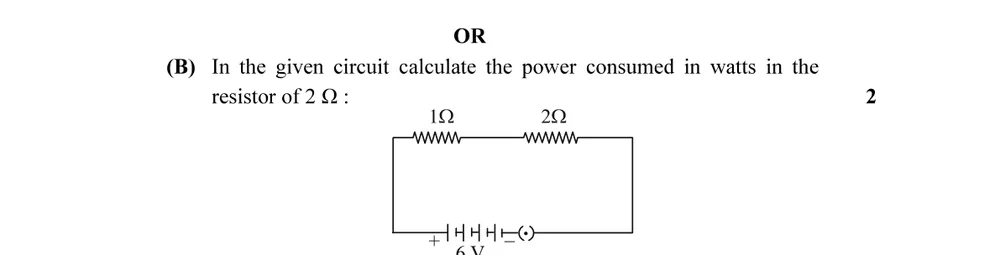
In the given circuit calculate the power consumed in watts in the resistor of 2 ohm: [circuit diagram shows a 1 ohm resistor and a 2 ohm resistor in series with a 6 V battery]
Electricity questions by paper
Paper
Questions
Marks
Board 2022
3
9
Board 2023
3
7
Board 2024
4
14
Board 2025
5
11
Sample 2025
5
17
Board 2026
4
14
Sample 2026
5
17
Counts include both options of internal-choice (OR) questions.
Previous year questions: Electricity
Board 2026 4 questions
A fuse in electric circuit is rated 4 A. Can it be used with an electric heater of rating 2 kW, 200 V? Explain your answer.
2 marks
(a) Define volt, the unit of potential difference. (b) Calculate the work done required to move an electron between two points A and B located at a potential difference of 100 V in an electric field.
2 marks
(i) The given electric circuit is a part of an electrical device. Use the information given in the electric circuit diagram to calculate: (I) Potential difference across the ends of resistor R2. (II) Value of resistor R2. (III) Value of resistor R1. [Circuit data: 12 V source with key K; branch with R1; a 4.0 Ohm resistor carrying 1.5 A; resistor R2 in parallel; a 2.0 Ohm resistor; total line current 2.0 A.] (ii) Write the factors on which resistance of a conductor depends and derive the formula for resistance of a given conductor.
5 marks
(i) How much electric current will an electric iron draw from 220 V source if the resistance of its heating element when hot, is 55 Ohm? Calculate the power consumed by the electric iron when it is operated at 220 V. (ii) In a house, 3 bulbs of 100 watt each, are lit for 5 hours daily and an electric heater of 1.0 kW is used for half an hour daily. Calculate the total energy consumed in a month of 30 days and its cost at the rate of Rs. 3.60 per kWh. (iii) With reason explain, why are alloys commonly used to make elements of electrical heating devices.
5 marks
Sample 2026 5 questions
Find out the following in the electric circuit given in the figure (an 8 V cell in series with a 4 ohm resistor and ammeter A1, connected to two 8 ohm resistors joined in parallel between points C and D, with ammeter A2 in the return path): (i) Effective resistance of two 8 ohm resistors in the combination. (ii) Current flowing through the 4-ohm resistor.
2 marks
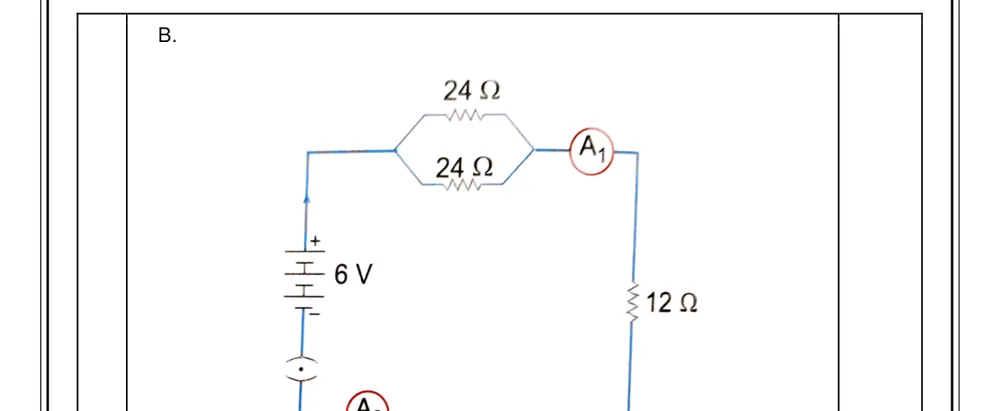
Study the circuit given in the figure (a 6 V cell connected to two 24 ohm resistors in parallel with ammeter A1, in series with a 12 ohm resistor, and ammeter A2 in the return path) and find out: (i) Current in 12 ohm resistor. (ii) Difference in the readings of ammeter A1 and A2 if any. (For visually impaired students: A. You are given four resistors each having resistance R ohm. Find the maximum and minimum resistance that can be made with these four resistors. OR B. A copper wire has a length L=2 m, a cross-sectional area A=0.5 mm2, and resistivity rho=1.7x10⁻⁸ ohm-m. Calculate the resistance of another wire made of the same material whose length is twice the length of the wire but has the same cross-sectional area.)
2 marks
A student needs to make a 0.12 ohm resistor. She has some copper wire of 0.80 mm diameter. Resistivity of copper is 1.8 x 10⁻⁸ ohm m. (i) Determine the cross-sectional area of the wire. (ii) Calculate the length of wire required for the 0.12 ohm resistor.
3 marks
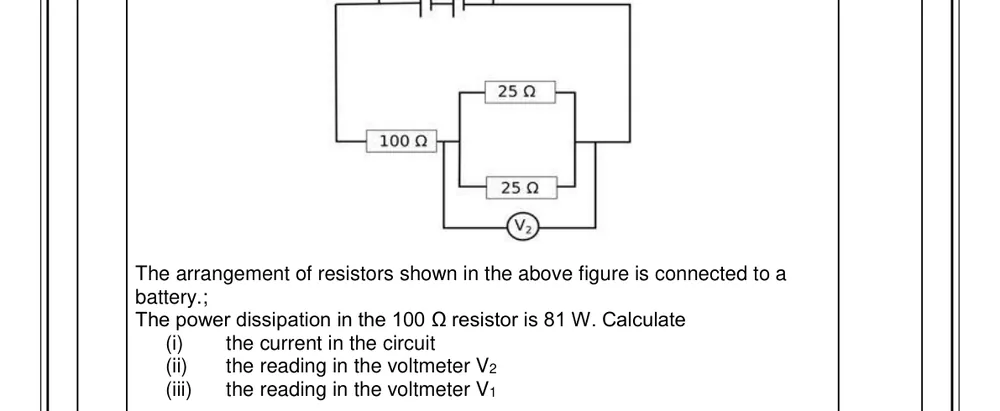
The arrangement of resistors shown in the given figure is connected to a battery (voltmeter V1 across the battery; a 100 ohm resistor in series with a parallel combination of two 25 ohm resistors; voltmeter V2 across the parallel combination). The power dissipation in the 100 ohm resistor is 81 W. Calculate (i) the current in the circuit (ii) the reading in the voltmeter V2 (iii) the reading in the voltmeter V1.
5 marks
An electric heater consists of three similar heating elements A, B and C, connected as shown in the figure (with switches S1, S2 and S3 and a 240 V supply). Each heating element is rated as 1.2 kW, 240 V and has constant resistance. The circuit is connected to a 240 V supply. (i) Calculate the resistance of one heating element. (ii) Calculate the current in each resistor when only S1 and S3 are closed. (iii) Calculate the power dissipated across A when S1, S2 and S3 are closed. (For visually impaired students: A. (i) Explain why in household circuits only the fuse is connected in series with all the rest of the appliances but all appliances are connected in parallel to each other. (ii) A 1500 W heater and a 500 W fan are connected in parallel to a 220 V supply with a 10 A fuse; (a) calculate the total current drawn and (b) determine whether the 10 A fuse will blow. OR B. Two resistors R1=6 ohm and R2=12 ohm are connected in parallel to a 24 V battery for 5 minutes; (i) calculate the total heat generated and (ii) if each resistor is rated 100 W, determine whether it is safe.)
5 marks
Board 2025 5 questions
[Case: Domestic mains supply at 220 V between live and neutral wires.] What should be the current rating of the electric circuit (220 V) so that an electric iron of 1 kW power rating can be operated ?
1 mark
A wire of resistance R is cut into three equal parts. If these three parts are then joined in parallel, calculate the total resistance of the combination so formed.
2 marks
Define electric power. When do we say that the power consumed in an electric circuit is 1 watt ?
2 marks
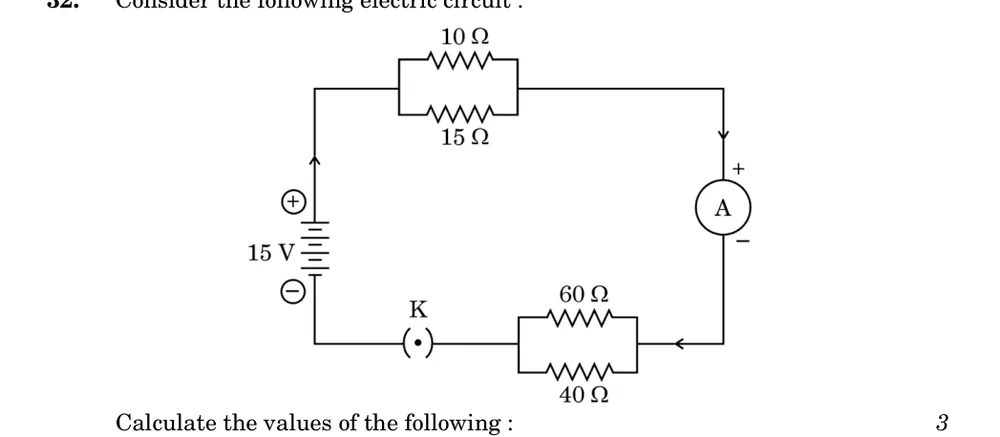
Consider the following electric circuit (see figure: a 15 V source, 10 ohm and 15 ohm resistors in parallel, in series with a parallel combination of 60 ohm and 40 ohm resistors, an ammeter A and key K). Calculate the values of the following : (a) The total resistance of the circuit (b) The total current drawn from the source (c) Potential difference across the parallel combination of 10 ohm and 15 ohm resistors.
3 marks
(a) Write the relationship between resistivity and resistance of a cylindrical conductor of length l and area of cross-section A. Hence derive the SI unit of resistivity. (b) Why are alloys used in electrical heating devices ?
3 marks
Sample 2025 5 questions
Attempt either option A or B. A. The electric circuit (given figure) in a clothes dryer contains two heaters X and Y in parallel connected to a 230 V power supply. When both switches are closed, the current in X is 3.5 A. Analyse the circuit and answer: (i) Calculate the power developed in heater X. (ii) If the resistance of X is double that of Y calculate the current in heater Y.
2 marks
Attempt either option A or B. B. The given figure shows two resistors X (R) and Y (2R) connected in series to a battery. The power dissipated for this combination is P1. When these resistors are connected in parallel to the same battery then the power dissipated is given by P2. Find out the ratio P1/P2.
2 marks
A. State the relationship between the resistance R of a wire to its length l and cross sectional area A. Use the mathematical symbols to arrive at the final formula. B. Using the formula define the resistivity of a material.
3 marks
Attempt either option A or B. A. The given circuit is a part of an electrical device (a 12 V source; a branch with R1 carrying 2.0 A; a middle branch with a 4.0 ohm resistor carrying 1.5 A; a branch with R2; and a 2.0 ohm resistor carrying 2.0 A). Use the information given to calculate the following. (i) Potential Difference across R2. (ii) Value of the resistance R2. (iii) Value of resistance R1.
5 marks
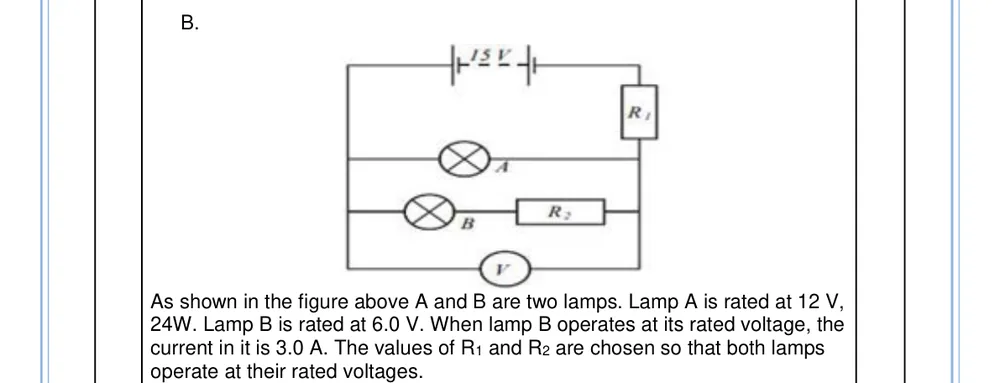
Attempt either option A or B. B. As shown in the given figure A and B are two lamps with resistors R1 and R2 and a voltmeter V, connected to a 15 V source. Lamp A is rated at 12 V, 24 W. Lamp B is rated at 6.0 V. When lamp B operates at its rated voltage, the current in it is 3.0 A. The values of R1 and R2 are chosen so that both lamps operate at their rated voltages. Based on the information given, answer the following. (i) Calculate the current in Lamp A. (ii) State and give reason for the reading of the Voltmeter. (iii) Calculate the resistance of R2. (iv) Find the value of the resistance R1.
5 marks
Board 2024 4 questions
Show how you would connect three resistors each of resistance 6 ohm, so that the combination has a resistance of 9 ohm. Also justify your answer.
2 marks
In the given circuit calculate the power consumed in watts in the resistor of 2 ohm: [circuit diagram shows a 1 ohm resistor and a 2 ohm resistor in series with a 6 V battery]
2 marks
(i) Define electric power. Express it in terms of potential difference (V) and resistance (R). (ii) An electric oven is designed to work on the mains voltage of 220 V. This oven consumes 11 units of electrical energy in 5 hours. Calculate: (a) power rating of the oven (b) current drawn by the oven (c) resistance of the oven when it is red hot.
5 marks
(i) Write the relation between resistance R and electrical resistivity rho of the material of a conductor in the shape of cylinder of length l and area of cross-section A. Hence derive the SI unit of electrical resistivity. (ii) The resistance of a metal wire of length 3 m is 60 ohm. If the area of cross-section of the wire is 4x10⁻⁷ m2, calculate the electrical resistivity of the wire. (iii) State how would electrical resistivity be affected if the wire (of part 'ii') is stretched so that its length is doubled. Justify your answer.
5 marks
Board 2023 3 questions
If four identical resistors, of resistance 8 ohm, are first connected in series so as to give an effective resistance Rs, and then connected in parallel so as to give an effective resistance Rp, then the ratio Rs/Rp is (a) 32 (b) 2 (c) 0.5 (d) 16
1 mark
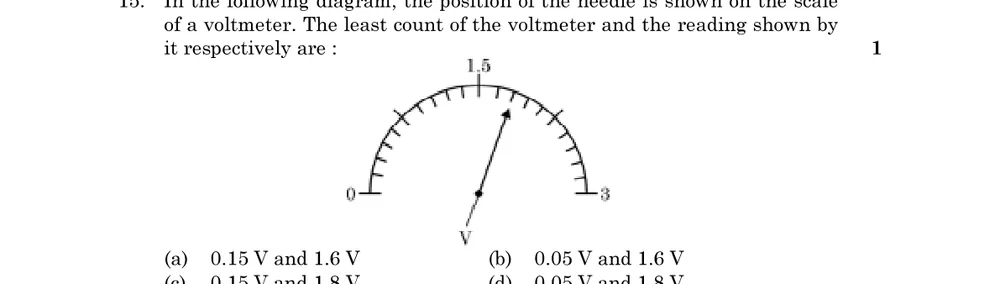
In the following diagram, the position of the needle is shown on the scale of a voltmeter. The least count of the voltmeter and the reading shown by it respectively are: (a) 0.15 V and 1.6 V (b) 0.05 V and 1.6 V (c) 0.15 V and 1.8 V (d) 0.05 V and 1.8 V [Diagram shows a voltmeter scale from 0 to 3 with 1.5 marked at the top and the needle pointing between 1.5 and 3.]
1 mark
(a) An electric iron consumes energy at a rate of 880 W when heating is at the maximum rate and 330 W when the heating is at the minimum. If the source voltage is 220 V, calculate the current and resistance in each case. (b) What is heating effect of electric current? (c) Find an expression for the amount of heat produced when a current passes through a resistor for some time.
5 marks
Board 2022 3 questions
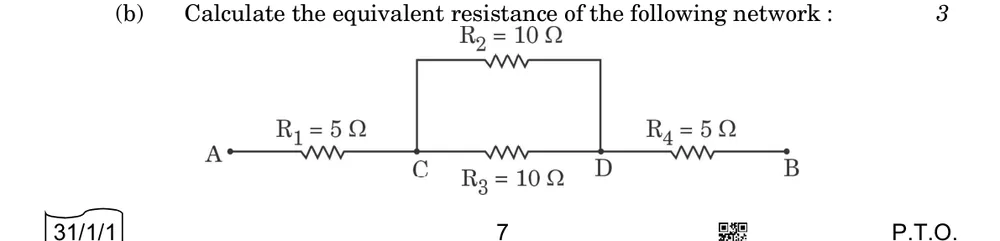
(a) Three resistors R1, R2 and R3 are connected in parallel and the combination is connected to a battery, an ammeter, a voltmeter and a key. Draw suitable circuit diagram to show the arrangement of these circuit components along with the direction of current flowing. (b) Calculate the equivalent resistance of the following network: [network shown: along line A-C-D-B, R1 = 5 ohm is between A and C and R4 = 5 ohm is between D and B; between C and D, R2 = 10 ohm (upper branch) and R3 = 10 ohm (lower branch) are in parallel].
3 marks
(i) Define Electric Power and write its SI unit. (ii) Two bulbs rated 100 W; 220 V and 60 W; 220 V are connected in parallel to an electric mains of 220 V. Find the current drawn by the bulbs from the mains.
3 marks
(i) State Joule's law of heating. Express it mathematically when an appliance of resistance R is connected to a source of voltage V and the current I flows through the appliance for a time t. (ii) A 5 ohm resistor is connected across a battery of 6 volts. Calculate the energy that dissipates as heat in 10 s.
3 marks
Frequently asked questions
What are the most important topics in CBSE Class 10 Science Chapter 11 Electricity?
By how often and how recently they were asked: Heating effect of current and electric power numericals; Series and parallel combination of resistors (numericals); Electric circuit diagrams and current/voltage calculation.
How many marks does Electricity carry in the CBSE Class 10 Science exam?
Electricity is part of the Effects of Current unit, which carries 13 marks in the official syllabus. In the analysed papers it had about 4.1 questions per paper.
Do questions from Electricity repeat in board exams?
Yes — 9 question patterns from this chapter appeared in two or more past board or official sample papers. They are listed on this page with the years they were asked.