CBSE Class 10 Science Chapter 9 Light - Reflection and Refraction Important Questions 2027
Last updated:
35 questions from Light - Reflection and Refraction appeared in 6 of the 7 CBSE papers we analysed (2022–2026) — here are the topics that matter, the questions that repeat, and every previous-year question from this chapter.
Key facts
Natural Phenomena unit — 12 marks in the official syllabus
Asked in 6 of 7 analysed papers (2022–2026)
About 5.0 questions per paper (OR alternatives counted separately)
8 question patterns repeated across papers
Important topics in Light - Reflection and Refraction
#
Topic
Asked in
Importance
1
Image formation by spherical mirrors / ray diagrams
Repeated questions from Light - Reflection and Refraction
1. Solve lens formula/magnification for the unknown
4×Board 2025Sample 20262 marks
The given figure shows the formation of an image with an optical instrument (shown schematically as a rectangle); an upright object forms an image with the distances 10 cm and 20 cm marked. A. Identify the optical instrument (shown schematically as a rectangle) in the image. B. What type of image is formed in this case? C. Based on the measurements given in the image, calculate the focal length of the instrument. (For visually impaired students: A. Under what conditions can a convex lens form a virtual image? B. Why does a piece of paper catch fire if we allow sunlight to pass through a convex lens onto the paper?)
2. Image nature for concave vs convex mirror (MCQ)
2×Board 2025Sample 20261 marks
Arnav was making notes and he wrote down the following statements from his understanding of reflection from curved surfaces. I. Concave mirrors can produce both real and virtual images depending on the position of the object. II. Convex mirrors always produce real, inverted images regardless of the object's position. III. In both concave and convex mirrors, the image location can be determined using the mirror formula 1/f = 1/v + 1/u where f is the focal length, v is the image distance, and u is the object distance. Choose from the following the correct option that lists the correct statements about reflection from curved surfaces. A. I and II B. I, II and III C. II and III D. I and III
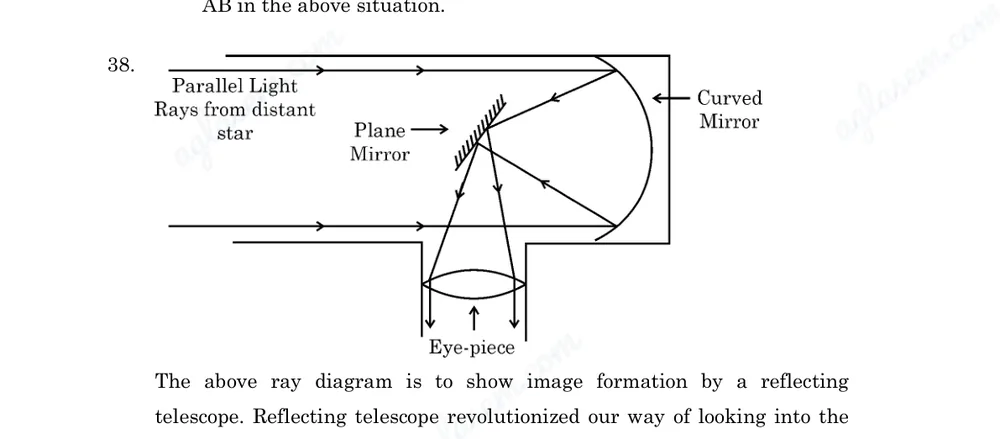
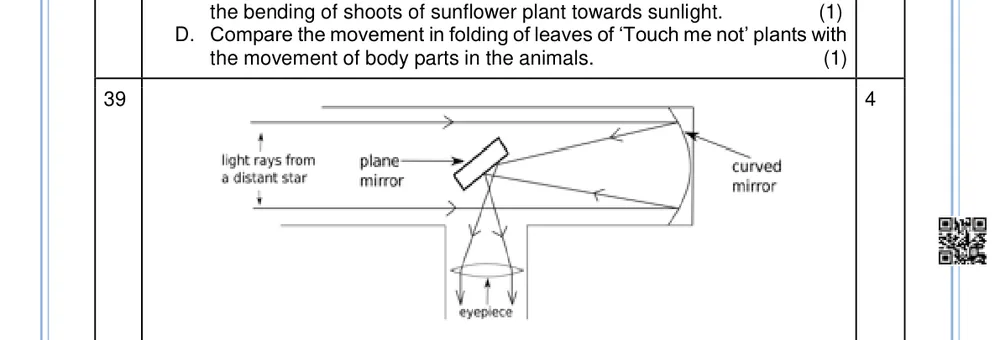
3. Nature of image of star in reflecting telescope
2×Board 2026Sample 20251 marks
[case context] A ray diagram shows image formation by a reflecting telescope, which uses large precisely-shaped curved mirrors (and a plane mirror) to gather and focus incoming light to a focal point where the image is formed for observation at the eye-piece. What kind of image of a star is seen by the observer in the eye-piece?
4. Type of mirror in reflecting telescope
2×Board 2026Sample 20251 marks
[case context] A ray diagram shows image formation by a reflecting telescope that uses large curved mirrors to gather and focus light. What kind of mirror is used in this reflecting telescope?
5. Optical device at telescope eyepiece
2×Board 2026Sample 20252 marks
[case context] A reflecting telescope uses curved mirrors and a plane mirror to form an image at the eye-piece. Explain with the reason, what kind of optical device (type of lens or mirror) is used at the eye-piece.
6. Role of plane mirror in reflecting telescope
2×Board 2026Sample 20252 marks
[case context] A reflecting telescope uses curved mirrors and a plane mirror to form an image. OR alternative for (c): What is the role of plane mirror in image formation by this telescope?
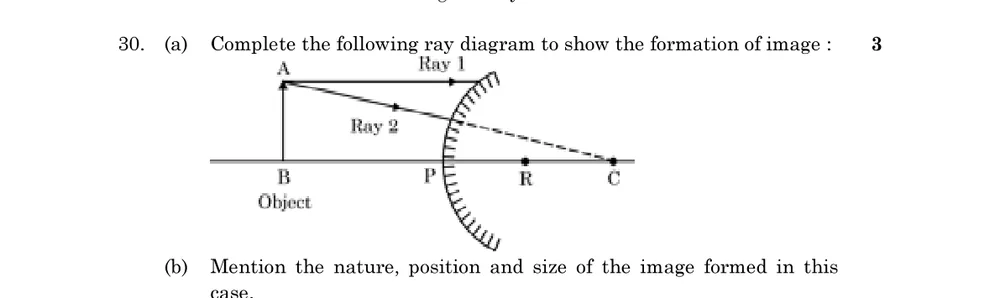
7. Draw/complete ray diagram and describe mirror image
3×Board 2023Board 20252/3 marks
(a) Complete the following ray diagram to show the formation of image. [Diagram shows a concave mirror with an object AB standing on the principal axis beyond the centre of curvature C; pole P, focus (between P and R) and R marked; Ray 1 from A travels parallel to the principal axis, Ray 2 from A passes towards the mirror.] (b) Mention the nature, position and size of the image formed in this case. (c) State the sign of the image distance in this case using the Cartesian sign convention.
8. Mirror formula numerical (find unknown)
3×Board 2023Board 20242 marks
An object is placed at a distance of 10 cm from a convex mirror of focal length 15 cm. Find the position of the image formed by the mirror.
Light - Reflection and Refraction questions by paper
Paper
Questions
Marks
Board 2022
0
0
Board 2023
5
9
Board 2024
6
9
Board 2025
5
16
Sample 2025
7
10
Board 2026
5
9
Sample 2026
7
10
Counts include both options of internal-choice (OR) questions.
Previous year questions: Light - Reflection and Refraction
Board 2026 5 questions
[case context] A ray diagram shows image formation by a reflecting telescope, which uses large precisely-shaped curved mirrors (and a plane mirror) to gather and focus incoming light to a focal point where the image is formed for observation at the eye-piece. What kind of image of a star is seen by the observer in the eye-piece?
1 mark
[case context] A ray diagram shows image formation by a reflecting telescope that uses large curved mirrors to gather and focus light. What kind of mirror is used in this reflecting telescope?
1 mark
[case context] A reflecting telescope uses curved mirrors and a plane mirror to form an image at the eye-piece. Explain with the reason, what kind of optical device (type of lens or mirror) is used at the eye-piece.
2 marks
[case context] A reflecting telescope uses curved mirrors and a plane mirror to form an image. OR alternative for (c): What is the role of plane mirror in image formation by this telescope?
2 marks
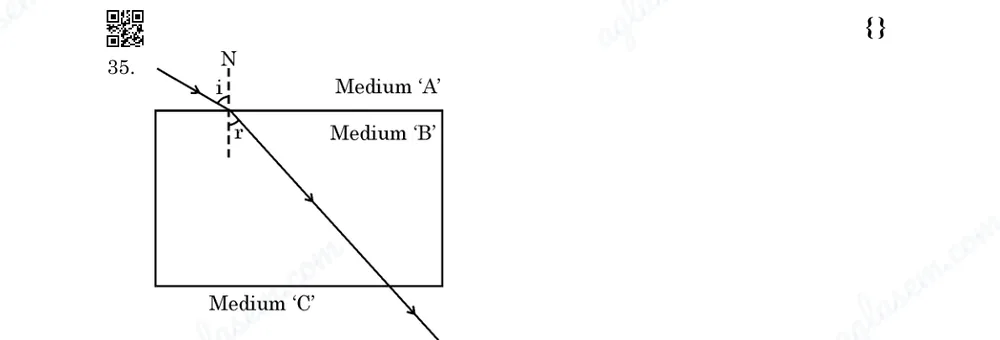
(a) Observe the given ray diagram and compare: (i) the speed of light in medium A and the speed of light in medium B. (ii) the optical densities of medium B and medium C. (b) Draw a ray diagram for refraction where the optical density of medium 'A' becomes equal to the optical density of medium 'C' and optical density of medium 'B' is greater than the optical density of medium 'A' and medium 'C'.
3 marks
Sample 2026 7 questions
Arnav was making notes and he wrote down the following statements from his understanding of reflection from curved surfaces. I. Concave mirrors can produce both real and virtual images depending on the position of the object. II. Convex mirrors always produce real, inverted images regardless of the object's position. III. In both concave and convex mirrors, the image location can be determined using the mirror formula 1/f = 1/v + 1/u where f is the focal length, v is the image distance, and u is the object distance. Choose from the following the correct option that lists the correct statements about reflection from curved surfaces. A. I and II B. I, II and III C. II and III D. I and III
1 mark
Assertion (A): A point object is placed at a distance of 26 cm from a convex mirror of focal length 26 cm. The image will not form at infinity. Reason (R): For above given system the equation 1/f = 1/v + 1/u gives v = infinity. Options: A. Both A and R are true, and R is the correct explanation of A. B. Both A and R are true, and R is not the correct explanation of A. C. A is true but R is false. D. A is false but R is true.
1 mark
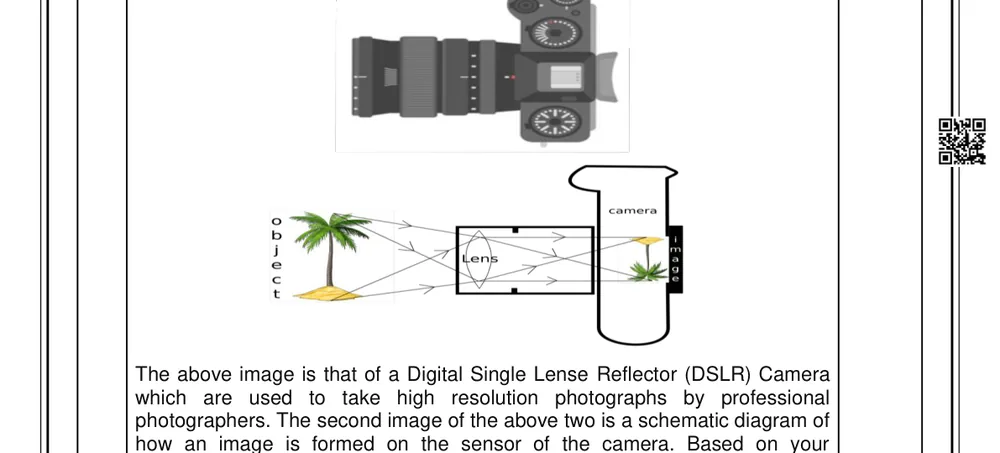
[case context] A DSLR (Digital Single Lens Reflector) camera; the figure shows a schematic of how an image of an object is formed on the sensor of the camera through a lens. A. What type of lens is used in the DSLR camera shown in the image?
1 mark
[case context] A DSLR camera forms an image of an object on its sensor through a lens (schematic figure). B. What type of image is formed on the sensor?
1 mark
The given figure shows the formation of an image with an optical instrument (shown schematically as a rectangle); an upright object forms an image with the distances 10 cm and 20 cm marked. A. Identify the optical instrument (shown schematically as a rectangle) in the image. B. What type of image is formed in this case? C. Based on the measurements given in the image, calculate the focal length of the instrument. (For visually impaired students: A. Under what conditions can a convex lens form a virtual image? B. Why does a piece of paper catch fire if we allow sunlight to pass through a convex lens onto the paper?)
2 marks
[case context] A DSLR camera forms an image of an object on its sensor through a lens. Attempt either subpart C or D. C. A photographer is using a DSLR camera with a lens of focal length f=50 mm to take a close-up photograph of a small object. The lens projects an image onto the camera sensor that is located 60 mm behind the lens. Calculate the object distance (i.e., the distance between the object and the lens).
2 marks
[case context] A DSLR camera forms an image of an object on its sensor through a lens. (OR) D. A photographer is using a DSLR camera to take a picture of a flower. The flower is positioned 150 mm away from the camera lens. The actual height of the flower is 80 mm, and the image height formed on the camera's sensor is measured to be 20 mm. Calculate the focal length of the camera lens.
2 marks
Board 2025 5 questions
Mirror 'X' is used to concentrate sunlight in solar furnace and Mirror 'Y' is fitted on the side of the vehicle to see the traffic behind the driver. Which of the following statements are true for the two mirrors ? (i) The image formed by mirror 'X' is real, diminished and at its focus. (ii) The image formed by mirror 'Y' is virtual, diminished and erect. (iii) The image formed by mirror 'X' is virtual, diminished and erect. (iv) The image formed by mirror 'Y' is real, diminished and at its focus. (A) (i) and (ii) (B) (ii) and (iii) (C) (iii) and (iv) (D) (i) and (iv)
1 mark
An object is placed at a distance of 60 cm from a concave lens of focal length 30 cm. Use lens formula to find the position of the image formed in this case.
2 marks
Draw ray diagrams to show the nature, position and relative size of the image formed by a convex mirror when the object is placed (i) at infinity and (ii) between infinity and pole P of the mirror.
3 marks
(i) The power of a lens 'X' is -2.5 D. Name the lens and determine its focal length in cm. For which eye defect of vision will an optician prescribe this type of lens as a corrective lens ? (ii) "The value of magnification 'm' for a lens is -2." Using new Cartesian Sign Convention and considering that an object is placed at a distance of 20 cm from the optical centre of this lens, state: (I) the nature of the image formed; (II) size of the image compared to the size of the object; (III) position of the image, and (IV) sign of the height of the image. (iii) The numerical values of the focal lengths of two lenses A and B are 10 cm and 20 cm respectively. Which one of the two will show higher degree of convergence/divergence ? Give reason to justify your answer.
5 marks
(i) Draw a ray diagram to show the refraction of a ray of light through a rectangular glass slab when it falls obliquely from air into glass. (ii) State Snell's law of refraction of light. (iii) Differentiate between the virtual images formed by a convex lens and a concave lens on the basis of: (I) object distance, and (II) magnification.
5 marks
Sample 2025 7 questions
In the following cases, a ray is incident on a concave mirror. In which case is the angle of incidence equal to zero? A. A ray parallel to the principal axis. B. A ray passing through the centre of curvature and incident obliquely. C. A ray passing through the principal focus and incident obliquely. D. A ray incident obliquely to the principal axis, at the pole of the mirror.
1 mark
Assertion (A): A convex mirror always forms an image behind it and the image formed is virtual. Reason (R): According to the sign convention, the focal length of a convex mirror is positive. [Options: A. Both A and R are true, and R is the correct explanation of A. B. Both A and R are true, and R is not the correct explanation of A. C. A is true but R is false. D. A is false but R is true]
1 mark
[Case context: the given image is that of a reflecting telescope (light rays from a distant star hit a curved mirror, reflect to a plane mirror, then to an eyepiece). Reflecting telescopes employ precisely shaped mirrors to gather and focus light to a focal point forming an image for observation.] A. What kind of image of the star is seen by the observer at the eyepiece?
1 mark
[Case context: reflecting telescope with curved mirror, plane mirror and eyepiece as in the figure.] B. What kind of mirror is used in this reflecting telescope?
1 mark
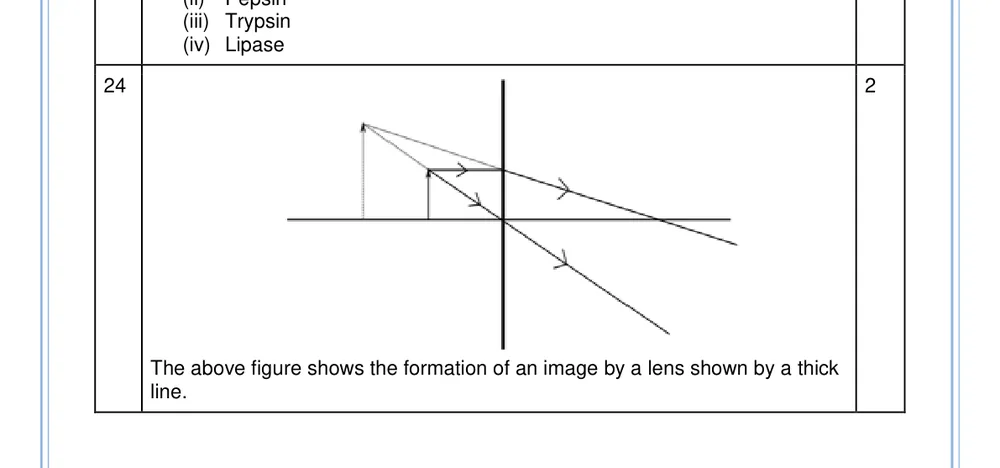
The given figure shows the formation of an image by a lens shown by a thick line (a ray diagram with an object and its image). Analyse the figure and answer the following questions. A. What is the type of lens used? B. What is the nature of the image? C. If the image is formed at a distance of 30 cm from the lens and the image is twice the size of the object, then where is the object placed?
2 marks
[Case context: reflecting telescope with curved mirror, plane mirror and eyepiece as in the figure.] Attempt either subpart C or D. C. Explain with reason what kind of optical device (type of lens or mirror) that is used at the eyepiece.
2 marks
[Case context: reflecting telescope with curved mirror, plane mirror and eyepiece as in the figure.] Attempt either subpart C or D. D. What is the role of the plane mirror in the telescope?
2 marks
Board 2024 6 questions
At what distance from a convex lens should an object be placed to get an image of the same size as that of the object on a screen? (a) Beyond twice the focal length of the lens. (b) At the principal focus of the lens. (c) At twice the focal length of the lens. (d) Between the optical centre of the lens and its principal focus.
1 mark
[case context: Data of three concave mirrors A, B and C with focal length and object distance are given: Case 1 - Mirror A, Focal Length 20 cm, Object Distance 45 cm; Case 2 - Mirror B, Focal Length 15 cm, Object Distance 30 cm; Case 3 - Mirror C, Focal Length 30 cm, Object Distance 20 cm.] In which one of the above cases the mirror will form a diminished image of the object? Justify your answer.
1 mark
[case context: concave mirrors A (f=20 cm, u=45 cm), B (f=15 cm, u=30 cm), C (f=30 cm, u=20 cm).] List two properties of the image formed in case 2.
1 mark
An object is placed at a distance of 10 cm from a convex mirror of focal length 15 cm. Find the position of the image formed by the mirror.
2 marks
[case context: concave mirrors A (f=20 cm, u=45 cm), B (f=15 cm, u=30 cm), C (f=30 cm, u=20 cm).] What is the nature and size of the image formed by mirror C? Draw ray diagram to justify your answer.
2 marks
[case context: concave mirrors A (f=20 cm, u=45 cm), B (f=15 cm, u=30 cm), C (f=30 cm, u=20 cm).] An object is placed at a distance of 18 cm from the pole of a concave mirror of focal length 12 cm. Find the position of the image formed in this case.
2 marks
Board 2023 5 questions
[Case context: A concave mirror is held with its reflecting surface towards the sun and the reflected light is focused on a white card-board moved back and forth until a bright sharp spot forms - the image of the sun, also termed the 'Principal Focus' of the concave mirror.] List two applications of concave mirror.
1 mark
[Case context: the sharp bright spot formed by a concave mirror focusing the sun's rays is its principal focus.] If the distance between the mirror and the principal focus is 15 cm, find the radius of curvature of the mirror.
1 mark
[Case context: concave mirror and image formation.] Draw a ray diagram to show the type of image formed when an object is placed between pole and focus of a concave mirror.
2 marks
[Case context: concave mirror numerical - internal choice for sub-part (c).] An object 10 cm in size is placed at 100 cm in front of a concave mirror. If its image is formed at the same point where the object is located, find: (i) focal length of the mirror, and (ii) magnification of the image formed with sign as per Cartesian sign convention.
2 marks
(a) Complete the following ray diagram to show the formation of image. [Diagram shows a concave mirror with an object AB standing on the principal axis beyond the centre of curvature C; pole P, focus (between P and R) and R marked; Ray 1 from A travels parallel to the principal axis, Ray 2 from A passes towards the mirror.] (b) Mention the nature, position and size of the image formed in this case. (c) State the sign of the image distance in this case using the Cartesian sign convention.
3 marks
Frequently asked questions
What are the most important topics in CBSE Class 10 Science Chapter 9 Light - Reflection and Refraction?
By how often and how recently they were asked: Image formation by spherical mirrors / ray diagrams; Image formation by lenses / ray diagrams; Lens formula, magnification and power numericals.
How many marks does Light - Reflection and Refraction carry in the CBSE Class 10 Science exam?
Light - Reflection and Refraction is part of the Natural Phenomena unit, which carries 12 marks in the official syllabus. In the analysed papers it had about 5.0 questions per paper.
Do questions from Light - Reflection and Refraction repeat in board exams?
Yes — 8 question patterns from this chapter appeared in two or more past board or official sample papers. They are listed on this page with the years they were asked.