CBSE Class 10 Science Chapter 2 Acids, Bases and Salts Important Questions 2027
Last updated:
33 questions from Acids, Bases and Salts appeared in 6 of the 7 CBSE papers we analysed (2022–2026) — here are the topics that matter, the questions that repeat, and every previous-year question from this chapter.
Key facts
Chemical Substances - Nature and Behaviour unit — 25 marks in the official syllabus
Asked in 6 of 7 analysed papers (2022–2026)
About 4.7 questions per paper (OR alternatives counted separately)
Preparation, properties and uses of important salts (washing soda, baking soda, bleaching powder, POP)
Board 2023Board 2025Board 2026Sample 2025
★★☆☆☆
4
Indicators and identifying acid/base
Board 2026Sample 2025Sample 2026
★★☆☆☆
5
Water of crystallisation / common salt family
Board 2024Board 2025
★☆☆☆☆
Repeated questions from Acids, Bases and Salts
1. Interpret/rank solutions by pH value
3×Board 2025Board 2026Sample 20261 marks
The following table shows the pH values of four solutions A, B, C and D on a pH scale (see figure: pH scale 1-14 with B at 7, C at 13, D at 3, A at 5). The solutions A, B, C and D respectively are of a : (A) Strong acid, weak acid, neutral, strong base (B) Weak acid, neutral, weak base, strong base (C) Weak acid, neutral, strong base, weak base (D) Weak acid, neutral, strong base, strong acid
2. Deduce acid/base nature from indicator/litmus
2×Board 2026Sample 20251 marks
An aqueous solution turns red litmus blue. Excess addition of which of the following solution would reverse the change? (A) Sodium hydroxide (B) Hydrochloric acid (C) Baking soda (D) Slaked lime
3. Electrolysis of brine: products/process
2×Board 2025Sample 20251/2 marks
[Case: Seawater contains many dissolved salts; common salt is separated from these, deposits of solid rock salt (brown due to impurities) are mined like coal, and common salt is an important raw material for chemicals of daily use.] Write balanced chemical equations to show the products formed during electrolysis of brine.
4. CO2 in lime water: milky then colourless
2×Board 2023Sample 20261 marks
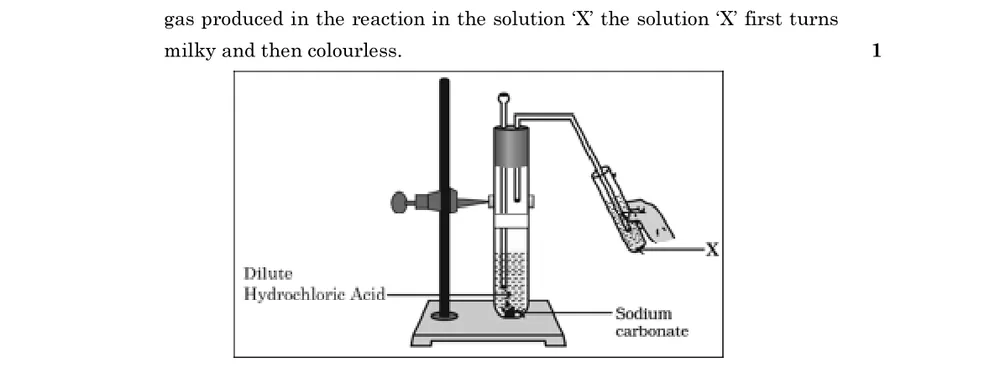
In the experimental setup given below, it is observed that on passing the gas produced in the reaction in the solution 'X' the solution 'X' first turns milky and then colourless. The option that justifies the above stated observation is that 'X' is aqueous calcium hydroxide and (a) it turns milky due to carbon dioxide gas liberated in the reaction and after sometime it becomes colourless due to formation of calcium carbonate. (b) it turns milky due to formation of calcium carbonate and on passing excess of carbon dioxide it becomes colourless due to formation of calcium hydrogen carbonate which is soluble in water. (c) it turns milky due to passing of carbon dioxide through it. It turns colourless as on further passing carbon dioxide, sodium hydrogen carbonate is formed which is soluble in water. (d) the carbon dioxide liberated during the reaction turns lime water milky due to formation of calcium hydrogen carbonate and after some time it turns colourless due to formation of calcium carbonate which is soluble in water. [Setup shows dilute hydrochloric acid and sodium carbonate in a test tube, the evolved gas passed into solution 'X'.]
5. Baking soda to washing soda from uses
2×Board 2025Board 20262 marks
(a) A compound 'A' is used in soda-lime fire-extinguisher and decomposes on heating to form compound 'B'. Compound 'B' is used for removing permanent hardness of water. Identify 'A' and 'B'. (b) Write chemical formula of Plaster of Paris. At what temperature gypsum is heated to obtain Plaster of Paris?
6. Apply pH to everyday life / acid strength
2×Board 2023Board 20243 marks
(i) The pH of a sample of tomato juice is 4.6. How is this juice likely to be in taste? Give reason to justify your answer. (ii) How do we differentiate between a strong acid and a weak base in terms of ion-formation in aqueous solutions? (iii) The acid rain can make the survival of aquatic animals difficult. How?
Acids, Bases and Salts questions by paper
Paper
Questions
Marks
Board 2022
0
0
Board 2023
5
8
Board 2024
3
5
Board 2025
6
8
Sample 2025
5
10
Board 2026
7
10
Sample 2026
7
8
Counts include both options of internal-choice (OR) questions.
Previous year questions: Acids, Bases and Salts
Board 2026 7 questions
An aqueous solution turns red litmus blue. Excess addition of which of the following solution would reverse the change? (A) Sodium hydroxide (B) Hydrochloric acid (C) Baking soda (D) Slaked lime
1 mark
How will you protect yourself from the heat generated while diluting a concentrated acid? (A) By adding acid to water with constant stirring. (B) By adding water to acid with constant stirring. (C) By adding water to acid followed by base. (D) By adding base to acid with constant stirring.
1 mark
[case context] pH plays an important role in daily life; strength of acids and bases depends on the number of H^+ and OH^- ions produced; the pH scale predicts strength via hydrogen ion concentration. What type of indicator is used to predict how strong an acid or base is?
1 mark
[case context] pH scale predicts strength of acids and bases via hydrogen ion concentration. Three solutions A, B and C showed pH as 3, 5 and 7. Which solution has the highest concentration of H^+ ions?
1 mark
(a) A compound 'A' is used in soda-lime fire-extinguisher and decomposes on heating to form compound 'B'. Compound 'B' is used for removing permanent hardness of water. Identify 'A' and 'B'. (b) Write chemical formula of Plaster of Paris. At what temperature gypsum is heated to obtain Plaster of Paris?
2 marks
[case context] Strength of acids and bases depends on H^+ and OH^- ions produced. What are strong acids and weak acids?
2 marks
[case context] pH plays an important role in daily life. OR alternative for (c): (i) Under what condition is rainwater called acid rain? (ii) In the following acids, identify weak acids: Nitric acid, hydrochloric acid, acetic acid, sulphuric acid, formic acid.
2 marks
Sample 2026 7 questions
Methyl orange is added to dilute hydrochloric acid and to aqueous sodium hydroxide. What is the colour of the methyl orange in each solution? Each option is a row [Sample | colour in dilute hydrochloric acid | colour in aqueous sodium hydroxide]: A. A | Orange | Red; B. B | Red | Yellow; C. C | Red | Orange; D. D | Yellow | Red
1 mark
Which of the following substances when dissolved in equal volume of water, will have the highest pH value? A. Sulphuric acid B. Acetic acid C. Magnesium hydroxide D. Sodium hydroxide
1 mark
When excess of carbon dioxide is passed through lime water, the milkiness disappears because A. water soluble calcium carbonate converts to water soluble calcium bicarbonate. B. insoluble calcium carbonate converts to water soluble calcium bicarbonate. C. water soluble calcium carbonate converts to insoluble calcium bicarbonate. D. insoluble calcium carbonate converts to insoluble calcium bicarbonate.
1 mark
[case context] Sara added phenolphthalein to 2 mL dilute NaOH (turned pink), then added dilute H2SO4 drop by drop until colourless (40 drops needed); a drop of NaOH turned it pink again. Table: 2 mL NaOH -> 20 drops H2SO4; 3 mL -> 30 drops; 4 mL -> 40 drops. A. If Sara used concentrated H2SO4 in place of dilute H2SO4, how many drops will be required for the change in colour to be observed? (a) 40 (b) < 40 (c) > 40. Justify your answer.
1 mark
[case context] Sara neutralises dilute NaOH with dilute H2SO4 using phenolphthalein; 20 drops of dil. H2SO4 = 1 mL, and proportionality 2 mL NaOH -> 20 drops, 3 mL -> 30 drops, 4 mL -> 40 drops. B. Sara measured 20 drops of dil. H2SO4 and found its volume to be 1 mL. If Sara observed a change in colour of NaOH solution by using 3 mL of H2SO4, how many mL of NaOH did she add to the test tube initially?
1 mark
[case context] Sara neutralises acid and base using phenolphthalein indicator. (OR) Sara takes 10 drops of dilute H2SO4 in the test tube and adds two drops of phenolphthalein solution to it. Then she adds NaOH dropwise. Sara observes a change in colour after adding 20 drops of NaOH. What change in colour would she observe and why?
1 mark
[case context] Sara neutralises dilute NaOH with dilute H2SO4 using phenolphthalein indicator. C. Write a balanced chemical equation for the reaction taking place in the above experiment. Which of the following is true and why? The reaction is a (a) neutralisation and double displacement reaction (b) neutralisation and precipitation reaction (c) precipitation and double displacement reaction (d) neutralisation, double displacement as well as precipitation reaction.
2 marks
Board 2025 6 questions
The following table shows the pH values of four solutions A, B, C and D on a pH scale (see figure: pH scale 1-14 with B at 7, C at 13, D at 3, A at 5). The solutions A, B, C and D respectively are of a : (A) Strong acid, weak acid, neutral, strong base (B) Weak acid, neutral, weak base, strong base (C) Weak acid, neutral, strong base, weak base (D) Weak acid, neutral, strong base, strong acid
1 mark
Consider the following reactions : (i) Dilute hydrochloric acid reacts with sodium hydroxide. (ii) Magnesium oxide reacts with dilute hydrochloric acid. (iii) Carbon dioxide reacts with sodium hydroxide. It is found that in each case : (A) Salt and water is formed. (B) Neutral salts are formed. (C) Hydrogen gas is formed. (D) Acidic salts are formed.
1 mark
[Case: Seawater contains many dissolved salts; common salt is separated from these, deposits of solid rock salt (brown due to impurities) are mined like coal, and common salt is an important raw material for chemicals of daily use.] Write balanced chemical equations to show the products formed during electrolysis of brine.
1 mark
[Case: Seawater/common salt/rock salt as raw material for chemicals of daily use.] List two uses of any one product obtained during electrolysis of brine.
1 mark
[Case: Seawater/common salt/rock salt as raw material for chemicals of daily use.] A mild non-corrosive basic salt 'A', used for faster cooking, is strongly heated to produce a compound 'B', that is used for removing permanent hardness of water. Identify A and B and also write the equation for the reaction that occurs when A is heated.
2 marks
[Case: Seawater/common salt/rock salt as raw material for chemicals of daily use.] Define water of crystallisation. Give two examples of salts that have water of crystallisation.
2 marks
Sample 2025 5 questions
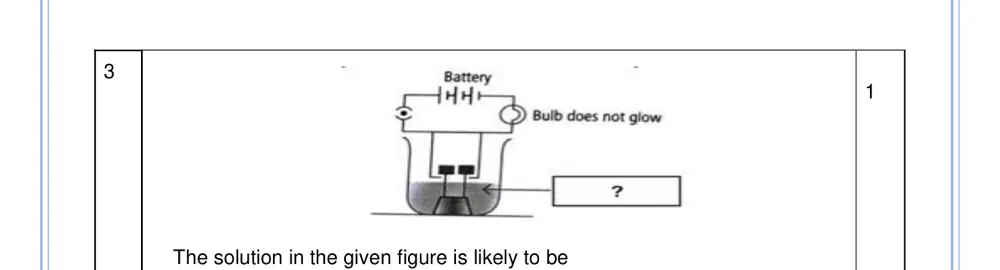
The solution in the given figure (circuit with a battery and a bulb, where the bulb does not glow) is likely to be A. HNO3 B. C2H5OH C. H2SO4 D. CO2 in water
1 mark
An aqueous solution 'A' turns the phenolphthalein solution pink. On addition of an aqueous solution 'B' to 'A', the pink colour disappears. Which of the following statement is true for the solutions 'A' and 'B'? A. A is strongly basic and B is a weak base. B. A is strongly acidic and B is a weak acid. C. A has a pH greater than 7 and B has a pH less than 7. D. A has a pH less than 7 and B has a pH greater than 7.
1 mark
[Case context: integrated chlor-alkali/esterification reaction scheme with boxed compounds A, X, Y, Z, M, P, Q, R.] Attempt either subpart B or C. C. Name the process in which compounds X, Y & Z are formed from A. Justify your response.
2 marks
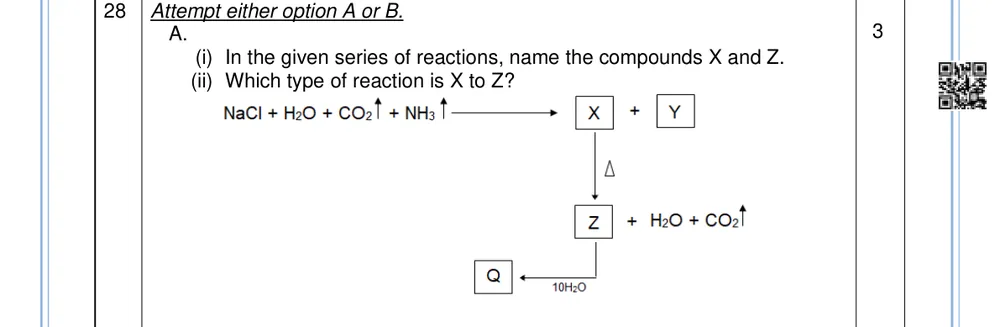
Attempt either option A or B. A. In the given series of reactions: NaCl + H2O + CO2(up-arrow) + NH3(up-arrow) -> X + Y ; X --(heat, delta)--> Z + H2O + CO2(up-arrow) ; Z --(10 H2O)--> Q. (i) Name the compounds X and Z. (ii) Which type of reaction is X to Z? (iii) You are given 3 unknown solutions A, B, and C with pH values of 6, 8 and 9.5 respectively. In which solution will the maximum number of hydronium ions be present? Arrange the given samples in the increasing order of H^+ ion concentration.
3 marks
Attempt either option A or B. B. Comment on the following statements: (i) Bee sting is treated with baking soda paste whereas wasp sting is treated with dilute vinegar. (ii) Farmers treat soil with quicklime when tilling. (iii) Ancient sculptures and marble structures are conserved by treating them with certain chemicals.
3 marks
Board 2024 3 questions
Consider the following compounds: FeSO4 ; CuSO4 ; CaSO4 ; Na2CO3. The compound having maximum number of water of crystallisation in its crystalline form in one molecule is: (a) FeSO4 (b) CuSO4 (c) CaSO4 (d) Na2CO3
1 mark
Assertion (A): Hydrogen gas is not evolved when zinc reacts with nitric acid. Reason (R): Nitric acid oxidises the hydrogen gas produced to water and itself gets reduced. Select the correct answer from codes: (a) Both A and R are true and R is the correct explanation of A. (b) Both A and R are true, but R is not the correct explanation of A. (c) A is true, but R is false. (d) A is false, but R is true.
1 mark
(i) The pH of a sample of tomato juice is 4.6. How is this juice likely to be in taste? Give reason to justify your answer. (ii) How do we differentiate between a strong acid and a weak base in terms of ion-formation in aqueous solutions? (iii) The acid rain can make the survival of aquatic animals difficult. How?
3 marks
Board 2023 5 questions
In the experimental setup given below, it is observed that on passing the gas produced in the reaction in the solution 'X' the solution 'X' first turns milky and then colourless. The option that justifies the above stated observation is that 'X' is aqueous calcium hydroxide and (a) it turns milky due to carbon dioxide gas liberated in the reaction and after sometime it becomes colourless due to formation of calcium carbonate. (b) it turns milky due to formation of calcium carbonate and on passing excess of carbon dioxide it becomes colourless due to formation of calcium hydrogen carbonate which is soluble in water. (c) it turns milky due to passing of carbon dioxide through it. It turns colourless as on further passing carbon dioxide, sodium hydrogen carbonate is formed which is soluble in water. (d) the carbon dioxide liberated during the reaction turns lime water milky due to formation of calcium hydrogen carbonate and after some time it turns colourless due to formation of calcium carbonate which is soluble in water. [Setup shows dilute hydrochloric acid and sodium carbonate in a test tube, the evolved gas passed into solution 'X'.]
1 mark
The table below has information regarding pH and the nature (acidic/basic) of four different solutions. Which one of the options in the table is correct? (a) Lemon juice / Colour of pH paper Orange / Approximate pH value 3 / Nature Basic. (b) Milk of magnesia / Blue / 10 / Basic. (c) Gastric juice / Red / 6 / Acidic. (d) Pure water / Yellow / 7 / Neutral.
1 mark
Select washing soda from the following: (a) NaHCO3 (b) Na2CO3.5H2O (c) Na2CO3.10H2O (d) NaOH
1 mark
(i) A compound 'X' which is prepared from gypsum has the property of hardening when mixed with proper quantity of water. Identify 'X' and write its chemical formula. (ii) State the difference in chemical composition between baking soda and baking powder.
2 marks
(a) Suggest one remedial measure each to counteract the change in pH in human beings in following cases: (i) Production of too much acid in stomach during indigestion (ii) Stung by a honey bee / nettle leaves. (b) Fresh milk has a pH of 6. When it changes into curd will its pH increase or decrease? Why?
3 marks
Frequently asked questions
What are the most important topics in CBSE Class 10 Science Chapter 2 Acids, Bases and Salts?
By how often and how recently they were asked: Chemical properties/reactions of acids and bases; pH scale and pH of common substances; Preparation, properties and uses of important salts (washing soda, baking soda, bleaching powder, POP).
How many marks does Acids, Bases and Salts carry in the CBSE Class 10 Science exam?
Acids, Bases and Salts is part of the Chemical Substances - Nature and Behaviour unit, which carries 25 marks in the official syllabus. In the analysed papers it had about 4.7 questions per paper.
Do questions from Acids, Bases and Salts repeat in board exams?
Yes — 6 question patterns from this chapter appeared in two or more past board or official sample papers. They are listed on this page with the years they were asked.