CBSE Class 10 Science Chapter 3 Metals and Non-metals Important Questions 2027
Last updated:
33 questions from Metals and Non-metals appeared in 6 of the 7 CBSE papers we analysed (2022–2026) — here are the topics that matter, the questions that repeat, and every previous-year question from this chapter.
Key facts
Chemical Substances - Nature and Behaviour unit — 25 marks in the official syllabus
Asked in 6 of 7 analysed papers (2022–2026)
About 4.7 questions per paper (OR alternatives counted separately)
7 question patterns repeated across papers
Important topics in Metals and Non-metals
#
Topic
Asked in
Importance
1
Physical/chemical properties distinguishing metals and non-metals
(i) Which method will be used to convert each of them to their respective metal oxides? (a) Carbonate ore (b) Sulphide ore. (ii) Write a chemical reaction to illustrate the use of aluminium for joining cracked railway tracks. (iii) During extraction of metals, electrolytic refining is used to obtain pure metals. Which material will be used as anode and cathode for the refining of copper metal by this process?
2. Displacement when metal dipped in salt solution
3×Board 2023Board 2024Sample 20261/2 marks
An iron nail is added to each of the two test tubes 'P' and 'Q' containing aqueous copper (II) sulphate, and aqueous silver nitrate respectively. Which of the following observation is correct? A. In test tube 'P' iron nail is coated with a blue coating and in test tube 'Q' there is no reaction. B. Iron nail is coated with a brown coating in test tube 'P' and silver coating in test tube 'Q'. C. There is no reaction in either of the test tubes 'P' or 'Q'. D. There is no reaction in test tube 'P' but a silver coating on iron nail is seen in test tube 'Q'.
3. Identify amphoteric oxides
3×Board 2023Board 2024Sample 20261 marks
Four statements about the reactions of oxides with dilute hydrochloric acid and aqueous sodium hydroxide are listed. I. Aluminium oxide reacts with both dilute hydrochloric acid and aqueous sodium hydroxide. II. Calcium oxide reacts with dilute hydrochloric acid and aqueous sodium hydroxide. III. Zinc oxide reacts with both dilute hydrochloric acid and aqueous sodium hydroxide. IV. Sulphur dioxide does not react with either dilute hydrochloric acid or aqueous sodium hydroxide. Which statements are correct? A. I and II B. I and III C. II and IV D. III and IV
4. Electrolytic extraction of reactive metals
2×Board 2025Sample 20261/3 marks
An element 'X' is stored in kerosene, and cannot be extracted from its ore using a reducing agent. 'X' forms an ionic compound on reaction with chlorine. (i) Can we store 'X' in water? Give reason to support your answer. (ii) Identify element 'X'. Name the process used and write the equation for extraction of 'X' from its ore.
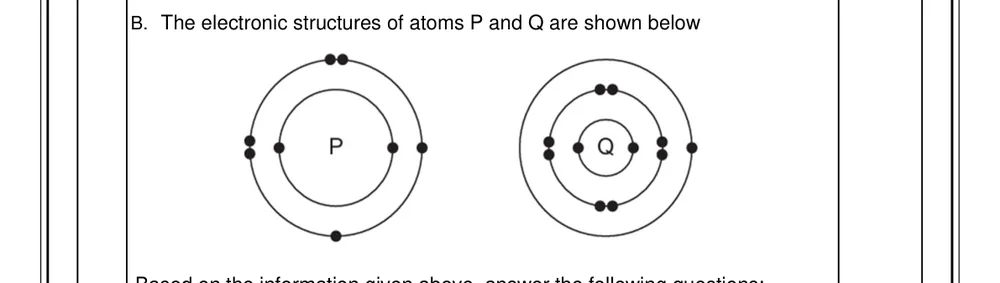
5. Ionic compound formation from electronic structures
2×Board 2025Sample 20261/5 marks
The electronic structures of atoms P and Q are shown in the given figure. Based on the information given above, answer the following questions: (a) If P and Q combine to form a compound, what type of bond is formed between them? (b) Give the chemical formula of the compound formed. (c) The compound so formed is dissolved in water. Is the resultant solution acidic or basic in nature? Justify your answer. (d) Write the chemical equation for the reaction between 'Q' and ethanol. (e) What will be the formula of the compound formed when 'P' undergoes bonding with carbon?
6. Metal reactivity with cold water
2×Board 2025Board 20261/3 marks
Which one of the following metals does not react with cold water? (A) Sodium (B) Potassium (C) Calcium (D) Magnesium
7. Metal + oxygen gives which oxide
2×Board 2023Board 20251 marks
The products formed when Aluminium and Magnesium are burnt in the presence of air respectively are : (A) Al3O4 and MgO2 (B) Al2O3 and MgO (C) Al3O4 and MgO (D) Al2O3 and MgO2
Metals and Non-metals questions by paper
Paper
Questions
Marks
Board 2022
0
0
Board 2023
6
8
Board 2024
6
8
Board 2025
7
13
Sample 2025
4
6
Board 2026
4
8
Sample 2026
6
15
Counts include both options of internal-choice (OR) questions.
Previous year questions: Metals and Non-metals
Board 2026 4 questions
Which one of the following metals does not react with cold water? (A) Sodium (B) Potassium (C) Calcium (D) Magnesium
1 mark
Alloys are homogeneous mixture of metal with a metal or non-metal. Which among the following alloys contain non-metal as one of its constituents? (A) Brass (B) Bronze (C) Amalgam (D) Steel
1 mark
(i) Which method will be used to convert each of them to their respective metal oxides? (a) Carbonate ore (b) Sulphide ore. (ii) Write a chemical reaction to illustrate the use of aluminium for joining cracked railway tracks. (iii) During extraction of metals, electrolytic refining is used to obtain pure metals. Which material will be used as anode and cathode for the refining of copper metal by this process?
3 marks
(i) Write all the reactions involved in the extraction of Zn from ZnS. (ii) Hydrogen gas is not evolved when most of the metals react with nitric acid. Give reason.
3 marks
Sample 2026 6 questions
Four statements about the reactions of oxides with dilute hydrochloric acid and aqueous sodium hydroxide are listed. I. Aluminium oxide reacts with both dilute hydrochloric acid and aqueous sodium hydroxide. II. Calcium oxide reacts with dilute hydrochloric acid and aqueous sodium hydroxide. III. Zinc oxide reacts with both dilute hydrochloric acid and aqueous sodium hydroxide. IV. Sulphur dioxide does not react with either dilute hydrochloric acid or aqueous sodium hydroxide. Which statements are correct? A. I and II B. I and III C. II and IV D. III and IV
1 mark
An iron nail is added to each of the two test tubes 'P' and 'Q' containing aqueous copper (II) sulphate, and aqueous silver nitrate respectively. Which of the following observation is correct? A. In test tube 'P' iron nail is coated with a blue coating and in test tube 'Q' there is no reaction. B. Iron nail is coated with a brown coating in test tube 'P' and silver coating in test tube 'Q'. C. There is no reaction in either of the test tubes 'P' or 'Q'. D. There is no reaction in test tube 'P' but a silver coating on iron nail is seen in test tube 'Q'.
1 mark
The following activity is set-up in the science lab by the teacher. He clamped an aluminium wire on a stand and fixed a pin to the free end of the wire using wax. Then he heated the wire with a burner from the end where the wire is clamped. Students observed the pin fall off. A. If the teacher replaces aluminium wire by silver wire, will the students' observation change? Justify your answer. B. Will the aluminium wire melt? Give reason for your answer.
2 marks
An element 'X' is stored in kerosene, and cannot be extracted from its ore using a reducing agent. 'X' forms an ionic compound on reaction with chlorine. (i) Can we store 'X' in water? Give reason to support your answer. (ii) Identify element 'X'. Name the process used and write the equation for extraction of 'X' from its ore.
3 marks
The domes of many building in Europe are made of copper. These domes now appear greenish in colour. (i) Why do the domes appear greenish though copper is orange-red in colour? (ii) In your opinion, should the copper domes be replaced by iron domes to overcome the problem of change of colour of copper domes? (iii) Domes used to be made from thin sheets of metals. Why did the ancient architects use copper to make domes?
3 marks
The electronic structures of atoms P and Q are shown in the given figure. Based on the information given above, answer the following questions: (a) If P and Q combine to form a compound, what type of bond is formed between them? (b) Give the chemical formula of the compound formed. (c) The compound so formed is dissolved in water. Is the resultant solution acidic or basic in nature? Justify your answer. (d) Write the chemical equation for the reaction between 'Q' and ethanol. (e) What will be the formula of the compound formed when 'P' undergoes bonding with carbon?
5 marks
Board 2025 7 questions
The products formed when Aluminium and Magnesium are burnt in the presence of air respectively are : (A) Al3O4 and MgO2 (B) Al2O3 and MgO (C) Al3O4 and MgO (D) Al2O3 and MgO2
1 mark
Reaction between two elements A and B, forms a compound C. A loses electrons and B gains electrons. Which one of the following properties will not be shown by compound C ? (A) It has high melting point. (B) It is highly soluble in water. (C) It has weak electrostatic forces of attraction between its oppositely charged ions. (D) It conducts electricity in its molten state or aqueous solution.
1 mark
The metals obtained from their molten chlorides by the process of electrolytic reduction are : (A) Gold and silver (B) Calcium and magnesium (C) Aluminium and silver (D) Sodium and iron
1 mark
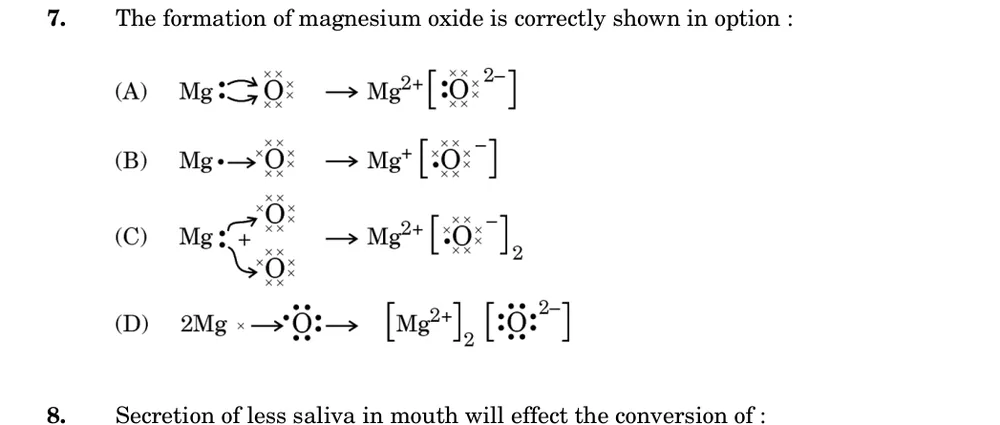
The formation of magnesium oxide is correctly shown in option : (four options (A)-(D) each showing an electron-dot / Lewis structure representation of Mg reacting with O to form Mg2+ and oxide ion - see figure).
1 mark
(a) "Displacement reactions also play a key role in extracting metals in the middle of the reactivity series." Justify this statement with two examples. (b) Why can metals high up in the reactivity series not be obtained by reduction of their oxides by carbon ?
3 marks
With the help of an activity, explain the conditions under which iron articles get rusted.
3 marks
(i) Name two metals which react violently with cold water. List any three observations which a student notes when these metal are dropped in a beaker containing water. (ii) Write a test to identify the gas evolved (if any) during the reaction of these metals with water.
3 marks
Sample 2025 4 questions
Match column I with column II and select the correct option using the given codes. Column I: a. A metal that forms amphoteric oxides; b. A metal which melts when kept on our palm; c. A metal that reacts with nitric acid; d. A metal which cannot displace hydrogen from acids. Column II: (i) Ga, (ii) Au, (iii) Al, (iv) Mn. A. a-(ii), b-(i), c-(iii), d-(iv) B. a-(iii), b-(i), c-(iv), d-(ii) C. a-(iv), b-(ii), c-(iii), d-(i) D. a-(iii), b-(ii), c-(i), d-(iv)
1 mark
The electronic configuration of three elements X, Y and Z are X- 2,8,7; Y- 2,8,2; and Z- 2,8. A. Y and Z are metals B. Y and X are non-metals C. X is a non-metal and Y is a metal D. Y is a non-metal and Z is a metal
1 mark
Assertion (A): On adding dil. HCl to a test tube containing a substance 'X', a colourless gas is produced which gives a pop sound when a burning match stick is brought near it. Reason (R): In this reaction metal 'X' is displaced by Hydrogen. [Options: A. Both A and R are true, and R is the correct explanation of A. B. Both A and R are true, and R is not the correct explanation of A. C. A is true but R is false. D. A is false but R is true]
1 mark
A. Anirudh took two metal oxides; aluminium oxide and magnesium oxide but he forgot to label them. How will you guide/help Anirudh to identify the oxides and label them? B. In an activity Aishu was given two substances; Copper Sulphide (Cu2S) and Copper Oxide (Cu2O) to obtain copper from these compounds. She was able to extract Copper successfully. Illustrate with the help of chemical equations how Aishu might have completed the activity.
3 marks
Board 2024 6 questions
A metal and a non-metal that exists in liquid state at the room temperature are respectively: (a) Bromine and Mercury (b) Mercury and Iodine (c) Mercury and Bromine (d) Iodine and Mercury
1 mark
Oxides of aluminium and zinc are: (a) acidic (b) basic (c) amphoteric (d) neutral
1 mark
[case context: The metals produced by various reduction processes are not very pure; the most widely used method for refining impure metals is electrolytic refining.] What is the cathode and anode made of in the refining of copper by this process?
1 mark
[case context: electrolytic refining of impure copper.] Name the solution used in the above process and write its formula.
1 mark
[case context: electrolytic refining of impure copper.] How copper gets refined when electric current is passed in the electrolytic cell?
2 marks
[case context: electrolytic refining of impure copper.] You have two beakers 'A' and 'B' containing copper sulphate solution. What would you observe after about 2 hours if you dip a strip of zinc in beaker 'A' and a strip of silver in beaker 'B'? Give reason for your observations in each case.
2 marks
Board 2023 6 questions
A metal 'X' is used in thermite process. When X is burnt in air it gives an amphoteric oxide 'Y'. 'X' and 'Y' are respectively: (a) Fe and Fe2O3 (b) Al and Al2O3 (c) Fe and Fe3O4 (d) Al and Al3O4
1 mark
Assertion (A): The colour of aqueous solution of copper sulphate turns colourless when a piece of lead is added to it. Reason (R): Lead is more reactive than copper, and hence displaces copper from its salt solution. Options: (a) Both (A) and (R) are true and (R) is the correct explanation of (A). (b) Both (A) and (R) are true, but (R) is not the correct explanation of (A). (c) (A) is true, but (R) is false. (d) (A) is false, but (R) is true.
1 mark
[Case context: Almost all metals combine with oxygen to form metal oxides; metal oxides are generally basic but some show both basic and acidic behaviour, and different metals show different reactivities towards oxygen.] What happens when copper is heated in air? (Give the equation of the reaction involved).
1 mark
[Case context: metal oxides are generally basic but some show both basic and acidic behaviour.] Why are some metal oxides categorized as amphoteric? Give one example.
1 mark
[case context: reactions of metal oxides with water and with a base.] Complete the following equations: (i) Na2O(s) + H2O(l) -> (ii) Al2O3 + 2NaOH ->
2 marks
[Case context: non-metal reacting with oxygen - internal choice for sub-part (c).] On burning Sulphur in oxygen a colourless gas is produced. (i) Write chemical equation for the reaction. (ii) Name the gas formed. (iii) State the nature of the gas. (iv) What will be the action of this on a dry litmus paper?
2 marks
Frequently asked questions
What are the most important topics in CBSE Class 10 Science Chapter 3 Metals and Non-metals?
By how often and how recently they were asked: Physical/chemical properties distinguishing metals and non-metals; Extraction of metals / metallurgy steps; Reactivity series and displacement of metals.
How many marks does Metals and Non-metals carry in the CBSE Class 10 Science exam?
Metals and Non-metals is part of the Chemical Substances - Nature and Behaviour unit, which carries 25 marks in the official syllabus. In the analysed papers it had about 4.7 questions per paper.
Do questions from Metals and Non-metals repeat in board exams?
Yes — 7 question patterns from this chapter appeared in two or more past board or official sample papers. They are listed on this page with the years they were asked.