CBSE Class 10 Science Chapter 1 Chemical Reactions and Equations Important Questions 2027
Last updated:
22 questions from Chemical Reactions and Equations appeared in 6 of the 7 CBSE papers we analysed (2022–2026) — here are the topics that matter, the questions that repeat, and every previous-year question from this chapter.
Key facts
Chemical Substances - Nature and Behaviour unit — 25 marks in the official syllabus
Asked in 6 of 7 analysed papers (2022–2026)
About 3.1 questions per paper (OR alternatives counted separately)
6 question patterns repeated across papers
Important topics in Chemical Reactions and Equations
#
Topic
Asked in
Importance
1
Identifying type of reaction (combination/decomposition/displacement/double displacement)
Oxidation and reduction / redox and corrosion-rancidity
Board 2023Board 2024Sample 2026
★☆☆☆☆
3
Balancing a chemical equation
Board 2023Board 2024Sample 2025
★☆☆☆☆
4
Writing a balanced equation from a word/observation description
Board 2023Board 2025
★☆☆☆☆
Repeated questions from Chemical Reactions and Equations
1. Exothermic vs endothermic classification
3×Board 2025Board 2026Sample 20251 marks
C6H12O6(aq) + 6O2(g) -> 6CO2(g) + 6H2O(l). The above reaction is an example of - (A) Displacement Reaction (B) Endothermic Reaction (C) Exothermic Reaction (D) Neutralisation Reaction
2. Name reaction type with justification
2×Board 2024Sample 20252 marks
Identify the type of each of the following reactions stating the reason for your answers. A. Fe2O3 + 2Al -> Al2O3 + 2Fe + heat B. Pb(NO3)2 + 2KI -> PbI2(down-arrow) + 2KNO3
3. Find coefficients to balance equation
2×Board 2023Sample 20251 marks
Identify 'p', 'q' and 'r' in the following balanced reaction: p Pb(NO3)2(s) --Heat--> q PbO(s) + r NO2(g) + O2(g) A. 2,2,4 B. 2,4,2 C. 2,4,4 D. 4,2,2
4. Gas ratio in electrolysis of water
2×Board 2025Board 20261 marks
The volume ratio of hydrogen and oxygen gases liberated during electrolysis of water is (A) 1 : 1 (B) 2 : 1 (C) 4 : 1 (D) 1 : 2
5. Identify a decomposition reaction
2×Board 2023Board 20241 marks
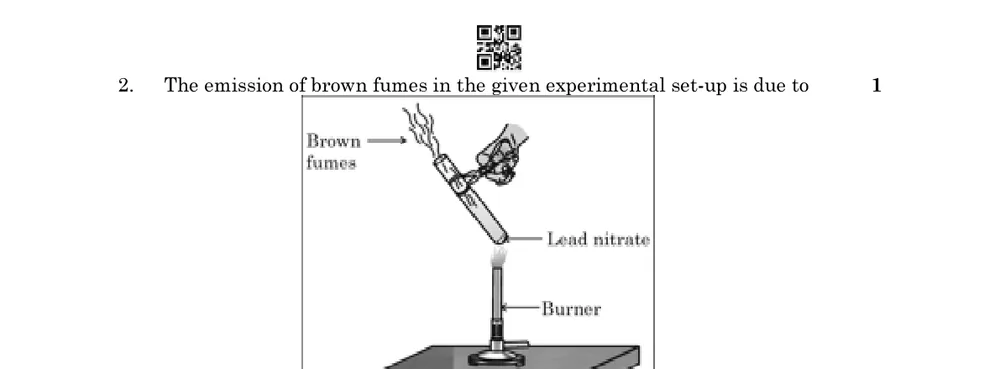
The emission of brown fumes in the given experimental set-up is due to (a) thermal decomposition of lead nitrate which produces brown fumes of nitrogen dioxide. (b) thermal decomposition of lead nitrate which produces brown fumes of lead oxide. (c) oxidation of lead nitrate forming lead oxide and nitrogen dioxide. (d) oxidation of lead nitrate forming lead oxide and oxygen. [Set-up shows lead nitrate being heated over a burner, giving off brown fumes.]
6. Identify oxidised/reduced species or agents
2×Board 2023Board 20241/3 marks
MnO2 + 4HCl -> MnCl2 + 2H2O + Cl2. The reaction given above is a redox reaction because in this case: (a) MnO2 is oxidised and HCl is reduced. (b) HCl is oxidised. (c) MnO2 is reduced. (d) MnO2 is reduced and HCl is oxidised.
Chemical Reactions and Equations questions by paper
Paper
Questions
Marks
Board 2022
0
0
Board 2023
4
7
Board 2024
5
8
Board 2025
3
4
Sample 2025
4
5
Board 2026
3
5
Sample 2026
3
5
Counts include both options of internal-choice (OR) questions.
Previous year questions: Chemical Reactions and Equations
Board 2026 3 questions
The volume ratio of hydrogen and oxygen gases liberated during electrolysis of water is (A) 1 : 1 (B) 2 : 1 (C) 4 : 1 (D) 1 : 2
1 mark
C6H12O6(aq) + 6O2(g) -> 6CO2(g) + 6H2O(l). The above reaction is an example of - (A) Displacement Reaction (B) Endothermic Reaction (C) Exothermic Reaction (D) Neutralisation Reaction
1 mark
Account for the following: (a) White silver chloride turns grey when exposed to sunlight. (b) Lead (II) nitrate on heating releases brown fumes. (c) Bags of oil and fat containing food items are flushed with nitrogen gas.
3 marks
Sample 2026 3 questions
Which of the following equations represent redox reactions and what are the values for 'p' and 'q' in these equations? Equation 1: Fe2O3(s) + 2Al(s) -> Al2O3(s) + p Fe(l) + heat. Equation 2: 2C4H10(g) + 13O2(g) -[heat]-> 8CO2(g) + q H2O(g). A. Only equation 1 is a redox reaction, p =1 and q=3 B. Both equations 1 and 2 are redox reactions, p= 2 and q=4 C. Only equation 2 is a redox reaction, p= 2 and q= 10 D. Both equations 1 and 2 are redox reactions, p= 2 and q=10
1 mark
In the reaction of aqueous solution of barium chloride with aqueous solution of sodium sulphate, the aqueous solution formed will be: A. BaCl2 B. BaSO4 C. Na2SO4 D. NaCl
1 mark
Amrita electrolysed distilled water using the set-up shown in figure 1. She was expecting two gases to be evolved at the anode and cathode respectively. Suddenly, she realised that the bulb in the circuit did not glow when she used distilled water (figure 2). After this realization, she added a substance to the distilled water for electrolysis to take place. Answer the following questions: A. Which gas was she expecting to be formed at the anode and which one at the cathode respectively? B. Why did the bulb not glow when Amrita passed electricity through distilled water? C. Which substance was added by Amrita to distilled water to get the expected result? (For visually impaired students: Identify the type of reaction: A. ZnO + C -> Zn + CO; B. ZnCO3 -[heat]-> ZnO + CO2; C. 2Mg + O2 -> 2MgO + heat.)
3 marks
Board 2025 3 questions
Electrolysis of water is a decomposition reaction. The mass ratio (MH : MO) of hydrogen and oxygen gases liberated at the electrodes during electrolysis of water is : (A) 8 : 1 (B) 2 : 1 (C) 1 : 2 (D) 1 : 8
1 mark
Assertion (A): Decomposition reactions are generally endothermic reactions. Reason (R): Decomposition of organic matter into compost is an exothermic process. Select the correct answer: (A) Both A and R are true and R is the correct explanation of A. (B) Both A and R are true, but R is not the correct explanation of A. (C) A is true, but R is false. (D) A is false, but R is true.
1 mark
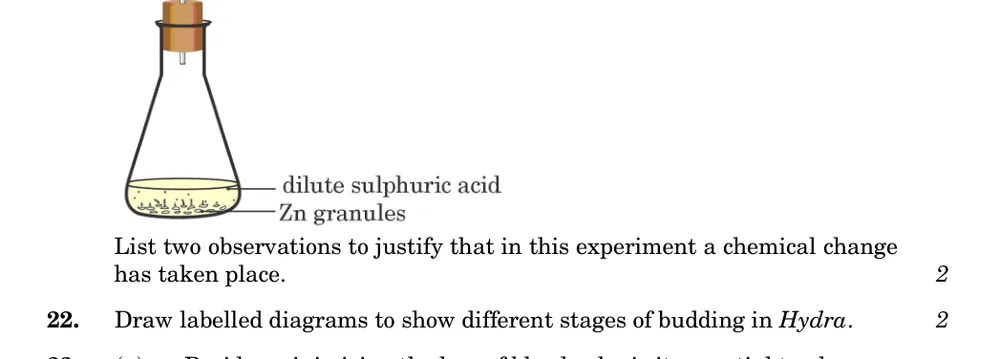
A student performs the following experiment in his school laboratory (a conical flask fitted with a delivery tube containing dilute sulphuric acid and Zn granules - see figure). List two observations to justify that in this experiment a chemical change has taken place.
2 marks
Sample 2025 4 questions
Identify 'p', 'q' and 'r' in the following balanced reaction: p Pb(NO3)2(s) --Heat--> q PbO(s) + r NO2(g) + O2(g) A. 2,2,4 B. 2,4,2 C. 2,4,4 D. 4,2,2
1 mark
When 50g of lead powder is added to 300 ml of blue copper sulphate solution, after a few hours, the solution becomes colourless. This is an example of A. Combination reaction B. Decomposition reaction C. Displacement reaction D. Double displacement reaction
1 mark
Which of the following is an endothermic reaction? A. Burning of candle. B. Cooking of food. C. Decomposition of Vegetable matter. D. Reaction of Sodium with air
1 mark
Identify the type of each of the following reactions stating the reason for your answers. A. Fe2O3 + 2Al -> Al2O3 + 2Fe + heat B. Pb(NO3)2 + 2KI -> PbI2(down-arrow) + 2KNO3
2 marks
Board 2024 5 questions
When 2 mL of sodium hydroxide solution is added to few pieces of granulated zinc in a test tube and then warmed, the reaction that occurs can be written in the form of a balanced chemical equation as: (a) NaOH + Zn -> NaZnO2 + H2 (b) 2NaOH + Zn -> Na2ZnO2 + H2 (c) 2NaOH + Zn -> NaZnO2 + H2 (d) 2NaOH + Zn -> Na2ZnO2 + H2O
1 mark
Select from the following a decomposition reaction in which source of energy for decomposition is light: (a) 2FeSO4 -> Fe2O3 + SO2 + SO3 (b) 2H2O -> 2H2 + O2 (c) 2AgBr -> 2Ag + Br2 (d) CaCO3 -> CaO + CO2
1 mark
MnO2 + 4HCl -> MnCl2 + 2H2O + Cl2. The reaction given above is a redox reaction because in this case: (a) MnO2 is oxidised and HCl is reduced. (b) HCl is oxidised. (c) MnO2 is reduced. (d) MnO2 is reduced and HCl is oxidised.
1 mark
Name the type of chemical reaction in which calcium oxide reacts with water. Justify your answer by giving balanced chemical equation for the chemical reaction.
2 marks
Write one chemical equation each for the chemical reaction in which the following have taken place: (i) Change in colour (ii) Change in temperature (iii) Formation of precipitate. Mention colour change/temperature change (rise/fall)/compound precipitated along with equation.
3 marks
Board 2023 4 questions
The emission of brown fumes in the given experimental set-up is due to (a) thermal decomposition of lead nitrate which produces brown fumes of nitrogen dioxide. (b) thermal decomposition of lead nitrate which produces brown fumes of lead oxide. (c) oxidation of lead nitrate forming lead oxide and nitrogen dioxide. (d) oxidation of lead nitrate forming lead oxide and oxygen. [Set-up shows lead nitrate being heated over a burner, giving off brown fumes.]
1 mark
MnO2 + x HCl -> MnCl2 + y H2O + z Cl2. In order to balance the above chemical equation, the values of x, y and z respectively are: (a) 6, 2, 2 (b) 4, 1, 2 (c) 4, 2, 1 (d) 2, 2, 1
1 mark
Write balanced chemical equation for the reaction that occurs when: (i) blue coloured copper sulphate crystals are heated and (ii) Sodium hydrogen carbonate is heated during cooking.
2 marks
(a) Identify the reducing agent in the following reactions: (i) 4NH3 + 5O2 -> 4NO + 6H2O (ii) H2O + F2 -> HF + HOF (iii) Fe2O3 + 3CO -> 2Fe + 3CO2 (iv) 2H2 + O2 -> 2H2O. (b) Define a redox reaction in terms of gain or loss of oxygen.
3 marks
Frequently asked questions
What are the most important topics in CBSE Class 10 Science Chapter 1 Chemical Reactions and Equations?
By how often and how recently they were asked: Identifying type of reaction (combination/decomposition/displacement/double displacement); Oxidation and reduction / redox and corrosion-rancidity; Balancing a chemical equation.
How many marks does Chemical Reactions and Equations carry in the CBSE Class 10 Science exam?
Chemical Reactions and Equations is part of the Chemical Substances - Nature and Behaviour unit, which carries 25 marks in the official syllabus. In the analysed papers it had about 3.1 questions per paper.
Do questions from Chemical Reactions and Equations repeat in board exams?
Yes — 6 question patterns from this chapter appeared in two or more past board or official sample papers. They are listed on this page with the years they were asked.