ISC Class 12 Mathematics Guess Paper 2027
Last updated:
A full practice paper on the official Mathematics pattern, built from the most-likely questions by repetition analysis. Not an official or leaked paper.
ISC Class 12 Mathematics — Guess Paper 2027
Time: 3 hours · Maximum marks: 80 · Practice paper
Section ACompulsory. Question 1 is made up of twenty subparts of 1 mark each: seventeen multiple-choice questions (i-xvii, including statement/assertion-reason and graph-based items) and three very-short-answer questions (xviii-xx). No internal choice.
Q1.1 mark
A cylindrical popcorn tub of radius 10 cm is being filled with popcorns at the rate of 314 cm3 per minute. The level of the popcorns in the tub is increasing at the rate of: (a) 1 cm/minute (b) 0.1 cm/minute (c) 1.1 cm/minute (d) 0.5 cm/minute
Why this question: Applications of Derivatives → application of derivatives: related rates word problem — appeared 5× Board 2023Board 2024Board 2025Board 2026Sample 2025
Q2.1 mark
The value of \int03/2 |x| dx is: (a) 1/8 (b) 9/8 (c) 9/4 (d) 3/4
Why this question: Integrals → definite integral of a modulus/absolute-value function — appeared 5× Board 2023Board 2024Board 2026Sample 2023Sample 2024
Q3.1 mark
Evaluate: \int 5/sqrt(2x+7) dx
Why this question: Integrals → evaluate the indefinite integral by substitution — appeared 4× Board 2023Board 2025Sample 2024
Q4.1 mark
Five numbers x1, x2, x3, x4, x5 are randomly selected from 1, 2, 3, ..., 18 and arranged in increasing order such that x1 < x2 < x3 < x4 < x5. What is the probability that x2 = 7 and x4 = 11? (a) 26/51 (b) 3/104 (c) 1/68 (d) 1/34
Why this question: Probability → probability: probability of an ordered selection using combinations — appeared 2× Sample 2025Sample 2026
Q5.1 mark
Given two events A and B such that P(A/B) = 0.25 and P(A ∩ B) = 0.12. The value P(A' ∩ B) is: (a) 0.36 (b) 0.48 (c) 0.88 (d) 0.036
Why this question: Probability → probability: compute joint probability with complement using conditional — appeared 2× Sample 2025Sample 2026
Q6.1 mark
If the direction cosines of a line are <1/c, 1/c, 1/c> then: (a) c > 0 (b) 0 < c < 1 (c) c = +/-sqrt(3) (d) c > 2
Why this question: Three-dimensional Geometry → 3D geometry: value from direction cosines identity — appeared 2× Sample 2025Sample 2026
Q7.1 mark
A relation R is defined on Z as aRb if and only if a2 - 7ab + 6b2 = 0. Then R is: (a) reflexive and symmetric (b) transitive but not reflexive (c) symmetric but not reflexive (d) reflexive but not symmetric
Why this question: Relations and Functions → relations: classify a given relation as reflexive/symmetric/transitive — appeared 2× Board 2024Sample 2027
Q8.1 mark
If \int (cot x - cosec2 x) ex dx = ex f(x) + c then f(x) will be: (a) cot x + cosec x (b) cot2 x (c) cot x (d) cosec x
Why this question: Integrals → integrals: apply the ex[f(x)+f'(x)] rule — appeared 2× Board 2024Sample 2025
Q9.1 mark
The interval in which the function f(x) = 5 + 36x - 3x2 increases will be: (a) (-inf, 6) (b) (6, inf) (c) (-6, 6) (d) (0, -6)
Why this question: Applications of Derivatives → application of derivatives: find interval where function is increasing/decreasing — appeared 2× Board 2023Sample 2025
Q10.1 mark
If theta = sin-1 x + cos-1 x - tan-1 x, x >= 0, then the smallest interval in which theta lies is: (a) pi/2 <= theta <= 3pi/4 (b) 0 < theta < pi (c) -pi/4 <= theta <= 0 (d) pi/4 <= theta <= pi/2
Why this question: Inverse Trigonometric Functions → inverse trig: find range of an expression of inverse functions — appeared 1× Sample 2027
Q11.1 mark
Let A be the area of a triangle having vertices (x1, y1), (x2, y2) and (x3, y3). Which of the following is correct? (a) det[[x1,y1,1],[x2,y2,1],[x3,y3,1]] = +A (b) det[...] = +/-2A (c) det[...] = +/-A/2 (d) (det[...])2 = A2
Why this question: Determinants → determinants: area of a triangle from a determinant — appeared 1× Sample 2027
Q12.1 mark
A particle moves along the curve 6y = x3 + 2. At what point(s) on the curve is the y-coordinate changing 8 times as fast as the x-coordinate? (a) (2, 5/3) only (b) (4, 11) only (c) (4, 11) and (-4, -31/3) (d) (8, 86) and (-8, -85)
Why this question: Applications of Derivatives → application of derivatives: related rates of change of coordinates — appeared 1× Sample 2027
Q13.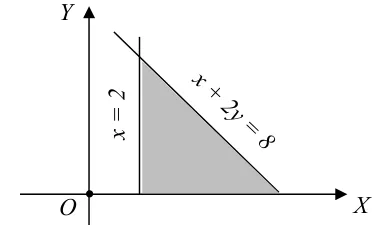 1 mark
The expression for finding the area of the shaded region (bounded by x = 2 and x + 2y = 8) is: (a) \int28 (4 - x/2 - 2) dx (b) \int28 (x/2 + 4) dx (c) \int28 (y/2 + 4) dy (d) \int28 (4 - x/2) dx
Why this question: Application of Integrals → application of integrals: set up integral for area of a region — appeared 1× Sample 2027
Q14.1 mark
If a = 2i + 3j - k, b = -i + 2j - 4k, c = i + j + k, then (a x b).(a x c) is: (a) 60 (b) 64 (c) 74 (d) -74
Why this question: Vectors → vectors: evaluate scalar product of two cross products — appeared 1× Sample 2027
Q15.1 mark
The point of intersection of the lines (x-1)/2 = (y-2)/3 = (3-z)/(-4) and (x-1)/5 = (2-y)/(-2) = (z-3)/1 is: (a) (1, 2, -3) (b) (-1, 2, 3) (c) (1, -2, 3) (d) (1, 2, 3)
Why this question: Three-dimensional Geometry → 3D geometry: find point of intersection of two lines — appeared 1× Sample 2027
Q16.1 mark
An objective function Z = ax + by is maximum at points (8, 10) and (7, 12). If a, b >= 0 and ab = 72, then the maximum value of the function is equal to: (a) 84 (b) 132 (c) 156 (d) 176
Why this question: Linear Programming → linear programming: maximum value with multiple optimal points — appeared 1× Sample 2027
Q17.1 mark
If P(A) = m, P(B/A-bar) = 3m, P(B/A) = 6m, then what will be P(A/B)? (a) 2m/(1+m) (b) 4m/(1+m) (c) 7m/(1+m) (d) 9m/(1+m)
Why this question: Probability → probability: compute a conditional probability from given relations — appeared 1× Sample 2027
Q18.1 mark
If a relation R on the set {a, b, c} defined by R = {(b, b)}, then classify the relation.
Why this question: Relations and Functions → relations: classify a given relation by its properties — appeared 3× Sample 2024Sample 2025Sample 2026
Q19.1 mark
Solve the differential equation: dy/dx = cosec y
Why this question: Differential Equations → solve the differential equation (variable-separable) — appeared 3× Board 2023Sample 2023Sample 2026
Q20.1 mark
The value of the determinant of a matrix A of order 3 is 3. If C is the matrix of cofactors of the matrix A, then what is the value of determinant of C2?
Why this question: Determinants → determinants: determinant of the cofactor/adjoint matrix — appeared 2× Sample 2025Sample 2026
Section BSeven short-answer questions of 2 marks each (Q2-Q8), some split into 1-mark sub-parts. Internal choice is provided in three of the questions.
Q21.2 marks
Solve the following differential equation: dx/dy = x/y + f(x/y)/f'(x/y)
Why this question: Differential Equations → solve the differential equation (homogeneous) — appeared 7× Board 2023Board 2024Board 2025Board 2026Sample 2025Sample 2026Sample 2027
Q22.2 marks
Evaluate: \int05 sqrt(x)/(sqrt(5 - x) + sqrt(x)) dx
Why this question: Integrals → definite integral: evaluate using king/property of definite integrals — appeared 6× Board 2024Board 2025Board 2026Sample 2023Sample 2026
Q23.2 marks
What are the values of x for which the angle between the vectors 2x2 i + 3x j + k and i - 2j + x2 k is obtuse?
Why this question: Vectors → vectors: find values for which angle between vectors is obtuse — appeared 2× Sample 2025Sample 2026
Q24.2 marks
Evaluate: \int x ex dx
Why this question: Integrals → evaluate the indefinite integral by parts — appeared 3× Board 2024Board 2025Sample 2024
Q25.2 marks
Let f(x) = 4 - (x - 7)3 be an invertible function, then find f-1(x).
Why this question: Relations and Functions → functions: find the inverse of a given invertible function — appeared 3× Board 2023Board 2024Board 2026
Q26.2 marks
Find the point on the curve y = (x - 2)2 at which the tangent is parallel to the chord joining the end points (2, 0) and (4, 4).
Why this question: Applications of Derivatives → application of derivatives: point where tangent is parallel to a chord/line — appeared 2× Board 2024Sample 2026
Q27.2 marks
If \int x5 cos(x6) dx = k sin(x6) + C, find the value of k.
Why this question: Integrals → integrals: find constant given result of an integral by substitution — appeared 2× Board 2023Sample 2026
Section CSeven moderately-long questions of 3 marks each (Q9-Q15), typically split into sub-parts (derivations, evaluations and reasoning). Internal choice is provided in three of the questions.
Q28.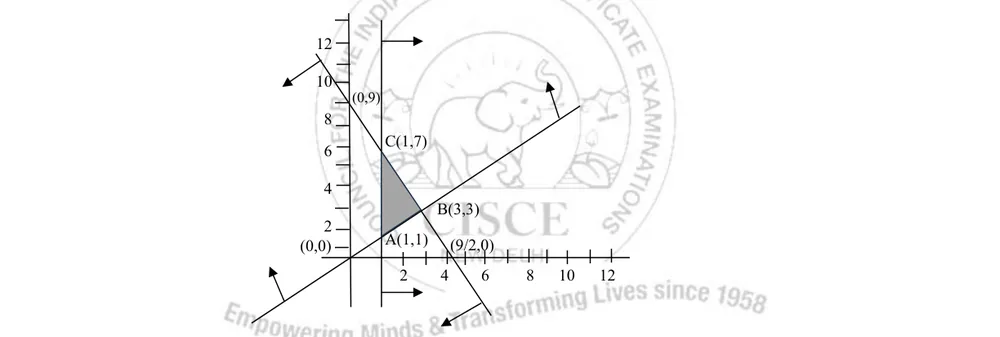 3 marks
The feasible region determined by some constraints is the shaded region with corner points (0,0), A(1,1), (9/2,0), B(3,3) and C(1,7), with lines reaching (0,9). (i) Formulate the constraints which represent the feasible region. (ii) Hence maximise the objective function Z = x + y. (iii) What change in the constraints will make the feasible region unbounded?
Why this question: Linear Programming → linear programming: determine constraints from graph and optimize — appeared 1× Sample 2027
Q29.3 marks
If x = 3z + 1 and y = f(x), then prove that 9 d2y/dx2 = d2y/dz2.
Why this question: Continuity, Differentiability and Differentiation → differentiation: relate second derivatives under a change of variable — appeared 1× Sample 2027
Q30.3 marks
(i) Find the derivative of the function f(x) = log[(sqrt(1+x2) + x)/(sqrt(1+x2) - x)] + tan-1(2x/(1-x2)) with respect to x. (ii) An analyst claims that the function f(x) has a local maximum at some point x = c. Evaluate this claim using the expression for f'(x).
Why this question: Continuity, Differentiability and Differentiation → differentiation: derivative of composite log/inverse-trig function and its sign — appeared 1× Sample 2027
Q31.3 marks
A vector n of magnitude 8 units is inclined to x-axis at 45 degrees, y-axis at 60 degrees and at an acute angle with z-axis. A plane through the point (sqrt(2), -1, 1) is normal to n. Find the equation of the plane in vector form.
Why this question: Three-dimensional Geometry → 3D geometry: equation of plane through a point with given normal — appeared 1× Sample 2027
Q32.3 marks
If x, y, z are distinct non-zero real numbers, prove that Delta = | x, x2, yz ; y, y2, zx ; z, z2, xy | = | y2, z2, x2 ; y3, z3, x3 ; 1, 1, 1 |. Hence or otherwise evaluate Delta in its simplest form if xy + yz + zx = 1.
Why this question: Determinants → determinants: prove/evaluate using row-column properties — appeared 1× Sample 2027
Q33.3 marks
A school decorates every chair with a ribbon and every table with a cover. There are 150 chairs and 20 tables. Company A charges rupees 12 per chair ribbon and rupees 180 per table cover. Company B charges rupees 10 per chair ribbon and rupees 200 per table cover. By setting up one matrix equation that includes both companies, compare the overall prices charged by the two companies.
Why this question: Matrices → matrices: represent and compare costs using matrix multiplication — appeared 1× Sample 2027
Q34.3 marks
Let \int15 3f(x) dx = 12. (i) Show that \int51 f(x) dx = -4. (ii) Find the value of \int12 (x + f(x)) dx + \int25 (x + f(x)) dx.
Why this question: Integrals → definite integral: apply additivity and constant-multiple properties — appeared 1× Sample 2027
Section DFive long-answer questions of 5 marks each (Q16-Q20), made up of multi-part application, evaluation and analysis sub-parts. Internal choice is provided in three of the questions.
Q35.5 marks
In a large organisation, only 1 out of every 1,500 emails contains a harmful attachment. An automated filter correctly marks a harmful email as dangerous 97% of the time and correctly marks a safe email as safe 97% of the time. (a) Find the probability that the email is safe. (b) Find the probability that given the email is harmful the filter marks it safe. (c) One email has been flagged as dangerous by the system. Find the probability that this email is actually safe.
Why this question: Probability → probability: total probability / Bayes theorem — appeared 6× Board 2023Board 2024Board 2025Sample 2023Sample 2026Sample 2027
Q36. 5 marks
The graph of f(x) = x - 6 sqrt(x) + 1 is shown. (i) State the natural domain of f(x). (ii) Does f(x) have an inverse function? Explain your answer. (iii) Let g(x) = x - 6 sqrt(x) + 1, 0 <= x <= 9. Find g-1(x) and verify (g o g-1)(4) = 4. (iv) Let h(x) = x - 6 sqrt(x) + 1, x >= 9. Find h-1(x) and verify (h o h-1)(16) = 16. (v) Find the value of x such that g-1(x) = h-1(x).
Why this question: Relations and Functions → functions: domain, invertibility and inverse of a restricted function — appeared 1× Sample 2027
Q37.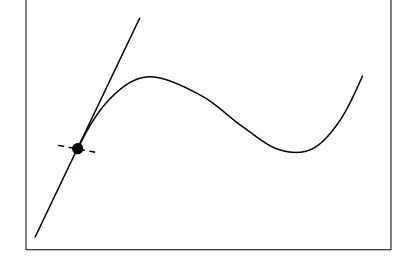 5 marks
A roller coaster vertical profile is f(x) = (1/3)x3 - 2x2 + 3x + 5, where x is the horizontal distance and f(x) the height (meters). (a) Identify the intervals of x where the roller coaster is climbing (increasing) and descending (decreasing). (b) A support beam is placed where the track's slope is exactly zero; find the coordinates of those points. (c) Determine the maximum and minimum heights in the interval x in [0, 4]. (d) At x = 1 a maintenance ladder must be placed perpendicular to the track (along the normal); find the equation of the maintenance ladder at x = 1.
Why this question: Applications of Derivatives → application of derivatives: increasing/decreasing, extrema and normal line — appeared 1× Sample 2027
Q38.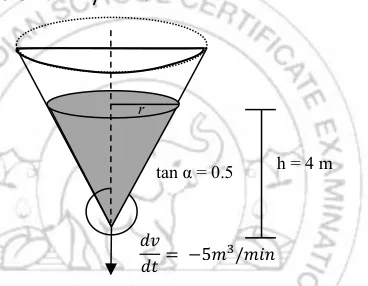 5 marks
A large industrial water tank is an inverted right circular cone with semi-vertical angle tan-1(0.5). Water is drained at a constant rate of 5 m3/min. (a) Find the rate at which the water level is dropping when the height of the water is 4 meters. (b) Show that the wetted surface area S(h) is a strictly increasing function of the water depth h. (c) A chemical additive is added to the interior surface; if the cost is proportional to the square of the surface area (C = K S2), find the depth h at which the cost is increasing most rapidly relative to time.
Why this question: Applications of Derivatives → application of derivatives: related rates and rate of change of a compound quantity — appeared 1× Sample 2027
Q39.5 marks
A ball is thrown vertically downwards from the top of a cliff, tracked from when first thrown until it hits the ground. The height above the ground after t seconds is S(t) = at2 + bt + c, where a, b, c are real constants and S is in meters. After 1 second the ball is 285 m above the ground; after 2 seconds its height is 260 m; after 4 seconds it is 180 m. Set up and solve a matrix equation to find the height of the cliff.
Why this question: Determinants → matrices: solve system of equations using inverse (matrix method) — appeared 6× Board 2024Board 2026Sample 2024Sample 2025Sample 2026Sample 2027