ISC Class 12 Economics Important Questions 2027 (Repeated in Board Exams)
Last updated:
104 question patterns that appeared in two or more of the analysed papers (4 board + 4 official sample papers (2023–2027)). The numbers change; the question does not.
Demand
1. Can indifference curves intersect / slope upward / be straight lines? Defend or refute
3×Board 2024Sample 2024Sample 20252 marks
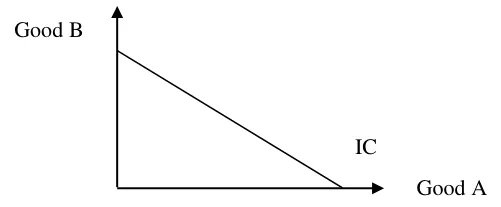
Will you defend or refute the case depicted in the following diagram (an indifference curve IC drawn as a downward-sloping straight line between the Good B and Good A axes)? Provide a rationale in support of your view.
2. Calculate marginal utility from total utility
2×Board 2025Sample 20271 marks
The table given below shows the Total Utility (TU) that a consumer derives by consuming slices of pizza:
No. of slices of Pizza: 1, 2, 3, 4, 5, 6
TU (Utils): 12, 22, 30, 36, 40, 38
At which level of consumption does the marginal utility begin to diminish?
(a) 1st slice
(b) 2nd slice
(c) 5th slice
(d) 6th slice
3. Effect of a rise in price of a complementary good (car and petrol)
2×Sample 2024Sample 20251 marks
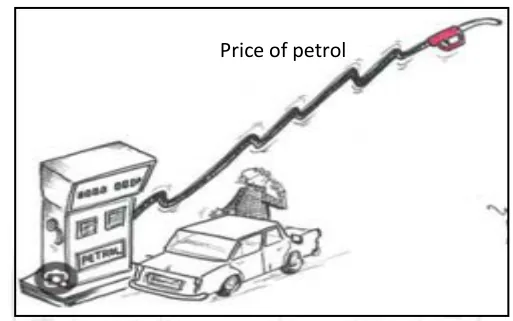
Naseer is planning to buy a car for his family. Observe the image shown below (a cartoon showing the price of petrol rising steeply) and select the MOST rational reaction of Naseer.
(a) Naseer will not change his decision to buy a car.
(b) He will postpone his plan to buy a car.
(c) Naseer will become indecisive.
(d) He will decide to purchase two cars instead of one.
4. Why does the demand curve slope downward? (income and substitution effects)
2×Board 2026Sample 20251 marks
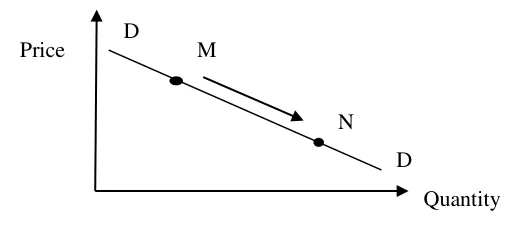
With reference to the diagram shown above, select the reason for the movement from point M to N from the following options.
(a) Increase in the real income of the consumer and rise in relative price of the commodity.
(b) Increase in the real income of the consumer and fall in relative price of the commodity.
(c) Decrease in the real income of the consumer and rise in relative price of the commodity.
(d) Decrease in the real income of the consumer and fall in relative price of the commodity.
5. Points inside, on and beyond the budget line: why is the consumer not in equilibrium there? (1-mark)
2×Board 2025Sample 20251 marks
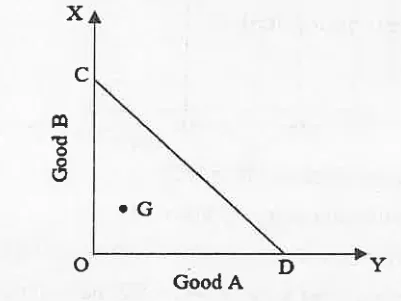
In the diagram given above (budget line CD for Good A and Good B, with point G lying inside the budget line), CD is the budget line. What does the point G represent?
(a) Combination of two goods on which a consumer spends her entire money income
(b) Combination of two goods on which a consumer spends less than her money income
(c) Combination of two goods on which a consumer spends greater than her money income
(d) Consumer spends her entire money income either on Good A or Good B
6. Why is an indifference curve convex to the origin? (DMRS) (short answer)
2×Board 2026Sample 20242 marks
Lisa's family consumes the following commodities on three different days in a week:
• 8 garlic breads and 2 pizzas on Monday
• 5 garlic breads and 3 pizzas on Thursday
• 3 garlic breads and 4 pizzas on Friday
The family derives the same level of satisfaction from these combinations. Does this phenomenon ensure the convexity of Indifference curve? Justify your answer.
7. Relationship between total utility and marginal utility (short answer)
2×Board 2026Sample 20232 marks
[context: schedule of total utility from strawberry ice creams — units 1 to 7: TU 55, 100, 140, 170, 185, 185, 170] How is Marginal Utility related to Total Utility till the point of satiety?
8. Relationship between total utility and marginal utility (1-mark)
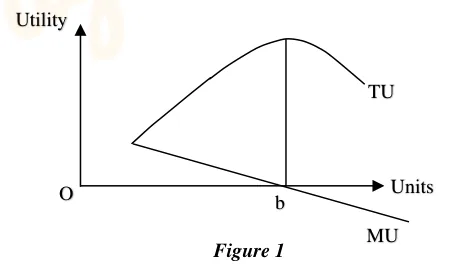
2×Board 2023Sample 20241 marks
Refer to the graph given below (Figure 1: TU and MU curves against units; MU falls and reaches zero at point 'b') and determine the behaviour of TU as MU decreases up to the point 'b'.
(a) TU increases up to a limit and remains positive.
(b) TU increases at an increasing rate
(c) TU increases at a diminishing rate.
(d) TU is at a point of satiety.
9. Consumer's equilibrium for one commodity with diagram (MU = P)
2×Board 2023Sample 20246 marks
A consumer can attain a stable equilibrium only when the marginal utility obtained from a commodity can be equated with the price of that commodity. Explain this phenomenon with the help of a diagram.
Elasticity of Demand
10. Numerical: price elasticity of demand by percentage method (find Ed, new price or quantity)
5×Board 2023Board 2025Sample 2023Sample 2024Sample 20252 marks
When the price of potato chips falls from ₹ 40 to ₹ 20 per unit, its demand increases by 20 units. If the price elasticity of demand is (−) 0·5, calculate the quantity demanded of potato chips at ₹ 20.
11. Factors affecting price elasticity of demand
2×Board 2023Sample 20276 marks
Explain how the following factors affect the price elasticity of demand for a product:
(a) Availability of substitutes
(b) Proportion of income spent
(c) Necessity versus Luxury
(d) Short run versus long run
12. MCQ: % change in quantity/price from given elasticity
2×Board 2024Board 20261 marks
Demand curve for a commodity will be negatively sloped but steeper when the demand rises by 15% due to a fall in its price from ₹ 40 to:
(a) ₹ 38.
(b) ₹ 36.
(c) ₹ 34.
(d) ₹ 32.
Supply
13. Shift in supply due to change in cost/technology/weather (with diagram)
4×Sample 2023Sample 2024Sample 2025Sample 20272 marks
Agro Gold Wheat Traders supplies wheat in the market. The firm purchases advanced grain storage technology, which reduces wastage and lowers its cost of handling wheat. As a result, Agro Gold is able to supply more wheat at the same price as before. Later, due to a sudden rise in international wheat prices, the market price of wheat increases, leading Agro Gold to supply more wheat. Illustrate these two types of changes in the supply of wheat in separate diagrams.
14. MCQ: elasticity of supply - shape of supply curve / factors
2×Sample 2023Sample 20271 marks
The supply of a commodity will be relatively inelastic when:
(a) the producer is a risk averter.
(b) the product is durable in nature.
(c) modern technology is used in production.
(d) the product is supplied over a long period.
15. MCQ: identify the cause of a shift/movement of the supply curve
2×Board 2026Sample 20241 marks
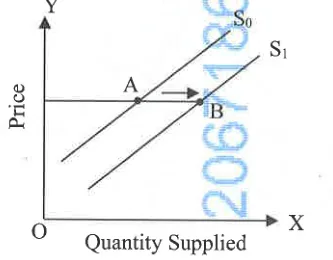
Which one of the following scenarios depicts the movement from A to B shown in the diagram below?
(a) Rise in supply of tomato due to an increase in its price
(b) Rise in supply of t-shirts of Brand Z following a fall in its price
(c) Fall in supply of fertilisers due to reduction in subsidy by the government
(d) Rise in supply of television by MG Electronics due to the use of Artificial Intelligence in its manufacturing
16. Identify the degree of elasticity of supply and draw the supply curve
2×Board 2023Board 20252 marks
The price of chocolates increased during the Valentine week in February leading to an increase in the supply at a greater rate. Identify the price elasticity of supply and illustrate it on a diagram.
17. Exceptions to the Law of Supply (backward-bending supply curve)
2×Board 2023Board 20252 marks
Ibrahim works as a mechanic and earns ₹ 5000 per month. To increase his family income, his wife and parents also begin to work. Over a period of time when his income increases to ₹ 20,000, Ibrahim asks his family members not to work and enjoy leisure. The phenomenon indicated in this situation does not conform to the Law of Supply. Give a reason to support this statement. Draw the supply curve based on the given situation.
Market Mechanism
18. Price ceiling with diagram (and its consequences) (short answer)
2×Board 2026Sample 20272 marks
If the state government imposes ceiling price on cab fares, it may cause a deficit in the supply of the cab services. As owner of an app-based cab service company, formulate a measure that you would take to overcome this problem. Illustrate the suggested measure with the help of a diagram.
19. Effect of a shift in supply on equilibrium price
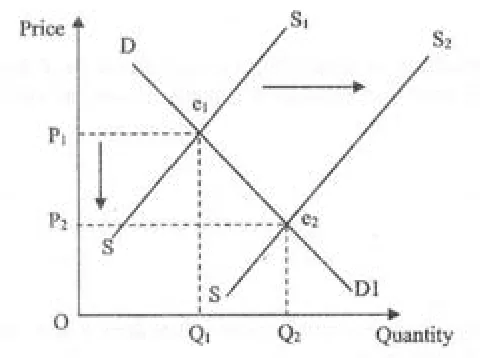
2×Board 2023Board 20241 marks
The diagram given below shows the change in price of cotton shirts (demand curve D fixed; supply shifts rightward from S1 to S2; equilibrium moves from e1 to e2, price falls from P1 to P2 and quantity rises from Q1 to Q2). Which one of the following causes the equilibrium price to move from P1 to P2?
(a) Increase in excise duty on raw cotton.
(b) Expected fall in future price of cotton shirts.
(c) Fall in the price of synthetic shirts.
(d) Increase in wage rate.
Concepts of Production
20. Causes of negative (diminishing) returns to a factor
3×Board 2026Sample 2024Sample 20272 marks
[context: Green Field Farm has a fixed 10 acres of land; hiring more workers first raises total output rapidly (division of tasks), then output grows more slowly and finally total output declines] '……… which eventually led to a decline in the farm's total output'. Briefly explain the reasons behind this phenomenon.
21. Explain the Law of Variable Proportions and its three stages with diagram
3×Sample 2023Sample 2024Sample 20274/6 marks
[context: Green Field Farm has a fixed 10 acres of land; hiring more workers first raises total output rapidly (division of tasks), then output grows more slowly and finally total output declines] With the help of a diagram, explain the law applicable to this situation.
22. Which stage of production will a rational producer choose?
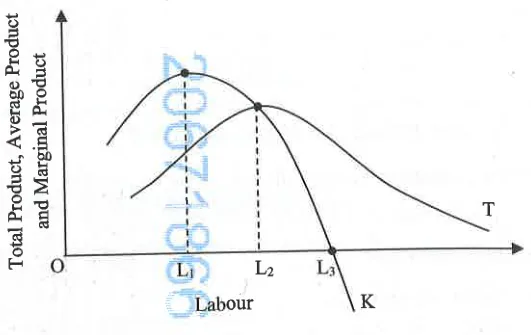
3×Board 2026Sample 2023Sample 20252 marks
[context: TP/AP/MP diagram with stages L1, L2, L3] Producer is reluctant to produce in the stage of production depicted by the range L2L3. Defend or refute the statement with a reason.
23. Returns to a factor vs returns to scale (short answer)
3×Board 2023Sample 20252 marks
Cite any two differences between Returns to Factor and Returns to Scale.
24. Relationship between TP, AP and MP with diagram
2×Board 2024Sample 20254/6 marks
What are Average product and Marginal product? With the help of a suitable diagram, discuss the relationship between Average product and Marginal Product.
25. MCQ: behaviour of TP when MP is maximum/zero/negative
2×Board 2023Board 20241 marks
At the point of inflexion, _______ is maximum.
(a) total product
(b) total cost
(c) average product
(d) marginal product
Cost and Revenue
26. Numerical: calculate TFC, TVC, AC, AVC, AFC, MC from a cost schedule
5×Board 2023Board 2026Sample 2023Sample 2024Sample 20252/3 marks
Study the data given below and answer the questions that follow.
Output (Units): 1, 2, 3, 4, 5, 6
TVC: 20, 32, 40, 45, 52, 62
(a) Calculate Marginal Cost (MC).
(b) State the nature of the MC curve and draw it.
27. Draw and explain cost curves (TFC, AFC, AC, TC)
4×Board 2024Board 2025Sample 2025Sample 20272 marks
Explain the total cost curve.
28. Producer's equilibrium: MR = MC and MC rising (with data/diagram) (long answer)
2×Sample 2024Sample 20274 marks
[context: a potato farmer sells at ₹ 850 per quintal like other farmers; MR = ₹ 850 throughout; MC = ₹ 850 at 6 quintals, ₹ 845 at 7, ₹ 850 at 8, ₹ 856 at 9] What amount of potato will he produce to maximise his profit? With reference to the given data, explain the principles that would motivate his decision.
29. Why are the AC/AVC/LAC curves U-shaped?
3×Board 2023Board 2025Sample 20241 marks
The long run average cost curve is U shaped due to the Law of Variable Proportions. Defend or refute the statement with a reason.
30. TR curve under perfect vs imperfect competition
2×Board 2024Sample 20272 marks
Explain the total revenue curve under the imperfectly competitive market.
31. MCQ: producer's equilibrium condition MR = MC
2×Board 2025Sample 20231 marks
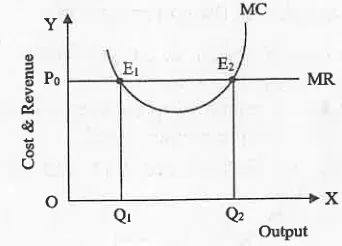
Refer to the diagram given below and choose the correct statement.
(a) E1 is the equilibrium point as MR = MC.
(b) E1 and E2 are equilibrium points as MR = MC.
(c) E2 is the equilibrium point because MC > MR beyond this point.
(d) E2 is the equilibrium point because MC < MR beyond this point.
32. Opportunity, accounting, explicit and implicit cost (1-mark)
2×Board 2023Board 20251 marks
Amit withdrew ₹ 50,000 from his savings to invest in his own business. He bought a Xerox machine for ₹ 30,000 for his office the same day. Identify the explicit cost and the implicit cost in the above situation.
Main Market Forms and Equilibrium of a Firm
33. Identify the market form from a real-life scenario and explain the feature
5×Board 2024Board 2025Board 2026Sample 20252 marks
What type of market structure does the online delivery sector belong to? Explain with a suitable reason.
34. MCQ: identify the market form from a stated feature
4×Board 2024Board 2026Sample 2025Sample 20271 marks
Sometimes a firm can sell its product at different prices to different buyers at the same time. Which of the following market forms supports this practice?
(a) Oligopoly
(b) Monopoly
(c) Monopsony
(d) Monopolistic competition
35. Identify oligopoly from a scenario and explain its features
4×Board 2023Board 2025Sample 20272 marks
'Uber and Ola Cabs are two major app-based taxi services that operate in major cities in India. Each closely monitors the pricing strategy of the other. During peak hours, a surge in demand triggers an automatic increase in fares through surge pricing.' (Source (edited): Economic Research Centre, CUHK, 31 May 2022) Identify the market form in the above context. Outline two features of this market form evident in the scenario.
36. Break-even point: meaning and diagram
4×Board 2023Board 2026Sample 2024Sample 20252 marks
How does break-even point differ from shut down point? Indicate break-even point in a diagram.
37. Demand (AR) curve of a firm under perfect competition vs monopoly/monopolistic competition (short answer)
3×Board 2025Sample 2024Sample 20272 marks
Compare the demand curve faced by a perfectly competitive firm with the one faced by a monopolist. Substantiate your comparison with suitable reasons.
38. Why does a competitive firm earn only normal profit in the long run? (free entry and exit)
4×Board 2023Board 2024Sample 2023Sample 20252 marks
A perfectly competitive firm always enjoys normal profit in the long run irrespective of the situation it faces in the short run. Discuss the statement in brief.
39. MCQ: read the equilibrium point and profit/loss from a cost-revenue diagram
3×Board 2024Board 2026Sample 20241 marks
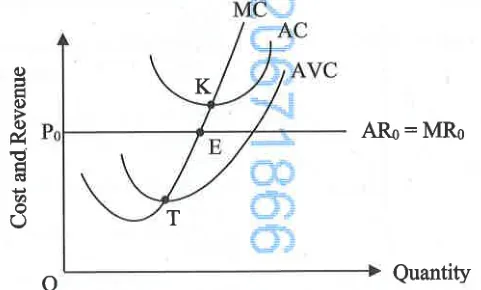
Refer to the diagram given below and choose the correct statement.
(a) K is the equilibrium point as MC = AC.
(b) MC = AVC at T and firm enjoys normal profit.
(c) E is the equilibrium point, but the firm stops production due to loss.
(d) E is the equilibrium point as both the equilibrium conditions have been satisfied.
40. Supernormal profit of a competitive firm: identify and show in a diagram
2×Board 2026Sample 20272 marks
What is meant by supernormal profit? Show it with the help of a diagram.
41. Why is the oligopolist's demand curve indeterminate? (1-mark)
2×Sample 2023Sample 20271 marks
Assertion: The demand curve under oligopoly is indeterminate.
Reason: MR curve is always discontinuous in oligopoly.
(a) Both Assertion and Reason are true and Reason is the correct explanation of Assertion.
(b) Both Assertion and Reason are true but Reason is not the correct explanation of Assertion.
(c) Assertion is true but Reason is false.
(d) Both Assertion and Reason are false.
42. Product differentiation and selling costs (short answer)
2×Board 2024Sample 20272 marks
Selling cost remains absent in a perfectly competitive market. Discuss.
43. Difference between perfect competition / oligopoly and monopolistic competition
2×Sample 2024Sample 20251 marks
Oligopoly differs from monopolistic competition on the basis of number of sellers. State any other difference between these two market forms.
44. Monopsony: features and why it is a buyers' market (1-mark)
2×Board 2026Sample 20251 marks
State any two features of a Monopsony market.
45. Short-run equilibrium of a perfectly competitive firm (profit/loss) with diagram
3×Board 2023Board 2024Sample 20234/6 marks
Explain the short run equilibrium of a perfectly competitive firm earning supernormal profit with the help of a diagram.
46. Price discrimination: identify it and the market where it occurs (1-mark)
2×Sample 2023Sample 20241 marks
Assertion: Price discrimination is possible only in a monopoly market.
Reason: AR curve of a monopoly firm exhibits the market demand for the commodity.
(a) Both Assertion and Reason are true, and Reason is the correct explanation for Assertion.
(b) Both Assertion and Reason are true, but Reason is not the correct explanation for Assertion.
(c) Assertion is true and Reason is false.
(d) Both Assertion and Reason are false.
47. Why is the oligopolist's demand curve indeterminate? (short answer)
2×Board 2025Sample 20242 marks
[context: LPG market with few interdependent competitors (oligopoly)] Briefly discuss the nature of demand curve in this form of market.
48. Demand (AR) curve of a firm under perfect competition vs monopoly/monopolistic competition (1-mark)
2×Board 2026Sample 20231 marks
A firm under perfect competition faces a perfectly elastic demand curve whereas the demand curve faced by it under monopolistic competition is less than perfectly elastic. Justify the statement.
49. Intense competition in oligopoly (short answer)
2×Board 2026Sample 20232 marks
Briefly explain the implications of each of the following:
(a) Intense competition in oligopoly
(b) Selling cost under monopolistic competition
50. MCQ: in which market is the firm's demand curve perfectly elastic / same as market demand?
2×Board 2024Sample 20241 marks
In which one of the following types of market, are Average Revenue curve and Market Demand curve the same?
(a) Monopoly
(b) Oligopoly
(c) Perfect Competition
(d) Monopolistic Competition
51. Shut-down point: when must a competitive firm stop production (P < AVC)? (short answer)
2×Board 2025Sample 20232 marks
Briefly discuss the situations when a perfectly competitive firm continues to produce even after facing losses in the short run.
52. Price discrimination: identify it and the market where it occurs (short answer)
2×Board 2024Board 20262 marks
A famous museum in India charges a high entry fee from the foreign tourists and low entry fee from Indian tourists.
(a) Identify and briefly describe the phenomenon evident here.
(b) Name the market in which the phenomenon referred to in subpart (a) is applicable.
Theory of Income and Employment
53. Determination of equilibrium income: AD-AS / saving-investment approach with diagram
4×Sample 2023Sample 2024Sample 2025Sample 20274/6 marks
National output or real national income is said to be at equilibrium level when aggregate supply becomes equal to the aggregate demand. Explain this phenomenon with the help of a diagram. Does this equilibrium always take place at full employment level? Explain.
54. Relationship between APC, APS, MPC and MPS (APC > 1, 0 < MPC < 1, break-even point)
4×Board 2024Sample 2023Sample 2025Sample 20271 marks
Which of the following statements is correct in the context of Keynesian break-even point?
(a) APC < 1
(b) APS > 1
(c) APS = 0
(d) APC = 0
55. Meaning of excess demand / deficient demand (inflationary and deflationary gap) (1-mark)
4×Board 2023Board 2024Sample 2024Sample 20251 marks
If aggregate demand exceeds aggregate supply in a situation of full employment, what will be its impact on the economy?
56. Numerical: multiplier, MPC/MPS and change in investment/income (1-mark)
2×Sample 2024Sample 20271 marks
What will be the value of MPS if the change in income is twice the change in investment expenditure?
57. Measures to correct excess/deficient demand (with diagram) (long answer)
2×Board 2025Sample 20274/6 marks
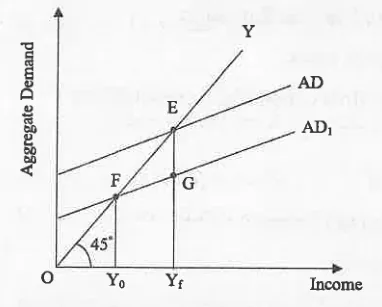
[context: AD-AS diagram showing deficient demand gap EG at full-employment income Yf] Recommend any two fiscal measures and any two monetary measures to combat the situation referred to in subpart (a).
58. Autonomous vs induced investment (1-mark)
3×Board 2023Board 2024Sample 20241 marks
Mention any one difference between Induced investment and Autonomous investment.
59. Investment multiplier: meaning and relation with MPC/MPS (1-mark)
2×Sample 2023Sample 20251 marks
Illustrate that Investment multiplier is inversely proportional to MPS.
60. Meaning of excess demand / deficient demand (inflationary and deflationary gap) (short answer)
2×Board 2025Board 20262 marks
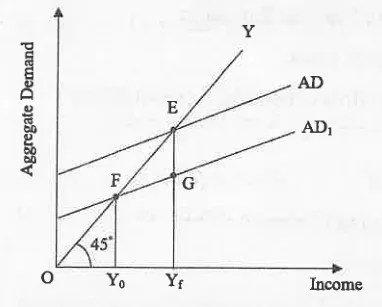
Refer to the diagram given below (45° line Y, AD and AD1; equilibrium at F with income Y0 below full-employment income Yf; E on AD at Yf, G on AD1 at Yf). What does the gap EG represent? Explain.
61. Complete the table: APC/APS/MPC/MPS
2×Board 2023Sample 20231 marks
Complete the following table:
INCOME (Y): 0, 20
SAVING (S): (−)12, 6
APC: ?, ?
62. Ex-ante and ex-post (effective) demand
2×Board 2023Board 20241 marks
With reference to Simple Keynesian model, give the meaning of ex-ante demand.
Money and Banking
63. Measures of money supply M0-M4 (components and liquidity) (short answer)
3×Board 2026Sample 2025Sample 20272 marks
How is High Powered Money different from Broad Money?
64. How can OMO / repo rate / bank rate control inflation or deflation? (short answer)
4×Board 2023Board 2026Sample 2023Sample 20242 marks
[context: Argentina at full employment facing inflationary pressure from excess demand] Explain any one monetary measure that can help resolve the economic crises like inflation and recession.
65. Credit creation by commercial banks (with numerical example) (long answer)
3×Board 2025Sample 2023Sample 20244 marks
Aditi deposits ₹ 1000 in a bank which leads to an increase in money supply in the economy to the extent of ₹ 4000. Name and explain the process of this increase in money supply.
66. Legal tender, fiat money and kinds of money (short answer)
2×Sample 2024Sample 20272 marks
In different border areas of India, currency of neighbouring country is used as money, but not as legal tender. Justify the statement.
67. Commercial bank deposits and credit facilities (short answer)
2×Board 2026Sample 20252 marks
Sohail requires ₹ 3 lakhs to meet his business needs. He has ₹ 1 lakh in his current account. He decides to arrange the amount in the following ways:
(a) Withdrawing ₹ 1·75 lakhs from his current account.
(b) Collecting the remaining amount as cash credit.
With reference to subparts (a) and (b), explain the credit facilities enjoyed by Sohail.
68. Inflation: meaning, demand-pull vs cost-push (short answer)
2×Sample 2023Sample 20252 marks
[context: passage — fixed deposits promise steady nominal returns, but with 6% interest and 5% inflation, Rs 1 crore grows to 1.79 crore nominally yet only 1.10 crore in real terms after 10 years; inflation erodes purchasing power] Differentiate between Demand pull and Cost push inflation.
69. Measures of money supply M0-M4 (components and liquidity) (1-mark)
2×Board 2025Board 20261 marks
Assertion: M0 is the monetary liability of Reserve Bank of India.
Reason: Reserve Bank of India controls credit whereas Commercial Bank can only create credit.
(a) Both Assertion and Reason are true and Reason is the correct explanation of Assertion.
(b) Both Assertion and Reason are true but Reason is not the correct explanation of Assertion.
(c) Assertion is true but Reason is false.
(d) Both Assertion and Reason are false.
70. Inflation: meaning, demand-pull vs cost-push (1-mark)
2×Board 2025Board 20261 marks
What is demand pull inflation?
71. Legal tender, fiat money and kinds of money (1-mark)
2×Board 2023Board 20261 marks
Why is Indian currency regarded a fiat money?
72. Functions of money (short answer)
2×Board 2023Board 20262 marks
One of the important functions of money is to assist the consumers in maximisation of utility. Explain.
73. Functions of the central bank (clearing house, custodian, controller of credit) (short answer)
2×Board 2023Board 20242 marks
[context: passage on RBI monetary policy] Differentiate between Reserve Bank of India and Commercial banks by giving any two points.
Balance of Payments and Exchange Rate
74. Effect of depreciation/appreciation/devaluation on exports, imports and BoP (short answer)
6×Board 2023Board 2024Board 2025Board 2026Sample 2024Sample 20272 marks
[context: graph — rupee per US dollar rose from 87·06 (Aug 25) to 88·75 (Oct 25) to 90·28 (Jan 26); India's exports Apr-Dec 2025 US$634·26 bn (+4·33%), imports US$730·84 bn (+4·95%); diaspora remittances $135·46 bn; FPIs pulled out ₹11,820 crore from Indian equities due to the falling rupee] Predict the impact of change in exchange rate of rupee against US dollar, on the national income of India.
75. Fixed, flexible and managed floating exchange rate systems (short answer)
4×Board 2024Sample 2023Sample 2025Sample 20272 marks
[context: graph — rupee per US dollar rose from 87·06 (Aug 25) to 88·75 (Oct 25) to 90·28 (Jan 26); India's exports Apr-Dec 2025 US$634·26 bn (+4·33%), imports US$730·84 bn (+4·95%); diaspora remittances $135·46 bn; FPIs pulled out ₹11,820 crore from Indian equities due to the falling rupee] The present trend of Indian rupee is associated with the flexible exchange rate system. Discuss whether this trend would be possible in fixed exchange rate system.
76. Classify transactions into current/capital account (debit/credit) of BoP (short answer)
3×Board 2024Board 2025Sample 20272 marks
[context: graph — rupee per US dollar rose from 87·06 (Aug 25) to 88·75 (Oct 25) to 90·28 (Jan 26); India's exports Apr-Dec 2025 US$634·26 bn (+4·33%), imports US$730·84 bn (+4·95%); diaspora remittances $135·46 bn; FPIs pulled out ₹11,820 crore from Indian equities due to the falling rupee] Categorise the transactions mentioned in the passage into different components of Balance of Payments.
77. How can a deficit in balance of payments be corrected? (1-mark)
3×Board 2025Board 2026Sample 20251 marks
Explain how deficit in Balance of Payments can be corrected by raising domestic rate of interest on savings.
78. Causes of adverse BoP (inflation, falling exports)
3×Board 2024Board 2025Sample 20232 marks
In July 2024, India's retail inflation rate was 3·54%. Though it is falling yet it continues to persist. Explain how this would affect India's Balance of Payments.
79. Meaning and components of balance of payments (vs balance of trade) (short answer)
2×Sample 2024Sample 20252 marks
List different components of Balance of Payment on current account and capital account.
80. Meaning and components of balance of payments (vs balance of trade) (case-based, 1-mark)
2×Sample 2023Sample 20241 marks
[context: PIB extract on India's foreign trade, Apr-Dec 2022 — exports and imports of merchandise and services; global slump reduced demand for exports; exports showed a higher negative growth rate than imports] Which account of BOP is the concern in this extract?
81. Why does demand for foreign exchange slope downward and supply slope upward? (1-mark)
2×Board 2024Board 20251 marks
Why does the supply of foreign exchange increase with an increase in the foreign exchange rate?
Public Finance
82. Progressive, proportional, regressive and degressive taxes
4×Board 2025Board 2026Sample 2024Sample 20251 marks
In the Union Budget for the year 2025-26, Goods and Services Tax (GST) on soaps has been fixed at 18%. Why is this tax regressive in nature?
83. Relationship between revenue deficit and fiscal deficit
2×Sample 2024Sample 20271 marks
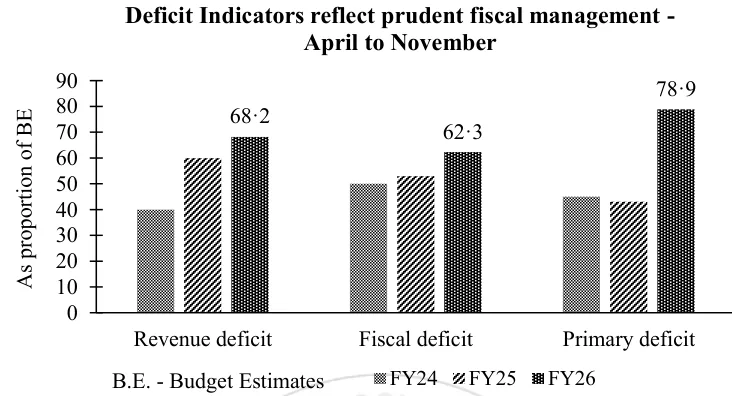
Observe the bar chart of deficit indicators (as proportion of BE, April to November, FY24-FY26; Source: Economic Survey, 2025-26). Compare the revenue deficit and fiscal deficit for the financial year 2024 (FY24).
84. Primary deficit: meaning and implication (1-mark)
2×Board 2025Sample 20271 marks
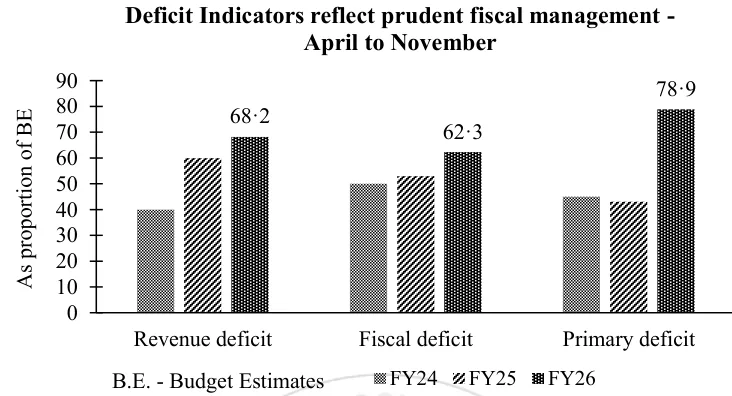
[context: bar chart 'Deficit indicators — April to November' as proportion of Budget Estimates for FY24, FY25, FY26 (revenue deficit, fiscal deficit, primary deficit; FY26 values 68·2, 62·3 and 78·9)] What is the implication of the trend in primary deficit over the period depicted in the graph?
85. Direct vs indirect taxes (short answer)
3×Board 2024Board 2025Sample 20232 marks
Budget 2024 outlined the sources of government revenue which comprised 19% from Income Tax, 18% from Goods and Service Tax and the remaining from borrowings. (Source (edited): Business Standard, New Delhi) Categorise the two types of taxes mentioned above. State any one difference between them.
86. What is a sinking fund?
2×Board 2023Sample 20271 marks
What is sinking fund?
87. Public expenditure as a fiscal tool against inflation/recession (short answer)
2×Sample 2024Sample 20252 marks
It is believed that increase in public expenditure leads to Inflation. Under what circumstances, may a government consider it prudent to increase public expenditure to control inflation?
88. Revenue receipts vs capital receipts (classify with reasons) (1-mark)
2×Board 2024Sample 20251 marks
Which one of the following statements is CORRECT with reference to government budget?
(a) Interest paid on government's borrowing reduces liability of the government.
(b) Financial aid received from the World Bank for cyclone affected areas is revenue receipt.
(c) Grants given by the central government to the state government is capital expenditure.
(d) Profits of BHEL, a PSU, increases the assets of the government.
89. Implications of a high fiscal deficit / reducing it
2×Board 2024Sample 20252 marks
Union Finance Minister Mrs. Nirmala Sitharaman announced during her Budget speech that the Centre would reduce its fiscal deficit to 5.1% of gross GDP in 2024–25. (The present fiscal deficit is 5.8% of GDP.) (Source: Union budget 2024-25) What would be the impact of this decision on government borrowing? Why?
90. Revenue receipts vs capital receipts (classify with reasons) (short answer)
2×Board 2023Board 20252 marks
With reference to government budget, classify the following as Revenue receipt or Capital receipt. Give a valid reason for each.
(a) Financial help from a Multinational Corporation (MNC) for victims in a flood affected area.
(b) Sale of shares of a Public Sector Undertaking (PSU) to a private company.
National Income
91. Numerical: national income / GNPmp by expenditure method
6×Board 2023Board 2024Board 2025Sample 2023Sample 2024Sample 20274/6 marks
Calculate GNPmp and National Income using the expenditure method (₹ in crore):
(a) Private final consumption expenditure 2750
(b) Government final consumption expenditure 300
(c) Gross domestic fixed capital formation 250
(d) Net factor income from abroad (−)25
(e) Import of goods and services 50
(f) Subsidy 25
(g) Decrease in stock 30
(h) Export of goods and services 45
(i) Consumption of fixed capital 100
(j) Net indirect taxes 100
92. Numerical: national income by income method (find NI, GDP or a missing factor income)
4×Board 2026Sample 2023Sample 2025Sample 20274/6 marks
Calculate the Income from Entrepreneurship from the following data (₹ in crore):
(a) Net Indirect Taxes 40
(b) Gross domestic product at factor cost 500
(c) Consumption of fixed capital 100
(d) Wages and salaries 90
(e) Mixed income of self-employed 105
(f) Rent 30
(g) Interest 20
(h) Employer's contribution to ESI fund 50
(i) Interest free loan given to the staff 35
(j) Contribution to provident fund by the employer 20
93. Distinguish national income aggregates (GDPmp/NNPfc, personal/private income, GNDI)
4×Board 2026Sample 2023Sample 20252 marks
State any one difference between each of the following:
(a) Gross National Disposable Income (GNDI) and Gross National Product at market price (GNPmp).
(b) Private Income and Personal Income
94. Components/steps of the income and expenditure methods
3×Board 2026Sample 20254 marks
Briefly explain different steps involved in estimation of GDPmp by Expenditure method.
95. Net exports in national income
3×Sample 2023Sample 2024Sample 20252 marks
Why are net exports added in the total expenditure in measuring National income by Expenditure method?
96. Why is GDP / per capita income not a true indicator of welfare? (long answer)
3×Board 2023Board 2025Sample 20274 marks
India's nominal GDP is projected to grow by 8·6% over the previous year in FY 2025-26. Does this indicate the economic welfare of the country? Justify your answer with four reasons.
97. Numerical: national income by value-added (output) method
4×Board 2023Board 2024Board 2025Board 20264/6 marks
Calculate GDPmp and National Income from the following data (₹ in crores):
(a) Value of output of primary sector 1000
(b) Value added of other sectors 250
(c) Raw materials purchased by primary sector 650
(d) Raw materials purchased by other sectors 100
(e) Factor income from abroad 45
(f) Factor income paid abroad 35
(g) Depreciation 65
(h) Indirect taxes 200
(i) Subsidies 45
98. Why are transfer payments / second-hand and financial transactions excluded from national income? (short answer)
3×Board 2025Board 2026Sample 20242 marks
Why are pure exchange transactions not included in estimation of national income of a country? Write any two examples of pure exchange transactions.
99. State with reason whether an item is included in national income
3×Board 2024Sample 20252 marks
With the help of a reason, explain why the following are included in calculation of National Income.
(a) Goods supplied free of cost by the government
(b) Own account production
100. Why are transfer payments / second-hand and financial transactions excluded from national income? (1-mark)
2×Sample 2023Sample 20271 marks
'Under Indira Gandhi National Old Age Pension Scheme, a monthly pension of ₹ 200/- is given to elderly aged 60-79 years belonging to BPL category.' (Source: pib.gov.in) This monthly pension scheme contributes to the growth of GDP in India. Defend or refute the statement by giving a valid reason.
101. Numerical: national income by both income and expenditure methods
2×Sample 2024Sample 20254/6 marks
Calculate GNPmp using Income method and Expenditure method from the following data (₹ in Crore):
(i) Private final consumption expenditure 800
(ii) Net exports 20
(iii) Rent 40
(iv) Interest 60
(v) Government final consumption expenditure 200
(vi) Profit 120
(vii) Net domestic capital formation 100
(viii) Compensation of employees 800
(ix) Net indirect taxes 100
(x) Consumption of fixed capital 20
(xi) Net factor income from abroad (−) 30
102. True or false with reason: national income concepts (1-mark)
2×Sample 2023Sample 20241 marks
State whether the following is True or False. Give one reason for your answer. Change in inventory is a stock concept.
103. Precautions in estimating national income (double counting) (short answer)
2×Board 2023Sample 20252 marks
Outline any two precautions that should be taken in estimation of National income by Expenditure method.
104. Draw the circular flow of income (two/three/four-sector model) (short answer)
2×Board 2023Board 20262 marks
Draw a well labelled diagram of circular flow of income for a mixed capitalist closed economy.