ICSE Class 10 Chemistry Important Questions 2027 (Repeated in Board Exams)
Last updated:
93 question patterns that appeared in two or more of the analysed papers (4 board + 5 official sample papers (2023–2027)). The numbers change; the question does not.
Periodic Properties and Variations of Properties
1. Deduce periodic position & compound formula from atomic number/config
4×Board 2025Sample 2023Sample 20272/3 marks
Study the table given below (periodic table with letters E, J, Q, L, M, G, D, N, P). Use only the letters given to answer. Do not identify the elements. (a) State the valency of element 'G'. (b) Which element can exhibit catenation? (c) Write the formula of the compound formed between 'M' and 'P'.

2. Compare EA, electronegativity & periodic position of given elements
3×Sample 2024Sample 2025Sample 20263 marks
The electron affinity of an element X is greater than that of element Y. (a) How is the oxidising power of X likely to compare with that of Y? (b) How is the electronegativity of X likely to compare with that of Y? (c) State whether X is likely to be placed to the left or to the right of Y in the periodic table?
3. Deduce valency/group/compound formula from an oxide formula
2×Sample 2025Sample 20272/3 marks
In the reactivity series of metals, Z is a metal above hydrogen and its oxide has the formula ZO. It was found that ZO reacted with water and formed a hydroxide as the product. (a) State the number of valence electrons present in element Z. (b) Name the group which Z belongs to. (c) What will be the formula of the hydroxide of Z?
4. Metallic/electropositive character trend down group
3×Board 2025Sample 20251 marks
Assertion (A): The tendency of losing electrons increases down the Group. Reason (R): The most reactive metal is placed at the top of Group 1. (a) Both (A) and (R) are true, and (R) is the correct explanation of (A). (b) Both (A) and (R) are true, and (R) is not the correct explanation of (A). (c) (A) is true but (R) is false. (d) (A) is false but (R) is true.
5. Fill in the blanks (mixed periodic terms)
2×Sample 2024Sample 20255 marks
Complete the following by choosing the correct answers from the bracket: (a) If an element has one electron in the outermost shell, then it is likely to have the _________ [smallest/ largest] atomic size amongst all the elements in the same period. (b) _________ [sulphuric acid/ hydrochloric acid] does not form an acid salt. (c) A _________ [reddish brown/ dirty green] coloured precipitate is formed when ammonium hydroxide is added to a solution of ferrous chloride. (d) Alkynes undergo _________ [addition / substitution] reactions. (e) An _________ [alkaline/acidic] solution will turn methyl orange solution pink or red.
6. Deduce metallic character & reducing agent from electronic configurations
2×Sample 2024Sample 20253 marks
X [2,8,7] and Y [2,8,2] are two elements. Using this information complete the following: (a) _________ is the metallic element. (b) Metal atoms tend to have a maximum of _________ electrons in the outermost shell. (c) _________ is the reducing agent.
7. Identify element by electron affinity trend
3×Board 2023Board 2024Sample 20231 marks
Electron Affinity is maximum in: (a) Mg (b) Ar (c) Li (d) Br
8. Arrange given elements in order of a periodic property
3×Board 2023Board 2024Sample 20233 marks
Arrange the following as per the instructions given in the brackets: (a) Carbon, Fluorine, Beryllium (decreasing order of atomic size) (b) Sulphuric acid, Phosphoric acid, Acetic acid (increasing order of number of replaceable H atoms per molecule) (c) Potassium, Lithium, Sodium (increasing order of ionization potential)
9. Identify element by atomic radius trend across a period
2×Board 2023Sample 20261 marks
Which element amongst the following has the largest atomic radius? (a) Al (b) S (c) Mg (d) Na
10. Identify element by ionisation potential trend
2×Board 2024Board 20251/2 marks
Given below are two sets of elements from two different periods. Name the element with the highest ionisation potential in each of the following sets. (a) Al, Cl, Mg (b) Ne, O, F
Chemical Bonding
11. Draw electron dot (Lewis) structures of given molecules
5×Board 2024Board 2025Board 2026Sample 20272/3 marks
A compound commonly used in the laboratory has formula H2P. H represents hydrogen, P represents a non-metal. Draw a dot and cross structure for the formation of the compound H2P.
12. Identify the term (mixed bonding)
3×Sample 2024Sample 2025Sample 20265 marks
Identify the following: (a) A bond formed between two atoms by sharing of a pair of electrons, with both electrons being provided by the same atom. (b) A salt formed by the complete neutralisation of an acid by a base. (c) A reaction in which the hydrogen of an alkane is replaced by a halogen. (d) The energy required to remove an electron from a neutral gaseous atom. (e) A homogenous mixture of two or more metals or a metal and a non-metal in a definite proportion in their molten state.
13. Deduce compound formula & molar mass from electronic configuration
3×Board 2024Sample 2025Sample 20271/2/3 marks
The diagram illustrates the structures of two atoms P (11p, 12n) and Q (8p, 8n). What is the formula and mass of one mole of the compound formed when P and Q react together? [At. wt of P is 23 and Q is 16]

14. Draw electron dot structure of ammonium ion (coordinate bond)
3×Board 2023Sample 2025Sample 20262 marks
Draw the electron dot diagram of ammonium ion. [Atomic No.: N=7, H=1]
15. Identify ion by number of lone pairs
2×Sample 2026Sample 20271 marks
Identify the ion that contains one lone pair of electrons. (a) OH-1 (b) H3O^+ (c) NH4^+ (d) H^+
16. High melting point of ionic compounds
2×Board 2026Sample 20271 marks
Assertion (A): Ionic compounds have high melting points. Reason (R): A strong electrostatic force of attraction exists between the oppositely charged ions. (a) (A) is true but (R) is false. (b) (A) is false but (R) is true. (c) Both (A) and (R) are true, and (R) is the correct explanation of (A). (d) Both (A) and (R) are true, but (R) is not the correct explanation of (A).
17. Draw electron dot structure of hydronium ion (coordinate bond)
2×Sample 2023Sample 20242 marks
Draw the electron dot diagram of Hydronium ion.
18. Match Column A with Column B (ionic vs covalent properties)
2×Board 2023Board 20245 marks
Match the Column A with Column B: A: (a) Water (b) Alkali metal (c) Halogen (d) Calcium oxide (e) Weak acid. B: 1. Lithium 2. Iodine 3. Covalent compound 4. Acetic acid 5. Ionic compound 6. Sulphuric acid
Study of Acids, Bases and Salts
19. Relate pH values to acid/base behaviour
5×Board 2024Sample 2024Sample 2025Sample 2026Sample 20273 marks
Rohit has three solutions X, Y and Z that have pH 2, 7 and 13 respectively. Which solution out of X, Y or Z will: (a) liberate sulphur dioxide gas when heated with sodium sulphite? (b) liberate ammonia gas when reacted with ammonium chloride? (c) not have any effect on litmus paper?
20. Write balanced equation for preparation of given salt
3×Board 2026Sample 2025Sample 20262/3 marks
Given below are some chemicals [Lead nitrate, Copper, Hydrochloric acid, Lead oxide, Iron, Sodium carbonate, Copper carbonate, Chlorine]. Using suitable chemicals from the box, write balanced chemical equations for the preparation of the following salts (chemicals may be used more than once): (a) Lead (II) carbonate (b) Copper (II) chloride (c) Iron (II) chloride
21. Identify reactions that produce water
2×Sample 2026Sample 20271 marks
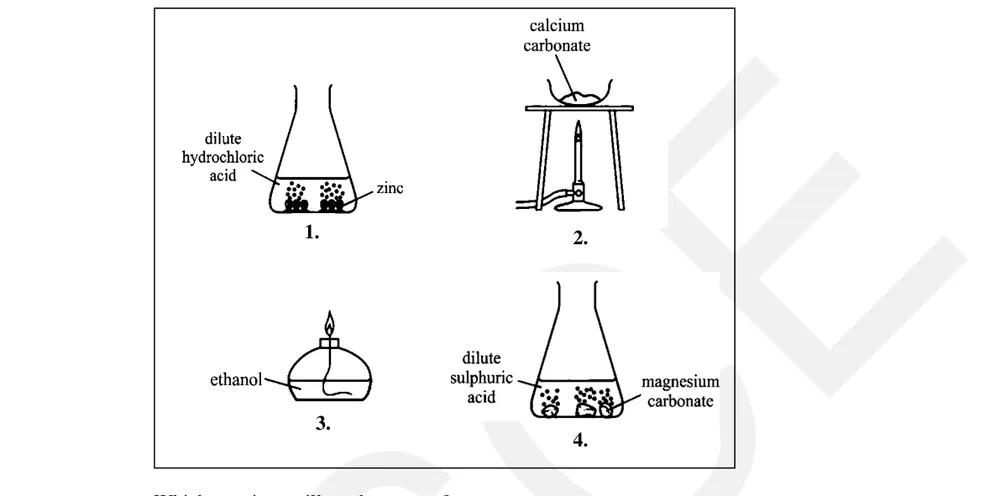
A teacher demonstrated four different reactions: 1. dilute hydrochloric acid + zinc 2. calcium carbonate heated 3. ethanol burning 4. dilute sulphuric acid + magnesium carbonate. Which reactions will produce water? (a) 1 and 2 (b) 1 and 3 (c) 3 and 4 (d) 2 and 3
22. Write equations for zinc conversion scheme to zinc salts
2×Sample 2026Sample 20273 marks
Write balanced chemical equations for the following conversions (A to C): ZnSO4 <-A- Zn -B-> ZnS; Zn -C-> Zn(OH)2.
23. Identify acid / its basicity
2×Sample 2023Sample 20241 marks
The basicity of acetic acid is: (a) 1 (b) 2 (c) 3 (d) 4
24. Match salt with its method of preparation
2×Board 2024Board 20253 marks
P, Q, R and S are the different methods of preparation of salts. P - Simple displacement; Q - Neutralisation by titration; R - Precipitation; S - Direct combination. Choose the most appropriate method to prepare the following salts: (a) PbCl2 (b) FeCl3 (c) Na2SO4
25. Indicator behaviour in acid/alkali
2×Board 2023Sample 20231 marks
The indicator which changes to pink colour in an alkaline solution is: (a) Blue Litmus (b) Methyl Orange (c) Red Litmus (d) Phenolphthalein
Analytical Chemistry
26. State whether given pair is distinguishable by the stated test
4×Sample 2024Sample 2025Sample 2026Sample 20272 marks
State giving reasons if: (a) Zinc metal and aluminium metal can be distinguished by heating the metal powders separately in two different test tubes with concentrated sodium hydroxide solution. (b) Zinc nitrate and lead nitrate can be distinguished by adding ammonium hydroxide solution to the salt solution.
27. Identify ammonium salt from action of NaOH
3×Sample 2024Sample 2025Sample 20261 marks
A compound P is heated in a test tube with sodium hydroxide solution. A red litmus paper held at the mouth of the test tube turns blue. Which of the following could compound P be? (a) Zinc sulphate (b) Copper sulphate (c) Ferrous sulphate (d) Ammonium sulphate
28. Special action of ammonium hydroxide on copper salts
3×Board 2023Sample 2025Sample 20261/2 marks
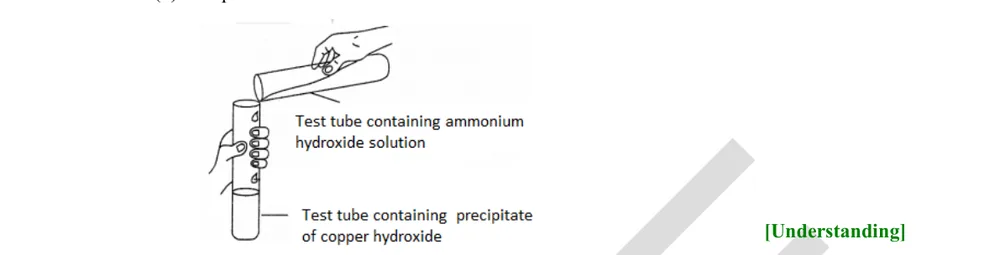
A student was asked to perform two experiments. State one observation for each of the Experiments 1 and 2 on mixing the given solutions. (a) Experiment 1: test tube containing solution of zinc sulphate and test tube containing solution of barium chloride. (b) Experiment 2: test tube containing ammonium hydroxide solution and test tube containing precipitate of copper hydroxide.
29. Identify cation/ion from precipitate observations
4×Board 2023Board 2024Board 2026Sample 20232 marks
Alex was given a solution of an unknown salt Y for analysis. To a part of the solution he added silver nitrate solution and obtained a white precipitate which was soluble in ammonium hydroxide solution. To the remaining solution he added a few drops of sodium hydroxide solution and obtained a pale blue precipitate. Based on the observations, identify: (a) the anion and (b) the cation present in salt Y.
30. Identify amphoteric hydroxide/oxide
3×Board 2024Sample 2023Sample 20261 marks
Identify from the following metal oxide which can react with an acid as well as an alkali. (a) Silver oxide (b) Calcium oxide (c) Copper(II) oxide (d) Aluminium oxide
31. Identify salt/ion from thermal decomposition & precipitate
2×Sample 2025Sample 20263 marks
Abhishek was given a salt 'X' for analysis which was white in colour. On strong heating it produced a yellow residue, a colourless gas, and also a reddish-brown gas. The solution of the salt 'X' when tested with excess of ammonium hydroxide produced a chalky white insoluble precipitate. (a) Name the coloured gas evolved when Abhishek heated the salt strongly. (b) Which cation was present in the sample given to Abhishek? (c) Identify the salt given to Abhishek for analysis.
32. Identify H2S/sulphide from gas test/smell
2×Board 2024Sample 20271 marks
When compound X reacts with dilute hydrochloric acid, it releases a gas that turns moist lead acetate paper black and decolourises acidified potassium permanganate solution. Which of the following is compound X? (a) Sodium nitrate (b) Sodium sulphide (c) Sodium carbonate (d) Sodium sulphite
33. Identify the anion from given observations
3×Board 2023Board 2024Sample 20232/3 marks
Identify only the anion present in the following compound: (a) The compound on heating produces a colourless, odourless gas which turns lime water milky and has no effect on acidified potassium dichromate solution. (b) The solution of the compound which on treating with concentrated sulphuric acid and freshly prepared ferrous sulphate solution produces a brown ring.
34. Distinguish given salt pair using stated reagent
2×Board 2025Sample 20232 marks
Differentiate between the following pairs of compounds using the reagent given in the bracket: (a) Ammonium chloride and Sodium chloride (using an alkali) (b) Zinc Nitrate solution and Calcium Nitrate solution (using excess sodium hydroxide solution)
35. Name the gas evolved in the given reactions
2×Board 2024Board 20253 marks
Name the gas produced during each of the following reactions: (a) When copper is treated with hot, concentrated nitric acid. (b) When ammonia is burnt in an atmosphere of oxygen. (c) When ferrous sulphide reacts with dilute hydrochloric acid.
Mole Concept and Stoichiometry
36. Stoichiometry from equation: mass, moles and gas volume
7×Board 2024Board 2025Board 2026Sample 2024Sample 2025Sample 2026Sample 20273/4 marks
Solid ammonium dichromate decomposes as under: (NH4)2Cr2O7 -> N2 + Cr2O3 + 4H2O. If 126 g of ammonium dichromate decomposes, calculate: (a) the number of moles of ammonium dichromate that undergoes decomposition. (b) the mass of chromic oxide formed at the same time. (c) the volume of nitrogen gas evolved at STP. [At wt: N=14, Cr=52, O=16, H=1]
37. Gas-volume (eudiometry) stoichiometry of reacting gases
6×Board 2023Board 2024Board 2025Board 2026Sample 2023Sample 20251/2/3 marks
What volume of carbon dioxide is produced at STP when 5 litres of propane is burnt completely according to: C3H8 + 5O2 -> 3CO2 + 4H2O? (a) 10 litres (b) 15 litres (c) 20 litres (d) 25 litres
38. Molar volume at STP calculations
3×Board 2024Sample 2026Sample 20271 marks
The volume occupied by 0.2 moles of a gas at S.T.P. is: (a) 22.4 litres (b) 2.24 litres (c) 44.8 litres (d) 4.48 litres
39. Compare masses/moles of given substances using molar mass
2×Sample 2025Sample 20271/2 marks
20 grams of a gas M2P has lesser number of moles than 20 grams of the gas MP. Justify the above statement using mathematical calculations. [At.wt. M=14, P=16]
40. Determine VD/molecular mass from equal-volume masses
3×Board 2025Sample 2023Sample 20242 marks
A gas cylinder can hold 150 g of hydrogen under certain conditions. If an identical cylinder with the same capacity can hold 450 g of gas 'G' under the same conditions, find: (a) the vapour density of the gas 'G'. (b) the molecular weight of gas 'G'.
41. Calculate volume ratio of given gases
2×Sample 2025Sample 20261 marks
The ratio between the volumes occupied by 22 grams of carbon dioxide and 10 grams of hydrogen gas is: (a) 2.2:1 (b) 1:2.2 (c) 1:10 (d) 10:1
42. Determine molecular formula from vapour density
2×Board 2025Sample 20271 marks
An organic compound X containing carbon and hydrogen only has Vapour Density (V.D.) 14. The molecular formula of X is _________. (At. wt. of C=12, H=1) (a) CH (b) C2H4 (c) C2H2 (d) CH2
43. Define/state the given law or term
3×Board 2024Board 2025Sample 20232 marks
(a) State Avogadro's Law. (b) Define Co-ordinate bond.
44. Empirical & molecular formula from percentage composition
2×Board 2025Sample 20232/4 marks
An organic compound 'X' contains carbon, oxygen and hydrogen only. The percentage of carbon and hydrogen are 47.4% and 10.5% respectively. The relative molecular mass of 'X' is 76. Find the empirical formula and the molecular formula of 'X'. [Atomic weight: C=12, O=16, H=1]
45. Molecular formula from empirical formula & molecular mass
2×Board 2023Sample 20242/3 marks
The empirical formula of an organic compound is C3H4N. Its molecular weight is 108. Find the amount of carbon in one mole of the compound. Show all the steps involved. (Atomic weights: C-12; H-1; N-14)
46. Calculate vapour density = molecular mass / 2
2×Board 2023Sample 20231 marks
The vapour density of CH3OH is ___________. (At. Wt. C=12, H=1, O=16) (a) 32 (b) 18 (c) 16 (d) 34
Electrolysis
47. Conduction of current by ions in electrolytes
4×Sample 2025Sample 2026Sample 20271 marks
Which statement given below is correct with reference to the flow of electric current? (a) In all aqueous solutions, current is carried by electrons. (b) In all acidic solutions, current is carried by ions. (c) In molten electrolytes, current is carried by electrons. (d) In metal wires, current is carried by ions.
48. Interpret electroplating diagram (electrode reactions, electrolyte)
4×Board 2024Board 2026Sample 2025Sample 20264/5 marks
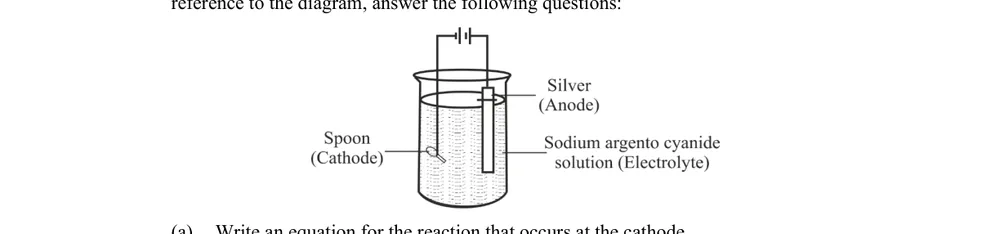
The diagram given below shows the electroplating of a spoon with silver (Silver anode, Spoon cathode, Sodium argentocyanide solution electrolyte). (a) Write an equation for the reaction that occurs at the cathode. (b) Silver nitrate solution is not preferred as an electrolyte in the above process. Give a reason. (c) Why is alternating current not used in the process? (d) What is the observation at the anode?
49. Electrolysis of acidified water
3×Board 2025Board 2026Sample 20271/3/5 marks
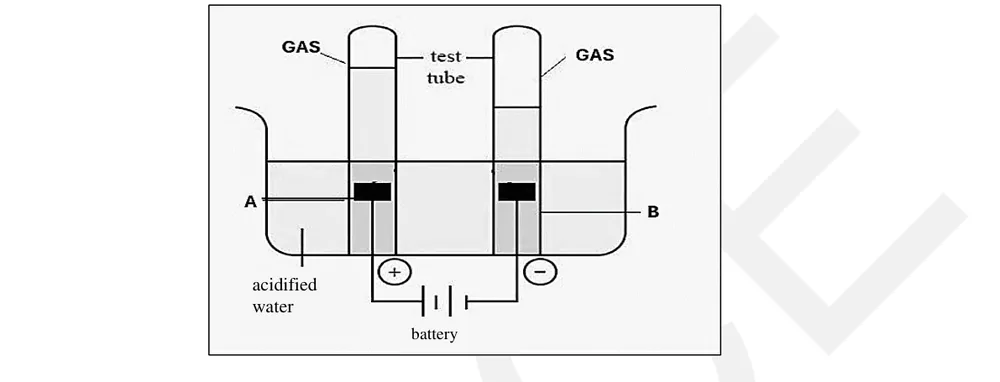
The diagram shows the electrolysis of acidulated water (electrode A at positive, electrode B at negative). (a) Write an equation for the reaction that takes place at A. (b) Give a test to confirm the product formed at A. (c) Which gas is liberated at B? (d) Why is water acidified for electrolysis? (e) What is the ratio by volume of the gases liberated at A and B?
50. Match reaction with oxidation/reduction/ionization/dissociation
2×Board 2026Sample 20275 marks
Match Column A with Column B: A: (a) CuO + C -> Cu + CO (b) Al3+ + 3e^- -> Al (c) PbBr2 -> Pb2+ + 2Br1- (d) 2O2- - 4e^- -> O2 (e) HCl -> H^+ + Cl1-. B: 1. Oxidation 2. Ionization 3. Reduction 4. Redox 5. Electrolytic dissociation
51. Identify electrodes/conditions from CuSO4 electrolysis result
2×Sample 2024Sample 20251 marks
An aqueous solution of copper sulphate turns colourless on electrolysis. Which of the following could be the electrodes? P: anode copper, cathode copper; Q: anode platinum, cathode copper; R: anode copper, cathode platinum. (a) only P (b) only Q (c) only R (d) both Q and R
52. Identify oxidising electrode & write electrode reaction (CuSO4)
2×Sample 2024Sample 20253 marks
Copper sulphate solution is electrolysed using copper electrodes. (a) Which electrode [cathode or anode] is the oxidizing electrode? Why? (b) Write the equation for the reaction occurring at the above electrode.
53. Electro-refining of copper
2×Board 2023Sample 20261/3 marks
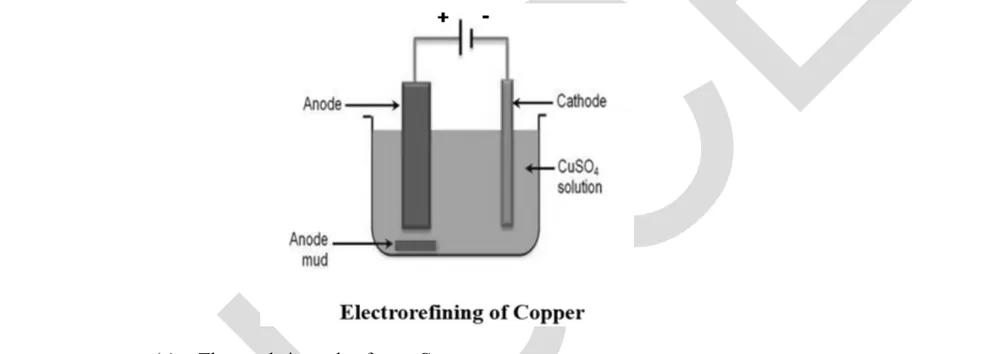
In the process of Electrorefining of Copper shown in the diagram, which of the following statements is correct? (a) The anode is made of pure Copper. (b) The cathode is made of impure Copper. (c) Copper is deposited at the anode. (d) Copper ions from the anode move to the cathode and get deposited as pure Copper.
54. Identify strong/weak electrolytes and mobile ions
2×Board 2026Sample 20231 marks
Assertion (A): Dilute Sulphuric acid is a stronger electrolyte than concentrated Sulphuric acid. Reason (R): Dilute Sulphuric acid has a higher concentration of mobile ions. (a) (A) is true but (R) is false. (b) (A) is false but (R) is true. (c) Both (A) and (R) are true and (R) is the correct explanation of (A). (d) Both (A) and (R) are true, but (R) is not the correct explanation of (A).
55. Electrolysis of copper sulphate with copper electrodes
2×Board 2025Board 20261 marks
With respect to the electrolysis of copper (II) sulphate solution using copper electrodes, which statement is correct? (a) Copper metal is deposited at the negative electrode. (b) Oxygen gas is produced at the positive electrode. (c) The positive electrode increases in mass. (d) The negative electrode decreases in mass.
56. Fill in the blanks (electrolysis)
2×Board 2025Board 20265 marks
Complete the following sentences by choosing the correct option from the brackets: (a) The oxide that dissolves in caustic potash (KOH) is _________. [ZnO / CuO] (b) The reaction that takes place at the anode during the electrolysis of molten lead bromide is _________. [2Br - 2e^- -> 2Br^- / 2Br^- - 2e^- -> Br2] (c) The volume occupied by 8 grams of oxygen gas at STP is _________ litres. [5.6 / 8.96] (d) _________ does not give hydrogen gas when it reacts with cold and very dilute nitric acid. [Cu / Mn] (e) _________ is a polar covalent compound. [HCl / CCl4]
57. Identify electrode reaction/product in electroplating
2×Board 2023Sample 20231 marks
Which of the following reactions takes place at the anode during the electroplating of an article with silver? (a) Ag - 1e^- -> Ag1+ (b) Ag + 1e^- -> Ag1- (c) Ag - 1e^- -> Ag (d) None of the above
Metallurgy
58. Identify the alloy from its composition
5×Board 2023Board 2024Sample 2023Sample 2024Sample 20251/2 marks
Name the alloy which is made up of: (a) Copper, Zinc and Tin (b) Lead and Tin
59. Match Column A with Column B (processes, ores, bonding)
3×Sample 2024Sample 2025Sample 20265 marks
Match Column A with Column B. A: (a) Aluminium (b) Sulphuric acid (c) Calcination (d) Calcium Chloride (e) Carbon tetrachloride. B: 1. Covalent compound 2. Carbonate ore 3. Hall Heroult's process 4. Contact Process 5. Electrovalent compound
60. State constituent/electrode reaction in aluminium extraction
3×Sample 2024Sample 2025Sample 20262 marks
The following questions relate to the extraction of Aluminium by electrolysis. (a) Name the other compound which contains aluminium added to alumina. (b) Give a balanced equation for the reaction that takes place at the cathode.
61. Reduction of metal oxide (hydrogen/reactivity series)
2×Board 2025Sample 20271 marks
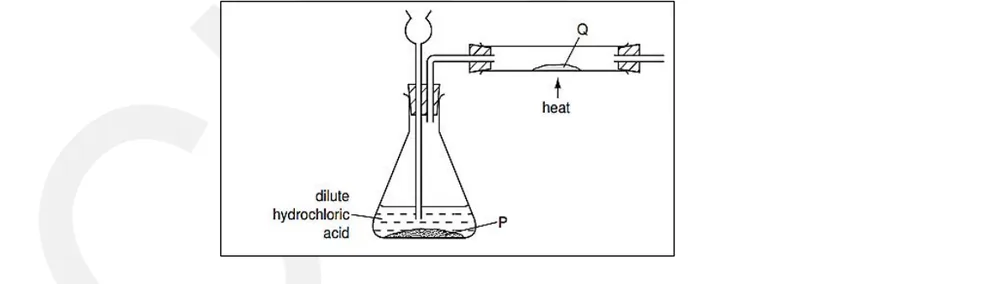
The diagram shows that P reacts with dilute hydrochloric acid to produce a gas which when passed through substance Q, reduces it. What are substances P and Q? (a) P-copper, Q-lead (II) oxide (b) P-lead, Q-magnesium oxide (c) P-magnesium, Q-calcium oxide (d) P-zinc, Q-copper (II) oxide
62. Displacement reaction outcome by reactivity series
2×Sample 2024Sample 20251 marks
A student takes Cu, Al, Fe and Zn strips separately in four test tubes labeled as I, II, III and IV respectively. He adds 10 ml of freshly prepared ferrous sulphate solution to each and observes the colour of the metal residue. He would observe a black residue in the test tubes: (a) (I) and (II) (b) (I) and (III) (c) (II) and (III) (d) (II) and (IV)

63. Fill in the blanks (metallurgy)
2×Board 2024Sample 20265 marks
Complete the following by choosing the correct answers from the bracket: (a) When dilute sulphuric acid reacts with zinc granules, the gas evolved is _________ (hydrogen / carbon dioxide), which can be tested using a burning splint. (b) A solution of copper(II) sulphate in sodium hydroxide solution forms a _________ (pale blue / green) precipitate. (c) In methane, each hydrogen atom share(s) _________ (one / two) electron(s) with the central carbon atom to complete its valence shell. (d) The electron affinity of element X is greater than that of element Y. The oxidising power of X is likely to be _________ (more / less) than that of element Y. (e) The naturally occurring compound of a metal from which the metal can be extracted is called its _________ (ore / mineral).
64. Name the base metal of the given alloy
2×Board 2024Sample 20262 marks
Name the main metal present in the following alloys: (a) Duralumin (b) Brass
65. Interpret Hall-Heroult aluminium extraction diagram
2×Board 2023Sample 20253/5 marks
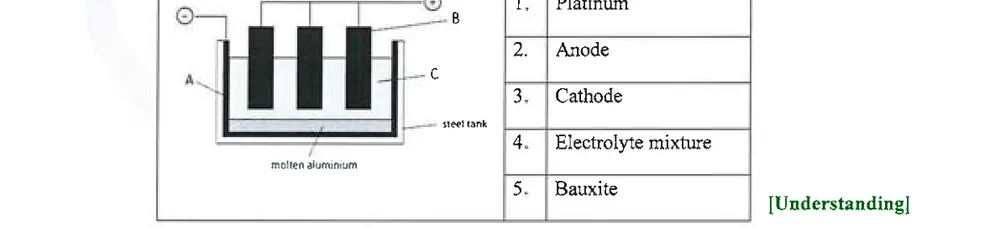
Given below in column A is a schematic diagram of the electrolytic reduction of alumina. Identify the parts labelled as A, B and C with the correct options from Column B. Column B: 1. Platinum 2. Anode 3. Cathode 4. Electrolyte mixture 5. Bauxite
66. Bayer's process for purification of bauxite
2×Board 2025Board 20262 marks
Bauxite is the principal ore used in the commercial extraction of aluminium. The Bayer's process is used to refine bauxite into pure alumina, with caustic soda playing a crucial role in the initial stage. (a) Explain the reason behind the addition of caustic soda during the Bayer's process. (b) Write a balanced chemical equation representing the reaction between bauxite and caustic soda during the Bayer's process.
67. Identify the ore / non-ore of a given metal
2×Board 2023Board 20251 marks
The ore that can be concentrated by using magnetic separation: (a) Corundum (b) Haematite (c) Calamine (d) Bauxite
Study of Compounds - Hydrogen Chloride
68. Laboratory preparation of HCl gas
2×Board 2024Sample 20233 marks
Hydrogen chloride gas is prepared in the laboratory by the action of concentrated sulphuric acid on sodium chloride. (a) Give balanced chemical equation for the above reaction. (b) State the method of collection of the gas formed above. (c) What is the property of sulphuric acid that makes it a suitable reagent for the reaction?
69. Identify drying agent/reagent for HCl gas
2×Board 2023Sample 20231 marks
In the laboratory preparation, HCl gas is dried by passing through: (a) dilute nitric acid (b) concentrated sulphuric acid (c) dilute sulphuric acid (d) acidified water
Study of Compounds - Ammonia
70. Reducing action of ammonia on copper oxide
4×Board 2024Board 2025Sample 2024Sample 20251/2 marks
Ammonia gas is passed over heated copper (II) oxide in a combustion tube: (a) Name the gas evolved. (b) What will be the colour of the residue that is left in the combustion tube at the end of the reaction?
71. Ammonia with excess chlorine; thermal decomposition of nitrate
2×Sample 2026Sample 20272 marks
Give one significant observation when: (a) Excess of chlorine gas reacts with ammonia. (b) Zinc nitrate is strongly heated in a test tube.
72. Haber process conditions/catalyst/manufacture
3×Board 2026Sample 2023Sample 20241/3/5 marks
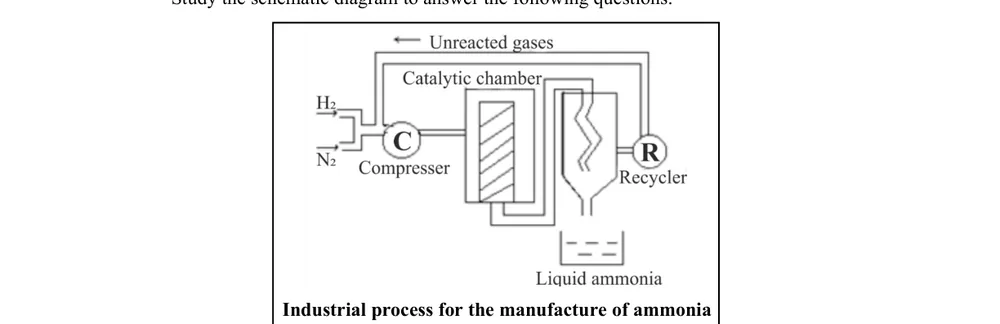
Given below is the industrial process for the manufacture of ammonia gas. Study the schematic diagram: (a) Name the process. (b) Which catalyst is used in the above process? (c) In the above diagrammatic setup, how is ammonia gas separated from the unreacted gases to obtain liquid ammonia? (d) Which two properties of ammonia gas can be demonstrated by the Fountain Experiment?
73. Laboratory preparation of ammonia (from nitride)
3×Board 2023Board 2025Sample 20233/5 marks
A student was instructed to prepare and collect ammonia gas in the laboratory by using aluminium nitride, with the apparatus shown. Study the diagram and answer: (a) Name the substance X added through the thistle funnel. (b) Write a balanced equation for the reaction between Aluminium nitride and substance X. (c) Identify the substance Y. (d) State the function of Y. (e) Why could the student not collect ammonia gas at the end of the experiment?

Study of Compounds - Nitric Acid
74. Action of nitric acid on a carbonate
3×Sample 2024Sample 2025Sample 20262 marks
Identify the reactant and write the balanced equation for the following: Nitric acid reacts with compound Q to give a salt Calcium nitrate, water and carbon dioxide.
75. Ostwald's process conditions/catalyst
2×Sample 2024Sample 20251/3 marks
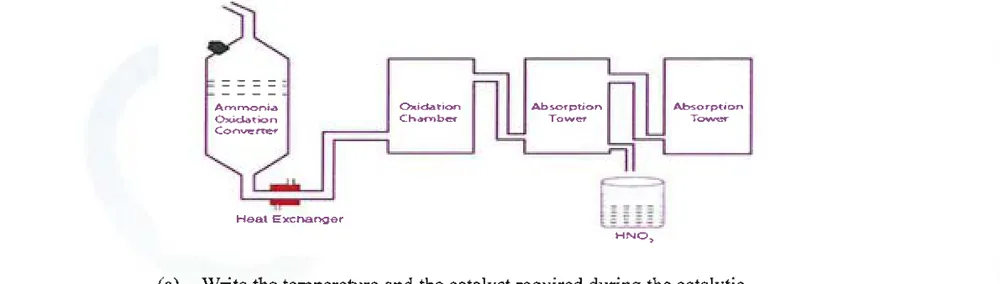
The diagram given below is a representation of the Industrial preparation of Nitric acid by Ostwald's process. (a) Write the temperature and the catalyst required during the catalytic oxidation of ammonia. (b) Give balanced chemical equation for the reaction occurring during the conversion of nitrogen dioxide to nitric acid.
76. Decomposition & storage of nitric acid
2×Board 2026Sample 20233 marks
Anil is a laboratory assistant. He prepared nitric acid but stored it in a transparent container exposed to sunlight. After a few days, brown fumes were observed in the container and the acid turned slightly yellowish in colour. (a) What was the error made by Anil while storing the acid? (b) Why were brown fumes observed in the container? (c) How can the yellowish tinge in the acid be removed?
Study of Compounds - Sulphuric Acid
77. Identify/state the property of sulphuric acid in a reaction
4×Board 2023Sample 2024Sample 2025Sample 20261/2/3 marks
State the property exhibited by sulphuric acid in each of the following reactions: (a) Sulphur with concentrated sulphuric acid. (b) Conversion of ferrous sulphide to hydrogen sulphide gas using sulphuric acid. (c) Ethanol with concentrated sulphuric acid.
78. Contact process: absorption of SO3 (oleum)
3×Board 2025Board 2026Sample 20271/3 marks
The diagram represents the industrial process for the manufacture of concentrated sulphuric acid by the Contact process (sulphur -> sulphur dioxide -> sulphur trioxide -R-> sulphuric acid). What is used in step R to obtain sulphuric acid from sulphur trioxide? (a) vanadium pentoxide (b) water only (c) water followed by concentrated sulphuric acid (d) concentrated sulphuric acid followed by water

79. Oxidising action of concentrated sulphuric acid
4×Board 2024Board 2025Board 2026Sample 20231 marks
A non-metal which reacts with concentrated sulphuric acid to form two gases which turn lime water milky is _________. (a) Sulphur (b) Carbon (c) Oxygen (d) Nitrogen
80. Dehydrating action of concentrated sulphuric acid
2×Sample 2024Sample 20271/3 marks
A student was given a crystalline salt 'B' for analysis which was blue in colour. He added a few drops of dense oily hygroscopic liquid to it and observed a colourless neutral gas/vapour being released and the salt turning white. (a) Identify the blue crystalline salt B. (b) Which property of the hygroscopic liquid is demonstrated in this reaction? (c) Write a balanced chemical equation for the above reaction.

Organic Chemistry
81. Give IUPAC name / draw structural formula of given compounds
9×Board 2023Board 2024Board 2025Board 2026Sample 2023Sample 2024Sample 2025Sample 2026Sample 20275 marks
(a) Give the IUPAC name of the following organic compounds: 1. HO-C(=O)-CH2-CH2-CH3 (a butanoic acid); 2. H-C-C-C-C-H chain with two methyl branches (a dimethylbutane). (b) Draw the structural diagram for the following compounds: 1. diethyl ether 2. isopentane 3. propanone.
82. Esterification reaction
3×Board 2024Sample 2026Sample 20271/3 marks
In a round bottom flask, a mixture of ethanol, acetic acid and concentrated sulphuric acid was heated. (a) Name the type of reaction occurring in the above set up. (b) What is the role of sulphuric acid in this reaction? (c) State one observation that takes place during the reaction.
83. Identify organic compounds from structures by a property
3×Board 2025Sample 2025Sample 20273/4 marks
The structures of five organic compounds, C, D, E, F and G are shown (C: alkene, D: alcohol, E: alkane, F: dibromo compound, G: alkene). State which compound C, D, E, F or G: (a) on halogenation will form F. (b) is an alcohol. (c) is an isomer of 2-methyl propane. (d) is in the same homologous series as ethene.
84. Write equations for organic preparations & lab prep of nitric acid
3×Sample 2024Sample 2025Sample 20263 marks
Give balanced equations for the following: (a) Laboratory preparation of ethyne from calcium carbide. (b) Conversion of acetic acid to ethyl acetate. (c) Laboratory preparation of nitric acid.
85. Write balanced equations for organic conversions/preparations
3×Board 2023Sample 2023Sample 20273 marks
Give balanced equations for each of the following: (a) Action of warm water on calcium carbide. (b) Oxidation of sulphur with conc. nitric acid. (c) Laboratory preparation of ethane by using sodium propionate and soda lime.
86. Count isomers of butene from structures
2×Sample 2025Sample 20261 marks
The structures of four hydrocarbons are shown (2-methylpropane, 2-methylprop-1-ene, but-1-ene, 2-methylprop-1-ene variant). How many isomers of butene are shown in the above structures? (a) 1 (b) 2 (c) 3 (d) 4
87. Fill in the blanks (organic)
2×Sample 2023Sample 20275 marks
Complete the following sentences by choosing the correct option from the brackets: (a) The general formula of an alkyl group is _________ (CnH2n+1/CnH2n-1). (b) The aqueous solution of _________ (zinc chloride/ sodium sulphate) gives white precipitate with barium nitrate. (c) The gas liberated when alkalis are heated with ammonium salts is _________ (N2/NH3). (d) The alloy that contains a non-metal as one of its constituents is _________ (bronze/steel). (e) A salt prepared by neutralization in which titration is involved is _________ (CaCl2/ NH4Cl).
88. Complete and balance the given organic equations
3×Board 2024Board 2025Board 20262/3 marks
Complete and balance the following equations: (a) C2H4Br2 + KOH (alcoholic) -> (b) NH3 (excess) + Cl2 -> (c) C12H22O11 -(conc. H2SO4)->
89. Identify the functional group in a compound
2×Sample 2023Sample 20241/2 marks
_________ is the functional group in methanol. (a) >C=O (b) -OH (c) -CHO (d) -COOH
90. Identify the term/compound (mixed organic)
2×Board 2026Sample 20235 marks
Identify the following terms / compounds: (a) A compound which reacts with water to give acetylene gas. (b) The gas evolved when sodium propanoate is heated with soda lime. (c) A reddish-brown precipitate formed when ferric chloride solution reacts with an alkali. (d) A pair of electrons present in an atom which is not shared with any other atom during bond formation. (e) The relative molecular mass of a substance expressed in grams.
91. Dehydration of ethanol to ethene
2×Board 2024Sample 20231 marks
Conversion of Ethanol to Ethene by the action of concentrated sulphuric acid involves: (a) Dehydration (b) Dehydrogenation (c) Dehydrohalogenation (d) Hydrolysis
92. State the term/process (mixed organic)
2×Board 2024Board 20255 marks
State the terms for the following: (a) Undistilled alcohol containing a large amount of methanol. (b) A salt formed by the partial replacement of the hydroxyl group of a di-acidic or a tri-acidic base by an acid radical. (c) Organic compounds having the same molecular formula but different structural formula. (d) The tendency of an atom to attract the shared pair of electrons towards itself when combined in a compound. (e) The type of covalent bond in which electrons are shared unequally between the combining atoms.
93. Identify general formula of a homologous series
2×Board 2023Board 20251 marks
Which formula represents a saturated hydrocarbon? (a) C4H8 (b) C5H12 (c) C4H6 (d) C5H10