CBSE Class 12 Chemistry Guess Paper 2027
A full practice paper on the official Chemistry pattern, built from the most-likely questions by repetition analysis. Not an official or leaked paper.
CBSE Class 12 Chemistry — Guess Paper 2027
Time: 3 hours · Maximum marks: 70 · Practice paper
Section A16 questions of 1 mark each — 14 MCQ + 2 Assertion-Reason
Q1.1 mark
In the ring structure of fructose, the anomeric carbon is :
(A) C2
(B) C3
(C) C4
(D) C1
Why this question: Biomolecules → Structure & properties of glucose/fructose — appeared 5× Board 2024Board 2025Board 2026Sample 2025Sample 2026
Q2.1 mark
[Case context: Carbohydrates are optically active polyhydroxy aldehydes or ketones or molecules that provide such units on hydrolysis. They are broadly classified into three groups : monosaccharides, oligosaccharides and polysaccharides. Monosaccharide units are held together by glycosidic linkages to form disaccharides or polysaccharides. Starch and cellulose are polysaccharides. Starch is a polymer of alpha-glucose and consists of two components : Amylose and Amylopectin. Amylose is water soluble, having 15-20% of starch, whereas Amylopectin is insoluble in water, having 80-85% starch. Chemically, amylose is a long unbranched chain of alpha-glucose units held together by C1-C4 glycosidic linkage. Amylopectin is a branched chain of alpha-glucose units held together by C1-C4 and C1-C6 glycosidic linkages.]
Write two differences between Amylose and Amylopectin.
Why this question: Biomolecules → Starch/cellulose structure & disaccharide hydrolysis — appeared 5× Board 2023Board 2026Sample 2025Sample 2026
Q3.1 mark
Write the formula of the following coordination complex:
I. diaquasilver(I) dichloridoargentate(I)
II. dihydroxidobis(triphenylphosphine)nickel(II)
Why this question: Coordination Compounds → Write IUPAC name and/or formula of coordination compounds — appeared 5× Board 2023Board 2024Board 2025Sample 2025Sample 2026
Q4.1 mark
Which of the following elements will:
I. exhibit similar magnetic behaviour and why? Magnesium (Atomic No. 12), Chromium (Atomic No. 24), Iron (Atomic No. 26) and Molybdenum (Atomic No. 42).
II. form white salts and why? Zinc (Atomic No. 30), Scandium (Atomic No. 21), Nickel (Atomic No. 28) and Vanadium (Atomic No. 23)
Why this question: d- and f-Block Elements → Spin-only magnetic moment / paramagnetic property (unpaired electrons) — appeared 3× Board 2025Sample 2025Sample 2026
Q5.1 mark
The organic compounds A, B and C are amines having equivalent molecular weight. A and B on reaction with benzene sulphonyl chloride give white precipitate, however white precipitate obtained from compound B remains insoluble in NaOH.
The variation in the boiling point of A, B and C can be seen as :
A. A> B>C
B. B>A>C
C. A=B > C
D. C>B>A
Why this question: Amines → Hinsberg test / benzenesulphonyl chloride distinction — appeared 3× Board 2024Sample 2025Sample 2026
Q6.1 mark
Assertion (A) : p-nitrophenol is less acidic than phenol.
Reason (R) : Nitro group is an electron-withdrawing group, which stabilises the phenoxide ion.
Why this question: Alcohols, Phenols and Ethers → Compare acidity of alcohols vs phenols — appeared 4× Board 2023Board 2025Board 2026
Q7.1 mark
Acetamide reacts with Br2 and aqueous KOH to form :
(A) Ethanamine
(B) Ammonia
(C) Methanamine
(D) Ethanenitrile
Why this question: Amines → Amide to amine (Hoffmann bromamide / reduction) — appeared 4× Board 2023Board 2024Board 2025Board 2026
Q8. 1 mark
Arrange the following compounds in increasing order of their boiling points:
(i) (CH3)2CH-CH2Br (ii) CH3CH2CH2CH2Br (iii) (CH3)3C-Br
The correct order is
(A) (ii) < (i) < (iii)
(B) (i) < (ii) < (iii)
(C) (iii) < (i) < (ii)
(D) (iii) < (ii) < (i)
Why this question: Haloalkanes and Haloarenes → Boiling point trends of haloalkanes — appeared 3× Board 2025Sample 2025
Q9.1 mark
The name inner transition metals is often used to refer to the
A. lanthanoids
B. actinoids
C. both lanthanoids and actinoids
D. d block elements
Why this question: d- and f-Block Elements → Identify lanthanoid/actinoid facts (config, oxidation state, inner transition) — appeared 2× Sample 2025Sample 2026
Q10.1 mark
For an electrolyte consisting of a monovalent cation and a monovalent anion undergoing dissociation in water, the van't Hoff factor (i) is :
(A) less than 1
(B) equal to 1
(C) greater than 1
(D) greater than 2
Why this question: Solutions → Predict van't Hoff factor / abnormal molar mass for association or dissociation (MCQ) — appeared 3× Board 2024Board 2025Board 2026
Q11.1 mark
Calculate the molarity and molality of a KI solution if the density of 20% (mass/mass) aqueous solution of KI is 1.2 g mL-1.
[Given : Molar mass of KI = 166 g mol-1]
Why this question: Solutions → Calculate/relate molarity and molality from density — appeared 2× Board 2026Sample 2026
Q12.1 mark
Write two differences between SN1 and SN2 reactions. Out of chlorobenzene and 2,4,6-trinitrochlorobenzene, which one is more reactive towards nucleophilic substitution reactions ?
Why this question: Haloalkanes and Haloarenes → Compare/classify SN1 vs SN2 — appeared 2× Board 2026Sample 2026
Q13.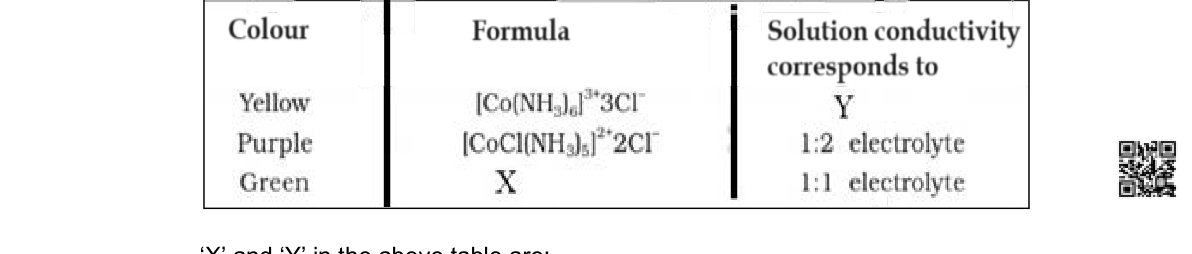 1 mark
Formulation of Cobalt(III) Chloride-Ammonia Complexes:
Colour / Formula / Solution conductivity corresponds to
Yellow / [Co(NH3)6]3+ 3Cl^- / Y
Purple / [CoCl(NH3)5]2+ 2Cl^- / 1:2 electrolyte
Green / X / 1:1 electrolyte
'X' and 'Y' in the above table are:
a. X=[Co(NH3)6]2+ 3Cl^-, Y= 1:3
b. X= [Co(NH3)4Cl2]^+ Cl^-, Y= 1:3
c. X=[Co(NH3)4Cl2]^+ Cl^-, Y= 1:1
d. X=[Co(NH3)4Cl2]3+ 3Cl^-, Y= 1:1
Why this question: Coordination Compounds → Deduce formula/structure from ionisation, precipitation or conductivity behaviour — appeared 3× Board 2022Board 2023Sample 2025
Q14.1 mark
Which of the following will give a yellow or orange ppt. with 2,4 DNP?
(i) Porpanal (ii) Propanone (iii) Propanoic acid
A. (i) and (ii)
B. (ii) and (iii)
C. (i) and (iii)
D. (i), (ii) and (iii)
Why this question: Aldehydes, Ketones and Carboxylic Acids → Carbonyl qualitative-test recognition — appeared 2× Board 2022Sample 2026
Q15.1 mark
Arrange the products obtained in the following cases in the increasing order of their pKa values:
A. Oxidation of ethanol in presence of acidified potassium dichromate
B. Reaction of propanoic acid with Br2 in the presence of red Phosphorus
C. Reaction of isopropyl magnesium bromide with carbon dioxide, followed by hydrolysis.
D. Reaction of propanoic acid with Cl2 in the presence of red Phosphorous.
Why this question: Aldehydes, Ketones and Carboxylic Acids → Compare acidic strength/pKa of carboxylic acids — appeared 2× Board 2024Sample 2026
Q16.1 mark
[Case context: passage on boiling points of alcohols and phenols increasing with number of carbon atoms and intermolecular hydrogen bonding.]
Arrange the following compounds in order of their increasing boiling points :
Propan-1-ol, Ethanol, Butan-2-ol, Butan-1-ol
Why this question: Alcohols, Phenols and Ethers → Boiling point trends & hydrogen bonding — appeared 2× Board 2025Board 2026
Section B5 Very Short Answer questions of 2 marks each
Q17.2 marks
Write the reactions involved when D-glucose is treated with the following reagents:
(a) HCN
(b) Br2 water
Why this question: Biomolecules → Reactions of glucose with reagents — appeared 4× Board 2023Board 2024Board 2025Sample 2025
Q18.2 marks
Define the following terms :
(a) Ambidentate ligand
(b) Crystal field splitting energy
Why this question: Coordination Compounds → Define ligand/complex terminology (ambidentate, denticity, CFSE) — appeared 2× Board 2026Sample 2026
Q19.2 marks
[case context: Conductivity of Aqueous Solutions - conductivity meter readings for two solutions A (Red LED bright, Green LED dim) and B (Red LED dim, Green LED off).] Refer to the table given below and draw the molar conductivity vs. concentration curve for solution A and B.
Why this question: Electrochemistry → Molar conductivity vs concentration behaviour for strong/weak electrolytes (graphical) — appeared 2× Board 2023Sample 2026
Q20.2 marks
Write the Nernst equation for the following:
I. Ni (s) + Cu2+ (aq) -> Ni2+ (aq) + Cu (s)
II. Al (s) + FeSO4 (aq) -> Al2(SO4)3 (aq) + Fe (s)
III. Mg (s)/Mg2+ (aq)//Ag^+ (aq)/Ag(s)
Why this question: Electrochemistry → Write the Nernst equation for a given cell reaction — appeared 2× Board 2022Sample 2026
Q21.2 marks
Complete the following reactions by writing the major and minor product in each case (any 2)
a. CH3CH2Br + KCN ->
b. CH3CH2CH = CH2 + HBr ->
c. (CH3)2CHCHClCH3 + alc KOH ->
Why this question: Haloalkanes and Haloarenes → Write products of halide substitution/elimination reactions — appeared 2× Board 2023Sample 2025
Section C7 Short Answer questions of 3 marks each
Q22.3 marks
The elements of 3d transition series are given as: Sc, Ti, V, Cr, Mn, Fe, Co, Ni, Cu, Zn. Answer the following:
(a) Copper has exceptionally positive E°M2+/M value, why?
(b) Which element is a strong reducing agent in +2 oxidation state and why?
(c) Zn2+ salts are colourless. Why?
Why this question: d- and f-Block Elements → Account for / assign reasons: properties of transition elements — appeared 6× Board 2022Board 2023Board 2024Board 2025Sample 2025
Q23.3 marks
Attempt either A or B.
A. Answer the following questions:
I. Identify and give any one point of difference between the protein present in the hair and protein present in egg albumin.
II. Both glucose and sucrose have aldehydic group, then why does only glucose reduces Fehling's Reagent and not sucrose?
III. Why do amino acids behave as salts?
IV. What chemical change takes place during curdling of milk?
V. Doctor advised a 50 year old woman enough exposure to sunlight and addition of fish and egg yolk to her diet. What is the possible disease diagnosed by the doctor?
Why this question: Biomolecules → Mixed biomolecule recall (proteins/carbs/vitamins) — appeared 4× Board 2024Board 2025Sample 2026
Q24.3 marks
(i) Write the hybridisation and magnetic behaviour of the following complexes :
(I) [Ni(CN)4]2-
(II) [FeF6]3-
(ii) What type of isomerism is shown by [Co(NH3)5(NO2)]2+ and [Co(NH3)5(ONO)]2+ ?
[Given : Atomic number : Ni = 28, Fe = 26]
Why this question: Coordination Compounds → State hybridisation & magnetic behaviour of given complex(es) (VBT) — appeared 4× Board 2022Board 2025Board 2026Sample 2025
Q25.3 marks
(i) The cell in which the following reaction occurs :
2Fe3+ (aq) + 2I^- (aq) -> 2Fe2+ (aq) + I2 (s)
has Eo(cell) = 0.24 V at 298 K. Calculate deltarGo and log KC of the cell reaction.
[Given : 1 F = 96500 C mol-1]
(ii) State the following laws :
(I) Faraday's first law of electrolysis
(II) Kohlrausch's law of independent migration of ions
Why this question: Electrochemistry → Relate standard cell EMF, Gibbs energy and equilibrium constant — appeared 4× Board 2022Board 2023Board 2026Sample 2025
Q26.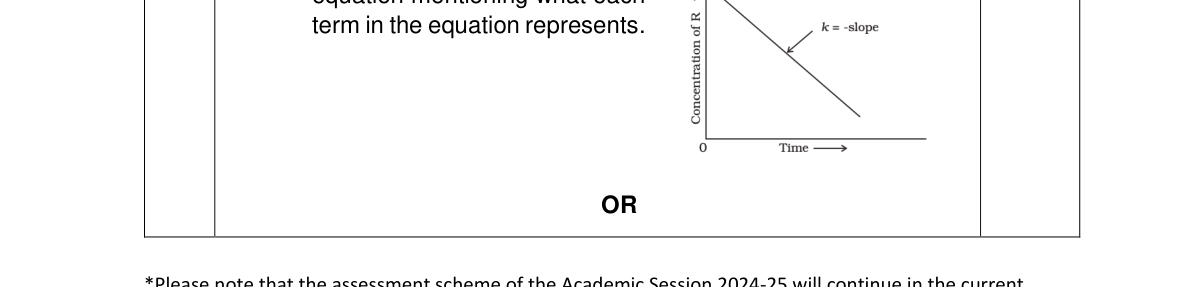 3 marks
Attempt either A or B.
A.
I. The rate of a reaction triples when the temperature changes from 298 K to 318 K. Calculate the energy of activation of the reaction assuming that it does not change with temperature. (Given R = 8.314 JK-1mol-1, log 3 = 0.4771)
II. Identify the order of reaction and write its integrated rate equation mentioning what each term in the equation represents. (graph of concentration of R vs time, a straight line with k = -slope)
Why this question: Chemical Kinetics → Calculate activation energy from rate change with temperature — appeared 2× Board 2025Sample 2026
Q27.3 marks
Answer the following questions:
I. Are the enthalpies of atomisation of Zinc and Copper matched correctly? Justify your answer. (Enthalpy of atomisation / kJmol-1: Zinc 339, Copper 130)
II. Out of sulphuric acid and hydrochloric acid, which acid will you prefer for permanganate titrations and why?
III. 5NO2^- + 2MnO4^- + 6H^+ -> (complete the equation)
Why this question: d- and f-Block Elements → Properties of KMnO4/K2Cr2O7 (oxidation product, titration medium, enthalpy) — appeared 2× Board 2025Sample 2026
Q28.3 marks
OR
An organic compound 'X', does not undergo aldol condensation. However 'X' with compound 'Y' in the presence of a strong base react to give the compound 1,3-diphenylprop-2-en-1-one.
a. Identify 'X' and 'Y'
b. Write the chemical reaction involved.
c. Give one chemical test to distinguish between X and Y.
Why this question: Aldehydes, Ketones and Carboxylic Acids → Aldol/Claisen-Schmidt based structure elucidation — appeared 2× Board 2024Sample 2025
Section D2 Case-study based questions of 4 marks each (with sub-parts)
Q29.4 marks
[case context: Amines are basic; pKb measures basic strength (lower pKb = more basic). Effect of substituent X on basic strength was studied by replacing the -CH2- group in piperidine (compound 1) and in propylamine CH3CH2CH2NH2 (compound 2). Data (X: electronegativity, pKa of substituted piperidine / pKa of substituted propylamine): CH2 2.55, 11.13/10.67; NH 3.12, 9.81/10.08; O 3.44, 8.36/9.45; CH3CON 3.6, 7.94/9.28; C6H5CON 3.7, 7.78/—. (source: Hall Jr, 1956)]
a. Plot a graph between the electronegativity of the substituent vs pKb value of the corresponding substituted propyl amine (given that pKa + pKb = 14). Is there any relation between the electronegativity of the substituent and its basic strength?
Why this question: Amines → Case study: substituent electronegativity vs basicity data — appeared 3× Sample 2025
Q30.4 marks
Assertion (A): [Mn(CN)6]3- has a magnetic moment of two unpaired electrons while [MnCl6]3- has a paramagnetic moment of four unpaired electrons.
Reason (R): [Mn(CN)6]3- is inner orbital complexes involving d2sp3 hybridisation, on the other hand, [MnCl6]3- is outer orbital complexes involving sp3d2 hybridisation.
Select the most appropriate answer from the options given below:
a. Both A and R are true and R is the correct explanation of A
b. Both A and R are true but R is not the correct explanation of A.
c. A is true but R is false.
d. A is false but R is true.
Why this question: Coordination Compounds → Explain inner vs outer orbital / paramagnetic vs diamagnetic nature — appeared 3× Board 2024Sample 2025
Section E3 Long Answer questions of 5 marks each
Q31.5 marks
Attempt either A or B.
A. Answer the following questions:
I. Write the structure of expected product of Cannizzaro reaction of 2-chlorobenzaldehyde.
II. How would the presence of -SO3H group effect the basic strength of aniline.
III. Convert acetic acid to ethanamine.
IV. Write the steps to prepare Benzoic acid from Benzoyl chloride.
V. Give a chemical test to distinguish between: propanal and propanone
Why this question: Aldehydes, Ketones and Carboxylic Acids → Mixed 5-mark A/B LA (Cannizzaro/Wolff-Kishner + conversions + tests) — appeared 2× Sample 2026
Q32.5 marks
(i) Write the Nernst equation and calculate the emf of the following cell at 298 K :
Mg (s) | Mg2+ (0.001 M) || Cu2+ (0.0001 M) | Cu (s)
Given : EoMg2+/Mg = - 2.36 V, EoCu2+/Cu = + 0.34 V
[log 10 = 1]
(ii) Define fuel cell and write its two advantages.
Why this question: Electrochemistry → Calculate cell EMF via Nernst equation — appeared 3× Board 2023Board 2025Board 2026
Q33.5 marks
Give reasons :
(i) Why are low spin tetrahedral complexes not formed ?
(ii) Why is [Co(en)3]3+ complex more stable than [Co(NH3)6]3+ ?
(iii) Why are geometrical isomers not possible for tetrahedral complexes having two different types of unidentate ligands coordinated to the central metal ion ?
Why this question: Coordination Compounds → Multi-part reasoning: low-spin tetrahedral, stability, isomerism, colour — appeared 2× Board 2025Board 2026