CBSE Class 12 Biology Important Questions 2027 (Repeated in Board Exams)
53 question patterns that appeared in two or more of the analysed papers (5 board + 2 official sample papers (2022–2026)). The numbers change; the question does not.
Sexual Reproduction in Flowering Plants
1. Apomixis / polyembryony / parthenocarpy
2×Sample 2025Sample 20263/4 marks
[Case context] Given below is a set of information about some fruits and seeds. (P: Nucellar cells surrounding the embryo sac develop into embryos. Q: Ovary develops into the fruit by the application of growth hormones. R: Thalamus contributes to fruit formation. S: Ovary matures into a fruit after fertilisation.) On the basis of the information provided above, answer the following questions with justification for each answer.
A. How many embryo sacs will be present in each ovule of S before maturation and how many egg(s) will be present in each embryo sac when the embryo sac is developed from a single megaspore? (1)
B. (i) Which of these fruits exhibits polyembryony? Will their embryos exhibit genetic variation? Justify. (ii) What will be ploidy of the embryonic cells in the above case? (2)
Attempt either subpart C or D.
C. Which of these fruits can be considered as parthenocarpic? Give a reason. (1)
OR
D. Which of the fruits P, Q, R or S is a true fruit with seeds? Give a reason. (1)
2. Gamete/meiosis number calculation
3×Board 2023Board 2025Sample 20251 marks
How many pollen grains and ovules are likely to be formed in the anther and the ovary of an angiosperm bearing 50 microspore mother cells and 50 megaspore mother cells respectively ?
(A) 100, 25
(B) 200, 50
(C) 50, 50
(D) 200, 100
3. Artificial hybridization / emasculation
2×Board 2026Sample 20261/2 marks
Identify the plant in which emasculation is not required for artificial hybridization. (A) Rice (B) Wheat (C) Pea (D) Papaya
4. Double fertilisation: fate of male nuclei / PEN
2×Board 2023Sample 20261/2 marks
The primary endosperm nucleus is formed by fusion of which of the following?
A. A male gamete and a female gamete
B. A male gamete and two polar nuclei
C. A female gamete and two synergids
D. Two male gametes and an egg cell
5. Modes of pollination diagram + aquatic pollination
2×Board 2023Board 20255 marks
Student to attempt either option-(A) or (B) :
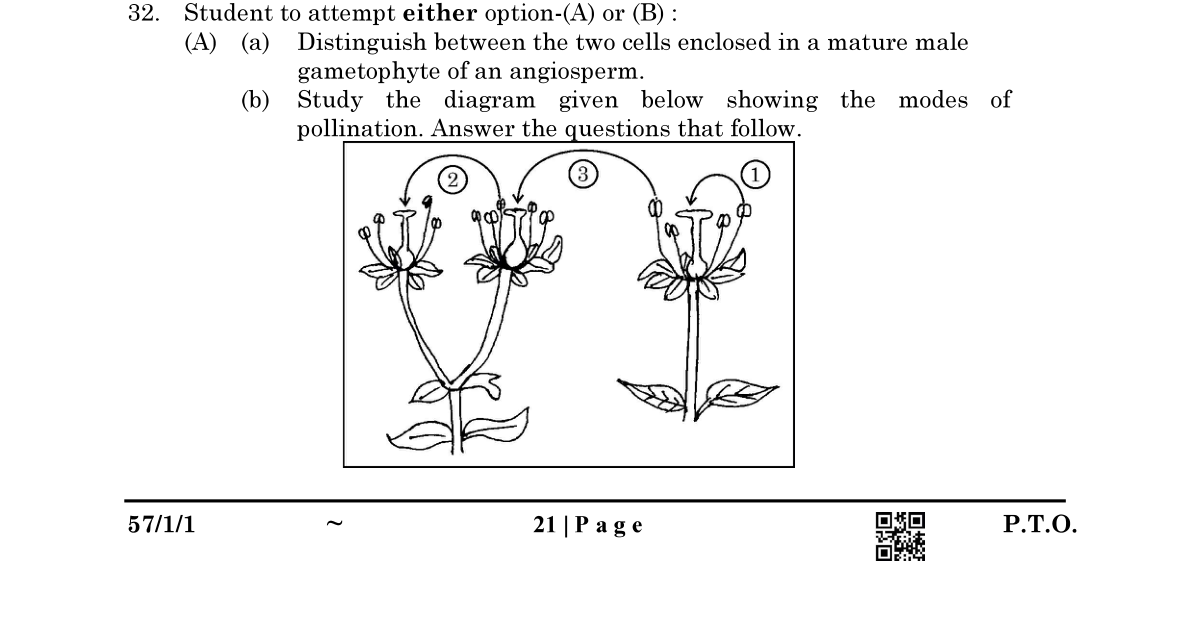
(A) (a) Distinguish between the two cells enclosed in a mature male gametophyte of an angiosperm. (b) Study the diagram given below showing the modes of pollination. Answer the questions that follow. [Diagram: three flowers showing pollen transfer methods labelled 1, 2 and 3.] (i) The given diagram shows three methods of pollen transfer in plants. Examine them carefully and write the technical terms used for pollen transfer methods '1', '2' and '3'. (ii) How do the following plants achieve pollination successfully ? (a) Water lily (b) Vallisneria. (iii) Write advantages of pollen transfer in method '3'.
OR
(B) Given below is the diagram of human ovum surrounded by a few sperms. Observe the diagram and answer the questions that follows : [Diagram: ovum with zona pellucida, perivitelline space, cells of the corona radiata, and sperms labelled P, Q and R.] (i) Compare the fate of sperms 'P', 'Q' and 'R' shown in the diagram. (ii) Write the role of Zona pellucida in this process. (iii) Analyse the changes occurring in the ovum after the entry of sperm. (iv) How acrosome and middle piece of a human sperm are able to play an important role in human fertilization ?
Human Reproduction
6. Trace fertilisation to implantation
2×Board 2026Sample 20263/5 marks
Trace the events from fertilization till implantation of blastocyst in human female. Also mention the site where fertilization takes place.
7. First meiotic division in oogenesis
2×Board 2026Sample 20252/3 marks
Identify the stage of follicle where primary oocyte undergoes first meiotic division. Also mention the products of this division.
8. hCG and placental hormones
2×Board 2024Sample 20251/2 marks
Attempt either option A or B.
A. (i) A blood test reported negative for hCG. What does negative hCG imply? Name the tissue which produces hCG?
(ii) If a blood test reported positive for hCG in a person, then which other hormones would also be secreted by the tissue secreting hCG?
OR
B. (i) The human male ejaculates about 200 to 300 million sperm during a coitus, however the ovum is fertilized by only one sperm. How does the ovum block the entry of additional sperms?
(ii) All copulations will not lead to fertilization. Why?
Reproductive Health
9. Suggest ART for infertility cases
2×Board 2026Sample 20255 marks
(i) Case studies of some couples are given below. They were not able to have kids even though the parents were not taking any precautions. They also do not wish to adopt a child or take the help of donors. Study these cases and suggest an appropriate Assisted Reproductive Technology that could help them. Case I – Female – Normal Reports. Male – Normal sperms but no connection between epididymis and vas deferens. Case II – Female – Normal eggs but Fallopian tube blocked. Male – Normal sperms. Male reports are normal. Case III – Female – Normal Reports. Male – Low sperm count with less motility. (ii) Copper releasing intrauterine devices are very effective and popular contraceptive devices. Name any two copper releasing IUDs. Write two reasons that make them effective contraceptives.
10. Select/match contraceptive to need or mode
2×Board 2023Sample 20261/3 marks
Suggest a suitable contraceptive device for the following cases with justification.
(i) Mohini does not want to take the risk of conception and sexually transmitted infections (STIs).
(ii) Lalita has two children and does not want any more children.
(iii) Geeta wants a contraceptive that she can take till she wants to avoid conception and can resume back to her fertile life without the intervention of the doctor. Also, it should have a lower failure rate.
11. Oral contraceptive pills / Saheli
2×Board 2024Board 20251/3 marks
Two statements are given - one labelled as Assertion (A) and the other labelled as Reason (R). Select the appropriate option: (A) Both (A) and (R) are true and (R) is the correct explanation of (A). (B) Both (A) and (R) are true, but (R) is not the correct explanation of (A). (C) (A) is true, but (R) is false. (D) (A) is false, but (R) is true.
Assertion (A) : Saheli is the World's first non-steroidal oral contraceptive pill.
Reason (R) : It has been developed by National Institute of Immunology, New Delhi.
12. ART techniques (abbreviations/steps)
2×Board 2023Board 20242/3 marks
Write the basic steps followed in the Assisted Reproductive Technologies (ART) programme to help childless couples. Why is it also known as test tube baby programme ?
Principles of Inheritance and Variation
13. Heterogamety type (XO/ZW)
2×Board 2023Board 20261/2 marks
Analyse the following two cases of sex determination in different organisms: Case I: Males have (XO) sex chromosomes and females have two copies of same sex chromosome (XX). Case II: Females have two different sex chromosomes (ZW) and males have two copies of same sex chromosome (ZZ). Identify the type of heterogamety in each case, giving one example of each.
14. Pedigree chart analysis
2×Board 2023Board 20263 marks
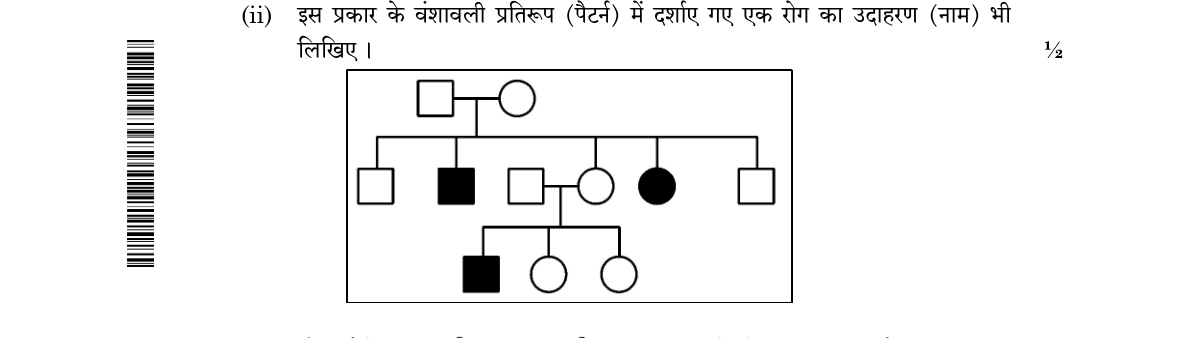
(a) What is pedigree analysis? Mention its importance in human genetics. (2 pts.) (b) Analyse the following pedigree and write the (i) Pattern of inheritance. (ii) Give one example of disease showing such an inheritance pattern.
15. Chromosomal aneuploidy disorders
2×Board 2024Board 20251/2 marks
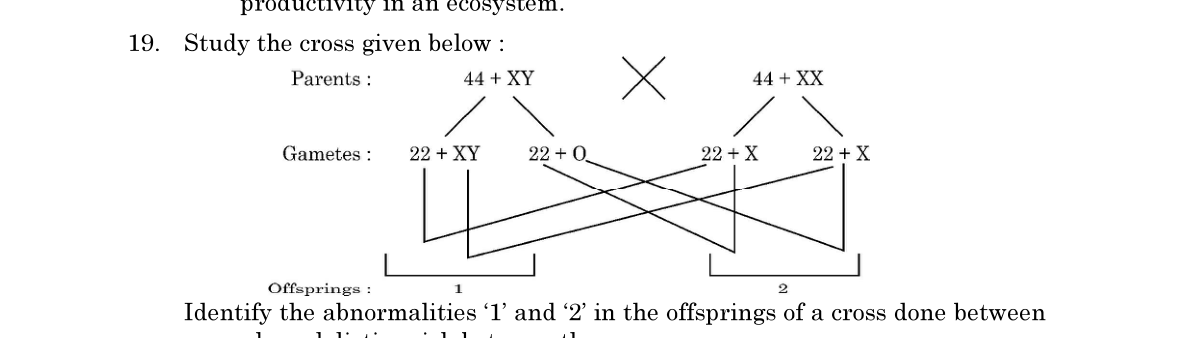
Study the cross given below : [Diagram: Parents 44+XY crossed with 44+XX; Gametes 22+XY, 22+O, 22+X, 22+X; Offsprings labelled '1' and '2'.] Identify the abnormalities '1' and '2' in the offsprings of a cross done between a couple and distinguish between them.
16. Colour-blindness inheritance cross
2×Board 2024Board 20251/3 marks
A man whose father was colour-blind marries a woman who had a colour-blind mother and normal father. What percentage of male children of this couple will be colour-blind ?
(A) 25%
(B) 0%
(C) 50%
(D) 75%
17. Assertion-Reason: linkage vs independent assortment
2×Board 2024Board 20251 marks
Two statements are given - one labelled as Assertion (A) and the other labelled as Reason (R). Select the appropriate option: (A) Both (A) and (R) are true and (R) is the correct explanation of (A). (B) Both (A) and (R) are true, but (R) is not the correct explanation of (A). (C) (A) is true, but (R) is false. (D) (A) is false, but (R) is true.
Assertion (A) : When the two genes in a dihybrid cross are situated on the same chromosome, the proportion of parental gene combinations is much higher than non-parental type.
Reason (R) : Higher parental gene combinations can be attributed to crossing over between two genes.
Molecular Basis of Inheritance
18. Construct transcription unit + processing
2×Board 2026Sample 20265 marks
Given below is a stretch of DNA showing the coding strand of structural gene of transcription unit. 5' - ATG ACC GTA TTT TCT GTA GTG CCC GTA CTT CAG GCA TTA 3'. (i) Write the corresponding template strand and m-RNA strand that will be transcribed along with its polarity. (ii) If GUA of transcribed mRNA is an intron, then depict the sequence involved in formation of mRNA / mature / processed hnRNA strand: (1) In a bacterium (2) In humans. (iii) How many amino acids the resulting polypeptide will have after the process of translation in humans?
19. Experiment proving stability of genetic material
2×Board 2024Sample 20261/5 marks
The experimental proof on the thermal stability of genetic material was first provided by experiments of
A. Hershey and Chase
B. Meselson and Stahl
C. Frederick Griffith
D. Jacob an Monod
20. Given DNA strand, write the mRNA
2×Board 2025Sample 20251 marks
The sequence of nitrogenous bases in a segment of a coding strand of DNA is 5' - AATGCTAGGCAC - 3'. Choose the option that shows the correct sequence of nitrogenous bases in the mRNA transcribed by the DNA.
(A) 5' - UUACGAACCGAG - 3'
(B) 5' - AAUGCUAGGCAC - 3'
(C) 5' - UUACGUACCGUG - 3'
(D) 5' - AACGUAGGCAGC - 3'
21. lac operon regulation
2×Board 2023Sample 20251/4 marks
In E.coli, the lac operon gets switched on when lactose is
A. present in the medium and it binds to the repressor.
B. not present in the medium and the repressor binds to the operator.
C. not present in the medium and RNA polymerase binds to the operator.
D. Active lactose present in the medium binds to RNA polymerase.
22. Bonds within a nucleotide
2×Board 2024Board 20261/2 marks
(i) Differentiate between a DNA and RNA nucleotide. (ii) Name the two types of bonds present within a single nucleotide.
Evolution
23. Convergent vs divergent evolution
2×Board 2025Sample 20263 marks
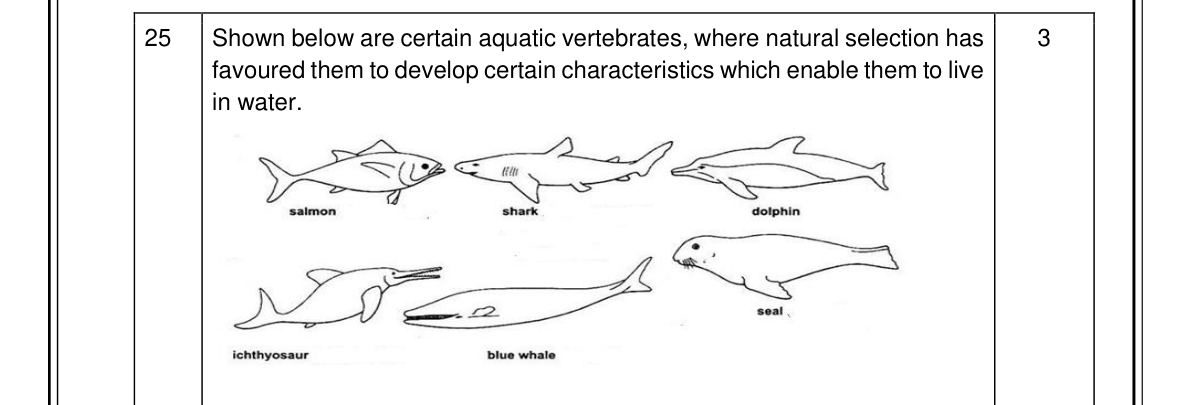
Shown below are certain aquatic vertebrates (salmon, shark, dolphin, ichthyosaur, blue whale, seal), where natural selection has favoured them to develop certain characteristics which enable them to live in water.
A. Name and explain the phenomenon exhibited by the above animals.
B. Which one of the above is the most primitive one? What is its significance?
[For Visually impaired students: A. What are the basic conceptual similarities and differences between Lamarckian and Darwinian theory of evolution? B. Give an example that supports any one of the above two theories.]
24. Lamarck's use and disuse (giraffe)
2×Board 2024Board 20261/2 marks
The idea of use and disuse of organs for evolution of organism was proposed by (A) Charles Darwin (B) Thomas Malthus (C) Hugo De Vries (D) Lamarck
25. Sequence and ancestors of human evolution
2×Board 2023Board 20251/3 marks
Evolution of modern man involves the following man-like primates. Choose the correct series of human evolution.
(A) Dryopithecus -> Homo erectus -> Australopithecines -> Homo sapiens
(B) Australopithecines -> Homo erectus -> Neanderthal -> Homo sapiens
(C) Australopithecines -> Ramapithecus -> Dryopithecus -> Homo sapiens
(D) Homo erectus -> Australopithecines -> Homo sapiens -> Neanderthal
Human Health and Disease
26. Malaria / Plasmodium life cycle, hosts and transmission
5×Board 2022Board 2025Board 2026Sample 2025Sample 20261/2/3/4/5 marks
(i) Name the protozoan species that is responsible for causing the most serious and even fatal malarial disease. (ii) Name the host in which the parasite completes its sexual stages and explain the changes taking place. (iii) How does the parasite damage the human body after entering the blood stream? (iv) Suggest two effective preventive measures to control the spread of this disease in endemic regions.
27. Active vs passive immunity and vaccination
3×Board 2023Board 2024Sample 20262/4/5 marks
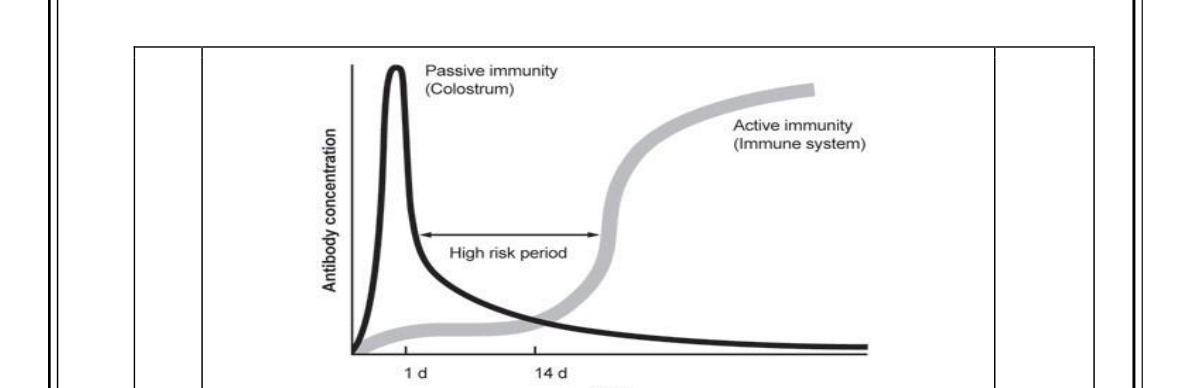
[Case context] The graph below shows the Antibody concentration in young calves. Study the graph and answer the questions that follow: (Graph: Passive immunity (Colostrum) peaks early then falls; Active immunity (Immune system) rises after a high risk period between 1 d and 14 d.)
A. What do you think is the difference between passive and active immunity in this case? (1)
B. What kind of immunity will be observed when a vaccine is administered to the calf and why? (2)
Attempt either subpart C or D.
C. What kind of trend does passive immunity show and why? (1)
OR
D. Why does active immunity start after 14 days as per the above graph?
[For visually impaired students: The antibody concentration in a young calf was studied. It was found that the antibodies derived from colostrum (passive immunity) decreased from day 1 to 14, while the antibodies derived from immune cells (active immunity) increased between day 1 to day 14 and remained steady thereafter. A. What do you think is the difference between passive and active immunity in this case? (1) B. What kind of immunity will be observed when a vaccine is administered to the calf and why? (2) Attempt either subpart C or D. C. What kind of trend does passive immunity show and why? (1) OR D. Why does active immunity start after 14 days as per the above graph?]
28. Humoral vs cell-mediated immune response
2×Board 2025Board 20261/2 marks
(a) Define Humoral immune response. (b) Name any two types of antibodies found to give humoral immune response in humans.
29. Opioids - morphine and heroin
2×Board 2025Board 20262/3 marks
(a) Mention the scientific name of the source plant and the part from which opioids are extracted. (b) How are morphine and heroin related? Mention the effect each one of them has on human body.
30. Cancer - tumour types, oncogenes, detection
2×Board 2023Board 20243/5 marks
(a) (i) Name and explain the property present in normal cells but is lost in cancer cells. (ii) All normal human cells have genes that may become cancerous under certain conditions. Name them and explain how. (iii) State the role of the following techniques in detection and diagnosis of cancer : (1) Biopsy and Histopathology (2) Magnetic Resonance Imaging. OR (b) Large quantities of sewage are generated every day in cities as well as in towns and are treated in Sewage Treatment Plants (STPs) to make them less polluting. Given below is the flow diagram of stages of STP [flow diagram: Primary effluent passed into large aeration tanks → Effluent passed into settling tanks to form 'sediment']. (i) (1) Why is primary effluent passed into large aeration tanks ? (2) What is the 'sediment' formed, referred to as ? Mention its significance. (3) Explain the final step in the settling tank before the treated effluent is released into water bodies. (ii) Name any two organisms commonly used as biofertilisers, belonging to different kingdoms. Write how each one acts as a biofertiliser.
31. Disease - pathogen - symptom / affected organ identification
2×Board 2022Board 20242/3 marks
Identify A, B, C, D, E and F in the table given below : Name of Human Disease | Causative Organism | Symptoms. Pneumonia | Streptococcus | 'A'; Typhoid | 'B' | High fever, weakness, headache, stomach pain; Common Cold | Rhino virus | 'C'; Ringworm | 'D' | Dry scaly lesions on body parts, redness, itching; Ascariasis | Ascaris | 'E'; 'F' | Entamoeba histolytica | Constipation, cramps, stools with mucous and blood clots.
Microbes in Human Welfare
32. Secondary sewage treatment - aeration, flocs, BOD, sludge
5×Board 2022Board 2023Board 2026Sample 2025Sample 20261/2/3 marks
Assertion (A): Flocs are masses of bacteria associated with fungal filaments in secondary treatment of sewage. Reason (R): Flocs help in digestion of solid waste by anaerobic respiration. (A) Both Assertion (A) and Reason (R) are true and Reason (R) is the correct explanation for Assertion (A). (B) Both Assertion (A) and Reason (R) are true, but Reason (R) is not the correct explanation for Assertion (A). (C) Assertion (A) is true, but Reason (R) is false. (D) Assertion (A) is false, but Reason (R) is true.
33. Sources of biofertilisers
3×Board 2022Board 2026Sample 20253/5 marks
(i) What are bio-fertilizers? (ii) Name the different types of microorganisms used as bio-fertilizers in organic farming and explain how each contributes to soil fertility. (iii) Write two advantages of using bio-fertilizers over chemical fertilizers.
34. Organic farming / Integrated Pest Management
2×Board 2022Sample 20261/3 marks
Integrated Pest Management involves
I. Using pesticides/insecticides judiciously
II. Using biocontrol agents
III. Engaging in organic farming
A. Only I
B. Only II
C. Both I and II
D. Only III
35. Biogas production
2×Board 2022Sample 20251/2 marks
Assertion (A): A floating cover placed over the slurry in a biogas plant keeps on rising.
Reason (R): This cover keeps on rising due to the gas produced in the tank by the microbial activity.
A. Both A and R are true and R is the correct explanation of A.
B. Both A and R are true and R is not the correct explanation of A.
C. A is true but R is false.
D. A is False but R is true.
Biotechnology - Principles and Processes
36. EcoRI recognition palindrome & sticky ends
3×Board 2025Board 2026Sample 20251/2/3 marks
Study the sequence of bases in a DNA molecule that is shown below and answer the questions. 5' – GAATTC – 3' / 3' – CTTAAG – 5'. (a) What are such sequences called? Name the enzyme used that recognises such nucleotide sequences. (b) How do these enzymes function?
37. Natural pathogens as rDNA tools (Agrobacterium / retrovirus, T-DNA)
3×Board 2022Board 2024Sample 20261/3/5 marks
Some plant and animal pathogens serve as one of the tools of recombinant DNA (rDNA) technology.
A. Name one animal and one plant pathogen and discuss the pathogenic nature of both. State how they serve as a tool in rDNA technology.
B. What are the enzymes needed for rDNA technology?
C. A farmer owns a cotton farm land which is getting infested with coleopteran pests. He is not willing to use the microbes to protect his farm. i. Name an alternate method to introduce the gene of interest the pathogen would have otherwise delivered and discuss how the alternate method would deliver the gene. ii. State how this gene would control the pest.
OR
BamH1 is a restriction enzyme which recognizes the sequence 5' - GGATCC - 3'. The restriction activity of this enzyme is between G and G.
A. Construct the palindrome for the above sequence.
B. Draw a labeled diagram to show the formation of recombinant DNA (rDNA) using BamH1.
C. PBR322 is a plasmid that has a restriction site for this enzyme at the tetracycline resistant gene. If BamH1 were to be used, how will it impact the response of the transformant with rDNA to antibiotics- ampicillin and tetracycline. Justify.
38. Gel electrophoresis - separation by size / staining
2×Board 2026Sample 20251/3 marks
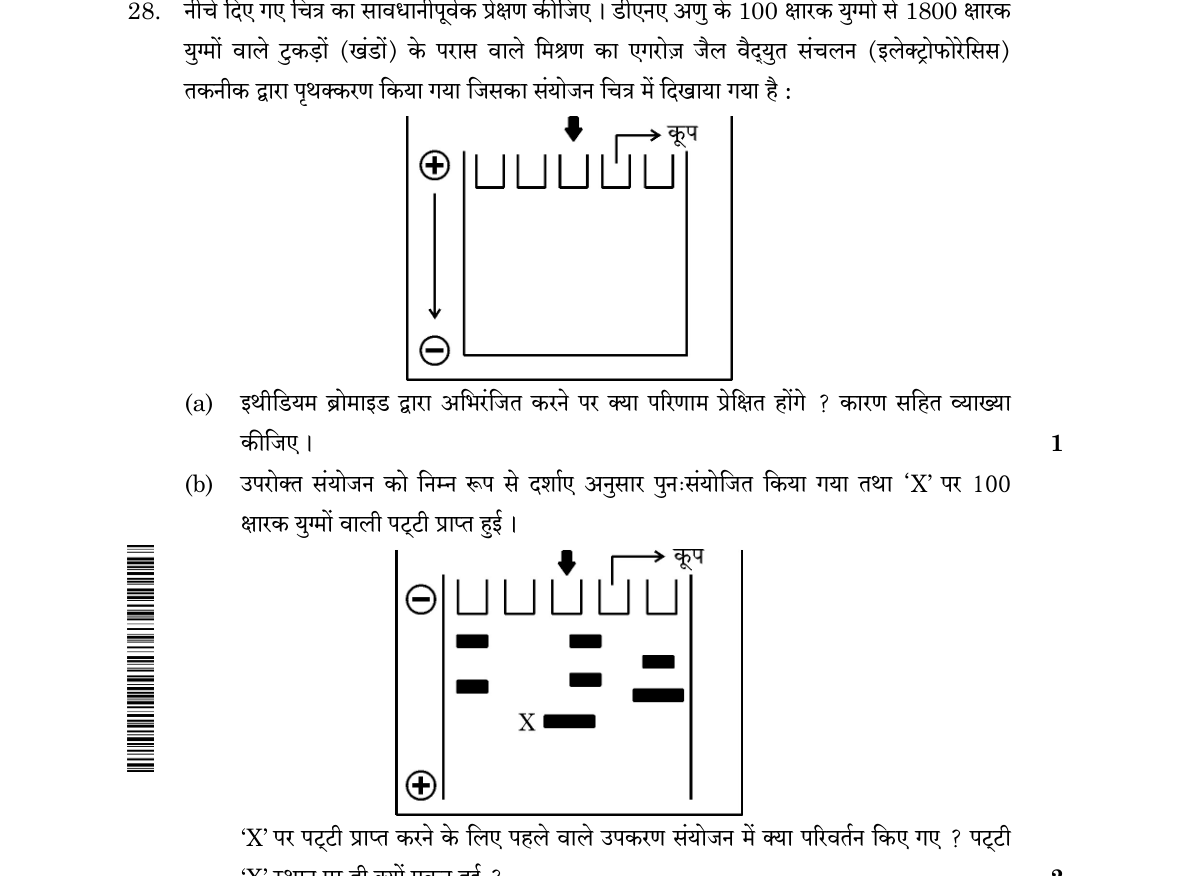
Observe the given picture carefully. A mixture of DNA with fragments ranging from 100 base pairs to 1800 base pairs were separated by electrophoresis on agarose gel with the following arrangement: (a) What result will be obtained in staining with ethidium bromide? Explain with reasons. (b) The above setup was modified as shown below and a band with 100 base pairs was obtained at X. What changes were made to the previous design to get a band at 'X'. Why did the band appear at 'X'?
39. PCR amplification of DNA
2×Board 2025Sample 20251/3 marks
Amplification of gene of interest by using DNA polymerase may go upto
(A) 0.1 million times
(B) 1 million times
(C) 1 billion times
(D) 1 trillion times
40. Isolation of genetic material / gene of interest
2×Board 2022Sample 20261/5 marks
In order to isolate genetic material of a bacterium, the cell must be treated with
A. Lysozyme, ribonuclease, protease, chilled ethanol
B. Cellulase, ribonuclease, protease, chilled ethanol
C. Chitinase, ribonuclease, chilled ethanol, water
D. Ribonuclease, protease, chilled ethanol, water
41. Insertional inactivation / blue-white colony selection
2×Board 2024Sample 20252/4 marks
A culture plate of Lactobacillus shows blue-coloured colonies and colourless colonies. Explain the principle involved in the formation of such variance in the colour of colonies.
42. Plasmids and cloning vectors
2×Board 2022Board 20261/3 marks
Which of the following statements about plasmids is incorrect? (A) Plasmids have the ability to replicate within the bacterial cell. (B) Their replication is controlled by chromosomal DNA. (C) They are autonomously replicating circular extra-chromosomal DNA. (D) They often carry antibiotic resistant genes.
Biotechnology and its Applications
43. First transgenic cow Rosie / transgenic animals
3×Board 2024Board 2026Sample 20261/3 marks
Assertion (A): The milk produced by transgenic cow 'Rosie' was nutritionally more balanced product for human babies than natural cow milk. Reason (R): It was human protein enriched milk containing human alpha lactalbumin. (A) Both Assertion (A) and Reason (R) are true and Reason (R) is the correct explanation for Assertion (A). (B) Both Assertion (A) and Reason (R) are true, but Reason (R) is not the correct explanation for Assertion (A). (C) Assertion (A) is true, but Reason (R) is false. (D) Assertion (A) is false, but Reason (R) is true.
44. RNA interference against nematode
2×Board 2025Sample 20251/5 marks
RNA interference (RNAi) helps in making tobacco-plant resistant to a nematode (Meloidegyne incognitia). Choose the correct option that shows how RNAi is achieved :
(A) Preventing the process of translation of mRNA of the nematode.
(B) Preventing the process of replication of DNA of the nematode.
(C) Preventing the process of transcription of DNA of the plant.
(D) Preventing the process of replication of DNA of the plant.
45. GEAC - full form and role
2×Board 2024Board 20251 marks
GEAC stands for
(A) Genome Engineering Action Committee
(B) Ground Environment Action Committee
(C) Genetic and Environment Approval Committee
(D) Genetic Engineering Approval Committee
46. Bt crops and cry genes
2×Board 2022Board 20263/5 marks
A farmer grew two varieties of corn crop in field A and B. He grew normal corn crops in field A and GM corn crops in field B. He observed that corn borers attacked only in field A. To control it, spores of Bt were sprayed on field A. (a) Name the gene in the spores responsible for control of pest. (b) What effect will the spores of Bt have on insect pest? (c) How has corn plants of field B developed resistance against this pest? Explain.
47. ADA deficiency and gene therapy
2×Board 2023Board 20251/2 marks
Student to attempt either option-(A) or (B) :
(A) A patient with ADA deficiency requires periodic infusion of genetically engineered lymphocytes. Explain why such periodic infusion is required and also suggest a permanent cure for such ADA deficiency.
OR
(B) Describe in brief any two techniques that can be utilised to transfer recombinant DNA into the host cell directly without using any vector.
Organisms and Populations
48. Competition, competitive exclusion and co-existence
3×Board 2026Sample 2025Sample 20263/4/5 marks
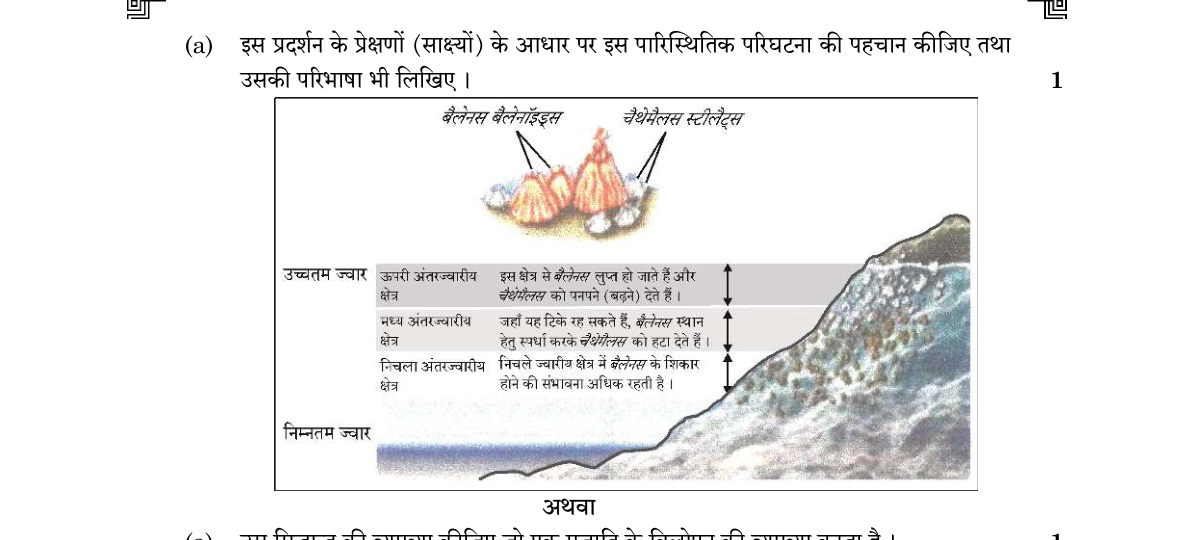
[Case: The diagram below shows the distribution of two barnacle species, Chthamalus and Balanus on a rocky sea shore. When Balanus is experimentally removed, Chthamalus expands its range in lower intertidal zone.] (a) Identify and define the ecological phenomenon demonstrated by this observation. OR (a) State the principle that explains the elimination of one species. (b) Two different species can compete for the same resource. Give another example of it. (c) How do species avoid competition in nature? Explain with an example.
49. Age-pyramid shape and population growth status
2×Board 2023Sample 20261/3 marks
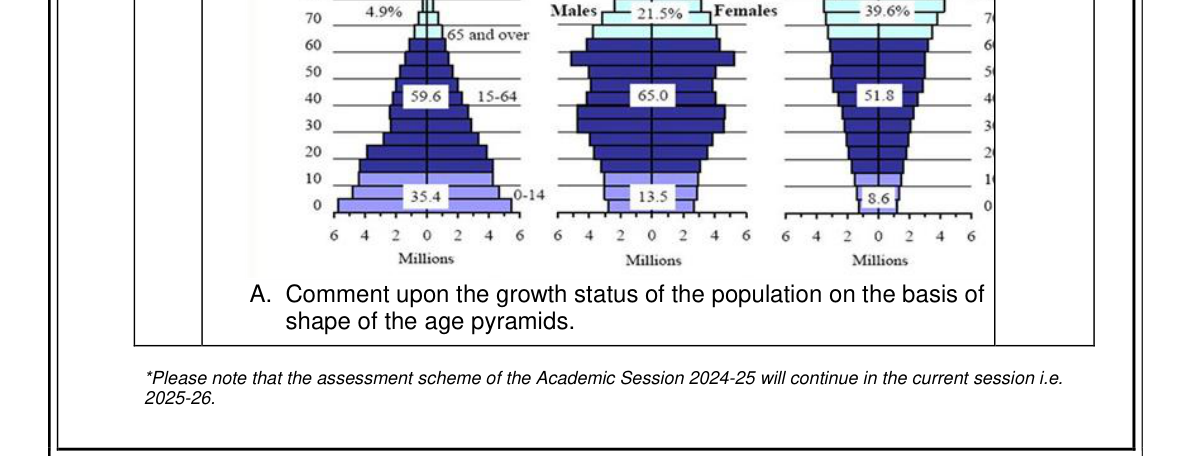
The population pyramids of Japan for the years 1950, 2007 and on the basis of the estimated value for 2050 have been shown below to answer the questions that follow:
A. Comment upon the growth status of the population on the basis of shape of the age pyramids.
B. What insights can you gain about their population dynamics?
[For visually impaired students: The population pyramids of Japan for the years 1950, 2007 and on the basis of the estimated value for 2050 have broad-based, inverted bell and urn shape, respectively. Answer the following questions: A. Comment upon the growth status of the population on the basis of shape of the age pyramids. B. What insights can you gain about their population dynamics?]
Ecosystem
50. Inverted biomass pyramid: identify and conditions
3×Board 2024Board 2026Sample 20262 marks
Given below is a pyramid found in an ecosystem, where each bar represents the standing crop available in the trophic level. (i) Identify the kind of pyramid and with the help of an example explain the conditions where this kind of pyramid is possible in nature. (ii) Write any two limitations of ecological pyramids.
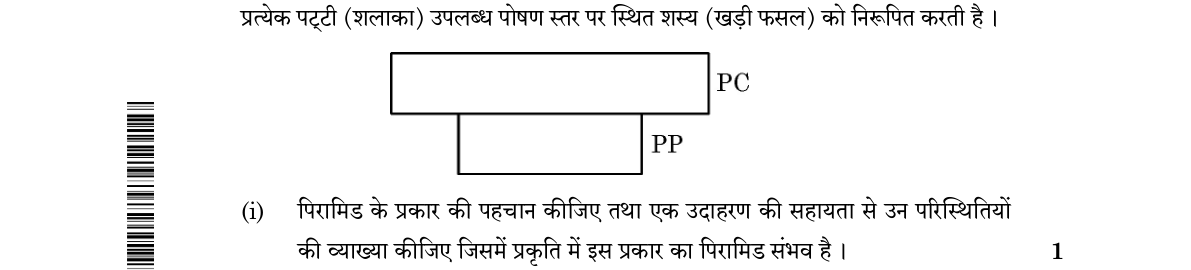
51. Primary vs secondary productivity (GPP/NPP)
2×Board 2024Board 20251/2 marks
Student to attempt either option-(A) or (B) :
(A) Analyse the following ecosystems and discuss, which will be more productive in terms of primary productivity : A young forest, a natural old forest, a shallow polluted lake.
OR
(B) Differentiate between Net primary productivity and Gross primary productivity in an ecosystem.
Biodiversity and Conservation
52. Causes and effects of biodiversity loss
3×Board 2025Board 2026Sample 20252/3/5 marks
In an ecosystem there was loss of biodiversity due to some project in that area. (i) How will biodiversity be affected? (2 points) (ii) List two major causes of loss of biodiversity.
53. Latitudinal species-richness gradient interpreted from region data
3×Board 2022Board 2023Board 20243/4 marks
[case context] Read the following passage and answer the questions that follow. Isn't it incredible that India's land area is only 2.4 per cent of the world's total land area whereas its share of the global species diversity is an impressive 8.1 per cent ! However, in these estimates of species, prokaryotes do not figure anywhere. Biologists are always keen on collecting data with respect to species diversity observed in different regions of the world. The data collected based on the survey conducted for species richness of groups of mammals in three different regions of the world is shown in the bar graph [bar graph of Taxonomic Richness for Region I, Region II and Region III, increasing from Region I to Region III]. (a) Why is the species richness maximum in Region III in the bar graph ? OR (a) Why is the species richness minimum in Region I in the bar graph ? (b) Plants and animals do not have uniform diversity in the world but show rather uneven distribution. Mention what this kind of diversity is referred to as. (c) Why is it that prokaryotes do not have an estimated number of their species diversity as seen in plants and animals ? Explain.